
Important information
This article includes references to armed violence, starvation, homelessness and sexual violence. An image of a document contains an ethnic slur. These are included here to accurately represent historical records and people’s past experiences.
Women in a battle zone
A small number of photographs of the 1944 Siege of Imphal – the capital city of the state of Manipur, North Eastern India – can be found in the records of the Royal Air Force (RAF). A report of around 60 pages, held by The National Archives as AIR 23/1956, focuses on military logistics but also describes the living conditions of those posted there.
-
- From our collection
- AIR 23/1956
- Title
- Narrative on the Siege of Imphal, India, March to June 1944
- Date
- 1945
Members of the British Army, the Indian Army, the RAF and the United States Air Force all found themselves in the city during one of the key battles of the Second World War. The Battle of Imphal was polled (jointly with the nearby battle of Kohima) as 'Britain’s Greatest Battle' by a poll from the National Army Museum in 2013.
In the course of the Second World War, the valley had received thousands of exhausted civilian refugees retreating from Burma (present day Myanmar) in early 1942, and had been bombed since December 1942 by the Japanese military. The wider state of Manipur had been partially invaded by the Japanese and subjected to a scorched earth policy by the Allies – the systematic destruction of resources that could later benefit the enemy. In some parts every single building was destroyed.
As a frontline of the war, the rice-growing valley became a military camp. North Eastern India received 340,000 Indian troops, 100,000 British troops, 90,000 African troops, 65,000 Chinese troops and 10,000 American troops. The Imphal valley alone at one point held 200,000 troops for 330,000 inhabitants. Over half of the houses owned by Meitei (the Tibeto-Burman people who make up the larger part of the population in the valley) were requisitioned for military purposes. New road infrastructures changed the landscape entirely, and food supplies and labour patterns were transformed.

This map printed by the Allied Land Forces South East Asia in 1944 show the movement of the 15th Division of the Japanese Army (in blue) towards and into the Imphal valley between March and June. Catalogue reference: WO 252/1444
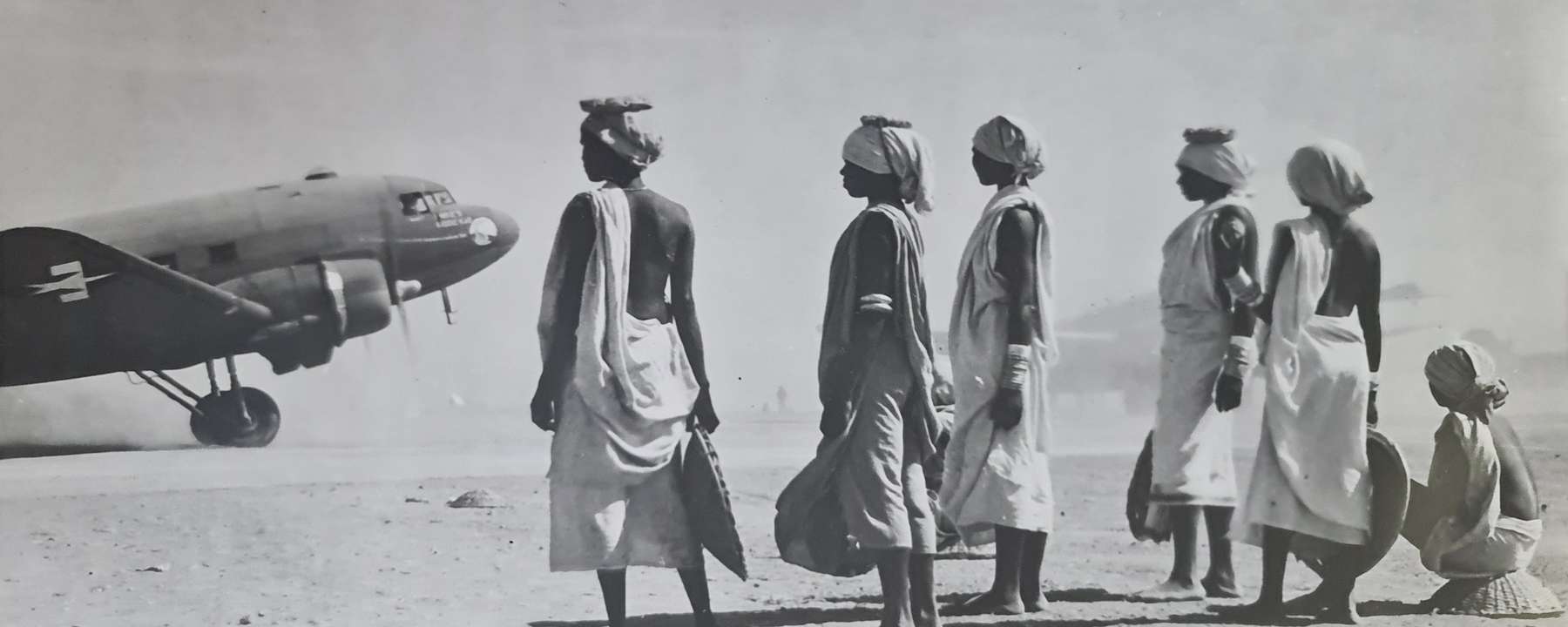
The photographs show an airfield where women are working and talking, alongside the soldiers, planes and military technologies supporting an unprecedented jungle warfare campaign. Framed by an unknown photographer, these may be some of a very small number of images that show Manipuri women at work during the conflict.

Manipuris show a keen interest in long range petrol tanks.
Photograph of Manipuri women possibly being shown to lift aircraft petrol tanks. They appear very young, and their clothing and hair suggest that some may be fairly recent brides. Catalogue reference: AIR 23/1956
While the impact of the Second World War on many places around the world has barely been recorded, the longer history of Imphal and Manipur has been politically contested and more closely studied. Historians have used both written sources and oral history accounts to bring better understanding of what that moment meant. In the military report in AIR 23/1956, and in the original captions for the photographs, the women are framed as exotic, attractive and useful to the war effort. Wider sources, however, invite us to consider the experience of the war from women’s own points of view.
Experiences of the conflict
Japan Lan (Japan War), as it is known in Meitei, was a moment of incredibly rapid change for individuals and society in Manipur. In first-hand accounts and in oral histories that have been collected we can see the ambiguities and contradictions, opportunity and desolation that characterised the experience of living in a battle zone. Many of those in this article come from How Women Remember War, a compilation of oral histories published in 2019 by Leisangthem Gitarani Devi.
Witness accounts demonstrate that the war brought violence and fear. The report in AIR 23/1956 mentions that bombing in 1944 killed ‘a certain number of civilian Manipuris’. Wider reports by the colonial administration and oral histories show that bombing by the Japanese destroyed entire residential areas and marketplaces. The only shelters from this threat were trenches with branches and leaves.
The plane began bombing the trench … my sister and elder brother were deeper inside. They were buried in the mud. The following morning, they had to be dug out with hands.
Yumkhaibam ongbi Manjuri
Apart from the danger of being killed by bullets or shells there was also the danger of being bitten by snakes in the trenches.
Thokchom Ramani

The town of Imphal as seen from the sky in December 1943. This image is part of a series documenting the frontier between British India and Burma, particularly roads, rivers, airfields and other lines of communication. Catalogue reference: CN 1/7
Forests and agricultural land were both requisitioned and destroyed by armed forces on both sides, and food was diverted to the troops.
We didn’t have any food. We would often fill our stomachs with water chestnut [from a large lake] when there was no rice available for days … They [the soldiers] burnt all the houses and the granaries. We lost a lot of food grains. We were asked to evacuate our houses. We fled the war for about a year.
Pukhrambam Ningol Khwairakpam ongbi Madhumati
Several accounts describe how the presence of large numbers of male troops was a threat to women.
They [the Allied soldiers] treated children very affectionately. However, at night, they would come asking for women. Women couldn’t venture out at night. Groups of men kept vigil at night with sticks and swords.
Thokchom Ramani
In the face of all of this, the accounts show that the encounter with military technology was still enthralling.
They [aeroplanes] used to fly very, very high like swallows. They would emit smoke in the sky all around, and we would especially watch the trails of smoke.
Madhumati
For an orphaned Manipuri boy, who later wrote an autobiography, The Second World War in Manipur And My Childhood, it was captivating:
Every day and night, thousands of different vehicles, quite strange to this place were ceaselessly coming in, carrying soldiers, guns, technicians... We hardly remembered our personal sorrows in the midst of all that grandeur of war.
Khuraijam Nimaicharan Singh
In Meitei society in the early 20th century women were important contributors to household income. One major market in Imphal was exclusively run by women vendors.
However, the war also shifted the kinds of work that women were likely to be doing. AIR 23/1956 describes women as loading and unloading transport aircraft that were bringing troops and supplies ‘a work in which the cheerful and gaily-clad Manipuri women would laughingly collaborate’.
Most accounts agree that labouring work for the Allied armed forces was well-paid, although some women reported being ashamed of taking on this kind of manual labour.

Dakota aircraft carried a wide variety of equipment to the Imphal Valley. Since all land communications had been cut by the Japanese, no M.T. could reach the garrison, and small vehicles such as jeeps were flown in by transport aircraft.
This photograph gives a sense of the airfield as the meeting of military and civilian, with men in uniform loading the plane and women in civilian clothes working in parallel. Catalogue reference: AIR 23/1956
However, women were also involved in heavier labour such as the construction of the the vital all-weather airfield at Imphal.
Once the tractor had laid the road, women carried all the stones and mud and many other things for tarring the road.
Khuraijam Nimaicharan Singh Koirengei
As property was destroyed and their livelihoods disrupted more women took up sex work.
[During the war] women couldn’t go out for over two months. They had to stop their businesses in the market. So they started trading their flesh for money… these women would often come back and take care of their children.
Yumkhaibam Manjuri
The war in context
Even these brief extracts describing the effect of the war suggest how Manipuri sources offer a more ambiguous picture of the Allies than we often encounter in the UK. Situating the years 1942 to 1944 in the longer history of the Imphal Valley give a better context to this moment of extreme conflict within the lives of the valley's inhabitants.
Manipur was only formally integrated into the British Empire as part of British India less than 50 years before the outbreak of the Second World War. At earlier moments Imphal had been part of the Toungoo Empire, centred around today’s Myanmar.
By the time of the Japanese invasion in 1942, Manipuri women had succeeded in turning back British colonial policy twice, in events known in Meitei as Nupi Lan (women’s wars). In 1904 women had successfully protested forced labour that had been imposed as a form of collective punishment. In 1939, at the outbreak of the war, thousands of women had conducted a market boycott to resist the export of rice that was causing famine conditions in Manipur. After several days of protest and enduring armed violence, they succeeded in this too.
While these photographs show the women working for the Allied forces, it might be wrong to interpret that they supported the Allies' cause.

In dry weather the difficulties of rain and mud are replaced by the dust hazard. At Kangla, a fair-weather strip near Imphal, hundreds of transport aircraft landed daily, and at times the dust raised an impenetrable fog. The photo gives a good impression of conditions. In the foreground, are Manipuri women who are employed by the Air Forces and by the Army.
Manipuri women who appear to be waiting at an airfield to begin work in loading or unloading, standing close to aeroplanes described elsewhere as like ‘swallows’. Catalogue reference: AIR 23/1956
Some Indians in the 1940s saw co-operation with the Japanese as a faster route to self-governance than loyalty to the British. Historians have shown that some Manipuris joined the Indian National Army, and fought on the side of the Japanese at Imphal. Intense propaganda campaigns were made by both sides. Records from the British administration and Japanese forces show that they were both keen to keep the people at the centre of the destruction in the Imphal Valley on ‘their side’.
Commit no offences whatever against them… The Indians have for years been awaiting their delivery at our hands.
The Commander of the Japanese forces to his troops at Imphal. Catalogue reference: CAB 106/50
A letter from the representative of the British Indian government in Manipur describes the destruction of Manipuri communities taking place in Imphal in 1944:
If many more of them see their houses, property and food destroyed by us, they can hardly be expected to remain enthusiastically pro-British.
E. F. Lydall, Political Agent in Manipur, 16 April 1944. Catalogue reference: WO 203/3200
He describes the effect of the Allied ‘Scorched Earth’ policy on the Imphal valley and asks for more attention from the military to the living conditions of the communities that have been displaced.

Economically, the piling up of villagers in increasing crowded conditions presents an immediate problem and the destruction of paddy and the prospect of considerable areas of paddy land being cultivated inadequately or not at all is one which forces one to envisage famine conditions in the devastated and evacuated areas. These so far are approximately all areas near the foothills to the north, north-east, south-east and south of the valley, as well as the area south of Bishenpur. Politically, the Manipuris have already had their confidence severely shaken by the Japanese invasion of their country, great play having been made in the last few years that they must not mind giving up their houses to the military who were here to defend them from the enemy. If many more of them see their houses, property and food destroyed by us, they can hardly be expected to remain enthusiastically pro-British.
Letter from E. F. Lydall, the Political Agent (representative of the British Indian government) in Manipur, 16 April 1944. Catalogue reference: WO 203/3200
The tensions of being at the site of conflict between empires are reflected in oral history. Some accounts from men and women speak favourably of their relationships with the Japanese invaders.
Ambiguous legacies
The extent of the destruction caused by both Allies and Japanese mean that for many Manipuris, the surrender of the Japanese forces did not mean a ‘win’. The end of the war left the Imphal valley entirely transformed.
Record revealed
Japanese Instrument of Surrender, 1945
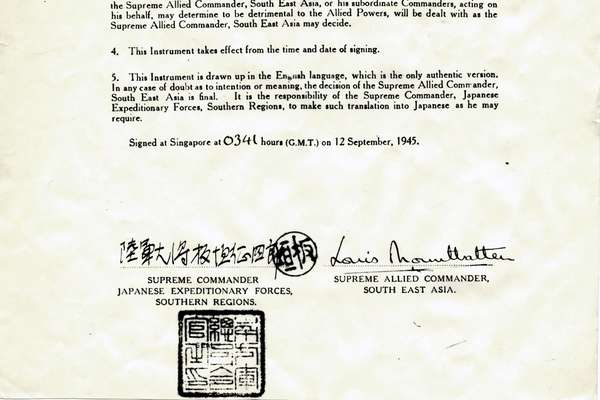
After six years of brutal global conflict, this document marked the end of the Second World War.
Some eventually received compensation to rebuild with, first from the Manipur government, and later from the independent Indian government. Other changes were permanent. Still a borderland territory, the new infrastructure meant that post-war Imphal was far less rural. It was now at the centre of a road network connecting India and Burma. The strengthening of the British presence and social change had meant a weakening of the Manipuri royalty. In 1947 Manipur became the first princely state in Asia to have democratic government.
Separatist movements remain active in Manipur, which has been governed under a state of emergency since it was declared a ‘disturbed territory’ by the Indian government in 1958. The fairly rapid retreat of the Allies left weapons behind, and the roads network into northwest Burma became and remains an important route for drug-smuggling.
For most of the 80 years since the Second World War, women have continued to survive alongside armed conflict, most recently insurgents and counter-insurgency forces. Some of the Manipuri women whose oral histories of the Second World War have been recorded were among the Meira Paibi movement (women bearing flaming torches). They have been campaigning for citizens’ rights, particularly protection for women against violence, through night-patrols and protests since the 1970s.
The images in AIR 23/1956, far more than the words in the report, open up reflection on how ‘Britain’s Greatest Battle’ was lived on the front-line by the women who found themselves caught up in that short moment, and in its legacy. They point to the ongoing work that is needed to build a fuller understanding of the impact of the Second World War in India, and of the complex legacies it has had in South Asia and beyond.
Further reading
- Leishangthem Gitarani Devi (2019), How Women Remember War: Unearthing Memories of the Second World War in Manipur, Zubaan Publishers Pvt. Ltd: New Delhi, India
- Berenice Guyot-Rechard, (2018), ‘When legions thunder past: The Second World War and India’s northeastern frontier’, War in History 25 (3)
- Hemant Singh Katoch (2018), The Battlefields of Imphal: The Second World War in North East India, Routledge: Oxford
- Yasmin Khan (2020), Women and War in the British Empire, War and Society 39 (3)
- Khuraijam Nimaicharan Singh (2012), The Second World War in Manipur and My Childhood, Imphal, India


