opendomesday.org
Open Domesday
A free online version of Domesday Book.
Teaching resource
This resource focuses on a single extract from Great Domesday book for the village of Preston in Sussex. Students can interrogate the source to find out more about the contents of Domesday Book and to discover the purpose behind it.

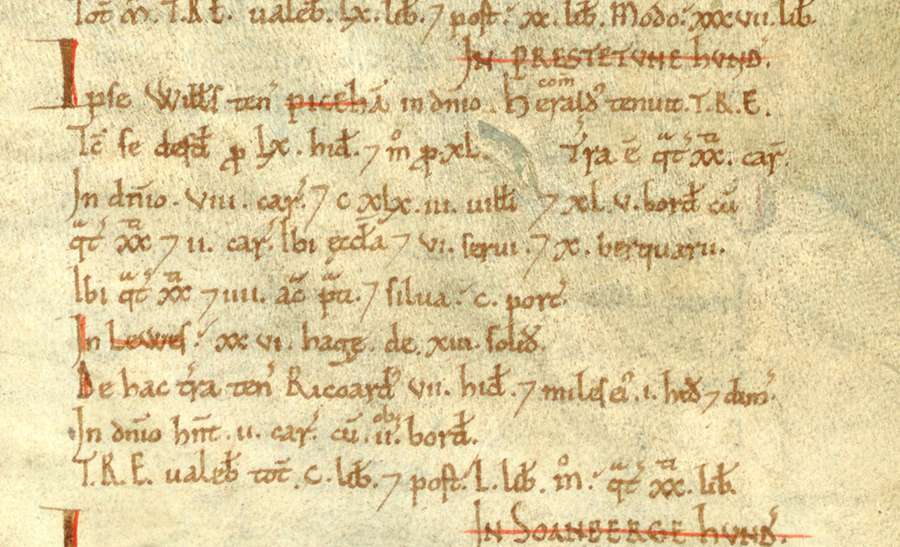
Great Domesday Book Sussex. Catalogue reference: E 31/2/1 f26
How important is Domesday book?

IN PRESTETUNE HUND.
Ipse Wills ten PICEHA in dnio . Herald tenuit . T.R.E.
Tc se desd p LX . hid . m p . XL . Tra . e qt XX . car.
In dnio. VIII . car. CXLX.III . uilli XL.V . bord cu
qt XX II . car . Ibi aeccla .VI . serui . X . berquarij.
Ibi qt XX IIII . ac pti . silua. c . porc.
In Lewes . XXVI . hagae . de . XIII . solid.
De hac tra ten Ricoard VII . hid . miles ej . I . hid dim.
In dnio hnt .II. car . cu . II . bord.
T.R.E.ualeb tot . c .lib . post . L . lib .m . qt XX . lib.
In PRESTON Hundred
William holds PATCHAM himself, in lordship. Earl Harold held it
before 1066. Then it answered for 60 hides; now for 40.
Land for 80 ploughs. In lordship 8 ploughs;
163 villagers and 45 smallholders with 82 ploughs;
A church; 6 slaves; 10 shepherds; meadow, 84 acres;
woodland, 100 pigs; 26 sites in Lewes at 13s.
Richard holds 7 hides of this land; and a man-at-arms of his 1/2 hides.
In lordship they have 2 ploughs, with
2 smallholders.
Total value before 1066 £100; later £50; now £80.
Extract of page from Vol. 1 of Great Domesday, showing survey entry for Preston Hundred in Sussex. Catalogue reference: E 31/2/1, f.26b
This lesson could be used in a scheme of work covering the development of Church, state and society in Medieval Britain 1066-1509, which includes the Norman Conquest.
Students are introduced to a single extract from Domesday Book about a place called Patcham in Sussex. From the source, using the transcript they can find out who held the land, what animals were kept there, how it was used and what it was worth during the time of Edward the Confessor and later in time of William Conqueror.
Teachers could also discuss how William I used Domesday Book to assert his control of England and why he wanted to carry out such a survey of the kingdom. Again it is worth exploring how hard life was for medieval people in town and country, and asking what Domesday Book can tell us about medieval society. What other sources could we use to find out about this period?
Lives of significant individuals: William the Conqueror; Significant historical events, people and places in their own locality: a study of an aspect of history or a site dating from a period beyond 1066 that is significant in the locality.
Lives of significant individuals: William the Conqueror; Significant historical events, people and places in their own locality: a study of an aspect of history or a site dating from a period beyond 1066 that is significant in the locality.
The development of Church, state and society in Medieval Britain 1066-1509: The Norman Conquest
On 5 January 1066, Edward the Confessor, the King of England, died. Harold Godwin was crowned King of England. Two other men claimed that the throne belonged to them: Harold Hardrada, King of Norway; the other was William Duke of Normandy. Harold Hardrada invaded the north of England but the King managed to defeat his army. Shortly after, William – had landed in the south of England. On 14 October 1066, the English and Norman armies clashed in a battle just outside Hastings, in which Harold died – legend has it that King Harold was shot in the eye by an arrow! William, Duke of Normandy was crowned King of England on Christmas Day 1066.
William took all the land and important jobs in the Government and Church away from the Saxons and divided it up amongst his Norman friends. He built castles to make the English feel so scared that they would not dare even to think about causing trouble. By 1085, William had a shortage of money and also many Normans had begun to disagree amongst themselves over the land they had been given as a reward for helping conquer England. William wanted to settle these disputes once and for all. Thus William decided to order a survey.
The survey would list all the land in England. It would list who was looking after each area, what lands they had, and which other people lived there. Importantly, the survey would find out how much tax-money William could get from this land. Official government inspectors were sent around the country to gather information. Fixed questions were asked, such as what the place was called, who owned it, how many men lived there, how many cows were there and so on. For each property, the questions were asked three times to see what changes had happened over time so that the king would know about the lands in Edward the Confessor’s time (before 1066), who William I had given it to and what it was worth then, and finally what the situation was in 1086 at the time of the survey. All the results of these questions were handwritten into the Domesday Book by scribes. The people in England spoke Saxon English and the Norman inspectors spoke French and Latin. A jury, which included the local important men such as the village priest and reeve who could understand the different languages, had to decide whether their neighbours were telling the truth.
Great Domesday contains most of the counties of England and was written by one scribe and checked by a second. Little Domesday, which contains the information for Essex, Norfolk and Suffolk, was probably written first and is the work of at least six scribes. Domesday Book describes almost all of England and more than 13,000 places are mentioned in it. Most of them still survive today. London, Winchester, County Durham and Northumberland were not included in King William’s survey. In spite of these omissions, the survey gives a wealth of information, as well as highlighting that a lot of property had been destroyed by William’s invasion in 1066. Most of the land originally owned by 2000 Saxons belonged to 200 Norman barons in 1086, showing just how powerful the Norman lords had become!
opendomesday.org
A free online version of Domesday Book.