









In pictures
Tom Smith’s Christmas crackers
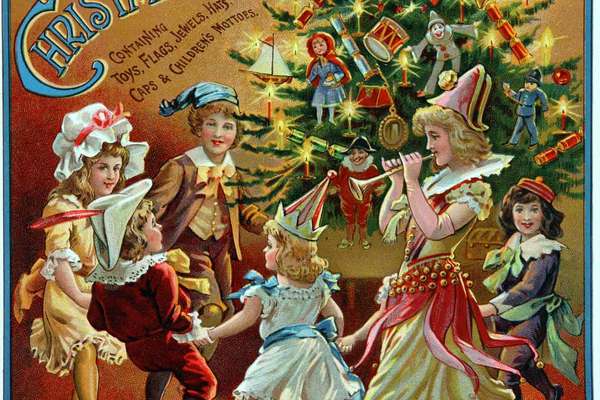
Confectioner Tom Smith invented the first Christmas cracker in the 1840s. These box labels show how he used popular themes to sell more crackers.
Teaching resource
The board games used in this lesson are very interesting as historical sources as they can reveal something about the society that made them. Use this resource to find out if the design of a board game can tell us anything about life in the past.

Box lid for a game called ‘Sugar and Salt’, 1898, Catalogue reference: COPY 1/142/i/226
Do we enjoy similar games?

The Little Teacher
Let's play at school.
Box lid for a game called ‘The Little Teacher’, 1908. Catalogue reference: COPY 1/275 f225
Queen Victoria died in 1901 after a reign of 64 years. Her eldest son, Edward, was crowned as King Edward VII at the age of 59. His wife Alexandra also became Queen. A coronation is a special ceremony when a king or queen received the crown. They were also given the orb (a globe with a cross on it) and a sceptre (a staff or wand) held in the hand. All these objects represented the power and authority of the new king or queen.

Board for a board game called Royal Coronation: The game for all true Britons, 1901. Catalogue reference: COPY 1/180 f247

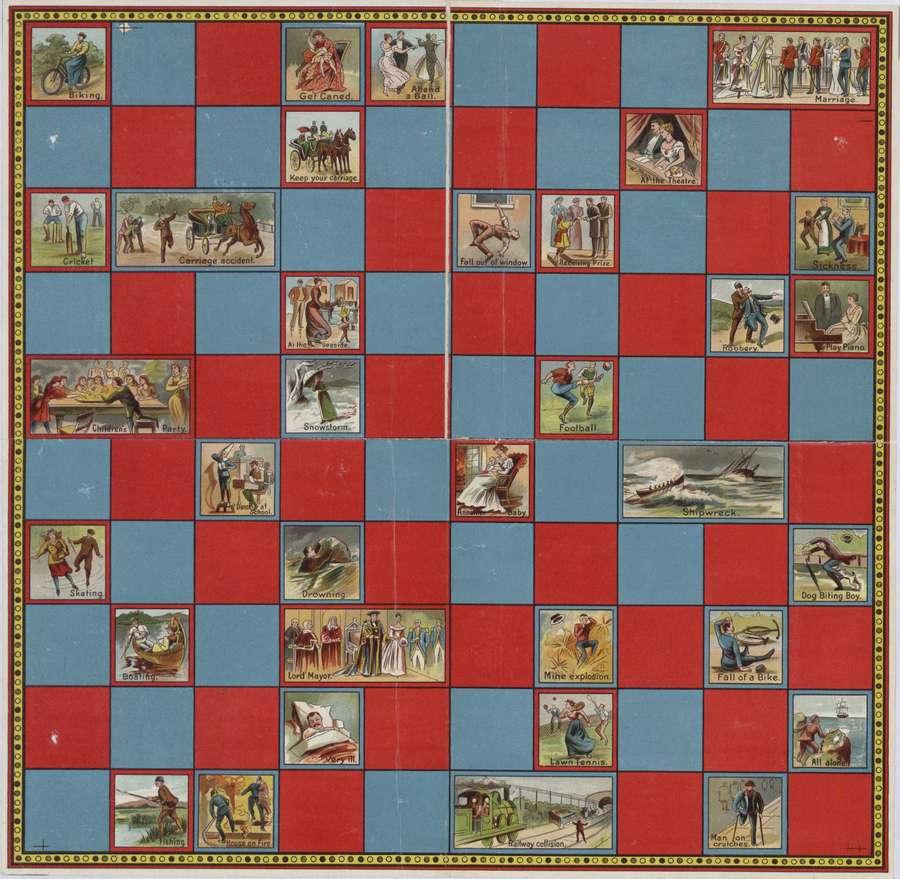
Box lid for a game called Ups and Downs of Life: A capital game for young and Old, 1899. Catalogue reference: COPY 1/146 f17

Board for Ups and Downs of Life.
This is a different sort of game. It is interesting because it was made by a company that sold cough syrup. The makers have included their name in the title of the game. The game is based on the Scouts, an organisation that started five years before.

OWBRIDGE’S SCOUTS EQUIPMENT GAME
INSTRUCTIONS: A game for two players. First carefully cut out the pieces forming the two figures of the boy scouts. Each player in turn spins the disc which indicates the piece he is to lay on the plain outline of the scout, but he must start with the Hat and place each succeeding piece to touch the last; for instance, should the indicator point to boots, before the stockings are laid on the figure the player forfeits that turn. The player who completes the equipment of his scout first, wins the game.
OWBRIDGE’S LUNG TONIC
FOR COUGHS
FOR COLDS
Owbridge’s Scout Equipment game, 1912. Catalogue reference: COPY 1/321 f343

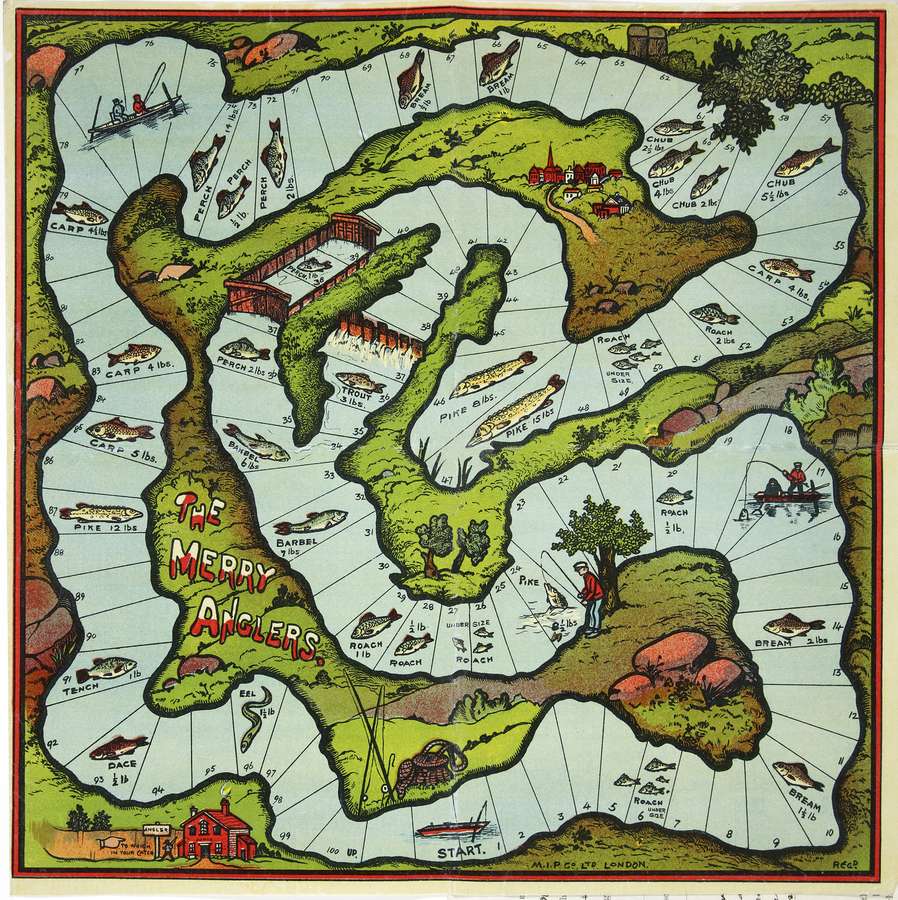
The Merry Anglers’ Board game, 1904. Catalogue reference: COPY 1/218 f309

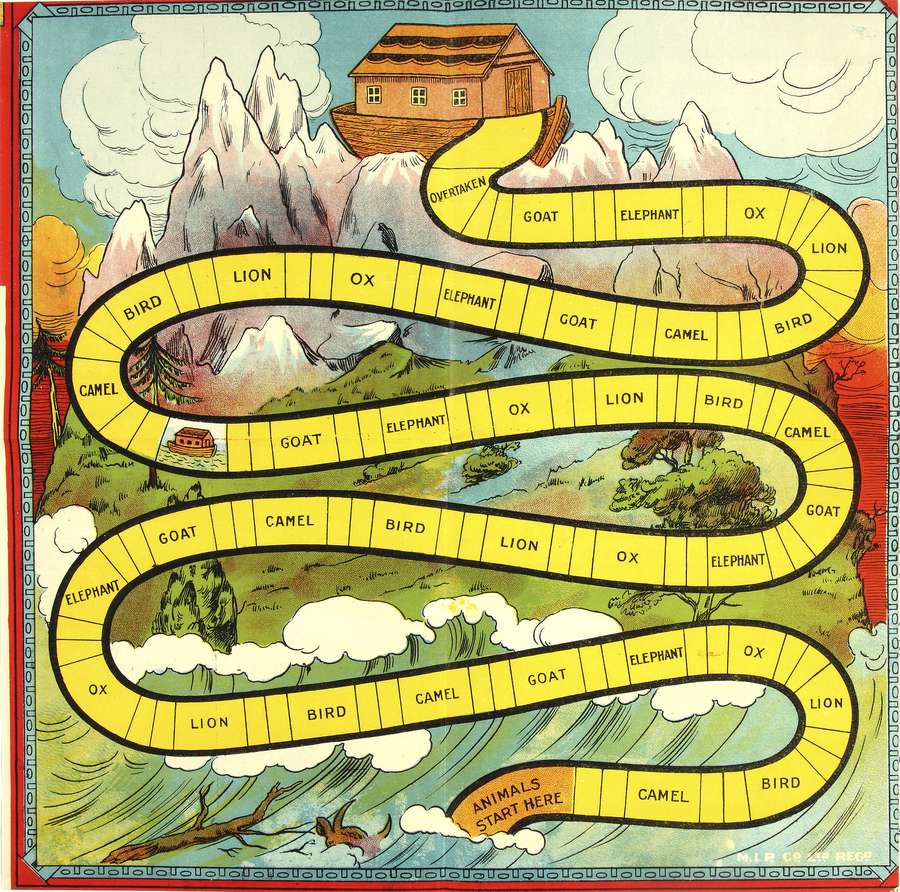
Noah’s Ark board game, 1908. Catalogue reference: COPY 1/270 f153
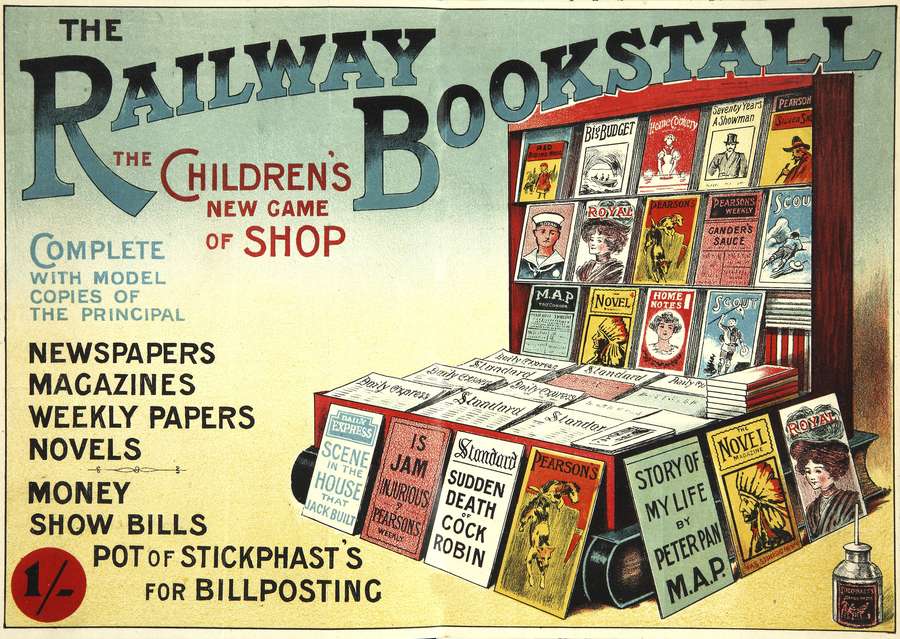
This is the lid of a children’s game that is not a board game.

The Railway Bookstall
The Children’s New Game of Shop
Complete with model copies of the principal
Newspapers
Magazines
Weekly papers
Novels
Money
Show bills
Pot of Stickphast’s for Billposting
Railway Bookstall game, 1908. Catalogue reference: COPY 1/274 f141
This is an example of a game where we only have the design from the lid and we don't know how it would have been played. Perhaps you can work it out.

Sugar & Salt
Across the mountains to Klondyke
A side-splitting game for all ages.
Box lid for a game called Sugar and Salt, 1898. Catalogue reference: COPY 1/142/i/226
Old board games are perhaps not typical historical sources. However, they are examples of our material culture that can help pupils understand past societies by allowing them to examine the objects that have been generated by those societies. Appreciation of material culture also widens pupils’ perception of the sheer range of historical sources we can engage with when trying to find out about the past.
This lesson could be used as part of a study following with the National Curriculum Key Stage 2 theme on the history of leisure and entertainment.
We have included some games with their box lid designs. In some cases, only the board design exists. In other cases, only its box lid. When we only have the lid, we do not know how a game would have been played! This true of the game shown here, ‘Sugar and Salt: Across the Mountains to Klondyke, a side-splitting game for all ages’ (1898). Perhaps we can only conclude that the game is based on the Klondike Gold Rush 1896-1899, the biggest gold rush in Canadian history. Gold was found in the Yukon River in North West Canada on the Alaskan border, causing a rush of over 100,000 miners looking for gold. Maybe this game was a race to cross the mountains to find gold, with hazards and wins on the way – sugar and salt!
The wide selection of games used in this lesson means that pupils could be broken up into small groups or pairs to work on one game, then report back to the class on their particular game. Some games are less complex than others and so this could also allow for differentiation.
Changes in an aspect of social history, such as crime and punishment from the Anglo-Saxons to the present, or leisure and entertainment in the 20th century.
Ideas, political power, industry and empire: Britain, 1745-1901.
According to the Guardian newspaper in April 2020, ‘sales of board games and jigsaw puzzles soared 240%’ in the first week of lockdown against COVID-19. Clearly, they offered a great way for families to spend time together at home.
Similarly, Victorians and Edwardians enjoyed board games and were familiar with games like chess, backgammon and draughts. Another traditional board game, Ludo, which originated from India in the 6th century known as pachisi, came to Britain in 1891, patented by Alfred Collier. A form of ‘Monopoly’ called the ‘Landlord’s Game’ was invented in 1903, and later became ‘Monopoly’ when copyrighted by Parker Brothers in 1935, then Hasbro in 1991.
Board games were highly valued as a form of entertainment for Victorian or Edwardian children as they were not too physical or noisy, allowing them to be ‘seen and not heard’. They could be played at home with the whole family or a group of children under the watchful eye of a parent or governess. They offered a change from the usual ‘parlour games’ that the Victorians favoured such as ‘Charades’ or ‘Pin the tail on the donkey’.
Many board games, not on sale today, were devised in the late 19th and early 20th centuries and some of their designs are held at The National Archives. The board games used in this lesson are very interesting as historical sources as they can reveal something about the society that made them.
Family and marriage were highly valued by the Victorians, and board games based on the end goal of marriage were not unusual. For example, in a board game called ‘Maricout’ (1882) players had to move around the board facing a range of setbacks during courtship. It emphasised Victorian values rewarding players who landed on squares holding specific virtues, including honesty and humility and highlighted the importance of acquiring, wealth and status in society – epitomised by the acquisition of carriages and servants. Another game called ‘The New Game of Married First or Wedding Bells’ (1904) followed a similar approach.
Edwardian board games were often educational and covered topics like history, science or geography. There were games based on the life of Dick Turpin: ‘The Game of Dick Turpin’s ride to York’ (1904), or the ‘Game of Scouts’ (1909), the ‘Boer War Game’ (1900) or even one called the ‘Game of Lord Gordon-Kitchener’ (1900). There was a somewhat tasteless game about the Titanic entitled: ‘The new game across the Atlantic, from Liverpool to New York without touching icebergs’ (1912).
Some games signalled moral values such as good behaviour, for example ‘The Little Teacher game’ (1908) and the importance of work. The game of ‘Temperanzo’ (1909) was designed to warn against the perils of drink and the importance of taking the pledge for adults. Children could play at shops with ‘The Play Town Post Office game’ (1909) or with ‘the Railway Bookstall game’ (1908). Other games were based upon nursery rhymes or fairy tales where the winner triumphed over evil characters during the course of the game, such as the ‘Enchanted Forest’ (1911).
New printing techniques meant companies could produce a wide range of board games fairly cheaply. The games were often very colourful and highly illustrated to make them appear more attractive to children. Sometimes instructions were printed on the board itself. The designs often involved a race with other players along a circuit or path in some shape or form. Counters or buttons were used to move along the board.
The number of moves was determined by teetotum or spinning top marked with letters or numbers to show the result of each spin. Dice were not often favoured as they were associated with gambling. Some games incorporated hazards or rewards, like in ‘Snakes and Ladders’ when players were sent backwards or forwards. In more sophisticated games, the players picked up cards that aided or impeded their progress in terms of ‘disasters’ or ‘windfalls’ according to the theme of the game.
In pictures
Confectioner Tom Smith invented the first Christmas cracker in the 1840s. These box labels show how he used popular themes to sell more crackers.