
































bbc.co.uk
BBC News story article on the struggle for the vote
100 Women: Suffragists or suffragettes - who won women the vote?
Teaching resource
This resource offers a wide selection of documents relating to the suffragette movement. It allows teachers and students to develop their own approaches and questions about the campaign for votes for women, and different responses to it.

Suffragettes shown outside the House of Commons ‘to persuade members to vote in favour of women’s suffrage’. Extract from The Illustrated London News, 1 February 1913. Catalogue reference: ZPER 34/142
This resource includes descriptions and images of violence. It also contains descriptions of force feeding.
What did the struggle for the vote involve?
Documents in this collection focus on the suffragette movement's tactics and marketing; how the government responded to it and treated prisoners; women's personal stories; support from politicians and the public; the role of the Women’s Social and Political Union; and male suffrage societies.
Discover more original documents in our related themed collection Suffragettes on file, 1840–1912.
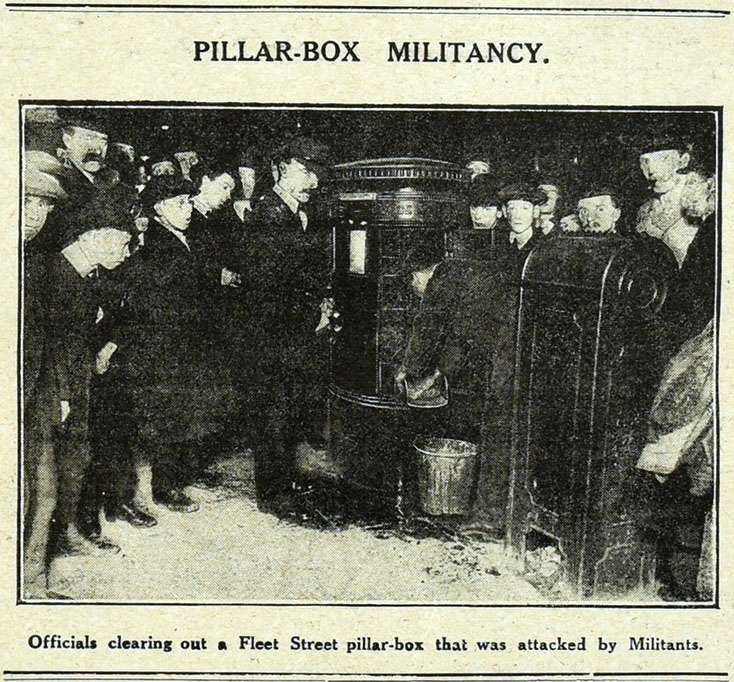
Photograph of men surrounding a damaged post box in Fleet Street, 20 December 1912.

PILLAR-BOX MILITANCY.
Officials clearing out a Fleet Street pillar-box that was attacked by Militants.
Pillar-box militancy. Catalogue reference: ASSI 52/212
Listen
PILLAR-BOX MILITANCY.
Officials clearing out a Fleet Street pillar-box that was attacked by Militants.
Instructions to governors in prisons on the treatment of First Division and Second Division prisoners, 1912.

Treatment of prisoners. Catalogue reference: PCOM 8/228
Listen
Statement showing the comparison between the treatment of prisoners under the first division, second division and rule 243A.
SEPARATION FROM OTHER CLASSES OF PRISONERS.
Division 2
Kept apart from others.
Division 2 rule 243A.
Kept apart from others.
Division 1
Kept apart from others.
BATH
Division 2
To be taken on reception, unless considered unnecessary by Governor or M.O. (all Suffragette prisoners have been exempted).
Division 2 rule 243A.
Not required on reception
Division 1
Not required on reception
SEARCHING:-
Division 2
Yes: subject to general Prison Rules.
Division 2 rule 243A.
Special search by a special officer.
Division 1
Special search by a special officer.
SPECIAL CELLS
Division 2
Must occupy cell assigned
Division 2 rule 243A.
Must occupy cell assigned
Division 1
Must be placed in room or cell appropriated to Division 1, unless suffering from an infectious disease.
SPECIAL ROOMS (OR CELLS)
Division 2
None.
Division 2 rule 243A.
None.
Division 1
(1) May occupy, on payment, specially fitted cell or room with suitable bedding &c.
(2) May have, at own cost use of private furniture & utensils suitable to habits.
(3) May have, on payment, assistance relieving him from performance of unaccustomed tasks or office.
(Only a limited number of rooms available).
APPLICATION OF PRISONERS’ PRIVATE MONEY
Division 2
Not allowed.
Division 2 rule 243A.
Not allowed.
Division 1
Money may be applied for making provision in respect of which payment is required.
FOOD
Division 2
As prescribed for these in Division 1. Who do not maintain themselves.
Division 2 rule 243A.
As in Division 2, but prisoner may receive parcel of food once a week not exceeding 11 lbs. M.O. may prescribe diet suitable to age, condition and health.
Division 1
May supply own food: not permitted to receive prison food at any meal for which he procures or receives food at own expense.
RESTRICTIONS AS TO SUPPLY OF FOOD
Division 2
Not applicable
Division 2 rule 243A.
Not applicable
Division 1
Only to be received at certain fixed hours. To be inspected; subject to restrictions preventing luxury or waste.
RESTRICTIONS AS TO SUPPLY OF DRINK:-
Division 2
No intoxicating liquor.
Division 2 rule 243A.
No intoxicating liquor.
Division 1
Shall not during 24 hours receive or purchase more than 1 pint of liquor &c or, if an adult, ½ pint of wine.
CLOTHING
Division 2
Prison dress of different colour (but this is not enforced in case of suffragette prisoners)
Division 2 rule 243A.
May wear own clothing.
Division 1
Own clothing, if fit. Prison dress, if worn of different colour.
DISINFECTION OF CLOTHING
Division 2
Not applicable
Division 2 rule 243A.
No special provision but the rule for Div. 1. would be applied if necessary.
Division 1
M.O. may order disinfection of own clothing, prison clothing to be worn meanwhile.
PROHIBITION OF SALE OF PROPERTY
Division 2
Not applicable
Division 2 rule 243A.
Not applicable
Division 1
Sale or transfer of any article introduced prohibited.
HAIR CUTTING
Division 2
Not compelled to shave or have hair cut, except on medical grounds.
Division 2 rule 243A.
As in Division 2.
Division 1
As in Division 2.
CLEANING OF ROOMS
Division 2
To be swept and cleaned by themselves; also furniture and utensils.
Division 2 rule 243A.
May be relieved from this duty if desired – to have on payment, services of some one to perform it.
Division 1
As in Division 2. (Rule 243A).
BOOKS & NEWSPAPERS
Division 2
Books from Prison Library.
Division 2 rule 243A.
Books at own expense, not bearing on current events, and unobjectionable.
Division 1
Books & newspapers or other means of occupation, at own expense, as are not objectionable.
EMPLOYMENT
Division 2
To be employed at work of industrial or manufacturing nature to be afforded means of earning remission of sentence and gratuity.
Division 2 rule 243A.
To be employed only on lighter forms of labour and thus afforded facilities to earn remission and gratuity.
Division 1
Not required to work:
permitted (a) to follow trade or profession if practicable and to receive earnings
(b) by consent employed on prison industries, and thus entitled to earn remission and gratuity.
VISITS AND LETTERS
Division 2
Visits once a month by not more than three friends for ¼ hour. Write one letter and receive one letter each month.
Division 2 rule 243A.
Visits one a month by not more than 3 friends for ¼ hour, in place provided for Div.1. offenders. Write one letter & receive one letter on private matters in each fortnight, such visits and letters depend on industry and good conduct.
Division 1
Visits once a fortnight by not more than three friends for ¼ hour. May write one letter & receive one letter each fortnight. Visits may be prolonged by V.C. or additional visits or letters granted to a reasonable extent. Not to receive visits in same place as other prisoners if other place can be provided.
EXERCISE, ASSOCIATION AND CONVERSATION:
Division 2
Exercise once a day. Conversation during exercise not allowed.
Division 2 rule 243A.
To exercise in forenoon and afternoon; to associate & converse during this time, so long as they behave.
Division 1
No special provisions. Reasonable opportunities of exercise allowed.
RELIGIOUS SERVICES
Division 2
Same as Division 1.
Division 2 rule 243A.
Same as Division 1.
Division 1
If attended or visited by Minister of other persuasion than Established Church shall not be compelled to attend any religious service. Otherwise, attend ordinary services.
APPLICATION OF GENERAL RULES
Division 2
Subject to general prison rules except as far as they are inconsistent with special rules of this Class.
Division 2 rule 243A.
As in Division 2.
Division 1
As in Division 2.
Extract from a transcript recording the Working Women’s Suffrage Deputation to Lloyd George. In this example, Mrs Hawkins represents the Leicester boot and shoe trades, 23 January 1913.

Mrs Hawkins: Gentlemen, I am here to represent a large body of women workers. There are many thousands of women working in the boot and shoe trade in Leicester and further, as you know, a large body of the women workers in the boot trade are brought under terrible sweating conditions.
The sweating is mostly done among the women who work in the homes. Some of the women belong to our Trade Union, and a large body of women who work in our factories belong to the Trade Union. Still we find even being organised that we cannot get on so well as the men. The men in the organised trade have been able to send many members to Parliament. No women have been able to send one woman or man to represent them. Women have to work exactly the same hours as the men work — from 8 in the morning till half-past 6 at night. Girls leaving school at 14 years of age have to put in exactly the same hours for 4/- and 5/- a week. The wages of women are very much less that the wages of men. We feel that very keenly in our Trades Union, because many of our women do exactly the same work as the men and we claim we ought to have exactly the same pay. We have not been able to get that because we have not been able to push it in the right place. I feel that now is the time. Women have been trying to get the vote in order to alter their status in life. I have two sons who have been working for the country, one in the Army and one in the Navy. Those sons under this new Bill — the Manhood Suffrage Bill — would have votes. I, the mother who brought them into the world, have nothing. I am looked down upon simply because they think we are not to be trusted. I feel this very keenly myself. I have worked amongst the sweated workers and citizens of our town for many years in order to help the weak and the poor. I have seen some terrible things in those homes, homes not fit for horses or dogs to live in, families brought up with boys and girls together. When I have spoken to the mothers they have said “what can we do?” But I have no voice in the matter. These things have been going on for many years and I do feel that now is the time that we should have this matter settled at once. My Trades Union, which is composed of a thousand members, sends this message to you:
“Tell Mr. Lloyd George that we demand the vote at once and we hope when you come back, you will be able to tell us it has been granted.”
Deputation to Lloyd George. Catalogue reference: T 172/110
Listen
Mrs Hawkins: Gentlemen, I am here to represent a large body of women workers. There are many thousands of women working in the boot and shoe trade in Leicester and further, as you know, a large body of the women workers in the boot trade are brought under terrible sweating conditions.
The sweating is mostly done among the women who work in the homes. Some of the women belong to our Trade Union, and a large body of women who work in our factories belong to the Trade Union. Still we find even being organised that we cannot get on so well as the men. The men in the organised trade have been able to send many members to Parliament. No women have been able to send one woman or man to represent them. Women have to work exactly the same hours as the men work — from 8 in the morning till half-past 6 at night. Girls leaving school at 14 years of age have to put in exactly the same hours for 4/- and 5/- a week. The wages of women are very much less that the wages of men. We feel that very keenly in our Trades Union, because many of our women do exactly the same work as the men and we claim we ought to have exactly the same pay. We have not been able to get that because we have not been able to push it in the right place. I feel that now is the time. Women have been trying to get the vote in order to alter their status in life. I have two sons who have been working for the country, one in the Army and one in the Navy. Those sons under this new Bill — the Manhood Suffrage Bill — would have votes. I, the mother who brought them into the world, have nothing. I am looked down upon simply because they think we are not to be trusted. I feel this very keenly myself. I have worked amongst the sweated workers and citizens of our town for many years in order to help the weak and the poor. I have seen some terrible things in those homes, homes not fit for horses or dogs to live in, families brought up with boys and girls together. When I have spoken to the mothers they have said “what can we do?” But I have no voice in the matter. These things have been going on for many years and I do feel that now is the time that we should have this matter settled at once. My Trades Union, which is composed of a thousand members, sends this message to you:
“Tell Mr. Lloyd George that we demand the vote at once and we hope when you come back, you will be able to tell us it has been granted.”
Extract from Special Branch report on suffragette meeting at Essex Hall, The Strand, London, 31 January 1913.

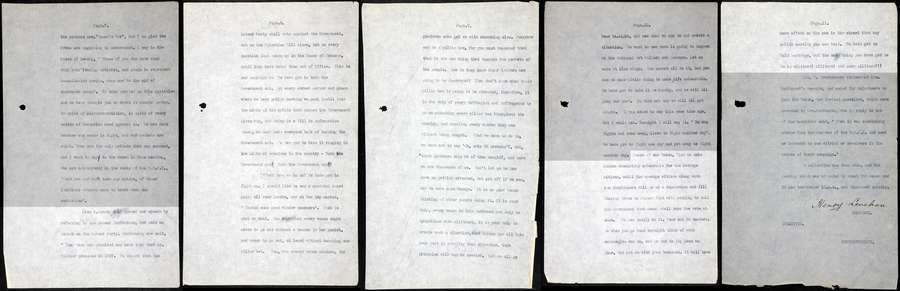
Miss A. Kenney [–] opened her speech by referring to the Labour Conference, and made an attack on the Labour Party. Continuing she said, “They have not promised any more than what Mr. Balfour promised in 1907. We demand that the Labour Party shall vote against the Government, not on the Franchise Bill alone, but on every question that comes up in the House of Commons, until they have voted them out of Office. This is our campaign:– We have got to turn the Government out. At every street corner and place where we have public meeting we must instil into the minds of the public that unless the Government gives way, and bring in a Bill to enfranchise women, we must make everyone talk of turning the Government out. We have got to have it ringing in the minds of everyone in the country – Turn the Government out! Turn the Government out!
“What have we to do? We have got to fight on. I should like to see a sandwich board going all over London, and on the top marked, ‘Wanted some good window smashers’. That is what we want. You know that every woman ought never to go out without a hammer in her pocket, and never to go out, at least without touching one pillar box. You, who cannot break windows, for goodness sake get on with something else. Everyone can do a pillar box, for you must remember that that is the one thing that touches the pockets of the people. How do they know their letters are going to be destroyed? They don’t know when their pillar box is going to be attacked, therefore, it is the duty of every Suffragist and Suffragette to go on attacking every pillar box throughout the country, and breaking every window they can without being caught. What we have to do is, we have not to say ‘Oh, only 50 arrests’!, but, ‘thank goodness only 50 of them caught!, and here we are thousands of us. Don’t let us be too keen on getting arrested, but get off if we can, and do some more damage. It is no good women thinking of other people doing it. It is your duty, every woman in this audience not only to sympathise with militancy, it is your duty to create such a situation, that unless you all take your part in creating that situation, that situation will not be created. […]
Women of our union, ‘Let us make London absolutely unbearable for the average citizen, until the average citizen along with the shopkeepers will go on a deputation and fill Charing Cross to Palace Yard with people, to tell the Government that women shall have the vote at once. We can easily do it. Come out in numbers. So when you go home to-night think of what scheme you can do, and go and do it; lose no time, but get on with your business. It will have more effect on the men in the street than any public meeting you can hold. We have got to hold meetings, but the only thing you have got to be is militant! Militant! And more militant!!!’
Annie Kenney. Catalogue reference: HO 45/10695/231366
Listen
Miss A. Kenney [–] opened her speech by referring to the Labour Conference, and made an attack on the Labour Party. Continuing she said, “They have not promised any more than what Mr. Balfour promised in 1907. We demand that the Labour Party shall vote against the Government, not on the Franchise Bill alone, but on every question that comes up in the House of Commons, until they have voted them out of Office. This is our campaign:– We have got to turn the Government out. At every street corner and place where we have public meeting we must instil into the minds of the public that unless the Government gives way, and bring in a Bill to enfranchise women, we must make everyone talk of turning the Government out. We have got to have it ringing in the minds of everyone in the country – Turn the Government out! Turn the Government out!
“What have we to do? We have got to fight on. I should like to see a sandwich board going all over London, and on the top marked, ‘Wanted some good window smashers’. That is what we want. You know that every woman ought never to go out without a hammer in her pocket, and never to go out, at least without touching one pillar box. You, who cannot break windows, for goodness sake get on with something else. Everyone can do a pillar box, for you must remember that that is the one thing that touches the pockets of the people. How do they know their letters are going to be destroyed? They don’t know when their pillar box is going to be attacked, therefore, it is the duty of every Suffragist and Suffragette to go on attacking every pillar box throughout the country, and breaking every window they can without being caught. What we have to do is, we have not to say ‘Oh, only 50 arrests’!, but, ‘thank goodness only 50 of them caught!, and here we are thousands of us. Don’t let us be too keen on getting arrested, but get off if we can, and do some more damage. It is no good women thinking of other people doing it. It is your duty, every woman in this audience not only to sympathise with militancy, it is your duty to create such a situation, that unless you all take your part in creating that situation, that situation will not be created. […]
Women of our union, ‘Let us make London absolutely unbearable for the average citizen, until the average citizen along with the shopkeepers will go on a deputation and fill Charing Cross to Palace Yard with people, to tell the Government that women shall have the vote at once. We can easily do it. Come out in numbers. So when you go home to-night think of what scheme you can do, and go and do it; lose no time, but get on with your business. It will have more effect on the men in the street than any public meeting you can hold. We have got to hold meetings, but the only thing you have got to be is militant! Militant! And more militant!!!’
Extract from the Daily Mirror, 23 September 1913.

The Daily Mirror
SUFFRAGETTES MOBBED AND BEATEN IN WALES: HAIR TORN FROM THE HEADS OF MR LLOYD GEORGE’S INTERRUPTERS
There were scenes of the wildest disorder at Llanystymdwy on Saturday, when some suffragettes were violently treated by an angry and excited crowd. Llanystymdwy is near Criccieth, where Mr. Lloyd George received his boyhood training, and the occasion was the visit of the Chancellor to open the village institute which he has presented to the parish. The suffragettes had been warned that it would injure their cause if they adopted their usual tactics towards Cabinet Ministers, but they paid no heed to the warning, and suffered in consequence. Those who interrupted the Chancellor were attacked with great fury, their hair being torn out and their heads beaten. One was actually stripped to the waist. The large photograph shows a policemen vainly endeavouring to protect a woman from the infuriated mob. The small one shows a man grabbing and pulling the hair of the same girl.
Women speak out. Catalogue reference: HO 45/10689/228470
Listen
SUFFRAGETTES MOBBED AND BEATEN IN WALES: HAIR TORN FROM THE HEADS OF MR LLOYD GEORGE’S INTERRUPTERS
There were scenes of the wildest disorder at Llanystymdwy on Saturday, when some suffragettes were violently treated by an angry and excited crowd. Llanystymdwy is near Criccieth, where Mr. Lloyd George received his boyhood training, and the occasion was the visit of the Chancellor to open the village institute which he has presented to the parish. The suffragettes had been warned that it would injure their cause if they adopted their usual tactics towards Cabinet Ministers, but they paid no heed to the warning, and suffered in consequence. Those who interrupted the Chancellor were attacked with great fury, their hair being torn out and their heads beaten. One was actually stripped to the waist. The large photograph shows a policemen vainly endeavouring to protect a woman from the infuriated mob. The small one shows a man grabbing and pulling the hair of the same girl.
Extract from the Daily Mirror, 23 September 1913.

FIERCE ATTACKS ON WOMEN
Chancellor’s Interrupters Beaten, Stunned and Kicked by Mob.
WILD SCENES
(From our Special Correspondent)
Llanystymdwy, Sept. 22- This pretty little North Wales village was the scene of a wild outburst against suffragettes yesterday. The crowd in its anger at the interruptions of the Chancellor’s speech, seemed for the moment to forget that the interrupters were women or even human beings.
Whether one agrees or disagrees with the militant methods of the suffragettes, it is impossible to justify the brutal attitude on the part of the angry crowd, however much they were incensed by the women’s ill-timed interjections.
The gathering assembled to hear the Chancellor – who was presenting to the parish where he received his boyhood training a village institute, the cost of which, £6,000, was mainly defrayed by damages from libel action – was composed mostly of men, but with a sprinkling of women.
Beginning his address, Mr. Lloyd George had only time to say, “Ladies and Gentlemen,” when almost in the front row a woman cried: “When are you going to give—”. She could not finish her sentence, but other women shouted: “Votes for Women!”
At once pandemonium reigned, and hundreds of Welshmen rushed at the luckless suffragette. Catching hold of her by the waist, they dragged her away from the crowd and maltreated her.
STUNNED BY BLOW IN FACE
Her hat was torn away and armed with cabbage stumps and sticks the crowd struck the unfortunate woman on the head, in the face and on other parts of her body.
Meanwhile the policemen – there were twenty-four – and the plain clothes detectives fought hard to give her protection. Their efforts were useless, as the gathering was nothing but a mass of howling men mad with anger.
One man forced his way through the dense mass to where the police were trying to get the half-fainting woman away.
Laughing and waving his hands, he struck her a terrible blow on the jaw. This stunned her, and she was then conveyed to a cottage, a howling crowd following her and her two protectors.
The Chancellor stood on the platform and appealed for mercy, and after leading off the singing of the Welsh National Anthem, again began his speech.
Undaunted by the fate of one of their comrades, four other suffragettes interrupted Mr. Lloyd George, and, all of them being caught, they received even worse treatment.
One woman was stripped to the waist, and one man pulled a bunch of her hair out and boastfully waved it to the view of those around him.
A second of the four women was heavily thrown to the ground and then lifted, ultimately being thrown into the middle of a ditch on her back. The crowd took the opportunity of throwing missiles at her as she lay.
COTTAGE BESIEGED
A rush was made for her when she had recovered her feet, and she was half carried and half dragged to Llanystymdwy bridge, the intention being to throw her over into the river. Had she gone over the parapet she would have been killed by striking the boulders studding the shallow river bed.
The police guessed the purpose of the mob and made gallant efforts to rescue her, and, after a short, sharp tussle, carried her to a house for safety.
The remaining two women were knocked about until they were rendered unconscious.
Even the occupiers of cottages and houses in the village were callous. They refused to give shelter to the hapless, suffering creatures, telling them to “take their chances”.
In one house an injured woman had gained shelter on the stairs when the mob spied her crouching near the partition.
She managed to shut the door, but the mob, shouting and swearing, had all but broken it in when the police arrived and dispersed them with drawn truncheons rescuing the frightened and almost demented woman.
The skirts of two women were ripped and portions of them ripped up and distributed amongst the crowd as souvenirs.
Even biting was resorted to by the insane mobbers. One woman was being conveyed to a place of shelter, and though she was between two policemen some of the crowd thrashed her till she fainted.
‘Fierce attacks on women’. Catalogue reference: HO 45/10689/228470
Listen
FIERCE ATTACKS ON WOMEN
Chancellor’s Interrupters Beaten, Stunned and Kicked by Mob.
WILD SCENES
(From our Special Correspondent)
Llanystymdwy, Sept. 22- This pretty little North Wales village was the scene of a wild outburst against suffragettes yesterday. The crowd in its anger at the interruptions of the Chancellor’s speech, seemed for the moment to forget that the interrupters were women or even human beings.
Whether one agrees or disagrees with the militant methods of the suffragettes, it is impossible to justify the brutal attitude on the part of the angry crowd, however much they were incensed by the women’s ill-timed interjections.
The gathering assembled to hear the Chancellor – who was presenting to the parish where he received his boyhood training a village institute, the cost of which, £6,000, was mainly defrayed by damages from libel action – was composed mostly of men, but with a sprinkling of women.
Beginning his address, Mr. Lloyd George had only time to say, “Ladies and Gentlemen,” when almost in the front row a woman cried: “When are you going to give—”. She could not finish her sentence, but other women shouted: “Votes for Women!”
At once pandemonium reigned, and hundreds of Welshmen rushed at the luckless suffragette. Catching hold of her by the waist, they dragged her away from the crowd and maltreated her.
STUNNED BY BLOW IN FACE
Her hat was torn away and armed with cabbage stumps and sticks the crowd struck the unfortunate woman on the head, in the face and on other parts of her body.
Meanwhile the policemen – there were twenty-four – and the plain clothes detectives fought hard to give her protection. Their efforts were useless, as the gathering was nothing but a mass of howling men mad with anger.
One man forced his way through the dense mass to where the police were trying to get the half-fainting woman away.
Laughing and waving his hands, he struck her a terrible blow on the jaw. This stunned her, and she was then conveyed to a cottage, a howling crowd following her and her two protectors.
The Chancellor stood on the platform and appealed for mercy, and after leading off the singing of the Welsh National Anthem, again began his speech.
Undaunted by the fate of one of their comrades, four other suffragettes interrupted Mr. Lloyd George, and, all of them being caught, they received even worse treatment.
One woman was stripped to the waist, and one man pulled a bunch of her hair out and boastfully waved it to the view of those around him.
A second of the four women was heavily thrown to the ground and then lifted, ultimately being thrown into the middle of a ditch on her back. The crowd took the opportunity of throwing missiles at her as she lay.
COTTAGE BESIEGED
A rush was made for her when she had recovered her feet, and she was half carried and half dragged to Llanystymdwy bridge, the intention being to throw her over into the river. Had she gone over the parapet she would have been killed by striking the boulders studding the shallow river bed.
The police guessed the purpose of the mob and made gallant efforts to rescue her, and, after a short, sharp tussle, carried her to a house for safety.
The remaining two women were knocked about until they were rendered unconscious.
Even the occupiers of cottages and houses in the village were callous. They refused to give shelter to the hapless, suffering creatures, telling them to “take their chances”.
In one house an injured woman had gained shelter on the stairs when the mob spied her crouching near the partition.
She managed to shut the door, but the mob, shouting and swearing, had all but broken it in when the police arrived and dispersed them with drawn truncheons rescuing the frightened and almost demented woman.
The skirts of two women were ripped and portions of them ripped up and distributed amongst the crowd as souvenirs.
Even biting was resorted to by the insane mobbers. One woman was being conveyed to a place of shelter, and though she was between two policemen some of the crowd thrashed her till she fainted.
Suffragettes shown outside the House of Commons ‘to persuade members to vote in favour of women’s suffrage’, 1913.

WHEN PATIENCE DID NOT SEEM A VIRTUE IN THE EYES OF MANY PARLIAMENTARIANS, SUFFRAGETTES “PICKETTING” ENTRANCES TO THE HOUSE OF COMMONS TO PERSUADE MEMBERS TO VOTE IN FAVOUR OF WOMAN’S SUFFRAGE
Our photograph illustrates some of the less strenuous methods adopted by the Suffragettes in their endeavours to gain the vote- the peaceful picketing of the House of Commons by ladies of the white, green and purple, who made it their business to persuade as many Members as possible to vote for their cause.
Extract from The Illustrated London News, 1 February 1913. Catalogue reference: ZPER 34/142
Listen
WHEN PATIENCE DID NOT SEEM A VIRTUE IN THE EYES OF MANY PARLIAMENTARIANS, SUFFRAGETTES “PICKETTING” ENTRANCES TO THE HOUSE OF COMMONS TO PERSUADE MEMBERS TO VOTE IN FAVOUR OF WOMAN’S SUFFRAGE
Our photograph illustrates some of the less strenuous methods adopted by the Suffragettes in their endeavours to gain the vote- the peaceful picketing of the House of Commons by ladies of the white, green and purple, who made it their business to persuade as many Members as possible to vote for their cause.
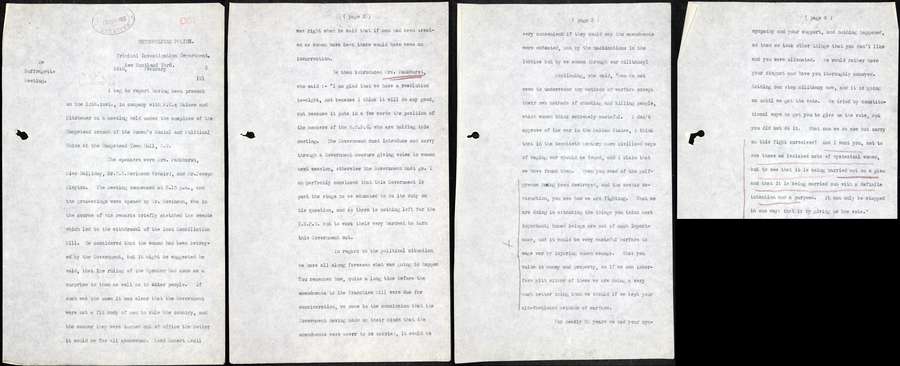
Extract from a police report on a suffragette meeting at Hampstead Town Hall with speakers including Emmeline Pankhurst, 14 February 1913.

Metropolitan Police
Criminal Investigation Department, New Scotland Yard, 14th February 1913
Re Suffragette Meeting.
I beg to report having been present on the 13th.inst., in company with P.C.s Haines and Kitchener at a meeting held under the auspices of the Hampstead branch of the Women’s Social and Political Union at the Hampstead Town Hall, N.W.
The speakers were Mrs. Pankhurst, Miss Halliday, Mr. H.W. Nevinson (chair), and Mr. Joseph Clayton. The meeting commenced at 8.15 p.m., and the proceedings were opened by Mr. Nevinson, who in the course of his remarks briefly sketched the events which led to the withdrawal of the last Conciliation Bill. He considered that the women had been betrayed by the Government, but it might be suggested he said, that the ruling of the Speaker had come as a surprise to them as well as to other people. If such was the case it was clear that the Government were not a fit body of men to rule the country, and the sooner they were turned out of office the better it would be for all concerned. Lord Robert Cecil was right when he said that if men had been treated as women have been there would have been an insurrection.
He then introduced Mrs. Pankhurst, who said: – “I am glad that we have a resolution to-night, not because I think it will do any good, but because it puts in a few words the position of the members of the W.S.P.U. who are holding this meeting. The Government must introduce and carry through a Government measure giving votes to women next session, otherwise the Government must go. I am perfectly convinced that this Government is past the stage to be educated to do its duty on t[h]is question, and so there is nothing left for the W.S.P.U. but to work their very hardest to turn this Government out.
In regard to the political situation we have all along foreseen what was going to happen You remember how, quite a long time before the amendments to the Franchise Bill were due for consideration, we came to the conclusion that the Government having made up their minds that the amendments were never to be carried, it would be very convenient if they could say the amendments were defeated, not by the machinations in the lobbies but by we women through our militancy:
Continuing, she said, “Men do not seem to understand any methods of warfare except their own methods of shooting and killing people, which women think extremely wasteful. I don’t approve of the war in the Balkan States, I think that in the twentieth century more civilised ways of waging war should be found, and I claim that we have found them. When you read of the golf-greens having been destroyed, and the orchid destruction, you see how we are fighting. What we are doing is attacking the things you think most important; human beings are not of much importance, and it would be very wasteful warfare to wage war by injuring human beings. What you value is money and property, so if we can interfere with either of these things we are doing a very much better thing than we should if we kept your old-fashioned methods of warfare.
For nearly 50 years we had your sympathy and your support, and nothing happened, so then we took other things that you don’t like and you were alienated. We would rather have your disgust and have you thoroughly annoyed. Nothing can stop militancy now, and it is going on until we get the vote. We tried by constitutional ways to get you to give us the vote, but you did not do it. What can we do now but carry on this fight ourselves? And I want you, not to see these as isolated acts of hysterical women, but to see that it is being carried out on a plan and that it is being carried out with a definite intention and a purpose. It can only be stopped in one way: that is by giving us the vote.”
‘Hysterical women’. Catalogue reference: HO 45/10695/231366
Listen
Metropolitan Police
Criminal Investigation Department, New Scotland Yard, 14th February 1913
Re Suffragette Meeting.
I beg to report having been present on the 13th.inst., in company with P.C.s Haines and Kitchener at a meeting held under the auspices of the Hampstead branch of the Women’s Social and Political Union at the Hampstead Town Hall, N.W.
The speakers were Mrs. Pankhurst, Miss Halliday, Mr. H.W. Nevinson (chair), and Mr. Joseph Clayton. The meeting commenced at 8.15 p.m., and the proceedings were opened by Mr. Nevinson, who in the course of his remarks briefly sketched the events which led to the withdrawal of the last Conciliation Bill. He considered that the women had been betrayed by the Government, but it might be suggested he said, that the ruling of the Speaker had come as a surprise to them as well as to other people. If such was the case it was clear that the Government were not a fit body of men to rule the country, and the sooner they were turned out of office the better it would be for all concerned. Lord Robert Cecil was right when he said that if men had been treated as women have been there would have been an insurrection.
He then introduced Mrs. Pankhurst, who said: – “I am glad that we have a resolution to-night, not because I think it will do any good, but because it puts in a few words the position of the members of the W.S.P.U. who are holding this meeting. The Government must introduce and carry through a Government measure giving votes to women next session, otherwise the Government must go. I am perfectly convinced that this Government is past the stage to be educated to do its duty on t[h]is question, and so there is nothing left for the W.S.P.U. but to work their very hardest to turn this Government out.
In regard to the political situation we have all along foreseen what was going to happen You remember how, quite a long time before the amendments to the Franchise Bill were due for consideration, we came to the conclusion that the Government having made up their minds that the amendments were never to be carried, it would be very convenient if they could say the amendments were defeated, not by the machinations in the lobbies but by we women through our militancy:
Continuing, she said, “Men do not seem to understand any methods of warfare except their own methods of shooting and killing people, which women think extremely wasteful. I don’t approve of the war in the Balkan States, I think that in the twentieth century more civilised ways of waging war should be found, and I claim that we have found them. When you read of the golf-greens having been destroyed, and the orchid destruction, you see how we are fighting. What we are doing is attacking the things you think most important; human beings are not of much importance, and it would be very wasteful warfare to wage war by injuring human beings. What you value is money and property, so if we can interfere with either of these things we are doing a very much better thing than we should if we kept your old-fashioned methods of warfare.
For nearly 50 years we had your sympathy and your support, and nothing happened, so then we took other things that you don’t like and you were alienated. We would rather have your disgust and have you thoroughly annoyed. Nothing can stop militancy now, and it is going on until we get the vote. We tried by constitutional ways to get you to give us the vote, but you did not do it. What can we do now but carry on this fight ourselves? And I want you, not to see these as isolated acts of hysterical women, but to see that it is being carried out on a plan and that it is being carried out with a definite intention and a purpose. It can only be stopped in one way: that is by giving us the vote.”
Letter from Walter Dodgson, the husband of a woman involved in the window smashing campaign warning of a hunger strike at Holloway prison, 16 April 1912.

Woodlesford
W Leeds
16 April 1912
To The Home Secretary,
Sir
I have to call your attention to the hunger strikes at Aylesbury Prison + to the fact that my wife at present lies in Holloway Gaol under a sentence of 2 months hard labor [sic] for the alleged smashing with other or others of a window at Bow Street estimated at £3
I say alleged for though after her arrest she was sent by me as her solicitor a letter explaining the charge and offering to defend her, you or your officials at the gaol supressed the letter till days after her conviction undefended.
The point at present I more particularly wish to bring before your notice is that owing to your continued connivance at these hard labour sentences for political prisoners, you are in danger of having to supress a hunger strike at Holloway on a large scale without any properly qualified trained nurses or an adequate medical staff in the establishment.
You are personally responsible for the prison regulations being kept abreast of the spirit of the times, and at present you are jeopardising the health + sanity of scores of noble women. If a hunger strike breaks out in Holloway you may overcome it but you will be execrated and the just indignation + resentment will cloud the Government as well as yourself.
You cannot justify the long sentences that have been given to high spirited women – or the cruelty of your regulations to these political prisoners – as compared with Hooleys treatment. The position is ludicrous if it were not lamentable.
As my wife has been convicted after being subjected either to a trick or gross negligence I shall hold you doubly responsible should anything untoward happen to her.
I am Sir
Yours truly
Walter Dodgson
Hunger strikes. Catalogue reference: HO144/1194/220196
Listen
Woodlesford
W Leeds
16 April 1912
To The Home Secretary,
Sir
I have to call your attention to the hunger strikes at Aylesbury Prison + to the fact that my wife at present lies in Holloway Gaol under a sentence of 2 months hard labor [sic] for the alleged smashing with other or others of a window at Bow Street estimated at £3
I say alleged for though after her arrest she was sent by me as her solicitor a letter explaining the charge and offering to defend her, you or your officials at the gaol supressed the letter till days after her conviction undefended.
The point at present I more particularly wish to bring before your notice is that owing to your continued connivance at these hard labour sentences for political prisoners, you are in danger of having to supress a hunger strike at Holloway on a large scale without any properly qualified trained nurses or an adequate medical staff in the establishment.
You are personally responsible for the prison regulations being kept abreast of the spirit of the times, and at present you are jeopardising the health + sanity of scores of noble women. If a hunger strike breaks out in Holloway you may overcome it but you will be execrated and the just indignation + resentment will cloud the Government as well as yourself.
You cannot justify the long sentences that have been given to high spirited women – or the cruelty of your regulations to these political prisoners – as compared with Hooleys treatment. The position is ludicrous if it were not lamentable.
As my wife has been convicted after being subjected either to a trick or gross negligence I shall hold you doubly responsible should anything untoward happen to her.
I am Sir
Yours truly
Walter Dodgson
Women’s Suffrage Pilgrimage map which shows the extent of national protest and peaceful campaign methods June–July 1913.

Pilgrimage map. Catalogue reference: HO45/10695/231366
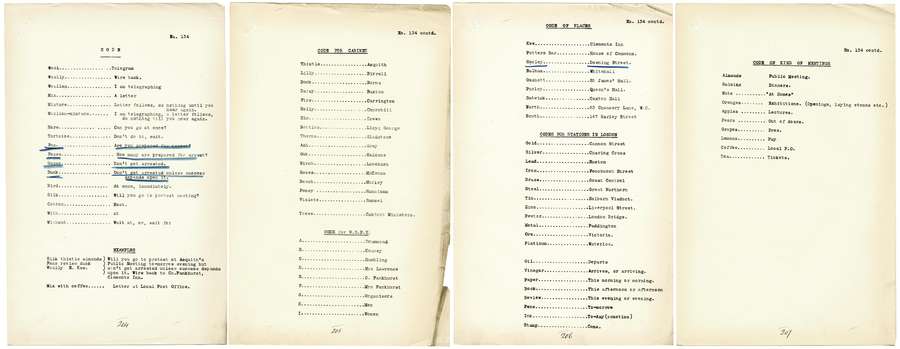
Codes used by Women’s Social and Political Union for secret messages. These were used as evidence in the conspiracy trials against the WSPU leaders.

Ex. 134
CODE
Wool - Telegram
Woolly - Wire back.
Woollen - I am telegraphing
Mix - A letter
Mixture - Letter follows, do nothing until you hear again.
Woollen-mixture - I am telegraphing, a letter follows, do nothing till you hear again.
Hare - Can you go at once?
Tortoise - Don’t do it, wait.
Fox - Are you prepared for arrest?
Foxes - How many are prepared for arrest?
Goose - Don’t get arrested.
Duck - Don’t get arrested unless success depends upon it.
Bird - At once, immediately.
Silk - Will you go to protest meeting?
Cotton - Meet.
With - at
Without - Wait at, or, wait for
Examples
Silk thistle almonds
Pens review duck Woolly
E.Kew.
Will you go to protest at Asquith’s Public Meeting to-morrow evening but don’t get arrested unless success depends upon it. Wire back to Ch. Pankhurst, Clements Inn.
Mix with coffee - Letter at Local Post Office.
CODE FOR CABINET
Thistle - Asquith
Lilly - Birrell
Dock - Burns
Daisy - Buxton
Firs - Carrington
Holly - Churchill
Elm - Crewe
Nettles - Lloyd George
Thorns - Gladstone
Ash - Gray
Oak - Haldane
Birch - Loreburn
Roses - McKenna
Beech - Morley
Pansy - Runciman
Violets - Samuel
Trees - Cabinet Ministers.
CODE for W.S.P.U.
A - Drummond
B - Kenney
C - Hambling
D - Mrs Lawrence
E - C. Pankhurst
F - Mrs Pankhurst
G - Organisers
H - Men
I - Women
CODE OF PLACES
Kew - Clements Inn
Potters Bar - House of Commons
Henley - Downing Street
Balham - Whitehall
Oxshott - St James’ Hall
Purley - Queen’s Hall
Gatwick - Caxton Hall
North - 63 Chancery Lane, W.C.
South - 147 Harley Street
CODES FOR STATIONS IN LONDON
Gold - Cannon Street
Silver - Charing Cross
Lead - Euston
Iron - Fenchurch Street
Brass - Great Central
Steel - Great Northern
Tin - Holborn Viaduct
Zinc - Liverpool Street
Pewter - London Bridge
Metal - Paddington
Ore - Victoria
Platinum - Waterloo
Oil - Departs
Vinegar - Arrives, or arriving
Paper - This morning, or morning
Book - This afternoon or afternoon
Review - This evening or evening
Pens - To-morrow
Ink - To-day (sometime)
Stamp - Come
CODE OF KIND OF MEETINGS
Almonds - Public Meeting
Raisins - Dinners
Nuts - “At Homes”
Oranges - Exhibitions (openings, laying stones etc.)
Apples - Lectures
Pears - Out of doors
Grapes - Free
Lemons - Pay
Coffee - Local P.O.
Tea - Tickets.
WSPU Codes. Catalogue reference: DPP 1/23 f205
Listen
Ex. 134
CODE
Wool - Telegram
Woolly - Wire back.
Woollen - I am telegraphing
Mix - A letter
Mixture - Letter follows, do nothing until you hear again.
Woollen-mixture - I am telegraphing, a letter follows, do nothing till you hear again.
Hare - Can you go at once?
Tortoise - Don’t do it, wait.
Fox - Are you prepared for arrest?
Foxes - How many are prepared for arrest?
Goose - Don’t get arrested.
Duck - Don’t get arrested unless success depends upon it.
Bird - At once, immediately.
Silk - Will you go to protest meeting?
Cotton - Meet.
With - at
Without - Wait at, or, wait for
Examples
Silk thistle almonds
Pens review duck Woolly
E.Kew.
Will you go to protest at Asquith’s Public Meeting to-morrow evening but don’t get arrested unless success depends upon it. Wire back to Ch. Pankhurst, Clements Inn.
Mix with coffee - Letter at Local Post Office.
CODE FOR CABINET
Thistle - Asquith
Lilly - Birrell
Dock - Burns
Daisy - Buxton
Firs - Carrington
Holly - Churchill
Elm - Crewe
Nettles - Lloyd George
Thorns - Gladstone
Ash - Gray
Oak - Haldane
Birch - Loreburn
Roses - McKenna
Beech - Morley
Pansy - Runciman
Violets - Samuel
Trees - Cabinet Ministers.
CODE for W.S.P.U.
A - Drummond
B - Kenney
C - Hambling
D - Mrs Lawrence
E - C. Pankhurst
F - Mrs Pankhurst
G - Organisers
H - Men
I - Women
CODE OF PLACES
Kew - Clements Inn
Potters Bar - House of Commons
Henley - Downing Street
Balham - Whitehall
Oxshott - St James’ Hall
Purley - Queen’s Hall
Gatwick - Caxton Hall
North - 63 Chancery Lane, W.C.
South - 147 Harley Street
CODES FOR STATIONS IN LONDON
Gold - Cannon Street
Silver - Charing Cross
Lead - Euston
Iron - Fenchurch Street
Brass - Great Central
Steel - Great Northern
Tin - Holborn Viaduct
Zinc - Liverpool Street
Pewter - London Bridge
Metal - Paddington
Ore - Victoria
Platinum - Waterloo
Oil - Departs
Vinegar - Arrives, or arriving
Paper - This morning, or morning
Book - This afternoon or afternoon
Review - This evening or evening
Pens - To-morrow
Ink - To-day (sometime)
Stamp - Come
CODE OF KIND OF MEETINGS
Almonds - Public Meeting
Raisins - Dinners
Nuts - “At Homes”
Oranges - Exhibitions (openings, laying stones etc.)
Apples - Lectures
Pears - Out of doors
Grapes - Free
Lemons - Pay
Coffee - Local P.O.
Tea - Tickets.
Part of an index listing articles in The Suffragette newspaper thought to incite crime. The source also suggests the importance of the publication to the WSPU campaign.

Index of The Suffragette news articles. Catalogue reference: TS 27/19
Listen
Ex 14.
INDEX TO PASSAGES in the “Suffragette” thought to come under heading of “Inciting to Crime”
Date of Issue of the Suffragette 13 August 1913, Page 573, Column A, Subject Legal Defence Fund
13 August 1913, Page 574, Column A&b, More destruction of property, Explosion in letter box.
13 August 1913, Page 584, Column C & d, Prison news & prisoners.
20 June 1913, Page 591, Column D, The Legal Defence Fund
20 June 1913, Page 592, Column A, The vote the only cure
20 June 1913, Page 597, Column A, b, & c., I am a rebel by Annie Kennedy
20 June 1913, Page 603, Column A, Mansion burned down more pillar box raids
26 June 1913, Page 620, Column D, Legal Defence Fund.
26 June 1913, Page 621, Column A & c, Country house burned down more pillar box raids.
26 June 1913, Page 622, Column A & b, Windows broken at Scotland Yard. Prison News, Prisoner’s funds and prisoners.
4 July 1913, Page 634, Column A, b & c., The right to rebel.
4 July 1913, Page 641, Column B & c, Prison news and prisoners.
4 July 1913, Page 642, Column A, c & d., Scottish Castle burned down. Railway station Fire, raids on pillar boxes.
11 July 1913, Page 654, Column A & b, Fires
11 July 1913, Page 662, Column A & b, Prisoner’s fund, Legal defence fund & Prisoners
18 July 1913, Page 674, Column A, b & d, Explosions, windows broken
18 July 1913, Page 678, Column A, News of the victims
18 July 1913, Page 682, Column A, b & c, Prisoners, prison news & Prisoner’s fund
25 July 1913, Page 695, Column C., The movements unbreakable
25 July 1913, Page 696, Column A, b., Windows smashed
25 July 1913, Page 702, Column D, News of the prisoners
25 July 1913, Page 704, Column A, b, & c., Fires pillar box raids.
25 July 1913, Page 706, Column A, Prison news & Prisoners.
Statement from Arthur Stockwell, a postman in Chelsea, describing finding sulphuric acid in a pillar box, May 1913.

ARTHUR STOCKWELL on Oath saith as follows:-
I live at 293 Guinness’s Buildings, Greycoat Avenue, Chelsea.
I am a postman in the Chelsea District.
On the evening of 7 Feb. I was going to collect from the Fulham Road, Elm Place, pillar box. When I opened the box a vapour arose out of it, and a smell as of sulphuric acid. I placed my hand in to clear the letters, and immediately had it burnt by acid in the box. In the box I found a long envelope with a glass tube in it, without cork: all the liquid had been emptied into the box, and it was all over the bottom of the box.
My hand was severely burnt, and after bringing in my collection I had to go to the doctor and have it dressed. It was burnt by acid, which turned the skin brown, and the skin all came off. The acid splashed on to my trousers and also on to my overcoat.
I was under the doctor a fortnight: I was not off duty.
CALL
Postman burnt by acid. Catalogue reference: TS 27/19
Listen
ARTHUR STOCKWELL on Oath saith as follows:-
I live at 293 Guinness’s Buildings, Greycoat Avenue, Chelsea.
I am a postman in the Chelsea District.
On the evening of 7 Feb. I was going to collect from the Fulham Road, Elm Place, pillar box. When I opened the box a vapour arose out of it, and a smell as of sulphuric acid. I placed my hand in to clear the letters, and immediately had it burnt by acid in the box. In the box I found a long envelope with a glass tube in it, without cork: all the liquid had been emptied into the box, and it was all over the bottom of the box.
My hand was severely burnt, and after bringing in my collection I had to go to the doctor and have it dressed. It was burnt by acid, which turned the skin brown, and the skin all came off. The acid splashed on to my trousers and also on to my overcoat.
I was under the doctor a fortnight: I was not off duty.
CALL
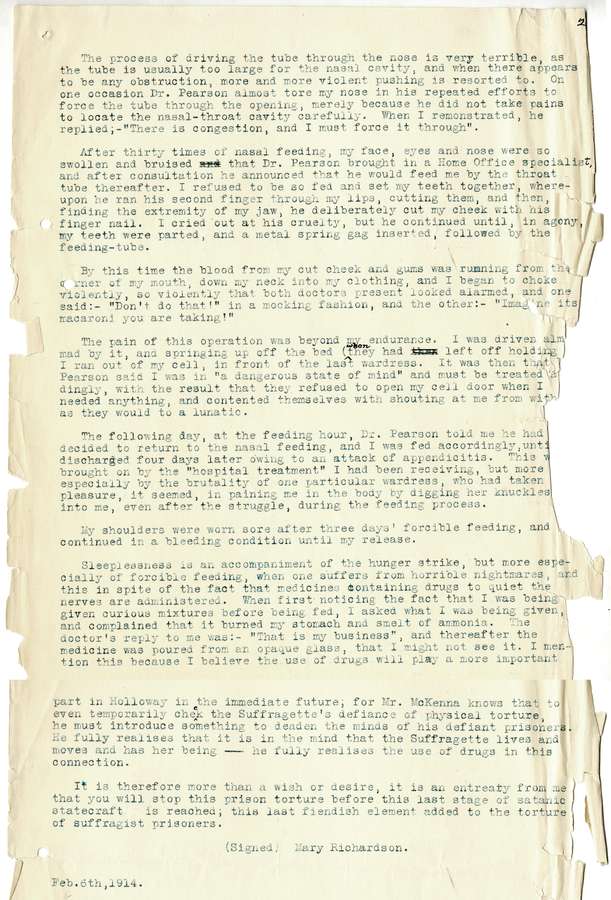
Extract of a statement from Mary Richardson on forcible feeding, 6 February 1914. Mary Richardson had been imprisoned in Holloway Prison and was regarded as a dedicated militant. She also slashed Velazquez’s Rokeby Venus, a painting in the National Gallery, and was sentenced to six months’ imprisonment.

The process of driving the tube through the nose is very terrible, as the tube is usually too large for the nasal cavity, and when there appears to be any obstruction, more and more violent pushing is resorted to. On one occasion Dr Pearson almost tore my nose in his repeated efforts to force the tube through the opening, merely because he did not take pains to locate the nasal-throat cavity carefully. When I remonstrated, he replied:- “There is congestion, and I must force it through”.
After thirty times of nasal feeding, my face, eyes and nose were so swollen and bruised that Dr Pearson brought in a Home Office specialist and after consultation he announced that he would feed me by the throat tube thereafter. I refused to be so fed and set my teeth together, whereupon he ran his second finger through my lips, cutting them, and then, finding the extremity of my jaw, he deliberately cut my cheek with his finger nail. I cried out at his cruelty, but he continued until, in agony, my teeth were parted, and a metal spring gag inserted, followed by the feeding-tube.
By this time the blood from my cut cheek and gums was running from the corner of my mouth, down my neck into my clothing, and I began to choke violently, so violently that both doctors present looked alarmed, and one said:- “Don’t do that!” in a mocking fashion, and the other:- “Imagine its macaroni you are taking!”
The pain of the operation was beyond my endurance. I was driven almost mad by it, and springing up off the bed when they had left off holding I ran out of my cell, in front of the last wardress. It was then that Pearson said I was in “a dangerous state of mind” and must be treated accordingly, with the result that they refused to open my cell door when I needed anything, and contented themselves with shouting at me from without as they would a lunatic.
The following day, at the feeding hour, Dr Pearson told me he had decided to return to the nasal feeding, and I was fed accordingly, until discharged four days later owing to an attack of appendicitis. This was brought on by the “hospital treatment” I had been receiving, but more especially by the brutality of one particular wardress, who had taken pleasure, it seemed, in paining me in the body by digging her knuckles into me, even after the struggle, during the feeding process.
My shoulders were worn sore after three days forcible feeding, and continued in a bleeding condition until my release.
Sleeplessness is an accompaniment of the hunger strike, but more especially of forcible feeding, when one suffers from horrible nightmares and this in spite of the fact that medicines containing drugs to quiet the nerves are administered. When first noticing the fact that I was being given curious mixtures before being fed, I asked what I was being given, and complained that it burned my stomach and smelt of ammonia. The doctor’s reply to me was:- “That is my business”, and thereafter the medicine was poured from an opaque glass, that I might not see it. I mention this because I believe the use of drugs will play a more important part in Holloway in the immediate future, for Mr. McKenna knows that to even temporarily check the Suffragette’s defiance of physical torture he must introduce something to deaden the minds of his defiant prisoners. He fully realises that it is in the mind that the Suffragette lives and moves and has her being—he fully realises the use of drugs in this connection.
It is therefore more than a wish or desire, it is an entreaty from me that you will stop this prison torture before this last stage of satanic statecraft is reached; this last fiendish element added to the torture of suffragist prisoners.
(Signed) Mary Richardson
Feb.6th, 1914.
Mary Richardson statement. Catalogue reference: HO 144/1305/248506
Listen
The process of driving the tube through the nose is very terrible, as the tube is usually too large for the nasal cavity, and when there appears to be any obstruction, more and more violent pushing is resorted to. On one occasion Dr Pearson almost tore my nose in his repeated efforts to force the tube through the opening, merely because he did not take pains to locate the nasal-throat cavity carefully. When I remonstrated, he replied:- “There is congestion, and I must force it through”.
After thirty times of nasal feeding, my face, eyes and nose were so swollen and bruised that Dr Pearson brought in a Home Office specialist and after consultation he announced that he would feed me by the throat tube thereafter. I refused to be so fed and set my teeth together, whereupon he ran his second finger through my lips, cutting them, and then, finding the extremity of my jaw, he deliberately cut my cheek with his finger nail. I cried out at his cruelty, but he continued until, in agony, my teeth were parted, and a metal spring gag inserted, followed by the feeding-tube.
By this time the blood from my cut cheek and gums was running from the corner of my mouth, down my neck into my clothing, and I began to choke violently, so violently that both doctors present looked alarmed, and one said:- “Don’t do that!” in a mocking fashion, and the other:- “Imagine its macaroni you are taking!”
The pain of the operation was beyond my endurance. I was driven almost mad by it, and springing up off the bed when they had left off holding I ran out of my cell, in front of the last wardress. It was then that Pearson said I was in “a dangerous state of mind” and must be treated accordingly, with the result that they refused to open my cell door when I needed anything, and contented themselves with shouting at me from without as they would a lunatic.
The following day, at the feeding hour, Dr Pearson told me he had decided to return to the nasal feeding, and I was fed accordingly, until discharged four days later owing to an attack of appendicitis. This was brought on by the “hospital treatment” I had been receiving, but more especially by the brutality of one particular wardress, who had taken pleasure, it seemed, in paining me in the body by digging her knuckles into me, even after the struggle, during the feeding process.
My shoulders were worn sore after three days forcible feeding, and continued in a bleeding condition until my release.
Sleeplessness is an accompaniment of the hunger strike, but more especially of forcible feeding, when one suffers from horrible nightmares and this in spite of the fact that medicines containing drugs to quiet the nerves are administered. When first noticing the fact that I was being given curious mixtures before being fed, I asked what I was being given, and complained that it burned my stomach and smelt of ammonia. The doctor’s reply to me was:- “That is my business”, and thereafter the medicine was poured from an opaque glass, that I might not see it. I mention this because I believe the use of drugs will play a more important part in Holloway in the immediate future, for Mr. McKenna knows that to even temporarily check the Suffragette’s defiance of physical torture he must introduce something to deaden the minds of his defiant prisoners. He fully realises that it is in the mind that the Suffragette lives and moves and has her being—he fully realises the use of drugs in this connection.
It is therefore more than a wish or desire, it is an entreaty from me that you will stop this prison torture before this last stage of satanic statecraft is reached; this last fiendish element added to the torture of suffragist prisoners.
(Signed) Mary Richardson
Feb.6th, 1914.
Leaflet produced by the Women’s Social and Political Union (WSPU) called ‘An open letter to one who condemns violence’, May 1913.

Exhibit 5
Obtained by P.S.Mole from the Offices of the W.S.P.U.
Lincoln’s Inn House, Kingsway, W.C. 14th April, 1913.
No.67.
Telegrams: “Wospolu, London” Telephone: No. 2724 Holborn (3 lines).
THE WOMEN’S SOCIAL AND POLITICAL UNION.
OFFICES – – – – 4,CLEMENTS INN, W.C.
“We demand the Vote on the same terms as it is or may be granted to men.”
Founder and Hon. Secretary – Mrs Pankhurst
Hon. Treasurer – Mrs. Pethick Lawrence
Joint Hon. Secretary – Mrs Tuke.
Organising Secretary – Miss Christabel Pankhurst, LL.B.
Bankers – Messrs. Barclay & Co., Fleet Street.
Newspaper – “Votes for Women.”
Publishing Office – The Woman’s press, 156, Charing Cross Road, London, W.C. Telephone: City 3961.
Colours: Purple, White, and Green.
An Open Letter to One Who Condemns Violence.
Dear Madam, — You “deplore and condemn methods of personal violence when used against persons in prominent positions,” and I must confess that, coming from a Liberal woman, the qualification implied in those last words sounds somewhat discordantly in my ears. It is, of course, true that sanction has been lent to it by the action of the present Government, which has shrunk from applying to the daughter of a peer those methods of torture which it has not scrupled to use against a working man’s wife. But you, though supporting this Government in their general policy, claim, I understand, to be a devotee of true Liberal principles, and I cannot but hope that those words, importing distinctions of class, escaped from you by a mere slip of the pen, and that you have not in your heart harboured a thought so treasonable to the principles you profess. Indeed, reading your letter as a whole, I gather that your real meaning is that you deplore personal violence altogether, against whomsoever it may be directed, and even when used by way of resistance to political oppression or to secure political freedom. You, in fact, go further, and say that in this condemnation of violence you have the support “of all right-thinking people.”
But if you consider it you will see that in this proposition you exclude from the category of “right-thinking people” almost every reformer of ancient and modern times. You exclude, for instance, to go back only one generation, John Bright and the great Gladstone; you exclude Mr. Lloyd George, Mr. John Burns, and indeed almost every member of the present Cabinet, of which you so warmly approve – for who is there amongst these who has not either actually instigated or at least deliberately defended and justified personal violence used in the cause of political freedom, even though that violence has been far more extreme than any that the women Suffragists have yet employed or contemplated?
Indeed, I think that before uttering such a condemnation of violence you can hardly have fully considered what it would mean. You can hardly, for instance, have put to yourself such questions as these:-
Do you condemn the personal violence by which the barons wrung the Magna Carta from the reluctant John?
Do you condemn the personal violence by which Cromwell and his Ironsides overthrew the tyranny of Charles the First?
Do you condemn the personal violence by which the great Reform Acts of 1832 and 1867 were secured?
You condemn, of course, the later excesses of the French Revolution committed after the cause was already won, but do you condemn the initial violence without which the people’s victory would never have been attained at all?
Do you condemn the personal violence used by the Northern States of America against the Southern to bring about the abolition of slavery?
Do you condemn the personal violence by which so recently the Young Turks have won constitutional liberty for their country?
And lastly, speaking with all reverence, I must cite a higher example still, and must ask you this question: Do you condemn the words and actions of Christ Himself, His words in the parable of the vineyard, or when He declared that He came not to bring peace upon earth but a sword; His actions when He scourged the money-changers with a whip of cords, and by personal violence drove them forth from the Temple they were desecrating?
'An open letter'. Catalogue reference: CRIM 1/140/1
Listen
Exhibit 5
Obtained by P.S.Mole from the Offices of the W.S.P.U.
Lincoln’s Inn House, Kingsway, W.C. 14th April, 1913.
No.67.
Telegrams: “Wospolu, London” Telephone: No. 2724 Holborn (3 lines).
THE WOMEN’S SOCIAL AND POLITICAL UNION.
OFFICES – – – – 4,CLEMENTS INN, W.C.
“We demand the Vote on the same terms as it is or may be granted to men.”
Founder and Hon. Secretary – Mrs Pankhurst Hon. Treasurer – Mrs. Pethick Lawrence
Joint Hon. Secretary – Mrs Tuke. Organising Secretary – Miss Christabel Pankhurst, LL.B.
Bankers – Messrs. Barclay & Co., Fleet Street. Newspaper – “Votes for Women.”
Publishing Office – The Woman’s press, 156, Charing Cross Road, London, W.C. Telephone: City 3961.
Colours: Purple, White, and Green.
An Open Letter to One Who Condemns Violence.
Dear Madam, — You “deplore and condemn methods of personal violence when used against persons in prominent positions,” and I must confess that, coming from a Liberal woman, the qualification implied in those last words sounds somewhat discordantly in my ears. It is, of course, true that sanction has been lent to it by the action of the present Government, which has shrunk from applying to the daughter of a peer those methods of torture which it has not scrupled to use against a working man’s wife. But you, though supporting this Government in their general policy, claim, I understand, to be a devotee of true Liberal principles, and I cannot but hope that those words, importing distinctions of class, escaped from you by a mere slip of the pen, and that you have not in your heart harboured a thought so treasonable to the principles you profess. Indeed, reading your letter as a whole, I gather that your real meaning is that you deplore personal violence altogether, against whomsoever it may be directed, and even when used by way of resistance to political oppression or to secure political freedom. You, in fact, go further, and say that in this condemnation of violence you have the support “of all right-thinking people.”
But if you consider it you will see that in this proposition you exclude from the category of “right-thinking people” almost every reformer of ancient and modern times. You exclude, for instance, to go back only one generation, John Bright and the great Gladstone; you exclude Mr. Lloyd George, Mr. John Burns, and indeed almost every member of the present Cabinet, of which you so warmly approve – for who is there amongst these who has not either actually instigated or at least deliberately defended and justified personal violence used in the cause of political freedom, even though that violence has been far more extreme than any that the women Suffragists have yet employed or contemplated?
Indeed, I think that before uttering such a condemnation of violence you can hardly have fully considered what it would mean. You can hardly, for instance, have put to yourself such questions as these:-
Do you condemn the personal violence by which the barons wrung the Magna Carta from the reluctant John?
Do you condemn the personal violence by which Cromwell and his Ironsides overthrew the tyranny of Charles the First?
Do you condemn the personal violence by which the great Reform Acts of 1832 and 1867 were secured?
You condemn, of course, the later excesses of the French Revolution committed after the cause was already won, but do you condemn the initial violence without which the people’s victory would never have been attained at all?
Do you condemn the personal violence used by the Northern States of America against the Southern to bring about the abolition of slavery?
Do you condemn the personal violence by which so recently the Young Turks have won constitutional liberty for their country?
And lastly, speaking with all reverence, I must cite a higher example still, and must ask you this question: Do you condemn the words and actions of Christ Himself, His words in the parable of the vineyard, or when He declared that He came not to bring peace upon earth but a sword; His actions when He scourged the money-changers with a whip of cords, and by personal violence drove them forth from the Temple they were desecrating?
And if you condemn all these acts of violence, are you prepared to face the logical consequences? Would you, in order that deeds of violence might be expunged from your country’s annals – would you, on that consideration, be content to live in an England such as she would be without these great reforms; in an England as she was before 1867 and before 1832, before the Commonwealth, before even Magna Charta? [sic] Would you willingly see the people of France sunk again in their pre-revolutionary subjection and misery, or have Turkey groaning once more under the bloodstained tyranny of Abdul Hamid?
I think not. I think that you, with your Liberal principles, must applaud the violence – the necessary, and therefore justifiable, violence – by which those beneficial changes have been brought about. And I venture to think that if you analyse more closely your feelings – if you consider why you applaud those great examples of violence, and yet condemn the violence now at length so reluctantly used by women – you will find that there is a very simple solution of the matter.
Is it not the fact that you, in common with so many others, look askance upon force which has not yet been successful, upon force where the issue is, or seems to you to be, still in doubt – that you, in short, condemn force militant, and applaud only force triumphant? And are you quite sure that when this fight is won your voice will not join in the chorus of acclamation that will hail the victors? But would it not be a happier and prouder moment for you – when you claim, as you will claim, your share in the spoils of victory – if you could say, “I, too, while the battle was raging – if I could not stand shoulder to shoulder with my sisters in the thickest of the fight – at least encouraged and supported them, and did not hold aloof”?
Yours very faithfully,
G. Penn Gaskell.
All the news of the moment will be found each week in “Votes for Women,” price One Penny, weekly, of all newsagents and bookstalls.
Copies of this Leaflet can be obtained from The Woman’s Press, 156, Charing Cross Road, W.C.
Price 9d. per 100; 6s. per 1,000, Post Free.
Printed by the St. Clements Press, Portugal St., W.C.
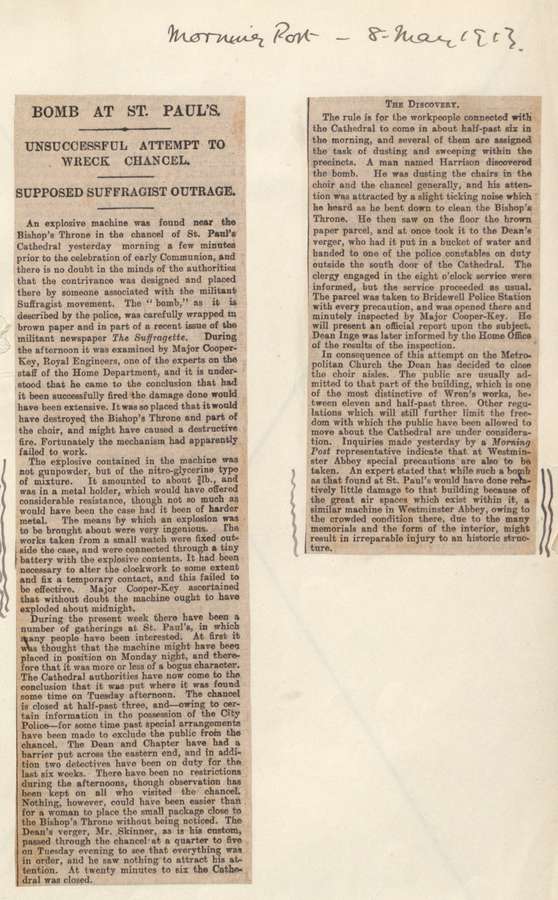
Extract from the Morning Post about an attempt to bomb the chancel at St Paul’s Cathedral, 8 May 1913.

BOMB AT ST. PAUL’S
UNSUCCESSFUL ATTEMPT TO WRECK CHANCEL
SUPPOSED SUFFRAGIST OUTRAGE
An explosive machine was found near the Bishop’s Throne in the chancel of St. Paul’s Cathedral yesterday morning a few minutes prior to the celebration of early Communion, and there is now no doubt in the minds of the authorities that the contrivance was designed and placed there by someone associated with the militant Suffragist movement. The “bomb” as it is described by the police, was carefully wrapped in brown paper and in part of a recent issue of the militant newspaper, The Suffragette. During the afternoon it was examined by Major Cooper-Key, Royal Engineers, one of the experts on the staff of the Home Department, and it is understood that he came to the conclusion that had it been successfully fired the damage done would have been extensive. It was so placed that it would have destroyed the Bishop’s Throne and part of the choir, and might have caused a destructive fire. Fortunately the mechanism had apparently failed to work.
The explosive contained in the machine was not gunpowder, but of the nitro-glycerine type of mixture. It amounted to about 3/4lb. and was in a metal holder, which would have offered considerable resistance, though not as much as would have been the case had it been of harder metal. The means by which an explosion was to be brought about were very ingenious. The works taken from a small watch were fixed outside the case, and were connected through a tiny battery with the explosive contents. It had been necessary to alter the clockwork to some extent and fix a temporary contact, and this failed to be effective. Major Cooper-Key ascertained that without doubt the machine ought to have exploded about midnight.
During the present week there have been a number of gatherings at St Paul’s, in which many people have been interested. At first it was thought that the machine might have been placed in position on Monday night, and therefore that it was more or less of a bogus character. The Cathedral authorities have now come to the conclusion that it was put where it was found some time on Tuesday afternoon. The chancel is closed at half-past three, and-owing to certain information in the possession of the City Police-for some time past special arrangements have been made to exclude the public from the chancel. The Dean and Chapter have had a barrier put across the eastern end, and in addition two detectives have been on duty for the last six weeks. There have been no restrictions during the afternoons though observation has been kept on all who visited the chancel. Nothing, however could be easier than for a woman to place the small package close to the Bishop’s Throne without being noticed. The Dean’s verger. Mr. Skinner, as is his custom, passed through the chancel at a quarter to five on Tuesday evening to see that everything was in order, and he saw nothing to attract his attention. At twenty minutes to six the Cathedral was closed.
THE DISCOVERY
The rule is for the workpeople connected with the Cathedral to come in about half-past six in the morning, and several of them are assigned the task of dusting and sweeping within the precincts. A man named Harrison discovered the bomb. He was dusting the chairs in the choir and the chancel generally, and his attention was attracted by a slight ticking noise which he heard as he bent down to clean the Bishop’s Throne. He then saw on the floor the brown paper parcel, and at once took it to the Dean’s verger, who had it put in a bucket of water and handed to one of the police constables on duty outside the south door of the Cathedral. The clergy engaged in the eight o’clock service were informed, but the service proceeded as usual. The parcel was taken to Bridewell Police Station with every precaution, and was opened there and minutely inspected by Major Cooper-Key. He will present an official report upon the subject. Dean Inge was later informed by the Home Office of the results of the inspection.
In consequence of this attempt on the Metropolitan Church, the Dean has decided to close the choir aisles. The public are usually admitted to that part of the building, which is one of the most distinctive of Wren’s works, between eleven and half-past three.
‘Bomb at St Paul’s’. Catalogue reference: HO 45/10700/236973
Listen
BOMB AT ST. PAUL’S
UNSUCCESSFUL ATTEMPT TO WRECK CHANCEL
SUPPOSED SUFFRAGIST OUTRAGE
An explosive machine was found near the Bishop’s Throne in the chancel of St. Paul’s Cathedral yesterday morning a few minutes prior to the celebration of early Communion, and there is now no doubt in the minds of the authorities that the contrivance was designed and placed there by someone associated with the militant Suffragist movement. The “bomb” as it is described by the police, was carefully wrapped in brown paper and in part of a recent issue of the militant newspaper, The Suffragette. During the afternoon it was examined by Major Cooper-Key, Royal Engineers, one of the experts on the staff of the Home Department, and it is understood that he came to the conclusion that had it been successfully fired the damage done would have been extensive. It was so placed that it would have destroyed the Bishop’s Throne and part of the choir, and might have caused a destructive fire. Fortunately the mechanism had apparently failed to work.
The explosive contained in the machine was not gunpowder, but of the nitro-glycerine type of mixture. It amounted to about 3/4lb. and was in a metal holder, which would have offered considerable resistance, though not as much as would have been the case had it been of harder metal. The means by which an explosion was to be brought about were very ingenious. The works taken from a small watch were fixed outside the case, and were connected through a tiny battery with the explosive contents. It had been necessary to alter the clockwork to some extent and fix a temporary contact, and this failed to be effective. Major Cooper-Key ascertained that without doubt the machine ought to have exploded about midnight.
During the present week there have been a number of gatherings at St Paul’s, in which many people have been interested. At first it was thought that the machine might have been placed in position on Monday night, and therefore that it was more or less of a bogus character. The Cathedral authorities have now come to the conclusion that it was put where it was found some time on Tuesday afternoon. The chancel is closed at half-past three, and-owing to certain information in the possession of the City Police-for some time past special arrangements have been made to exclude the public from the chancel. The Dean and Chapter have had a barrier put across the eastern end, and in addition two detectives have been on duty for the last six weeks. There have been no restrictions during the afternoons though observation has been kept on all who visited the chancel. Nothing, however could be easier than for a woman to place the small package close to the Bishop’s Throne without being noticed. The Dean’s verger. Mr. Skinner, as is his custom, passed through the chancel at a quarter to five on Tuesday evening to see that everything was in order, and he saw nothing to attract his attention. At twenty minutes to six the Cathedral was closed.
THE DISCOVERY
The rule is for the workpeople connected with the Cathedral to come in about half-past six in the morning, and several of them are assigned the task of dusting and sweeping within the precincts. A man named Harrison discovered the bomb. He was dusting the chairs in the choir and the chancel generally, and his attention was attracted by a slight ticking noise which he heard as he bent down to clean the Bishop’s Throne. He then saw on the floor the brown paper parcel, and at once took it to the Dean’s verger, who had it put in a bucket of water and handed to one of the police constables on duty outside the south door of the Cathedral. The clergy engaged in the eight o’clock service were informed, but the service proceeded as usual. The parcel was taken to Bridewell Police Station with every precaution, and was opened there and minutely inspected by Major Cooper-Key. He will present an official report upon the subject. Dean Inge was later informed by the Home Office of the results of the inspection.
In consequence of this attempt on the Metropolitan Church, the Dean has decided to close the choir aisles. The public are usually admitted to that part of the building, which is one of the most distinctive of Wren’s works, between eleven and half-past three. Other regulations which still further limit the freedom with which the public have been allowed to move about the Cathedral are under consideration. Inquiries made yesterday by a Morning Post representative indicate that at Westminster Abbey special precautions are also to be taken. An expert stated that while such a bomb as that found at St Paul’s would probably have done relatively little damage to that building because of the great air spaces which exist within it, a similar machine in Westminster Abbey, owing to the crowded condition there, due to the many memorials and the form of the interior, might result in irreparable injury to an historic structure.
The cover of the WSPU Seventh Annual Report, 1913.

THE WOMEN’S SOCIAL & POLITICAL UNION
SEVENTH ANNUAL REPORT
1913
WSPU Seventh Annual Report. Catalogue reference: CRIM 1/140/1
Listen
THE WOMEN’S SOCIAL & POLITICAL UNION
SEVENTH ANNUAL REPORT
1913
List of fictitious names used by the suffragettes, 1913.

List of false names. Catalogue reference: DPP 1/23
Listen
Ex. 126 (Continued.)
FICTITIOUS NAMES
Albert, Miss Sophia, Real name Mrs. Margaret Bennett
Bennett, Dorothy, Real name Miss D. Barnwell
Black, Miss Norah, Real name Miss Nellie Blackledge
Bowen, Mrs., Real name Mrs. E. Bodell
Brown, Kate, Real name Miss Katherine Blackledge
Callum Emmeline, Real name Miss Maude Mac Callum
Campbell, Mrs., Real name Mrs L. Galway
Chatt, Mrs., Real name Mrs. Chatterjee
Dew, Miss Margaret, Real name Miss Ingledew
Edwards, Mary, Real name Miss Selina Martin
Fry, Selina, Real name Miss Stella D. Fife
Green, Janet, Real name Miss Rebeccan Hyams
Grey, Miss Laura, Real name Miss Lavender Guthrie
Harley, Frances, Real name Miss Florence Harris
Hodkinson, Miss, Real name Hutchinson
Hotham, Miss Jane, Real name Brenda Francklyn
Johnson, Mrs. Sarah, Real name Mrs Alice Dilks
Leland, Audrey, Real name Miss Gwen Pryce
Ley, Miss Ethel, Real name Mrs. Edith Annie Lees
Mickle, L.E., Real name Miss S. E. Tuequand
Mitchell, Heather, Real name Miss Dorothy Hartopp Radcliffe
North, Miss Mabel, Real name Miss Mabel Norton
Nugent, Mrs., Real name Mrs Avery
Reynolds, Mrs. Margaret, Real name Mrs Winifred Reinold
Rice, Miss Helen, Real name Miss H B Hanson
Pilkington, Miss Katherine, Real name Miss Alison Graham
Slade, Miss Ethel, Real name Miss Ella Stevenson
Stuart, Miss Grace, Real name Miss Geraldine Phyllis Stevenson
Stuart, Jane, Real name Miss Ethel Symour Bennett
Taylor, Evelyn, Real name Miss Evelyn Hannah Chesshire
Woolridge, Mary, Real name Miss Edith Pridden
Summers, Mrs., Real name Mrs. Bach, Grosvenor Rd.
This source includes an extract from suffragette policy on hunger strikes from Mrs Pethick Lawrence. It also shows Mrs Pankhurst’s demand to have the same treatment accorded to political prisoners and Winston Churchill’s concessions, 1911–1912.

[…]
Hunger Strike
The Committee have decided that the Hunger Strike is inapplicable to the present conditions. This for two reasons:
The Policy of the W.S.P.U, must not be forced and the Hunger Strike if ever resorted to against must be organised as a political policy with utmost deliberation.
Yours,
EMMELINE PETHICK LAWRENCE
COPY OF THE DEMANDS MADE BY MRS PANKHURST DURING HER IMPRISONMENT BASED ON THE TREATMENT THAT HAS BEEN ACCORDED ON THE PAST TO POLITICAL MALE PRISONERS.
COPY OF CONCESSIONS GRANTED BY MR. CHURCHILL TO RELIEVE CERTAIN PRISONERS NOT GUILTY OF OFFENCES INVOLVING MORAL TURPITUDE, OF THE DEGRADING CONDITIONS OF THEIR CONFINEMENT
——————————————–
I propose to relieve them of the compulsion:-
Behaviour and treatment in prison. Catalogue reference: DPP 1/23
Listen
[…]
Hunger Strike
The Committee have decided that the Hunger Strike is inapplicable to the present conditions. This for two reasons:
The concessions given by Mr. Churchill have rendered the strike against present prison conditions unnecessary, and the time for a strike against prison itself has not at this juncture arrived. It is a weapon which the W.S.P.U. can always take up if it is judged expedient to do so, but when it is taken up it must be done in a thoroughly organized way and the agitation must be organised outside as well as inside. Moreover every volunteer must know exactly what she is committed to for before she is arrested. The Committee hope therefore that no individual of this Deputation will resort to the hunger Strike in prison. For any individual to act in this matter upon her own account would be unfair to others and a breach of that discipline which is incumbent upon us all and which is none the less binding because it is voluntary.
The Policy of the W.S.P.U, must not be forced and the Hunger Strike if ever resorted to against must be organised as a political policy with utmost deliberation.
Yours,
EMMELINE PETHICK LAWRENCE
COPY OF THE DEMANDS MADE BY MRS PANKHURST DURING HER IMPRISONMENT BASED ON THE TREATMENT THAT HAS BEEN ACCORDED ON THE PAST TO POLITICAL MALE PRISONERS.
1. To be allowed newspapers and books for her own selection.
2. To be allowed to do literary work and needlework of her own selection.
3. To see her Secretary and deal with correspondence relative to the Suffragist work.
4. To associate with other ladies imprisoned for the Cause.
5. To wear her own clothing.
6. To provide her own food.
COPY OF CONCESSIONS GRANTED BY MR. CHURCHILL TO RELIEVE CERTAIN PRISONERS NOT GUILTY OF OFFENCES INVOLVING MORAL TURPITUDE, OF THE DEGRADING CONDITIONS OF THEIR CONFINEMENT
——————————————–
I propose to relieve them of the compulsion:-
1. To wear prison dress.
2. To be specially searched.
3. To have their hair cut.
4. To be compelled to take a regular prison bath.
5. To be relieved of cell cleaning.
6. To be permitted to obtain their food from outside.
7. To exercise in the morning and afternoon.
8. To converse, subject to good behaviour with other prisoners when at exercise.
9. To have such books not bearing on current events.
'From pavement-chalking to arson, window-breaking and bombing: the progress of Militant Suffragism’.

[Photographs left to right, first row]
Early Methods: A Suffragette writing on the pavement
Destructive militancy begins: A shop window broken
Arson: Remains of the burnt-out tea pavilion in Kew Gardens, a London landmark
Bombing: The Walton Heath House, leased by Mr. Lloyd George, damaged in explosion
Arson: The refreshment kiosk in Regents Park burnt almost to the ground
Destruction: Orchids destroyed at Kew Gardens
Obstruction: Mr Asquith “tackled” by Suffragettes
[Photographs left to right, second row]
Arson: A £2000 house at Cheam burnt out
Arson: Croxley Green Railway Station Burnt
Arson: Lady White’s house, Staines burnt (£3000)
Arson: Saunderton Railway Station Burnt
Arson: A house near Chorley Wood burnt
[Photographs left to right, third row]
Arson: A railway-carriage burnt on the London and South Western Railway at Teddington
Arson: House (Formally Mr. Arthur Du Cros) burnt at St Leonards
Arson: Tunbridge Wells Cricket Pavilion burnt
Arson: Fulham Park Bowling Green Pavilion burnt
Arson: Farington Hall, near Dundee, burnt with damage estimated at £20,000
Arson: The Highlands, Sandgate, burnt-postcard addressed to “Dishonourable Prime Minister” found
[Photographs left to right, fourth row]
Arson: A detective with captured petroleum-cans
Window-breaking: A hammer in a “Dorothy bag”
Arson: Hillcrest, Golder’s Green, burnt
Bombing: Where the bomb was found in St. Paul’s (X)
Arson: The burned organ of Penn Church, Bucks
Bombing: Bombs found at Bow Street and in a train
Bombing: A bomb and remains of a bomb at Walton Heath
Wire-cutting: A detective with telegraph and signal-wire cutter
The Suffragettes, who began their vote-seeking by such comparatively innocent devices as chalking announcements on the pavements, holding meetings and waylaying Ministers in the hope of securing their support, have, we need hardly say, now developed militancy to a very dangerous extent, and have caused much damage to property by breaking glass, by committing arson, and by exploding bombs. It must be understood, f course, that not all the outrages credited of late to those vote-seekers who have been called “the wild women” have been proved to be their work. Such matters are obviously exceeding difficult of proof; but there can no doubt that that a great deal of the damage done is due to the militants and no others. On this double page and on another page in this issue, we give a number of illustrations which depict the growth of militant methods and of outrages generally attributed to militant Suffragettes.
Extract from The Illustrated London News, 24 May 1913. Catalogue reference: ZPER 34/142 13
Listen
[Photographs left to right, first row]
Early Methods: A Suffragette writing on the pavement
Destructive militancy begins: A shop window broken
Arson: Remains of the burnt-out tea pavilion in Kew Gardens, a London landmark
Bombing: The Walton Heath House, leased by Mr. Lloyd George, damaged in explosion
Arson: The refreshment kiosk in Regents Park burnt almost to the ground
Destruction: Orchids destroyed at Kew Gardens
Obstruction: Mr Asquith “tackled” by Suffragettes
[Photographs left to right, second row]
Arson: A £2000 house at Cheam burnt out
Arson: Croxley Green Railway Station Burnt
Arson: Lady White’s house, Staines burnt (£3000)
Arson: Saunderton Railway Station Burnt
Arson: A house near Chorley Wood burnt
[Photographs left to right, third row]
Arson: A railway-carriage burnt on the London and South Western Railway at Teddington
Arson: House (Formally Mr. Arthur Du Cros) burnt at St Leonards
Arson: Tunbridge Wells Cricket Pavilion burnt
Arson: Fulham Park Bowling Green Pavilion burnt
Arson: Farington Hall, near Dundee, burnt with damage estimated at £20,000
Arson: The Highlands, Sandgate, burnt-postcard addressed to “Dishonourable Prime Minister” found
[Photographs left to right, fourth row]
Arson: A detective with captured petroleum-cans
Window-breaking: A hammer in a “Dorothy bag”
Arson: Hillcrest, Golder’s Green, burnt
Bombing: Where the bomb was found in St. Paul’s (X)
Arson: The burned organ of Penn Church, Bucks
Bombing: Bombs found at Bow Street and in a train
Bombing: A bomb and remains of a bomb at Walton Heath
Wire-cutting: A detective with telegraph and signal-wire cutter
The Suffragettes, who began their vote-seeking by such comparatively innocent devices as chalking announcements on the pavements, holding meetings and waylaying Ministers in the hope of securing their support, have, we need hardly say, now developed militancy to a very dangerous extent, and have caused much damage to property by breaking glass, by committing arson, and by exploding bombs. It must be understood, of course, that not all the outrages credited of late to those vote-seekers who have been called “the wild women” have been proved to be their work. Such matters are obviously exceeding difficult of proof; but there can no doubt that that a great deal of the damage done is due to the militants and no others. On this double page and on another page in this issue, we give a number of illustrations which depict the growth of militant methods and of outrages generally attributed to militant Suffragettes.
Letter from B. J. Richardson to Mrs Pankhurst explaining she disagrees with militant methods.

Ex. 145.
Ladies College,
Nantwich,
19.2.12
Dear Mrs Pankhurst,
No doubt that in the hundreds of letters you receive mine will be swamped but all the same as I have ignored so many from you and your party I thought I might as well answer fully.
I am sorry that I cannot promise to join you in your protest of March 4th.
I am in every sympathy with your determination to obtain Votes for Women, and did I possess a vote I should certainly use it, but I do not approve of your militant methods. I know that you argue that peaceful methods fail, but two blacks won’t make a white and I do not believe in fighting by brute force to obtain our desires. It seems to me that militant methods tend to alienate your friends rather than procure you more. Besides this with so much unrest already in the Country and so many strikes it seems to me wicked to make more disturbances and harass a Government which has passed and is still passing such excellent laws.
All the same I admire you all intensely for your splendid pluck and courage, and only wish that I was half so brave.
Yours sincerely,
B. J. RICHARDSON
‘Militant methods’ rejected. Catalogue reference: DPP 1/23
Listen
Ex. 145.
Ladies College,
Nantwich,
19.2.12
Dear Mrs Pankhurst,
No doubt that in the hundreds of letters you receive mine will be swamped but all the same as I have ignored so many from you and your party I thought I might as well answer fully.
I am sorry that I cannot promise to join you in your protest of March 4th.
I am in every sympathy with your determination to obtain Votes for Women, and did I possess a vote I should certainly use it, but I do not approve of your militant methods. I know that you argue that peaceful methods fail, but two blacks won’t make a white and I do not believe in fighting by brute force to obtain our desires. It seems to me that militant methods tend to alienate your friends rather than procure you more. Besides this with so much unrest already in the Country and so many strikes it seems to me wicked to make more disturbances and harass a Government which has passed and is still passing such excellent laws.
All the same I admire you all intensely for your splendid pluck and courage, and only wish that I was half so brave.
Yours sincerely,
B. J. RICHARDSON
Article with photographs about a demonstration of non-militant suffragists in Hyde Park, 1913.

“Better is Wisdom than Weapons of War”: Non-Militant Suffragists in Hyde Park
“Better is wisdom than weapons of war” was the motto on the banner of the Cambridge contingent of non-militant suffragists who held a great meeting on July 26 in Hyde Park, at which converged a number of Pilgrimages from distant parts of the country, such as Land’s End, Carlisle, Newcastle and Keswick. Lady Rochdale, who started from Keswick, missed only one day of the March – that on which she took part in a reception of the King and Queen in Lancashire. Mrs Fawcett, who presided over the demonstration in Hyde Park, spoke from the central platform of nineteen massed waggons. Three ladies riding astride led the procession.
Extract from The Illustrated London News, 2 August 1913. Catalogue reference: ZPER 34/143
Listen
“Better is Wisdom than Weapons of War”: Non-Militant Suffragists in Hyde Park
1. A PILGRIMAGE OF LAW-ABIDING SUFFRAGISTS: MARCHING THROUGH EALING
2. A LEADER WHO MARCHED ALL THE WAY FROM KESWICK TO LONDON: LADY ROCHDALE SPEAKING IN HYDE PARK
3. THE SUFFRAGETTE AS HORSEWOMAN: THE PROCESSION ENTERING HYDE PARK
4. PRESIDENT OF THE NATIONAL UNION OF WOMEN’S SUFFRAGE SOCIETIES MRS HENRY FAWCETT ADDRESSES THE GREAT MEETING
“Better is wisdom than weapons of war” was the motto on the banner of the Cambridge contingent of non-militant suffragists who held a great meeting on July 26 in Hyde Park, at which converged a number of Pilgrimages from distant parts of the country, such as Land’s End, Carlisle, Newcastle and Keswick. Lady Rochdale, who started from Keswick, missed only one day of the March – that on which she took part in a reception of the King and Queen in Lancashire. Mrs Fawcett, who presided over the demonstration in Hyde Park, spoke from the central platform of nineteen massed waggons. Three ladies riding astride led the procession.
Letter from George Lansbury, MP to King George V, requesting the release of Sylvia Pankhurst and demonstrating support for the movement from certain politicians and men, 11 June 1914. As you can see from the image, the first page of this letter has been damaged and, while we have done our best to offer a complete transcription, some information has been lost.

To His Majesty King George.
Sir,
I wish to approach your Majesty for the purpose of calling attention to the fact that the administration of law in this country has become a farce and a sham.
I am an ex prisoner, having been arrested and tried before a Magistrate for offences alleged against me in connection with the Suff[rage] agitation, these alleged offences being that I incited men and women [to] commit outrages. In default of finding sureties I was sentenced to [-] months imprisonment. This sentence I have not served, as I was released after hunger striking under what is known as the “Cat and Mouse” Act.
This took place in August 1913, since which time I have been unmolested by the Police and have spoken at all kinds of Suffrage and other meetings in all parts of the country, making exactly the same kind of speeches as that for which I was sentenced, even repeating exactly the same words.
At the same time that I was arrested, a young woman named Sylvia Pankhurst, was also arrested, and under the same act of Edward Third was also in default of sureties sentenced to three months imprisonment. She also went on hunger strike and was released under the same “Cat and Mouse” Act, but in her case she has been taken back to prison at least eight times. Last night she was again rearrested and is now lying in Holloway on hunger strike, and slowly but surely is being starved to death.
She is rearrested in the name of the King and in the same name I am released, and what I wish to ask is why should a man in my position by allowed to go free and a young woman be forced back into prison time after time.
This is so gross an instance of partiality and is so alien to the spirit of Justice, that I am impelled to ask you to override your Ministers and yourself exercise the prerogative of mercy and order the unconditional release of Miss Pankhurst forthwith or my rearrest.
I am,
Your obedient servant,
George Lansbury
Some Time member of Parliament for Bow + Bromley
Support from G Lansbury. Catalogue reference: HO 144/1264/237169
Listen
To His Majesty King George.
Sir,
I wish to approach your Majesty for the purpose of calling attention to the fact that the administration of law in this country has become a farce and a sham.
I am an ex prisoner, having been arrested and tried before a Magistrate for offences alleged against me in connection with the Suff[rage] agitation, these alleged offences being that I incited men and women [to] commit outrages. In default of finding sureties I was sentenced to [-] months imprisonment. This sentence I have not served, as I was released after hunger striking under what is known as the “Cat and Mouse” Act.
This took place in August 1913, since which time I have been unmolested by the Police and have spoken at all kinds of Suffrage and other meetings in all parts of the country, making exactly the same kind of speeches as that for which I was sentenced, even repeating exactly the same words.
At the same time that I was arrested, a young woman named Sylvia Pankhurst, was also arrested, and under the same act of Edward Third was also in default of sureties sentenced to three months imprisonment. She also went on hunger strike and was released under the same “Cat and Mouse” Act, but in her case she has been taken back to prison at least eight times. Last night she was again rearrested and is now lying in Holloway on hunger strike, and slowly but surely is being starved to death.
She is rearrested in the name of the King and in the same name I am released, and what I wish to ask is why should a man in my position by allowed to go free and a young woman be forced back into prison time after time.
This is so gross an instance of partiality and is so alien to the spirit of Justice, that I am impelled to ask you to override your Ministers and yourself exercise the prerogative of mercy and order the unconditional release of Miss Pankhurst forthwith or my rearrest.
I am,
Your obedient servant,
George Lansbury
Some Time member of Parliament for Bow + Bromley
A selection of police photographs of militant suffragettes held by the Wallace Collection, 1914. These were probably compiled in the light of the suffragette attack on the National Gallery’s ‘Rokeby Venus’.

Women to watch. Catalogue reference: AR 1/528
Listen
KEY TO ABOVE PHOTOGRAPHS OF KNOWN MILITANT SUFFRAGETTES
Fig. 1, Name Scott Margaret, Year born 1888, Height 5.3, Eyes Blue, Hair D. Brown, C. R. O. number S.168279, Crime Damage
Fig. 2, Name Hockin Olive, Year born 1881, Height 5.3 ½, Eyes Brown, Hair Brown, C. R. O. number S.169280, Crime Conspiry [sic]
Fig. 3, Name McFarlane Margaret, Year born 1888, Height 5.1, Eyes Hazel, Hair Brown, C. R. O. number S.168518, Crime Damage
Fig. 4, Name Wyan Mary @ [alias] Nellie Taylor, Year born 1864, Height 5.1, Eyes Brown, Hair Brown, C. R. O. number S.168705, Crime Damage
Fig. 5, Name Bell Annie @ Hannah Booth and Elizabeth Bell, Year born 1874, Height 6 ½, Eyes Blue, Hair Lt. Brn., C. R. O. number S.165769, Crime Damage
Fig. 6, Name Short Jane @ Rachel Peace, Year born 1882, Height 5.3, Eyes Blue, Hair Brown, C. R. O. number S.168517, Crime Arson
Fig. 7, Name Ansell Gertrude Mary, Year born –, Height 5.4, Eyes Grey, Hair Tg. Grey, C. R. O. number S.169570, Crime Damage
Fig. 8, Name Brindley Maud, Year born 1866, Height 5.3, Eyes Grey, Hair Grey, C. R. O. number S.167057, Crime Damage
Fig. 9, Name Oates Verity, Year born –, Height 5, Eyes Brown, Hair Brown, C. R. O. number S.172313, Crime Damage
Fig. 10, Name Manesta Evelyn, Year born 1888, Height 5.2, Eyes Grey, Hair Fair, C. R. O. number S.166692, Crime Damage
Fig. 11, Name Richardson Mary, Year born 1883, Height 5.5 ½, Eyes Brown, Hair Brown, C. R. O. number S.168429, Crime Arson
Fig. 12, Name Dennis May @ Lilian Lenton, Year born 1891, Height 5.2 ¾, Eyes Brown, Hair D. Brown, C. R. O. number S.167399, Crime Arson
Fig. 13, Name Marion Kitty, Year born 1872, Height 5.5 ¼, Eyes Blue, Hair Auburn, C. R. O. number S.168044, Crime Arson
Fig. 14, Name Forrester Lillian, Year born 1880, Height 5.3 ½, Eyes Grey, Hair Brown, C. R. O. number S.167641, Crime Damage
Fig. 15, Name Johansen Miss, Year born 1881, Height 5.5 ½, Eyes Blue, Hair Brown tg. Grey, C. R. O. number S.170195, Crime Damage
Fig. 16, Name Giveen Clara, Year born 1887, Height 5.4, Eyes Blue, Hair Fair, C. R. O. number S.168045, Crime Arson
Fig. 17, Name Baines Jennis, Year born 1864, Height 4.10 ½, Eyes Brown, Hair D. Brown, C. R. O. number S.165980, Crime Damage
Fig. 18, Name Pratt Miriam, Year born 1890, Height 5.7 ½, Eyes Blue, Hair Lt. Brown, C. R. O. number S.172271, Crime Arson
With the Representation of the People Act on 6 February 1918 some women got the right to vote at age 30.

Representation of the People Act, 1918
AN ACT
TO
Amend the Law with respect to Parliamentary and Local Government Franchises, and the Registration of Parliamentary and Local Government Electors, and the conduct of elections and to provide for the Redistribution of Seats at Parliamentary Elections, and for other purposes connected therewith.
Chapter 64. 6th February 1918
[8 GEO 5.] Representation of the People Act, 1918. [Ch. 64.] Franchises (women)
(a) has attained the age of thirty years; and
(b) is not subject to any legal incapacity; and
(c) is entitled to be registered as a local government elector in respect of the occupation in that constituency of land or premises (not being a dwelling-house) of a yearly value of not less than five pounds or of a dwelling-house, or is the wife of a husband entitled to be so registered.
(2) A woman shall be entitled to be registered as a parliamentary elector for a university constituency if she has attained the age of thirty years and either would be entitled to be so registered if she were a man, or has been admitted to and passed the final examination, and kept under the conditions required of women by the university the period of residents, necessary for a man to obtain a degree at any university forming, or forming part of, a university constituency which did not at the time the examination was passed admit women to degrees.
(3) A woman shall be entitled to be registered as a local government elector for any local government electoral area –
(a) where she would be entitled to be so registered if she were a man; and
(b) where she is the wife of a man who is entitled to be so registered in respect of premises in which they both reside, and she has attained the age of thirty years and is not subject to any legal incapacity.
For the purpose of this provision, a naval or military voter who is registered in respect of a residence qualification which he would have had but for his service, shall be deemed to be resident in accordance with the qualification.
Representation of the People Act, 6 February 1918. Catalogue reference: C65/6385
Listen
Representation of the People Act, 1918
AN ACT
TO
Amend the Law with respect to Parliamentary and Local Government Franchises, and the Registration of Parliamentary and Local Government Electors, and the conduct of elections and to provide for the Redistribution of Seats at Parliamentary Elections, and for other purposes connected therewith.
Chapter 64. 6th February 1918
[8 GEO 5.] Representation of the People Act, 1918. [Ch. 64.] Franchises (women)
– (1) A woman shall be entitled to be registered as a parliamentary elector for a constituency (other than a university constituency) if she-
(a) has attained the age of thirty years; and
(b) is not subject to any legal incapacity; and
(c) is entitled to be registered as a local government elector in respect of the occupation in that constituency of land or premises (not being a dwelling-house) of a yearly value of not less than five pounds or of a dwelling-house, or is the wife of a husband entitled to be so registered.
(2) A woman shall be entitled to be registered as a parliamentary elector for a university constituency if she has attained the age of thirty years and either would be entitled to be so registered if she were a man, or has been admitted to and passed the final examination, and kept under the conditions required of women by the university the period of residents, necessary for a man to obtain a degree at any university forming, or forming part of, a university constituency which did not at the time the examination was passed admit women to degrees.
(3) A woman shall be entitled to be registered as a local government elector for any local government electoral area –
(a) where she would be entitled to be so registered if she were a man; and
(b) where she is the wife of a man who is entitled to be so registered in respect of premises in which they both reside, and she has attained the age of thirty years and is not subject to any legal incapacity.
For the purpose of this provision, a naval or military voter who is registered in respect of a residence qualification which he would have had but for his service, shall be deemed to be resident in accordance with the qualification.
The purpose of this document collection is to make available to teachers and students a wide selection of documents relating to the suffragette movement. The sources include material from the Home Office, Metropolitan Police and prison files, the Women’s Social and Political Union office (WSPU) which were used as exhibits in the trial of Emmeline Pankhurst and other leaders, and The Suffragette newspaper. We hope that such a collection will offer teachers the flexibility to develop their own approaches and questions and differentiate student tasks. All documents are provided with transcripts. Please note that in many cases we have displayed the whole document and highlighted the extract we have chosen to transcribe. These records support numerous lines of enquiry on a range of significant themes. Here are some suggestions:
It is important that students recognise that the same document can serve as evidence for more than one line of enquiry. Encourage students to interpret the records, spot inferences and try and detect any unwitting testimony.
Key stage 5 teachers could break their class up into groups and ask students to feed back on the different documents and/or annotate them on a white board. Students can discuss their interpretations having analysed the sources. This could generate discussion about the nature of evidence and how it can be used to construct different interpretations of the past.
Key stage 3 teachers may prefer to work with selected documents or extracts from the collection and/or use the material for their own research. The material from the Illustrated London News is highly accessible, in particular the source entitled: ‘From pavement-chalking to arson, window-breaking and bombing: the progress of Militant Suffragism’, 24 May 1913. This contains over 25 photographs and a chronology. Also ‘the Women’s Suffrage Pilgrimage map’ which shows the extent of national protest and peaceful campaign methods is an interesting visual source. The samples of suffragette ‘message codes’ used to conceal their activities are provided in this collection. Younger pupils could be tasked to write their own messages using the code words.
The students’ interpretations of the documents could be captured using a variety of approaches:
Finally, students could compare how the suffragette movement has been analysed and described in a number of published history textbooks in light of these original documents.
loathed, cursed, denounced, condemned
financial fraudster jailed in 1912. He was nicknamed The Splendid Bankrupt after signing his previous wealth over to his wife and living the same luxurious lifestyle despite his bankruptcy.
Challenges for Britain, Europe and the wider world 1901 to the present day and Women’s Suffrage
Christabel Pankhurst, 23 years old, was impatient for change: ‘the vote question must be settled. Mine was the third generation of women to claim the vote and the vote must now be obtained. To go on helplessly pleading was undignified. Strong and urgent demand was needed. Success must be hastened.’
On 10 October 1903 the Women’s Social and Political Union, a new organisation demanding Votes for Women, pushed its way noisily onto the women’s suffrage scene. Until then the effort was led by Mrs Millicent Fawcett and her National Union of Women’s Suffrage Societies, a movement founded in the 1860s. At Mrs Emmeline Pankhurst’s home in Manchester, the new Union announced its modernity with the three-word slogan: ‘Deeds Not Words.’ Mrs Pankhurst’s eldest daughter Christabel became the strategist for the movement. The campaign was a response to the Great Reform Act of 1832, which had enfranchised only ‘male persons’ with property, excluding, by definition, all women.
The WSPU demonstrated their agitprop approach in the first of many militant protests: Christabel, and Annie Kenney, a mill girl from Oldham, chose a meeting held by Liberal politicians Winston Churchill and Sir Edward Grey, in Manchester on 13 October 1905. As result of their noisy interruptions and persistent questions, they were ejected and continued to protest outside and were later sent to Strangeways Prison. Today we might now describe their actions as controversial, but at the time they were found deeply troubling and unfeminine. The slogan ‘Deeds Not Words’ had become a reality, and a precedent for their entire campaign.
This public disobedience earned the WSPU a derogatory nickname, ‘Suffragettes’, coined by a Daily Mail reporter in January 1906. The Suffragettes adopted the term and used it for their militant newspaper, The Suffragette, launched in the summer of 1912.
The WSPU moved to London in 1906, and opened a national headquarters at 4 Clement’s Inn. Frederick and Emmeline Pethick-Lawrence funded the office accommodation in the early days. Emmeline’s fundraising and Frederick’s expertise as a barrister initiated a formidable campaign, which has never been seen before or since. By the end 1912, fifty-eight branches existed across the country recruiting women from all backgrounds and occupations. Membership lists were not kept in case of police raids on their premises. Donors listed in their weekly newspaper ‘Votes for Women’ showed that thousands of women supported the campaign financially and actively.
Nowadays we take marketing for granted, but it was first used politically by the WSPU, who created their campaign as a brand. There were well-designed logos, stylish exhibitions, spectacular processions and meetings in London and the major cities. Special colours represented the movement, purple, white and green for freedom, purity, and hope respectively. Supporters wore the colours and they were used on badges, bicycles, chocolate bars, cakes, jewellery and even a motorcar.
Faced with determined opposition from many politicians, the press and the public (including women), Keir Hardie, M.P. (Independent Labour Party) was a good political friend to the women’s suffrage campaigners. While Liberal politicians consistently voted in support of the Conciliation Bills to grant a measure of women’s suffrage in 1910, 1911 and 1912, their wishes were crushed by the anti-women’s suffrage Prime Minister Herbert Asquith and others who refused to steer a Bill through Parliament. The collapse of the 1912 Conciliation Bill was the trigger which propelled the WSPU into sanctioning extreme militancy which marked the final two years of the campaign until the outbreak of the First World War.
The two men’s organizations which worked for votes for women were the Men’s League for Women’s Suffrage, founded in 1907, and the Men’s Political Union for Women’s Enfranchisement of 1910. Many men supported their wives, sisters and girlfriends, although most men did not. Those who did paid a heavy price for being ‘sex traitors’ and suffered violence whilst offering protection at public meetings and lost their reputations or jobs.
Until the increased militancy of 1912 the moderate suffragists – the National Union of Women’s Suffrage Societies – and the militant suffragettes worked together. Members of both wore each-others’ badges and joined the same marches. They all handed out leaflets about enfranchisement of women, canvassed for the private members’ bill and sold newspapers. Yet, these documents reveal that the suffragettes went further: they attempted to enter the House of Commons; heckled meetings; blew up pillar-boxes; smashed windows; burnt down empty buildings and attacked works of art.
By the summer of 1914 the positions of suffragettes and Liberal government were deeply entrenched: the WSPU was determined to force the government to give women the vote, and the establishment equally stubbornly refused to comply. Over a thousand British suffragettes had acquired a criminal record and many were imprisoned for demanding the vote. These records show that suffragettes were denied the status of political prisoners and treated as ‘common criminals’. In protest many went on hunger-strike and were force fed with terrible consequences for their health. The WSPU awarded women who experienced this torture with ‘For Valour’ medals: ‘in recognition of a gallant action, whereby through endurance to the last extremity of hunger and hardship, a great principle of political justice was vindicated.’
Background information from Rise Up Women! The Remarkable Lives of the Suffragettes (published by Bloomsbury, February 2018), by Dr. Diane Atkinson.
bbc.co.uk
100 Women: Suffragists or suffragettes - who won women the vote?