We are refreshing our teaching resources and regularly adding new and updated ones. All of our old resources are permanently available in the UK Government Web Archive.
Teaching resource
Partition of British India
Use this lesson with original letters, maps, oral history testimony and newspapers on the partition of British India. What do these documents reveal about the attitudes of British officials to the violence that occurred after partition?
Age range
Key stage 3 (Ages 11–14)
About this image
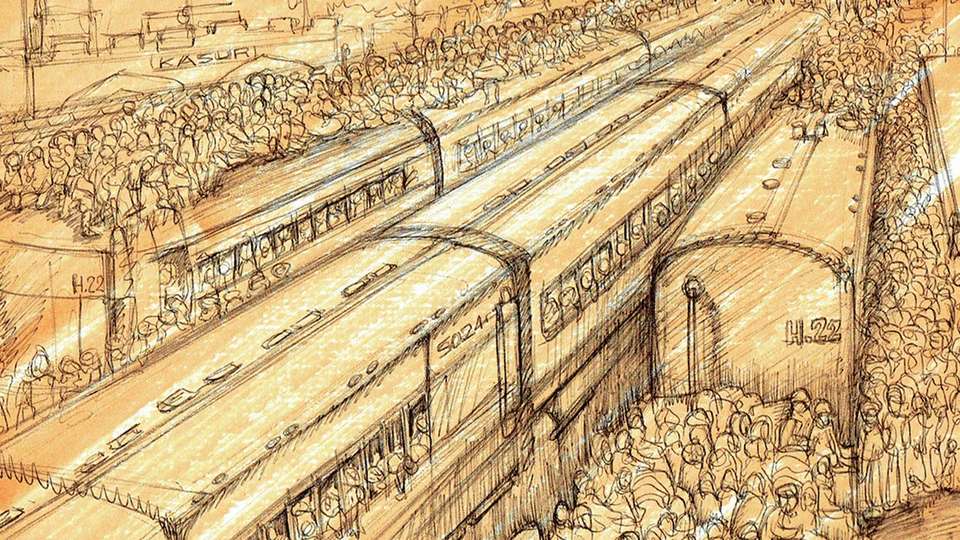
Three Trains at Kasur, 1947 by PINS
Bhupinder Singh, 2020
About this resource
Time period
Post-War and modern
Themes
Black, Asian and global majority history
Empire and decolonisation
Important information!
This resource includes descriptions of violence and the forced displacement of millions of people.
Enquiry question
What can documents at The National Archives reveal about the partition of British India?
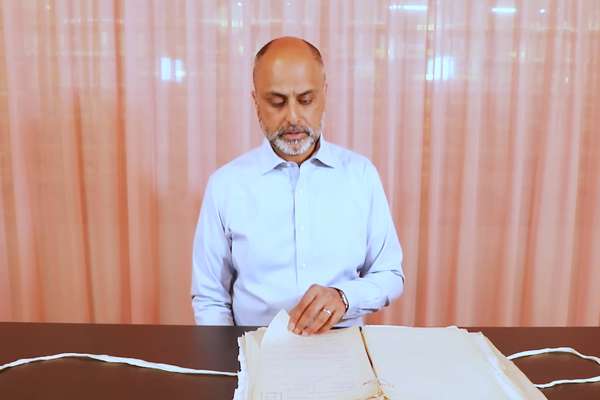
In this video, Iqbal Singh, Hannah Carter and Eleanor Newbigin introduce a document relating to the partition of British India. They explore what this document’s tone and content can tell us about British officials' attitudes to the violence that occurred after partition. Students also hear an oral testimony from Iqbal’s aunt whose family were displaced in 1946 due to growing tensions in British India.
The document is titled ‘Communal disturbances’. ‘Communal’ is not a term we use a lot today but was used in British India by officials to describe tensions between religious groups. It was thought that Indian people had stronger religious beliefs than British people and, as a result, were more likely to resolve things through violence.
INWARD TELEGRAM
Allotted to Political Department.
Copies to:-
Sir A. Carter P.S to Min. of State (C.R.).
Sir J. Stephenson PS. To SS. for Burma.
Sir P. Patrick Sir G. Laithwaite
Mr. Baxter Mr. Joyce.
General Scoones Resident Clerk
PS. To SS. (C.R.). C.R.O. (Downing Street)
CYPHER (O.T.P.)
From U.K. High Commissioner in India
To Secretary of State for Commonwealth Relations
Dated New Delhi, 22.57 hours, 23rd September 1947
Received 03.30 hours, 24th September 1947
IMMEDIATE.
No. 817
My telegram No.613 dated 22nd September. Communal disturbances.
PUNJAB
(1) Military spokesman at Press Conference on September 22nd stated that while communal incidents in Punjab have markedly decreased harassment of refugees, who are moving from Pakistan to India and vice versa, by armed gangs is chief source of anxiety now.
(2) West Punjab. In Lahore district convoy of non-Muslims in trucks was attacked on way to Amritsar. 17 killed and 35 wounded. In Montgomery District refugee special train was derailed and mob attacked civilian lorries carrying non-Muslims from Multan. 6 are reported to have been killed in Multan District non-Muslim refugees were also attacked. Stray cases of looting are reported Dera Ghazi Khan.
(3) Kangra and India portion of Gurdaspur District (East Punjab). Three attacks on Muslim refugee columns are reported. In each case military escort opened fire and dispersed gangs. 21 refugees killed in two of these attacks there being no casualties in third. 15 of attacks are known to have been killed.
(4) Hissar. Muslim mob of 8,000 attacked village.
(5) Ambala. General situation throughout district has improved during 24 hours ended September 20th. No incidents of stabbing or killing were reported.
(6) Simla. Searches for looted property are being conducted by Military police and in Kalka situation is completely under control.
DELHI.
(1) Expect for a few minor incidents in some parts of city New Delhi and Old Delhi were quiet.
Telegram from the UK High Commissioner in India, September 1947. Catalogue reference: DO 142/416
What can The National Archives' documents reveal about the partition of British India? In this video, Hannah Carter, Iqbal Singh, and Eleanor Newbigin introduce the file DO 142/416 and what it can tell us about the partition of British India in 1947.
Examine the source
What type of document is Source 1a?
When was it sent?
Who sent it and to whom?
Why was this document sent?
What do you notice about the numbers and figures that are used?
What is the tone of the document?
How do you think British officials got the information for this document?
What does the title ‘Communal disturbances’ reveal about how British officials viewed the violence?
How useful is this document for exploring what happened in the months following the partition of British India?
Source 2:A personal note by Lord Ismay, 1947
Lord Ismay was chief of Staff to Lord Mountbatten and therefore closely involved in negotiations.
TOP SECRET
THE INDIAN SITUATION
A PERSONAL NOTE BY LORD ISMAY
SECTION I
On my way back to India from England towards the end of last July, I concluded my notes with the following passage:-
“I was worried when I was in England at the prevalence of the idea that everything was over bar the shouting. Personally I feel that we are nothing like out of the wood yet. There is so much explosive material lying about and it remains to see whether it can be prevented from going off. I am, for example, extremely worried about the Sikhs. They imagine that they are going to get a far more favourable boundary then, so far as I can judge, the Boundary Commission can possible award them. All possible precautions have been taken by the despatch to the areas of potential trouble of a joint India-Pakistan force under single command, but even so it may be a very unpleasant business. The truth of the matter is that both sides are in panic, and people do sillier things when they are frightened than they do under the stress of any other emotion.”
These views were shared by many people. It is therefore a mistake to imagine that the storm which broke out in August, and which is still raging, was unexpected. It must, however, by frankly admitted that neither its character nor its extent were anticipated by anyone in authority, whether in India, Pakistan or England.
The last two months have been so chaotic that it would be difficult to find two people who agree as to how the trouble started, why it was not checked, what has actually happened, and what is to be the outcome. While, therefore, I have thought it right to set out in this paper my personal conception of the past, and my estimate of the future, I do not claim that either would receive any general measure
A personal note by Lord Ismay, 1947. Catalogue reference: DO 121/69
What audience was intended for this document? Hint: look at the text at the top of the document.
It is described as a ‘personal note.’ How does this affect the tone of the document?
How does Lord Ismay describe the partition of British India and the following months? (See Source 1a and Source 3)
What does he suggest about who is responsible for the way partition happened and the violent outcome?
Source 3:Violence following partition: Sikh case study
Lahore is a special place for Sikh people. It was the location of many important Sikh religious and historical sites. In addition Guru Nanak, the founder of Sikhism, was born in Nankana Sahib, near Lahore. However, this was a Muslim majority area and was made part of Pakistan. This decision didn’t take into account that non-Muslim people had strong connections to this area, they had businesses and had played a large role in developing the Punjab. Before the boundary line was drawn there were appeals from many in the Sikh community to give greater acknowledgement to the Sikh history and heritage of the area.
Santokh Singh was a writer who wrote in Punjabi, with a Sikh father and a Hindu mother. In Source 3b, he is writing to Lord Pethick Lawrence, a British politician involved in the negotiations leading to the partition of British India.
Source 3d is written by J.S.H. Shattock, who was based at the British High Commision at Delhi. The British High Commission reported between its offices in India and also informed bodies like the Commonwealth Relations Office in London about what was happening in India.
India/Pakistan boundaries as fixed by the Boundary Commission 17 August 1947: [Red line]
Sikh demand for line for River Chenab: [Red dashes]
PAKISTAN
PUNJAB
Red dashes going along the River Chenab, through the area of the Punjab. This shows the border that the Sikhs want.
In this area is the city of LAHORE
UNION OF INDIA
Red line showing the border of the UNION OF INDIA
These places are located in the UNION OF INDIA.
AMRISTAR
JULLUNDUR
FEROZEPORE
1947 map of the Punjab, India and Pakistan boundaries. Catalogue reference: CO1054/76
The situation is painful for the Sikhs particularly as the proposals emerge from the British with whom they have had such great friendship for a long time. Sikh blood has been spilt ungrudgingly at every war for the last Century in which the British have been involved. They do not want any reward for this, but their feelings should be understood when their very experience is threatened by the proposals of the British whom they have always regarded as friends.
The Mission has recognised the Sikhs as a minority but have not conceded minority privileges to them as they have done to the only other minority, the Muslims.
Yours truly,
Santokh Singh M.A. (Oxon) B. Sc.
of Shahkot.
Letter from Santokh Singh, 1 June 1946. Catalogue reference: CAB 127/106
Under these conditions alone (loss of police officer, magistrates, and over full jails OR could say break down in law and order) the new administration was bound to be confronted with many difficulties in the first few months of its existence, but added to these arose a series of events unprecedented in the history of this sub-Continent . Violent and widespread massacres of Muslims by Sikhs and Jats in August and September 1947 reduced the Province and the interspersed territories of the Punjab Sikh States to a virtual state of anarchy for nearly two months. This was followed during the succeeding months by a complete evacuation of the four million odd Muslim inhabitants of the Province and by the arrival of a similar number of Hindus and Sikhs from Western Pakistan. For several months the whole economy of the Province was crippled. Every public servant and every public service was devoted exclusively to restoring internal peace, to looking after the mass of refugees moving in two directions and making arrangements for their temporary housing and re-settlement.
1948 report by J.S.H. Shattock. Catalogue reference: DO 142/439
What does the red line and the red dotted line show on the map?
When do you think this map was made? Hint: Look at the date mentioned in the key.
The boundary lines for Pakistan and India were drawn mainly by looking at the percentage of Muslim people in the population. What group of people may have objected to this and why?
What is the tone of the letter from Santokh Singh? Give an example to support.
What does the letter from Santokh Singh reveal about the concerns of the Sikh population relating to the partition of British India?
How does Shattock describe the situation in the Punjab during August and September 1947?
What does Shattock's report suggest was the impact of this violence?
Source 4:The British perspective on 'communal' tensions
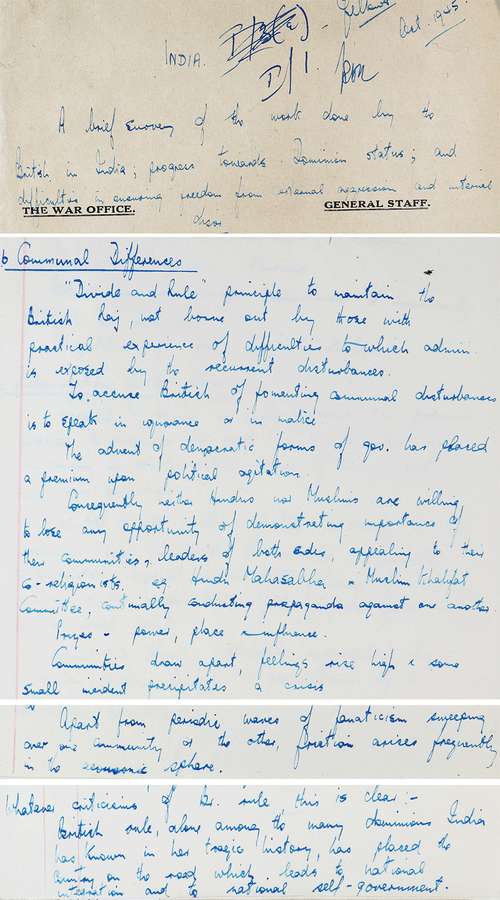
This is a page from a set of notes made by an unknown British official. The writer uses the term ‘communal' to describe religious tensions. Religion was always assumed the cause, not more specific, local issues. This enabled officials to see the violence as something they were not responsible for, that it was caused by timeless differences between people.
INDIA Oct 1945
A brief survey of the work done by the British in India; progress towards Dominion status; and difficulties in ensuring freedom from external aggression and internal disorder
THE WAR OFFICE GENERAL STAFF
Communal Differences
“Divide and Rule” principle to maintain the British Raj, not bourne out by those with practical experience of difficulties to which admin?is exposed by the recurrent disturbances.
To accuse British of fomenting communal disturbances is to speak in ignorance or in malice.
The advent of democratic forms of gov. has placed a premium upon political agitation.
Consequently neither Hindus nor Muslims are willing to lose any opportunity of demonstrating importance of their communities, leaders of both sides appealing to their co-religion (illegible) e.g Hindu Mahasabha and Muslim Khilafat Committee, continually conducting propaganda against one another.
Prizes- power, place and influence.
Communities draw apart, feelings rise high and some small incident precipitates a crisis.
Whatever criticisms of Br. Rule this is clear:
British rule, along among the many dominions India has known in her tragic history, has placed the country on the road which leads to national integration and to national self-government.
Notes on British involvement in India from 1945. Catalogue reference: WO 208/755
What did the author mean by the title ‘communal differences’?
What does the author think is causing divisions between religious groups? Hint: Look at the paragraph that begins ‘Consequently neither Hindus or Muslims are willing…’
How effective does the author think British rule in India has been? Hint: Look at the final paragraph.
Source 5:Forced displacement of people
75-Mile Non-Moslem Convey Quits Pakistan for India
File on Punjab disturbances file
New Delhi, October 6
One of the greatest mass migrations in history was today nearing completion as a 75-mile convoy of uprooted non-Moslem population continued to pour over the Pakistan border into India from the most fertile areas of the West Punjab.
The whole convoy was expected to have crossed into the East Punjab within the enxt two or three days. Then the gigantic task of (illegible) them will begin.
So vast is this moving mass of humanity- sustained by food dropped by air and by doctors flown to its aid – that it took eight days to pass a stationary point.
The convoy included shopkeepers, artisans, doctors, lawyers and once-rich landlords. The old and sick died on the way, but the convoy moved on, blood from torn feet of the weary immigrants staining the dusty road.
A report on refugee movements after partition. Catalogue reference: DO 142/416
What language is used to describe displaced people?
It was made by the international news agency Reuters. What do you think its purpose was?
How do you think the author gathered their information?
How does the language and tone of the document compare to Source 1b?
Source 6:Oral testimony
These are extracts from a conversation with Iqbal’s aunt whose family were displaced prior to the partition of British India. There are themed audio clips and a typed transcript.
Listen
Train journey
Audio transcript for "Train journey"
We were in a train, never seen before, but everyone was quiet, no one was saying anything, later on my mother told me were all wandering where are we going, what’s happening, that’s what she told us and I remember Lahore Station, the railway station, where there were people, people, people and my mother’s sister and her husband they came to see us at the station saying why are we going, are we mad, they still didn’t realise but then grandfather told us we must go, it is going to happen, that everybody will have to leave, those who are not of that religion of Pakistan going to leave. And then the train slowly moves, people are very happy, as children we were going to Ferozepur, Ferozepur, Ferozepur, it was going to be India. And my mother says that everybody was happy, and loud religious things were being said, thank God, we were saved and very sad and very unhappy that they had to leave their homes forever.
Listen
Learning Hindi
Audio transcript for "Learning Hindi"
We had to learn a new language, which was Hindi. In Pakistan it was Urdu and English, and here it was going to be Hindi and English, so we had to go to a Hindi learning school to learn Hindi to go into school, to be admitted, and to learn that language. The teacher who was teaching us came from a very good local rich landlord family so that is a very beautiful memory, of learning the language from her. But we could not go to an English medium school because they were more expensive, and the Hindi medium was low fees and my parents could afford only that for the girls and the boys, brother, cousins, they went to the English medium. That trauma of Hindi medium stayed in me, that complex, lasted I think almost forever, but of course we managed with confidence but I remember wherever you went we grew up they would say you know so-and-so’s daughters. They are okay girls but you know they went to the Hindi medium schools, they are simpletons.
Listen
‘Refugee girls’
Audio transcript for "‘Refugee girls’"
I don’t remember the word refugee. It came only when we decided we are going to Dehradun because all the refugees are going towards Dehradun, towards Dehradun. Saharanpur, Rurki, Delhi. We were about to reach Dehradun, a beautiful place, it’s a valley between the two mountain ranges of the Himalayas. That is where I remember, ‘oh, they are refugees. They are the refugee girls. They are the refugee girls.’
Listen
My father and Mr Ansari
Audio transcript for "My father and Mr Ansari"
You see when the refugees were given houses which were left by the Muslims who went to Pakistan and the other way around. One very major trauma that in my mind is I must tell you, is my father, who suffered the maximum and he never, never laughed, never smiled easily because he could not get over it. 23 years after partition when he became ill, subconsciously or unconsciously he kept on saying, let’s go home, let’s go home. And my mother said, we are home. No, no, let’s go home. Because he was thinking home that is left behind.
We were given this place which belonged to Mr. Ansari, had a beautiful garden, seven types varieties of mangoes and lychees and all kinds of fruit. And he was a very nice man, who also had to leave the other way round, and then when I was thinking of my father saying, let’s go home, I wondered, Mr. Ansari must be missing his home, which became our home.
What challenges did Iqbal’s aunt face when her family were displaced?
Iqbal’s aunt shows a lot of empathy for Mr Ansari who was Muslim and recognition that he must have felt loss, like her family did. How does that challenge some of the simplistic ideas about ‘non-Muslim’ and ‘Muslim’ people in Source 1a?
How useful do you think oral testimony is as a source to learn about partition? Explain your answer.
Creative activities
Look at the drawings by the artist PINS inspired by Iqbal’s aunt’s testimony.
Pick another scene from the testimony and create a drawing of it. You can use words and captions.
Listen to more oral testimonies from people who lived through partition using other archival collections. Create an illustration of their story.
Teachers’ notes
This film and set of resources is suitable for an assembly, form time or a lesson on the history of the partition of British India. The film is around 10 minutes in length.
Glossary of terms found in the sources
Boundary Commission
This was a group created in July 1947 to recommend how the Punjab and Bengal regions of British India were to be divided. The commission, appointed by Lord Mountbatten, the final viceroy of British India, had four members from the Indian National Congress and four from the Muslim League and was chaired by Sir Cyril Radcliffe. Cyril Radcliffe submitted the map of the new countries
British Raj
The period of direct British rule over the Indian subcontinent from 1858 until 1947.
Commonwealth
An international association consisting of the United Kingdom together with states that used to be British colonies
communal
This was a term used in British-India by officials to describe tensions between different religious groups.
convoy
A group of people or vehicles travelling together, especially for safety.
Dominion
This is what India and Pakistan became after independence in August 1947. The countries became part of the Commonwealth.
Punjab
The Punjab was an area previously part of British India that was divided in 1947. West Punjab became part of West Pakistan (now Pakistan) and East Punjab part of India. The area of Bengal was also divided to form East Pakistan (now Bangladesh).
refugee column
A line of people who have been forcibly displaced from their homes and are trying to reach safety
self-government
Government of a country by its own people, especially after having been a colony.
UK High Commissioner in India
The High Commissioner is the UK government’s representative in a Commonwealth nation. So a British official in India.
Connections to the curriculum
Key stage 3 (Ages 11–14)
Challenges for Britain, Europe and the wider world 1901 to the present day
Indian independence and end of Empire
Britain’s place in the world since 1945
Extension activities
Teachers may want to use the documents included in the resource to extend learning. It is suggested that students look at Source 1b first. This is the same document used in the film. You might want to encourage students to come up with a question relating to Source 1b; these questions could be returned to at the end of the lesson/series of lessons.
Then students could work in smaller groups looking at the other documents. There are questions they can explore and they are invited to draw comparisons with the telegram.
There is also a creative outcome that is suggested inspired by Iqbal’s aunt’s testimony.
Background information
Partition of British India
The partition of British India occurred in August 1947 when the British government withdrew from India after almost two hundred years of British rule.
People in British India had called for independence for decades. But, until the early 1940s, very few people, in Britain or India, would have thought that this independence would take the form of dividing up land.
A very important reason for British rule in India was military resources, particularly soldiers. In 1942, a point of uncertainty in the war for Britain, and growing Indian opposition to colonialism, the British government announced they would leave India after the war. There were many different political leaders and groups who disagreed about how to make everyone feel represented after Britain left.
Muslims only made up a quarter of the population but these communities were not spread evenly. There were a few areas where Muslims were most of the population. There were calls from some Muslim leaders for these regions to have greater independence. Divisions grew.
By late 1946 British officials had given up on finding a solution in which many different groups could be represented within a single state. In February 1947 Lord Mountbatten was sent to oversee Britain’s withdrawal. On the 3 June 1947 he stunned everyone by announcing with leaders Jawaharlal Nehru and Muhammad Ali Jinnah that Britain would give power to not one but two new governments, the government of India and the government of Pakistan, a year earlier than previously planned.
Regions affected by partition
Officials from Britain and British India were given just nine weeks to work out how British India would be divided. The final borders split the eastern and western areas of British India and ran through the provinces of Punjab and Bengal, important areas economically and politically with a roughly 50:50 split of Hindu and Muslim populations.
Independence was declared on 14 and 15 August 1947, but the borders of these two new nations were announced 2 days later on 17 August. This meant that people celebrated independence without knowing for sure quite where the line between these two countries would be drawn.
People living in the regions affected by partition felt scared and uncertain about their future, not wanting to end up on the ‘wrong side’ of the border. In the months around August 1947 over 15 million people are thought to have migrated across the new borders. In Punjab in particular this huge human migration was accompanied by brutal violence, some of which we can see as a reflection of the fear and uncertainty of what was going on. However, it is important to stress that much of the violence was not random but orchestrated by militias connected to various political parties who wanted to secure the best possible outcome after the British left India.
The National Archives documents about Partition
The documents at The National Archives alongside those at the British Library India Office collection and records published in the Transfer of Power collection are some of the major collections of records in the UK about the period we are studying. While there is some duplication, the records at The National Archives are particularly strong for records of policy making at the highest level and for records of British armed forces stationed in India.