We are refreshing our teaching resources and regularly adding new and updated ones. All of our old resources are permanently available in the UK Government Web Archive.
Teaching resource
Medieval women
Medieval women’s lives were as varied as they are today. They can be found living and working in the countryside, in towns and cities or in religious communities. Use this lesson to find out about their lives from records held at The National Archives.
Age range
Key stage 3 (Ages 11–14)
About this image
Image from compendium of Christine de Pizan’s works, 1413.
From the British Library Archive. Harley 4431 volume II, f.259v.
About this resource
Time period
Medieval
(900–1485)
Theme
Women's history
Enquiry question
How are women represented in wills, petitions, court and financial records?
Christine de Pizan (1364–1430) was one of the earliest women to earn her living by writing after her husband died. Born in Italy, she lived at the French court after her father, Thomas de Pizan, an astrologer, became secretary to King Charles V of France. She was a Greek and Latin scholar and had access to important libraries and collections of books. Christine de Pizan wrote about the lack of education for women and their lack of rights and freedoms, as well as poetry, and religious and political commentary.
Her most well-known work is ‘The book of the City of Ladies’ (1405) which described the achievements of women, which imagined a city populated only by women. ‘The Treasure of the City of the Ladies’ followed, making the point that if women had equal rights they could contribute to society. Christine de Pizan was arguably one of the earliest feminist writers.
Image from compendium of Christine de Pizan’s works, 1413.
From the British Library Archive. Harley 4431 volume II, f.259v.
What does it reveal about the class and social position of Christine de Pizan?
How typical do you think her life was in comparison to the experience of other medieval women?
Who do you think was the audience for her writings?
How would her work have benefited the lives of women in general?
Source 2:In the countryside: Joan Marshal
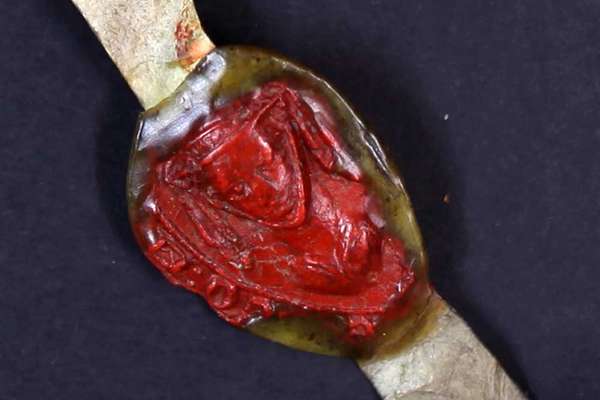
Joan had some claim to part of a field called ‘the east field’ in Langham, Essex probably as part of her dowry, usually a third of her husband’s money and lands set aside for her to live on after his death. This deed, or grant of land, from 10 April 1323 shows that it is genuine, as Joan Marshal’s own seal (with an image of a dolphin) is attached to the document.
To all Christ’s faithful to whom these present writings come, whether seen or heard, from Joan Marshal, widow of Peter de Raydon, greetings. Know that I have granted, returned and entirely given up for myself and my heirs in perpetuity [for ever] to John de Langwode the whole right and claim which I had and in any way will have in two pieces of meadow in the village of Langdon, in the part called ‘the east meadow’, which John de Langwode sought to obtain from Master William, the rector [priest] of the church of Raydon. So that I, Joan, and any other, for me or in my name in the name of my dowry or by any other ownership by law, by any in law or claim will not be able to expel, to claim or to sell the said two pieces of meadow with their appurtenances [rights] against [the rights of] John, his heirs and assigns in perpetuity. In testimony of this matter in writing of a quitclaim [deed declaring no claims on the land], I have placed my seal, with these witnesses, Master Benedict de Kokefeld, knight, Gilbert de Dyham, Richard Wenlac, Adam Favel, Robert Vigorous and others. Dated at Langham, 10 April (1325) 18 Edward II.
Document with seal concerning Joan Marshal. Catalogue reference: DL 25/1515
His Majesty The King in Right of His Duchy of Lancaster, reproduced by permission of the Chancellor and Council of the Duchy of Lancaster.
Why do you think Joan Marshal chose a dolphin for her seal?
Why do you think Joan has ‘given up my rights’ and sold her land to John de Langwode?
Why do you think John de Langwode wanted the land?
What does this document tell you about how medieval villagers farmed their lands?
Why do you think this document was created and had a seal attached to it?
What do you think the document shows about Joan Marshal’s position in society?
Source 3:In the countryside: Pupelina, Alice and Genevieve Galle
This document from the late 1100s concerns the sale of some family land with a mill on it in Lincolnshire.
Know all present and future, that I John and I Alan sons of Arnald Galle, with the help and consent of our mother Pupelina and our sisters Alice and Genevieve, are selling and quit-claiming [giving up all claims to the land and property] for ourselves and our heirs to Odo Galle and his heirs all the lands which we hold in Saltfleetby that in that place 8 acres … with all services, mills and exactions.. for 5½d [5½ pence] at Christmas, Easter, St Botulph’s day [18 June], and Michaelmas [29 September]….
Deed of Pupelina Galle, her sons and her daughters. Late 12th century. Catalogue reference: DL 25/2719
His Majesty The King in Right of His Duchy of Lancaster, reproduced by permission of the Chancellor and Council of the Duchy of Lancaster.
Look at the four surviving seals on this document. Can you find the women’s names: Aliz (Alice), Pupelina and Gene (Genevieve)? (Clue: The names might be upside down.)
What kind of farming do you think this land is used for?
Why do you think the women are included in this document and have attached their seals?
Why do you think they are selling this land to their cousin? (We know Odo is Arnald Galle’s nephew from a different document in the same collection.)
Source 4:Foreign women: Queen Philippa of Hainault
Queen Philippa of Hainault was married to Edward III (born around 1310, married 1328, died 1369). She came from Hainault, which is an area on the border between Belgium and France. She was considered a model queen, and the chronicler Jean Froissart said she was ‘the most courteous, noble and liberal queen that ever reigned’.
To the very excellent princess. I have heard that many cloths and other goods, entrusted [sent by ship] to the sea, belonging to my dear friend Gille Hoeft, burgess [townsman] of Bruges, have been seized [taken by force] in your kingdom of England, namely sixteen fardels [bundles] in which are sixteen cloths sent from Ypres and twenty-five covers of half-cloths and two escairlates [scarlets, a type of fine cloth] and two cloths of Filford and thirty-four cloths of Louvain and of Mechelen and a part of the pieces of cloth. These goods and cloths were taken on the ship belonging to Baldwin Goliaes and Laurens Just, of which Arnoul Piic is master, and in the said ship are sixteen cloths from Ypres, and five blue cloths of Ypres and thirty-five sets of half-cloths and twelve cloths of Valenciennes, belonging to my dear friend Conraerd Coene, merchant, in sixteen fardels, entrusted to the sea. Most excellent and most dear princess, I implore [beg] Your Royal Majesty humbly and with my whole heart, if it pleases you to have the said goods delivered [returned] to Gille and Coeraerd… because they are my friends and good and true [honest] merchants of Bruges. And may it please you to do this by your generosity and grace …
Most excellent princess, may the saints keep you in their holy keeping and may you have a good and long life. 16 January [1343] Your most humble servant, Jacques de Artevelde, burgess of Ghent.
Petition sent to Philippa of Hainault by Jacques de Artevelde, 1343. Catalogue reference: SC 1/56/57
What does this source tell you about Philippa’s role as queen?
What is Jacques expecting her to do?
Do you think Queen Philippa’s role was different to that of today’s monarch?
Source 5:Noblewomen: Agnes de Vescy
Agnes de Vescy (born de Ferrers) was a noblewoman in the 13th century. She was one of the many co-heiresses of the Marshal family in England and Ireland, through her mother, Sibyl Marshal. She married William de Vescy around 1244 and was widowed about ten years later. For the rest of her life, she did not remarry, and died in 1290. As a widow and heiress, she controlled her own lands and money. There is a range of documents written about her, but we do not have any written by Agnes herself.
This document from September 1283 shows that Henry III appointed two men to look into what Agnes de Vescy had done in Yorkshire.
In the document, a prior means the person in charge of a priory where a group of monks lived and worked together. A canon means a member of the religious community who served a cathedral or other church.
[A commission [investigation]… is granted] to John de Reigate and Geoffrey Aguillun concerning a complaint by the prior and monastery of Malton in Yorkshire that although they had done nothing wrong, nor been excommunicated [no longer allowed to be a member of the church] by the church authorities, nor by orders of any church judge… Agnes de Vescy, Master Richard de Pywelsdon, Roger Clerk, John de Davile and other servants of Agnes attacked Brother William de Malton and
William de Cauncewyk, canons and other lay brothers [workers on the monastery’s estates] of the monastery in the common road near the church of St Leonard’s Malton. They seized them, imprisoned them and treated them badly and many times took their horses, sheep, oxen, cows and other animals and would not return them. They detained [kept] [the animals] without food… And by public proclamation [announcement] in Agnes’ market of Malton forbade anyone from selling or taking any food to [the monastery] and from talking to them. They stole food and by various means prevented the monks from farming their lands, carrying their hay or storing their corn in their barns.
Commission investigating Agnes de Vescy, 1283. Catalogue reference: C 66 /102 m. 10
What was Agnes de Vescy’s role in the events that led to Malton Abbey’s complaint?
Why do you think Agnes was involved in these events?
Why was Agnes a woman of influence and power?
Source 6:Noblewomen: Maud de Lacy
This is a petition from Maud de Lacy, Agnes de Vescy’s cousin, dated between 1272 and 1283.
‘Knight’s service’ was a fixed sum of money paid by each county in Ireland for the king’s wars. It was divided up among the inhabitants and collected by the King’s sheriffs (the main royal official in each county). Aids and premises are also forms of taxation. Today a bailiff takes people’s possessions away for debts, but a medieval bailiff collected rents for the lord or lady of the manor.
Lady Maud de Lacy prays remedy [asks for justice] against the bailiffs of Agnes de Vescy, who are seeking to recover £24 from her for arrears [money owed] of [knight’s] service. She also requests remedy against the bailiffs of Kildare, who are harassing [threatening] her for 100 shillings as a fine for the escape of felons [criminals]. She requests remedy against the bailiffs of Theobald de Verdon in Kells, who are seeking aids and premises which she never granted. She seeks remedy against William de Londres, who is trying to levy [demand] £39 from the rent of land which he and his brother hold of her in Nobber.
Petition from Maud de Lacy, about 1275. Catalogue reference: SC 8/124/6174
What does this source tell us about the lives and responsibilities of Agnes and Maud?
What might we find out if we had Agnes’ answer to Maud’s petition?
Look at both sources 5 and 6 again. How would you describe Agnes de Vescy and her role in society?
Source 7:Religious women: Prioress Agnes Allesley
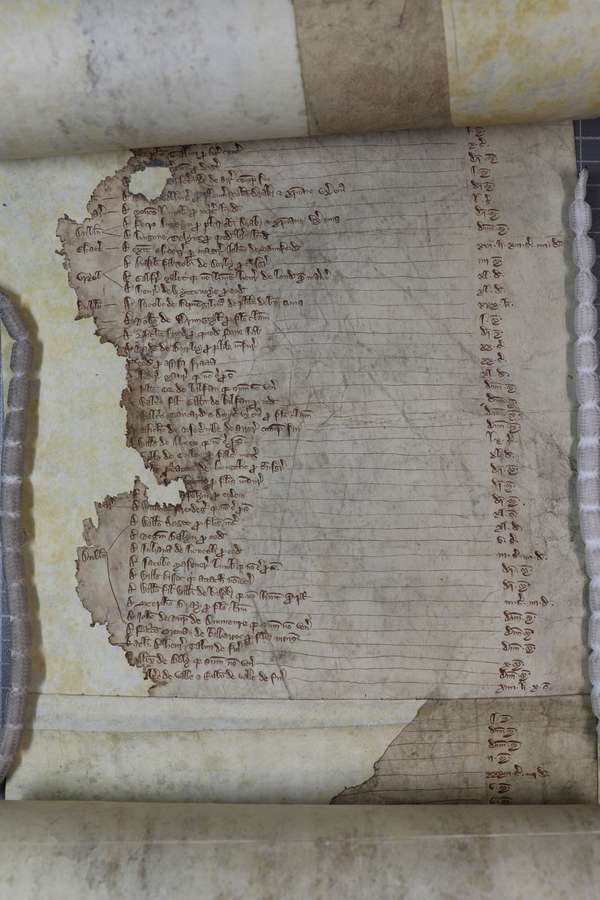
This is an indenture, a rental agreement between Agnes Allesley, the Prioress of Catesby Abbey, and the family of John Horewood of Staverton, in Northamptonshire. March 1457.
According to the document, the Prioress agreed to rent out a house and fields to John, his wife Alice and their son Thomas in Staverton for 15 shillings in rent to be paid twice a year. The prioress would have kept this copy, and the Horewoods would have kept a copy as well, each attaching their seal to the other’s copy. You can see at the top the jagged edge where the two copies were cut apart. If needed, they could be checked by fitting the cut edges together.
This indenture [rental agreement] witnesses that Mistress Agnes Allesley, prioress of Catesby and the convent in the same place grant, hand over and convey [give] at farm [to rent] to John Horewood of Staverton, Alice his wife, and Thomas the son of the same John and Alice, one messuage [house] in Staverton aforesaid lying between a messuage [house] that John Odam inhabits on one side and the high road on the other side, with three parts of pasture and its appurtenances [rights of the land] in the town and fields of Staverton aforesaid, [mentioned] to have the same messuage [house] equally and wholly as William Braundon once had and held the aforesaid messuage, with three parts of pasture and its appurtenances for the said John, Alice and Thomas from the day of the present agreement until the end and term of their lives… they are to pay annually the prioress and convent and their successors fifteen shillings in good and legal money, in two equal portions, that is at Lady Day [25 March] and Michaelmas [29 September]. And the aforesaid John, Alice and Thomas are to repair, sustain and maintain the messuage at their own expense… Given at Catesby in the chapter house, 10 March 1457.
Indenture between Agnes Allesley, the prioress of Catesby Abbey and family of John Horewood of Staverton, 1457. Catalogue reference: E 326/8274
How much rent did the Horewoods have to pay Catesby Abbey to rent the messuage or dwelling house and three parts of pasture?
Who rented the house and land before the Horewood family?
How could there have been a disagreement between Prioress Agnes and the Horewoods?
How do you think Prioress Agnes might have dealt with any future disagreement?
What does this source tell us about Catesby Abbey’s relationship with people living near it?
Source 8:Women in education
This is an extract from the Parliament Roll of 1406. It was published in ‘The Statutes of the Realm: a collection of the Acts of the Parliament of England from earliest times until 1707’.
Statutes of the Realm, 1406. Catalogue reference: C 65/68 m. 2
Chacun homme ou femme de quele estate ou condicion qil soit, soit fraunc de mettre son fitz ou file dapprendre lettereure a quelconque escole que leur plest deinz le Roialme.
Translation
Each man or woman of whatever estate or condition [social status] be, be theythat son or daughter to obtain learning at whichever kind of theirfree to set school that pleases him within the Realm.
Why do you think she might use the wrong size measurement when selling ale?
How do you think she was caught?
Teachers’ notes
In this lesson students explore how women appear in court cases, in petitions, and in wills. Court records record the details of disputes between individuals heard by judges. Petitions were received by queens asking them to do things or to make things happen. Other sources explore how girls appear in a statute from 1406 concerning a law about their education in ‘Statutes of the Realm’. It is important to note that of course the sources do imply details about wider medieval society, for example the church, and we have provided questions to prompt this.
As part of the lesson students are asked to search other financial records that give us evidence for women’s economic activity, for example by using taxation records digitised for the England’s Immigrants database.
All documents are provided with transcripts with difficult terms defined in square brackets. Some also have simplified transcripts for additional support. Students can work through the questions individually or in pairs and report back to the class. Alternatively, teachers may want to use this lesson in two parts owing to the large number of sources. Finally it is worth considering with students what other sources could help us understand the lives of medieval women.
Connections to the curriculum
Key stage 3 (Ages 11–14)
The development of Church, state and society in Medieval Britain 1066-1509: Society, economy and culture: for example, feudalism, religion in daily life (parishes, monasteries, abbeys), farming, trade and towns (especially the wool trade), art, architecture and literature
Extension activities
Further activities
Use the sources to write the day in the life of a medieval woman of your choice.
Which source is most surprising/interesting?
Curate your exhibition on the role of medieval women using the sources in this lesson and those found in our lesson on medieval seals.
Research activity
The England’s immigrants database lists all the people who are known to have immigrated to England in the later middle ages. Try searching for the Netherlands and then choosing ‘women’. It should give you the 58 women who were originally from Belgium. If you click ‘summary’ for any woman listed, it will tell you what more we know about them.
What kind of information can we find about these women using this database?
A fully-searchable database containing over 64,000 names of people known to have migrated to England during the period of the Hundred Years’ War and the Black Death, the Wars of the Roses and the Reformation.
Background information
Varied medieval lives
Women’s lives in medieval times were most often shaped by the family they were born into and their economic, social and legal position. Unlike today, most women (and men) lived in the countryside and worked the land on what were known as manors, estates on which tenants rented their properties from the lord and often performed services for him at harvest time.
There were extremely rich and powerful women, such as queens and noblewomen, but there were also countless ordinary women, whose names we do not always know, who emerge from the archives.
Women’s status under the law
One of the most important differences between women’s position today concerned the law. Medieval women were treated differently under the law to men depending on whether they were married. In medieval English law, an unmarried woman was under the authority of her father or brother, or another male relative, and they represented her in any court case, or business matter.
A married woman and her husband were treated as one person legally, usually represented by the husband even when it related to his wife’s interests or property. However, a widow whose husband had died could act on her own and manage her own business and lands. Many medieval widows were socially very powerful because of this.
Women in The National Archives' records
Women appear in the records alongside male relatives, by themselves and with other women.
The most obvious examples of groups of women living and working together are in convents as nuns. Some convents were particularly known for education and their libraries, but most were quite small. The head of a convent, the abbess, managed the community and its finances.
We also find women running businesses in towns, often after the deaths of their male relatives. Women also appear in the archives as immigrants, moving to England either by themselves or with family members.
Sometimes women might receive formal training as apprentices, but often their education was informal. Instead, they were expected to fit in any paid work they did around family life, usually for less money than men, although there are times in the sources when men and women received the same rate of pay.
Women of power
Powerful women, including members of the nobility and royal family, managed large and complex households. They might be responsible for feeding and supplying hundreds of individuals at any one time. These households would include servants, both men and women, as well as young women who were there as ladies-in-waiting, to be educated in the ways of a large, busy organisation.
Education and training
Many girls would have experienced a period of being sent away for their education, whether they were noble girls sent to other noble families, or peasant girls sent to another farm to learn there as servants. In family workshops in towns and cities, the wife of the head craftsman would probably be involved in teaching apprentices as well as working alongside male family members when needed.
Spinsters and brewers
Our word ‘spinster,’ meaning an unmarried woman, comes from spinning wool. This was a job that was generally done by women during ‘the Middle Ages’. Another largely female job was brewing ale, which most people drank rather than water because it was cleaner and safer. Ale might be made at home for a family or as a small business supplying neighbours.
Women played a key role in medieval society but can sometimes be hard to find in written records. One place we find women is in deeds relating to land or money.
Beta
Download all sources
You can save a single ZIP file of all sources from The National Archives on this page that are not in copyright.
Images will be provided as JPEG files.
Transcripts are provided as markdown files, which can be opened in most text and word-processing applications.
This is an experimental feature still in development. Please let us know what you think of it by using the feedback link at the bottom of this page.