









Archived page
A parting as of brothers: Bangladesh at 50
Blog from The National Archives looking at Sheikh Mujibur Rahman’s surprise visit to London, published to mark the 50th anniversary of Independence Day on 26 March 2021.
Teaching resource
In 1971, West and East Pakistan fought in the Bangladesh Liberation War. This led to the creation of Bangladesh on 16 December 1971. Use the documents in this lesson to find out how the British government responded to the conflict that led to the independence of Bangladesh.

'Recognise Bangla-Desh Rally' in Trafalgar Square, 8 August 1971.
Keystone Press/Alamy
This resource discusses the partition of India, the cyclone Bhola disaster and the 1971 Bangladesh Liberation War.
What can British documents tell us about the creation of Bangladesh?
British India, also referred to as the ‘British Raj’ or ‘Direct rule in India’, was part of the British Empire from 1858 until independence in 1947. This map shows how British India was divided up after the 1947 Partition into India (majority non-Muslim) and Pakistan (majority Muslim).

INDIA & PAKISTAN
SHOWING DIAGRAMMATICALLY THE POSITION OF THE STATES
To Accompany Pol. 1431/48 of 30th June 1948
International frontiers = [dotted line]
” ” undemarcated = [dotted line with x]
State boundaries = [dotted line with blue]
Inter-Dominion boundary = [green line]
Portuguese Territory = [circle with diagonal lines] (P)
French ” = [circle with horizontal lines] (F)
Patiala Union = P. U.
INDIA = [white]
PAKISTAN = [green]
States included in Part 5 of Pol. 1431/48 = [yellow]
India and Pakistan, showing states and areas, 1948. Catalogue reference: MFQ 1/1145
Source 2a describes the moment in 1948 when Urdu was confirmed to be the State language of both West and East Pakistan. This meant that all official business would be done in Urdu.
Source 2b is a photograph of the Shaheed Minar (martyrs’ monument) in Altab Ali Park in Whitechapel, London. It is a replica of the same monument in Dhaka, Bangladesh.

Jinnah received tumultuous welcome on arrival at Dacca airport. Following day he reviewed troops including newly-constituted East Bengal Regiment and said that though East Bengalis were formerly considered a non-martial race, East Bengal was now one of the most powerful components of Pakistan in which all would have opportunity to join Army and do their duty to their country.
They were before all else Muslims belonging now to a Muslim nation and essential condition for success of Pakistan was complete internal solidarity… He confirmed that Urdu must be the State language of Pakistan, but that decision regarding Provincial language of East Bengal would be according to will of people.
Report from the British government on the political situation in Pakistan, March 1948. Catalogue reference: DO 142/423

Photograph of the Shaheed Minar in Altab Ali Park in Whitechapel, London.
In 1970, the Bhola cyclone struck East Pakistan, killing an estimated 300,000–500,000 people. This is a British report on how the Pakistan government responded to the disaster.

British High Commission,
RAWALPINDI.
24 November, 1970.
Dear Webb,
Political Aspects of the Cyclone Disaster
Criticisms of the Pakistan Government’s handling of the relief work after the cyclone is now world-wide news. You might therefore like to have our first impressions of the political aspects of the situation. A more considered report will be in order later.
Letter from the British High Commission in West Pakistan to the Foreign & Commonwealth Office. 24 November 1970. Catalogue reference: FCO 37/719
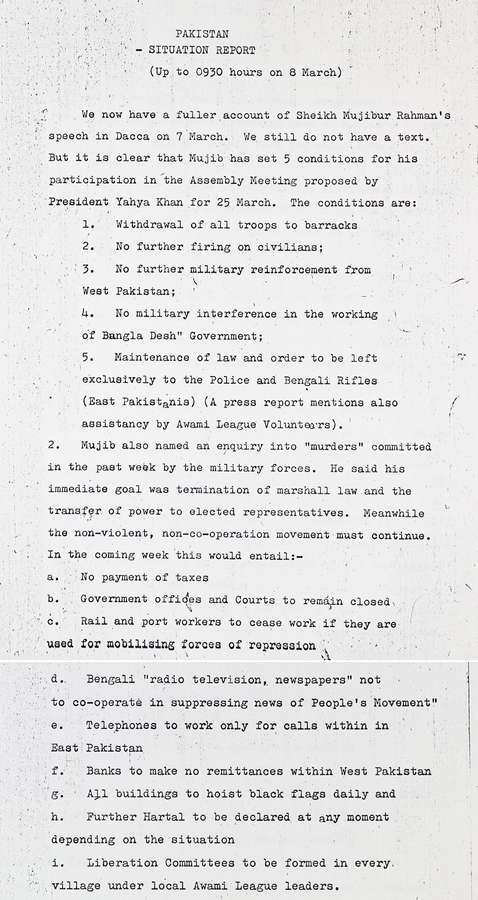
West Pakistan did not accept the 1970 election results (in which the Awami League, led by Sheikh Mujibur Rahman, won). This led to escalating protests in East Pakistan. On 7 March 1971, Sheikh Mujibur held a speech, reported on in Source 4.

PAKISTAN
SITUATION REPORT
(Up to 0930 hours on 8 March)
We now have a fuller account of Sheikh Mujibur Rahman’s speech in Dacca on 7 March. We still do not have a text. But it is clear that Mujib has set 5 conditions for his participation in the Assembly Meeting proposed by President Yahya Khan for 25 March. The conditions are:
Pakistan situation report from the British government – up to 0930 hours on 8 March 1971. Catalogue reference: PREM 15/567
Source 5a is a photograph of the ‘Recognise Bangla-Desh Rally’ in Trafalgar Square, 8 August 1971.
Source 5b is a report that describes Sheikh Mujibur Rahman’s surprise appearance in London in January 1972 after being imprisoned by West Pakistan during the war.

Photograph of the 'Recognise Bangla-Desh Rally' in Trafalgar Square, 8 August 1971.
Keystone Press/Alamy

WEU COUNCIL MEETING: 12 JANUARY 1972
INDIA/PAKISTAN/BANGLA DESH
However, although he spoke with bitterness of the actions of the Pakistani Army, he showed no rancour towards Bhutto and said he wished to establish good relations with Pakistan. Relations with India would, of course, be much closer. The partition should be, in his words, “a parting of brothers”. But first, he said, Bhutto must acknowledge that the division of Pakistan was a reality.
5. It is clear particularly since the return of Sheikh Mujib to Dacca, that an independent Bangladesh now exists, and that the Bangladesh Government commands the obedience of the majority of the population. Furthermore the decision to release the Shiekh indicates that the Pakistan Government is beginning to reconcile itself to the loss of East Pakistan. The question of recognition is therefore likely to arise in the near future.
Meeting notes on Sheikh Mujibur Rahman’s arrival in London, 12 January 1972. Catalogue reference: FCO 37/1019
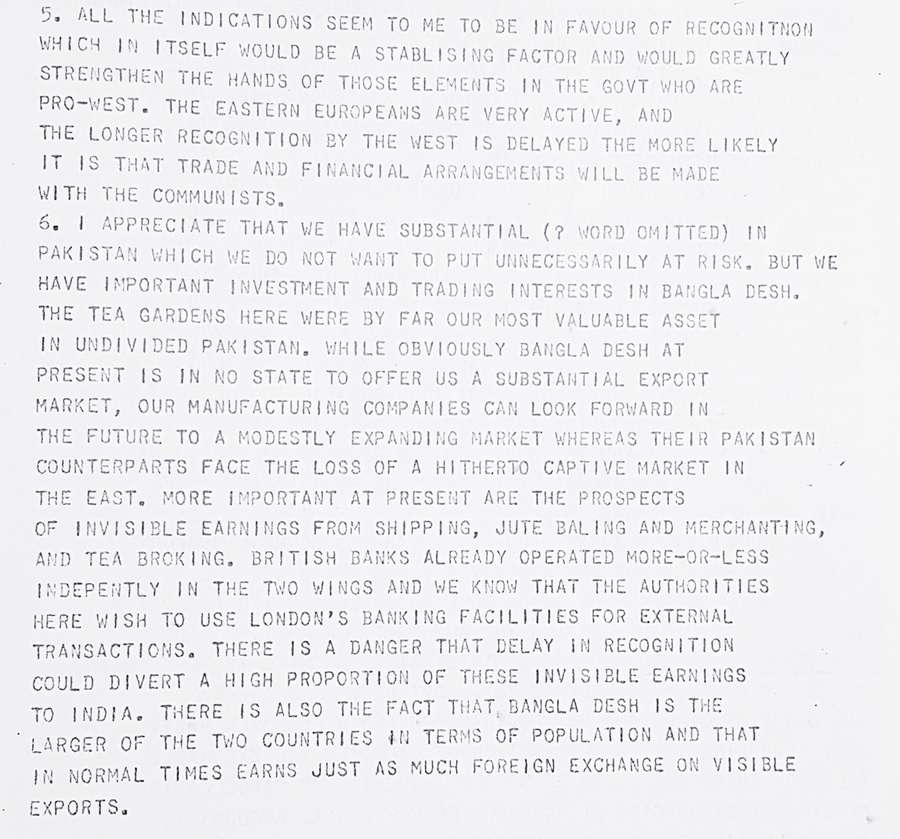
Britain recognised Bangladesh as an independent country on 4 February 1972. There was a lot of internal discussion before this date on the advantages and disadvantages that might come with recognition. Britain wanted to maintain good relationships with both Bangladesh and Pakistan.

5. All the indications seem to me to be in favour of recognition of which in itself would be a stabilising factor and would greatly strengthen the hands of those elements in the govt who are pro-West. The Eastern Europeans are very active, and the longer recognition by the West is delayed the more likely it is that trade and financial arrangements will be made with the Communists.
6. I appreciate that we have substantial (? word omitted) in Pakistan which we do not want to put unnecessarily at risk. But we have important investment and trading interests in Bangla Desh. The tea gardens here were by far our most valuable asset in undivided Pakistan. While obviously Bangla Desh at present is in no state to offer us a substantial export market, our manufacturing companies can look forward in the future to a modestly expanding market whereas their Pakistan counterparts face the loss of a hitherto captive market in the East. More important at present are the prospects of invisible earnings from shipping, jute baling and merchanting, and tea broking. British banks already operated more-or-less independently in the two wings and we know that the authorities here wish to use London’s banking facilities for external transactions. There is a danger that delay in recognition could divert a high proportion of these invisible earnings to India. There is also the fact that Bangla Desh is the larger of the two countries in terms of population and that in normal times earns just as much foreign exchange on visible exports.
Telegram on the recognition of Bangladesh for distribution within the Foreign & Commonwealth Office. 6 January 1972. Catalogue reference: FCO 37/1019

The Embassy of Pakistan presents its compliments to the Foreign and Commonwealth Office and has the honour to state that the Government of Pakistan has noted with profound regret the decision by the British Government to accord recognition to ‘Bangla Desh’.
The Government of Pakistan earnestly hopes that the British Government which has recognised ‘Bangla Desh’ and has expressed its sincere desire to maintain friendly relations with Pakistan should use its good offices and impress upon India the need for the unconditional implementation of UN resolutions in respect of the withdrawal of troops. India should also be called upon to fully comply with the Geneva Convention relating to Prisoners of War and other civilians in Indian hands who should be repatriated to Pakistan without delay. Further, the British Government may consider urging the authorities in Dacca to ensure the safety and security of non-Bengalis and to stop the persecution of Bengalis who subscribed to the concept of a united Pakistan.
The Embassy of Pakistan avails itself of this opportunity to renew to the Foreign & Commonwealth Office the assurances of its highest consideration.
The Foreign & Commonwealth Office,
Downing Street,
London, SW1
Letter from Embassy of Pakistan to Foreign & Commonwealth Office, 15 February 1972. Catalogue reference: FCO 37/1025
This lesson looks at how Bangladesh became an independent country after the Bangladesh Liberation War in 1971. It shows one of the many outcomes of the 1947 Partition of British India, and one of the many independence movements that happened in former British colonies in the 20th century. This topic also sheds light on migration patterns into Britain and the large Bangladeshi community here.
To begin with, students examine a map of the 1947 Partition. This shows how British India was divided into India and Pakistan based on religion, and how far away West and East Pakistan were from each other. It can also show why East Pakistan had a better relationship with India, which was just over the border.
Source 2 is related to the Bengali Language Movement, which was an early sign of the tensions between West and East Pakistan. Source 2 is a British report on the moment when Urdu was declared the state language of Pakistan. This excluded the majority of East Pakistanis who did not speak Urdu from official business. It sparked the Bengali Language Movement, in which East Pakistanis protested to get official recognition of Bengali as a state language.
Source 3 is a British report on West Pakistan’s response to the cyclone Bhola disaster in November 1970. This disaster is considered the deadliest tropical cyclone ever recorded and killed 300,000-500,000 people in East Pakistan. West Pakistan’s lack of any significant response or aid was widely criticised and increased animosity in the East towards the West right before the first general election.
Source 4 is a British report on Sheikh Mujibur Rahman’s famous speech on 7 March 1971. It shows how tensions were rising due to the Pakistan government refusing to accept Sheikh Mujibur’s win.
Source 5 describes Sheikh Mujibur Rahman’s surprise visit to London after having been imprisoned by West Pakistan during the war. It’s useful for students to reflect on why he chose London as his destination.
Sources 6a and 6b look at the British recognition of Bangladesh in February 1972 and the British interests in the conflict. Source 6a is a telegram describing the British financial interests that may be affected by recognition. Students can use this to infer some of the reasons why Britain has been watching the situation so closely. Source 6b shows a letter to the British Foreign & Commonwealth Office from the Embassy of Pakistan, and shows the (West) Pakistan view of the conflict. Students can use these sources to reflect on why a majority of the sources in this lesson have been British reports. How can this be linked to the colonial past of this region?
capital of Bangladesh, now known as Dhaka
packing jute fibres into bales
military rule
selling
facilitating the buying and selling of tea
capital of Iran
Challenges for Britain, Europe and the wider world 1901 to the present day
We can start the story of the 1971 Bangladesh Liberation War with the poorly planned and tragic ‘partition’ of British India in 1947, based on religion. The separate north-eastern and north-western areas of the country, which were mostly Muslim, became a ‘united’ Pakistan. The rest of the country, mostly non-Muslim, became known as India. (See Source 1, catalogue reference: MFQ 1/1145.)
West and East Pakistan shared a religion, but not much else. For decades after partition, the East Pakistanis (present-day Bangladeshis) were treated unfairly by the West Pakistani government over 1,000 miles away. East Pakistan had more people than West Pakistan but got less money and resources from the government. From the early 1950s, the amount of money earned per person in West Pakistan grew three times as much each year compared to East Pakistan.
In 1948, Urdu became the only state language of both West and East Pakistan (see Source 2, catalogue reference: DO 142/423). It was imposed on millions of Bengali-speaking people. This led to the rise of the Bengali Language Movement, resulting in mass protests and deaths in Dhaka in 1952.
Bengalis have a rich and proud history and culture focused around language, art, food, fashion, community, family and religion. The 1971 Liberation War can be seen as a struggle to preserve and protect this heritage.
A few key events leading up to 1971 sped up the start of the war:
Maybe the most important event leading up to the war was the 1970 election. The winning Awami League Party was led by Sheikh Mujibur Rahman, who wanted more freedom and independence for East Pakistan. He won the national elections by a clear majority, as East Pakistan had a much larger population than West Pakistan. However, the centralised government in West Pakistan did not accept Rahman as leader. They declared the election results void. This led to the famous and emotional ‘Joy Bangla’ (‘victory to Bengal’) speech by Rahman on 7 March 1971 at a rally attended by thousands, in which he declared an ‘independent’ Bangladesh (see Source 4, catalogue reference: PREM 15/567). He was later arrested. There were more and more protests by his supporters.
On 25 March 1971, the West Pakistani army invaded East Pakistan, trying to stop these protests. It launched Operation Searchlight, killing many Bengali civilians, intellectuals, students, politicians, and armed forces.
The brutal war that followed lasted for nine months. Estimates for the total number of civilian and military deaths range from 500,000 to over three million. Millions of refugees fled to neighbouring India. Groups of Bengali guerrilla fighters (‘mukti bahini’) and regular soldiers, helped by the Indian military, fought back against the West Pakistani army. West Pakistan eventually surrendered on 16 December 1971 (known as ‘Victory Day’), leading to the creation of Bangladesh.
You can see how complex the 1971 war was by looking at the many terms used to describe it: Bangladesh War of Independence, Liberation War, genocide, Civil War, or, by many Bangladeshis, ‘mukti juddho’/‘shongram’ (battle and resistance). The war has been immortalised in the symbolism of the national flag of Bangladesh – a dark green background with a red (bloody) circle in the middle.
Britain played an important role in bringing global attention to the war. During 1971, as members of the Commonwealth, many thousands of Bengalis were living and working in Britain. It was a harrowing time for many, as they were living far away and were worried about family and kin in East Pakistan. Foreign journalists were expelled from the region before the suppression started, so there was little international coverage of the events of 1971 (see Pakistani journalist Anthony Mascarenhas’ article ‘Genocide’ for a rare example). However, Bengalis in the UK raised funds to help the resistance. They organised peaceful campaigns and demonstrations to bring international attention to the war, such as the ‘Recognise Bangla-Desh Rally’ in Trafalgar Square on 8 August 1971, which drew thousands of people. The British government formally recognised Bangladesh as an independent nation on 4 February in 1972.
Background information written by Dr Aminul Hoque MBE (Goldsmiths, University of London).
Archived page
Blog from The National Archives looking at Sheikh Mujibur Rahman’s surprise visit to London, published to mark the 50th anniversary of Independence Day on 26 March 2021.
ideastore.co.uk
The Tower Hamlets Local History Library and Archives holds historical records from London’s Borough of Tower Hamlets.
bbc.co.uk
BBC article looking at the legacy of Pakistani journalist Anthony Mascarenhas’ article ‘Genocide’, published in the British Sunday Times on 13 June 1971. It was a rare look inside the beginning of the war and gave it significant international attention.
swadhinata.org.uk
The Swadhinata Trust is a London-based community group that promotes Bengali history and heritage.
npg.org.uk
A showcase by the National Portrait Gallery of Yousuf Choudhury’s photos of British-Bangladeshi demonstrations in 1971, from the book Bangladesh 50 Years.
youtube.com
Video footage from George Harrison and Ravi Shankar’s Concert for Bangladesh in August 1971, reflecting the international attention drawn to the war.
bbc.co.uk
A short and education-friendly BBC resource on the 1947 Partition, including a video and maps of West/East Pakistan.
bbc.co.uk
A BBC ‘Witness History’ podcast (9 minutes) on the Bengali language movement and the 1952 deaths.
smithsonianmag.com
Article in Smithsonian Magazine about the American reactions to the war, drawing on former Indian Prime Minister Indira Gandhi’s defining it as ‘genocide’.