Teaching resource
Examine an anti-Poor Law poster
Use this lesson to interrogate with your students an anti-Poor Law poster from 1837. What can it tell us about the lives of poor people at the time and attitudes to the Poor Law? Aimed at Key Stages 1, 2 and 3.
- Age ranges
- Key stage 1 (Ages 5–7)
- Key stage 2 (Ages 7–11)
- Key stage 3 (Ages 11–14)

About this image
Anti Poor Law poster, 1837. Catalogue reference: HO 44/27
About this resource
Time period
- Industrial revolution (1750–1901)
Themes
- Medicine, welfare and society
- Power, politics and reform
Enquiry question
How does this poster show us the public's opinion of the Poor Law?
Explore the source
-
Source 1: The poster in full
-

The New Poor Law with a description of the new Workhouses
Look at the Picture - SeeAnti Poor Law poster, 1837. Catalogue reference: HO 44/27
-
-
Source 2: Getting into the workhouse
-
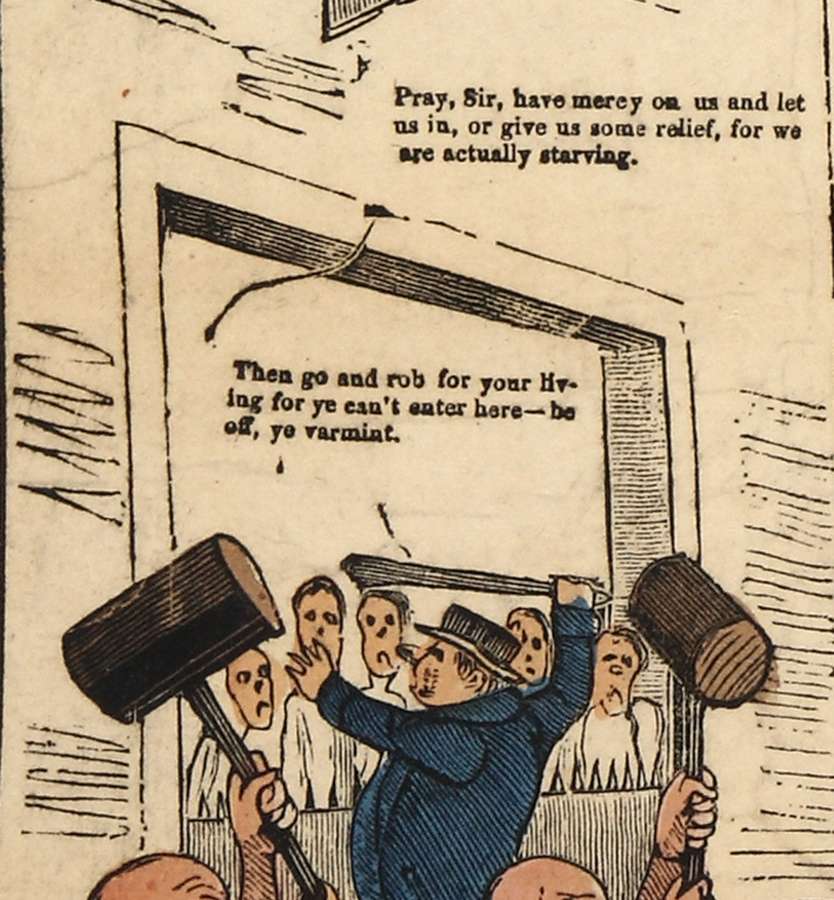
[Man outside door:]
Pray, Sir, have mercy on us and let us in, or give us some relief, for we are actually starving.
[Man in doorway wielding a baton:]
Then go and rob for your living for ye can’t enter here – be off, ye varmint.
Look at the source
- How desperate are the people trying to get into the workhouse?
- What is the response of the workhouse master?
-
-
Source 3: Beating hemp
-

[Worker #1:]
Beating this here hemp is worser than breaking stones. Lord ha’ mercy on us poor.
[Worker #2:]
Our heads shaved and no shirt allowed us to wear; talk of Vest Ingy slaverys, indeed vy they’re expectable mechanics to us.
Look at the source
- What work are these paupers doing?
- The paupers believe they are treated much worse than slaves in the West Indies. Why would this statement have shocked people at this time?
- Why do you think the paupers’ heads have been shaved?
-
-
Source 4: Pulling a truck
-
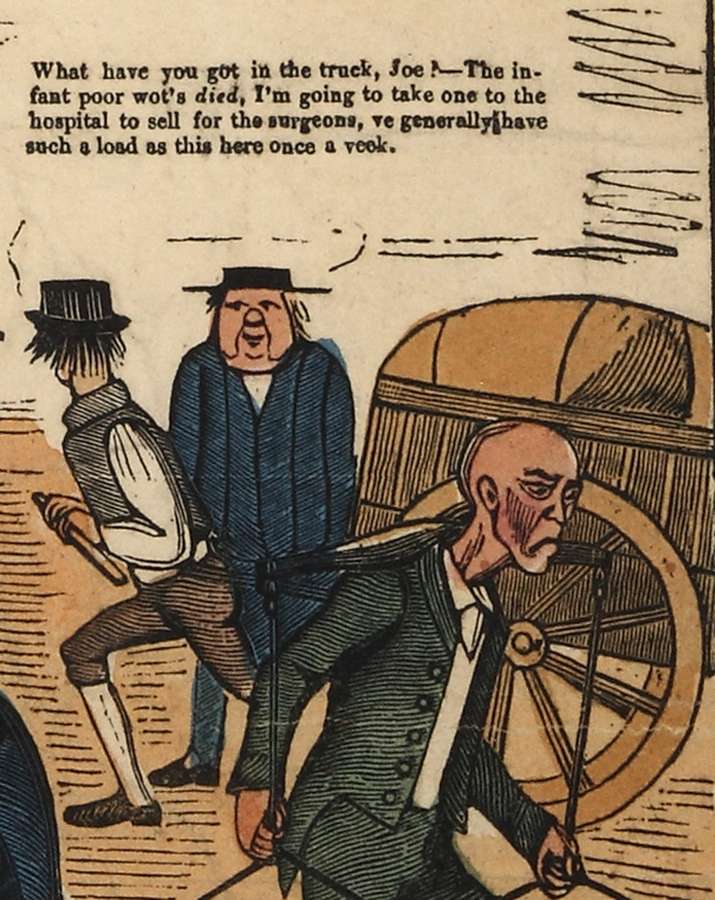
[Conversation between a man wearing a hat and a man pulling a cart:]
What have you got in the truck, Joe? – The infant poor wot’s died, I’m going to take one to the hospital to sell for the surgeons, we generally have such a load as this here once a week.
Look at the source
- What has ‘Joe’ got in the truck?
- What is he going to do with it?
-
-
Source 5: The treatment of the old
-
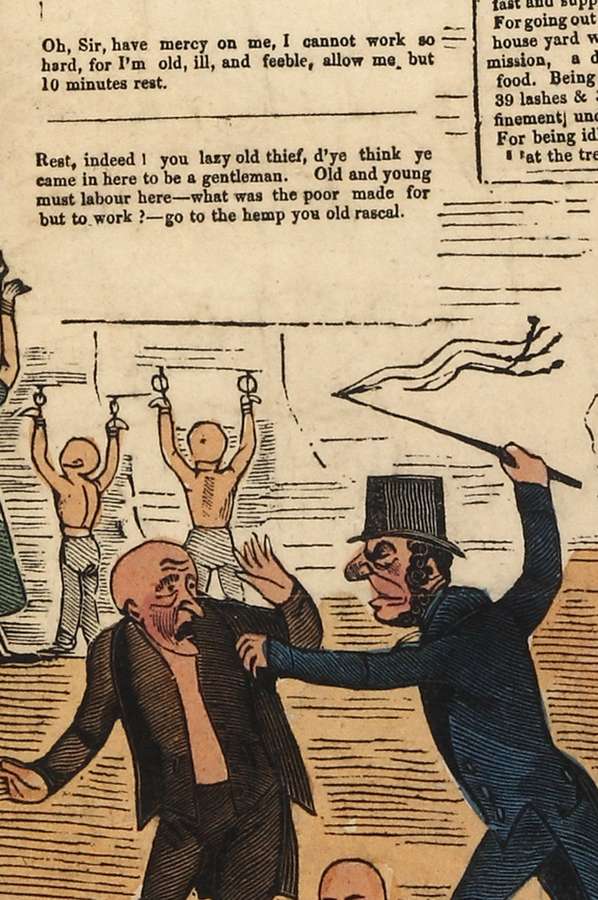
[Man with shaved head:]
Oh, Sir, have mercy on me, I cannot work so hard, for I’m old, ill and feeble, allow me but 10 minutes rest.
[Man brandishing a whip:]
Rest, indeed! you lazy old thief, d’ye think ye came in here to be a gentleman. Old and young must labour here – what was the poor made for but to work? – go to the hemp you old rascal.
Look at the source
- What does this part of the poster tell you about the treatment of the old?
- Why do you think that the government was keen to make sure that people in workhouses worked?
-
-
Source 6: Punishments in the workhouse
-

By order of the Commissioners of the New Poor Laws, the period for all paupers to work is from 4 in the morning to 10 at night. 3 hours allowed for clearing away & sweeping the workhouse yard
NOTICE. For being longer than 10 minutes to each of the two meals per day, viz. breakfast and supper, 39 lashes. For going out of the workhouse yard without permission, a day without food. Being disobedient 29 lashes & 3 days confinement under ground. For being idle a month at the tread-mill.
NOTICE is hereby given, all ablebodied paupers who conduct themselves in a mutinous or disorderly manner will be knocked on the head without a trial and their bodies sold to the surgeons. By order of government.
Look at the source
- According to the poster how long were inmates expected to work each day?
- How many hours sleep were they allowed?
- What punishments can you see in the poster?
-







Teachers’ notes
The poster in this lesson is an excellent piece of evidence showing opposition to the new Poor Law and public conceptions of life inside the workhouses. One way of encouraging pupils to analyse this rich source is by helping them to see that the poster is really made up of smaller pictures. By dealing with one small picture at a time, commenting on and analysing the poster can become more manageable.
The lesson can also be used as a starting point for investigating the new Poor Law in more depth and discussing attitudes to the poor in 19th-century Britain.
Connections to the curriculum
Key stage 1 (Ages 5–7)
Events beyond living memory that are significant nationally.
Key stage 2 (Ages 7–11)
Changes in an aspect of social history; a significant turning point in British history.
Key stage 3 (Ages 11–14)
Ideas, political power, industry and empire: Britain, 1745-1901: party politics, extension of the franchise and social reform.
Extension activities
To extend their work, pupils can create their own new Poor Law poster, either for or against the law. Or they can be asked to write to the government complaining about the harshness of the new Poor Law. They could also work in groups to create an alternative plan to deal with the problem of the rising cost of looking after the poor.
Further enquiry questions
- What does the artist think about the new Poor Law?
- What are the problems of using this poster as evidence of what the workhouses were like?
Background information
Looking after the poor
Before 1834, the cost of looking after the poor was growing more expensive every year. This cost was paid for by the middle and upper classes in each town through their local taxes. There was a real suspicion amongst the middle and upper classes that they were paying the poor to be lazy and avoid work.
Purpose of the new Poor Law 1834
After years of complaint, a new Poor Law was introduced in 1834. The new Poor Law was meant to reduce the cost of looking after the poor and impose a system which would be the same all over the country. Some people welcomed it because they believed it would reduce the cost of looking after the poor; take beggars off the streets and encourage poor people to work hard to support themselves.
Setting up of unions and workhouses
Under the new Poor Law, parishes were grouped into unions, and each union had to build a workhouse if they did not already have one. Except in special circumstances, poor people could now only get help if they were prepared to leave their homes and go into a workhouse. The new Poor Law ensured that the poor were housed in workhouses, clothed and fed. Children who entered the workhouse would receive some schooling. In return for this care, all workhouse paupers would have to work for several hours each day.
Conditions in the workhouse
Conditions inside the workhouse were deliberately harsh, so that only those who desperately needed help would ask for it. Families were split up and housed in different parts of the workhouse. The poor were made to wear a uniform, and the diet was poor and monotonous. There were also strict rules and regulations to follow. Inmates, male and female, young and old were made to work hard, often doing unpleasant jobs such as picking oakum or breaking stones. Children could also find themselves hired out to work in factories or mines.
Shortly after the new Poor Law was introduced, several scandals hit the headlines. The most famous was Andover Workhouse, where it was reported that half-starved inmates were found eating the rotting flesh from bones. In response to these scandals the government introduced stricter rules for those who ran the workhouses and they also set up a system of regular inspections. However, inmates were still at the mercy of unscrupulous masters and matrons who treated the poor with contempt and abused the rules.
Although most people did not have to go to the workhouse, it was always threatening if a worker became unemployed, sick or old. Increasingly, workhouses contained only orphans, the old, the sick and those with mental health conditions. Not surprisingly the new Poor Law was very unpopular. It seemed to punish people who were poor through no fault of their own.
Demands for reform
The factory reformer, Richard Oastler (1789-1861) spoke out against the new Poor Law, calling the workhouses ‘Prisons for the Poor’. The poor themselves hated and feared the threat of the workhouse so much that there were riots in northern towns. Also, John and Joseph Fielden the owners of textile mills in Todmorden, Yorkshire opposed the 1834 Poor law. They did all they could to resist it for their town. John Fielden was an MP who also campaigned for the 1847 Factory Act.