



















Teaching resource
Elizabeth I’s monarchy, part one
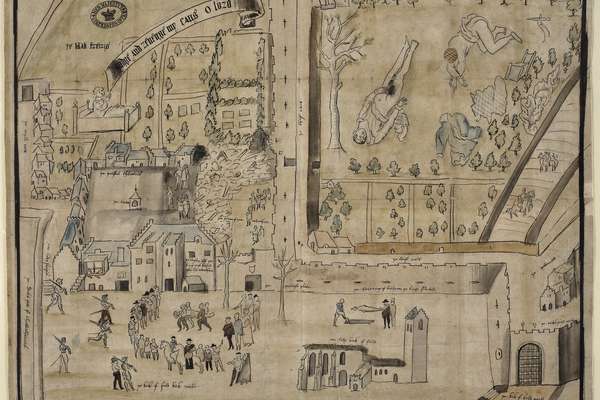
This resource covers key points in the early years of Elizabeth's reign, including the question of her marriage and the tempestuous life of Mary Queen of Scots.
Teaching resource
The records in this resource illustrate key points in the later years of Elizabeth I's monarchy. Spanning from 1580 to the end of her reign in 1603, they cover significant events including the Spanish Armada, wars in Ireland and the execution of Mary, Queen of Scots.

The Great Seal of Elizabeth I, 1586–1603. Catalogue reference: SC 13/N3
This resource features a source containing racist attitudes towards Black people.
A substantial number of Elizabeth’s subjects still adhered to the Catholic faith. For the most part, they sustained their faith in private through spiritual reading, prayer and meditation, or the preservation of rosaries and relics. But from 1574 onwards, they had cause to hope that they might soon be able to worship more freely. From that year onwards, Elizabethan England experienced an influx of Roman Catholic missionaries from a seminary in Douai founded by William Allen, the former principal of St Mary Hall, Oxford.
In June 1580, they were joined in England by the Jesuits, members of a dynamic religious order founded during the Reformation. One of the first to arrive was Edmund Campion, who had trained as a Roman Catholic priest in Dublin, Douai (in the Low Countries) and Prague.
In this letter, which he may have written to his friend Allen, he describes what it was like for a Roman Catholic priest travelling in secret around England. Clearly he found many supporters, but he lived in fear of his life. The fact that this letter found its way into The National Archives suggests that the authorities were already aware of his activities. Campion was arrested at Wantage in July 1581. He was tortured, tried as a traitor and hanged.

So we arived safelye at Dover the morowe followinge very earely my little man and I together. There we were at the very pointe to be taken beinge by comaundment brought before ye Maior of the towne, who coniectured many thinges, suspected us to be suche as in dede we were, adversaries of the
newe hereticall faction, favourers of the old fathers faithe that we discembled oure names, had bene abroade for religion, and returned againe to spreade the same…
I ride aboute some pece of the country every day. The harvest is wonderfull
greate. On Horse backe I meditate any sermons, when I come to ye house I poolishe it. Then I talke with suche as come to speake with me, or hear theire confessions. In the morninge after masse I preache, they heare with excedinge gredines, and very often receyve the sacramentes. For the ministration whereof we are ever well assisted by preistes whom we finde in every place…
I can not longe escape the handes of the heretickes the enemyes have so many eyes, so many tonges, so many scoutes. I am in apparell to my selfe verye ridiculous, I often change it and my name also…
I had sett downe in writinge by severall articles the causes of my comminge in, and made certaine demaundes most reasonable. I professed my selfe
to be A preist of the societie, that I returned to enlarge the catholike faithe, to teache the gospell, to minister the sacramentes, humblye askinge audience
of the Quene and the nobilitie of the realme, and proferinge disputations to ye adversaries.
Letter from Edmund Campion to a friend (possibly Dr Allen), 1580. Catalogue reference: SP 15/27B f117
This proclamation by Elizabeth I’s chief minister William Cecil, Lord Burghley, assigns a warship to a wool convoy operating between London and Flanders. This protection was vital at a time of heightened international tension, when England was preparing for naval aggression by Spain. The cost of the venture was £80 (equivalent to almost £12,000 today), but given that the infrastructure of the entire wool industry depended on safe links with the continent, Burghley no doubt judged it worth the investment.

Be yt remembred that I William Lord Burghley Lord Treasurer of England have made covenante in grant to Sir Thomas Cotton knight for the furnishing of one ship of war for the conducting of wool of late of four ships from the port of London to the porte and town of Bruges in the lowe countreyes of Flanders the eighth day of March in the twentieth and three year of the reigne of our sovereigne Ladye Quene Elizabethe for the sum of five score pounds of lawfull English monie to be payed by the mayor constables and fellowship of the staples of England. In witness whereof I have hereunto subscribed my hand and set my seale the seconde day of March in the said xxiij th yeare of the reign of the sayd Quene.
W. Burghley
Proclamation by Lord Burghley, 2 March 1581. Catalogue reference: E 101/668 f.48
On 10 August 1585, Elizabeth had forged an alliance with the United Provinces of the Netherlands – a group of seven states that had broken away from Spanish rule. The Treaty of Nonsuch pledged financial and military support for the Dutch rebels against Philip II.
Although the United Provinces shared Elizabeth’s Protestant faith, the alliance was motivated more by self-interest than ideology. The Netherlands provided an ideal base from which the King of Spain could launch an invasion of England.
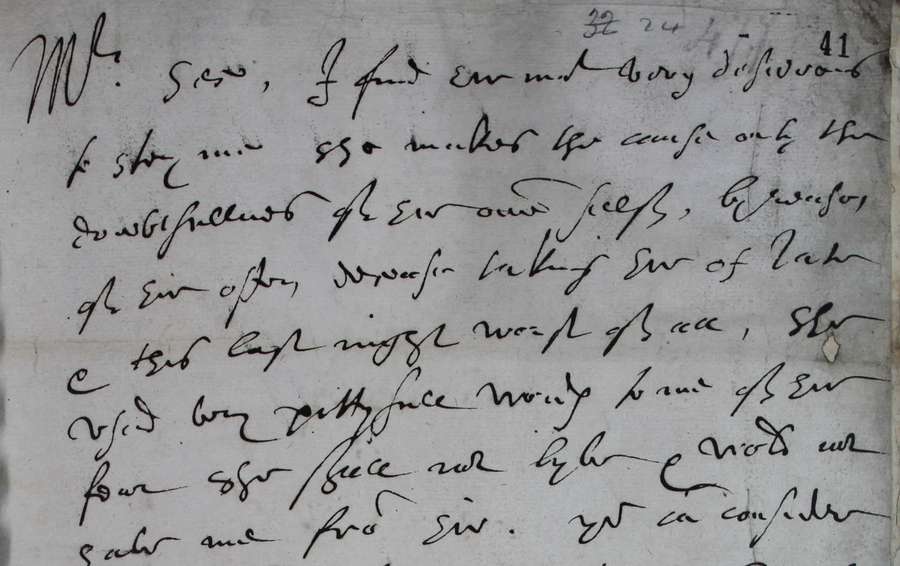
As part of the treaty, the Dutch rebels handed over the key strategic towns of Brill and Flushing to the English queen, and in December 1585 she dispatched Robert Dudley to the latter as commander of her forces in the Netherlands. But when it came to his departure, Elizabeth suddenly lost her nerve and proved very unwilling to let him go, as Dudley confides to Sir Francis Walsingham in this letter.

Mr. Secretary, I find hir majesty very desirous to stey me, she makes the cause only the dowtfullnes of hir owen self, by reason of hir often decease taking hir of late & this last night worst of all. She used very pittyfull words to me of hir fear she shall not lyve & wold not have me from hir. You can consider what manner of perswasion this must be to me from hir.
Robert Dudley, Earl of Leicester, to Sir Francis Walsingham, 28 September 1585. Catalogue reference: SP 12/182 f.41
Almost all documents during the Tudor period were closed with seals, both to ensure that they would not be read before they reached the intended recipient and to identify the sender. Most seals had a picture of the owner and a motto around the edge. The same was true of a Great Seal, which belonged to the monarch and was attached to all the important transactions that he or she carried out.
The Great Seal was also an important instrument of propaganda. Of all the Tudor monrachs, Elizabeth I was the most skilled at crafting her public image. This, her second Great Seal, is laden with symbolism. The inscription reads: Elizabetha dei gracia Anglie Francie et Hibernie Regina Fidei Defensor (‘Elizabeth, by grace of God, Queen of England, France and Ireland, Defender of the Faith’). It depicts the queen in typically resplendent dress, flanked by the royal arms and Tudor roses. It was engraved by the celebrated miniaturist Nicholas Hilliard.
The image presented in this seal became the unwritten ‘official’ portrayal of the queen, and was reproduced in numerous portraits and illuminations.

The Great Seal of Elizabeth I, 1586–1603. Catalogue reference: SC 13/N3
Dudley was provided with no authority other than his military command over the English forces, and only an informal instruction to advise the Dutch on political matters. But bad weather in the North Sea severely restricted communication with England over the next two months, and as a result he felt abandoned. This may have prompted his fateful decision to accept the appointment as Governor-General of the Netherlands, and he was sworn in on 15 January 1586 [O.S.]. Elizabeth was incandescent with rage when she heard of this and demanded his immediate recall. But she could never stay angry with her favourite for long, and in July she wrote him this letter, making it clear that he had been entirely forgiven. Despite her protestations, Elizabeth was always reluctant to properly provide for her troops – an issue that sparked widespread criticism in the years to come.

Rob: I am affrayd you will suppose by my wandring writings, that a midsomer moone hathe taken large possession of my braynes this moneth, but you must needes take thinges as they com in my head though order be left behind me. When I remember your request to have a discreate and honest man, that may carie my mynde and see how all goes there, I have chosen this berer whome you knowe, and have made good tryall of: I have froughte him full of my conceipte of those Country maters, & imparted what waye I mynde to take and what is fitt for you to use: I am sure you can credit him and so I wilbe short with thes fewe notes. First that Counte Morice and Counte Hollocke [Count Maurice and Count Hollock, commanders of the Dutch resistance against Spain] fynde them selves trusted of you, esteemd of mee and to be carefullie regarded if ever peace shold happen, and of that assure them on my worde, that yet never deceived any. And for Norrys [Sir John Norris, one of Elizabeth’s commanders in the Netherlands, and a rival of Dudley] and other captains that volontarilie without commandment have many yeres ventured their lives, and won our nation honor and themselves fame be not discouraged by any meanes, neither by newecom [new come] men nor by olde trayned soldiers elsewhere: If there be faulte in using of Soldiers or making of profitte by them, lett them heare of it without open shame, and doubt not but I will well chasten them therefore. Yt frettes me not a litle that the poore soldier that howrelie ventures life, should want ther due, that well deserve rather reward: and looke in whome the faulte may dulie be proved let them smarte therefore. And if the Treasurer be found untrue or negligent, according to desart he shalbe used, thoughe you knowe my old wont, that love not to discharge from office without desert, God forbid. I pray you let this berer knowe what may be lerned herein: and for this treasure I have joined, Sir Thomas Sherley to see all this money discharged in due sort where it nedeth and behoveth. Now will I end that do imagine I talke still with you, and therefore lothely say farewell ōō [the symbol for ‘eyes’, Elizabeth’s nickname for Dudley] thoughe ever I pray God blesse you from all harme and save you from all foes with my million and legion of thanckes for all your paines and cares. As you know, ever the same.* E.R.
[Postscript] Let Wilkes see that he is acceptable to you. Yf any thyng there be, that Wilkes shall desire answer of, be suche as you wold have but me to knowe, write it to my selfe: you know I can keep both others’ Counsaill and myne owne: mistrust not that anything you wold have kept shalbe disclosed by me: for althoughe this berer aske many thinges, yet may you answer him suche as you shall thincke mete, and write to me the rest.
* ‘Ever the same’ or ‘Semper eadem’ was Elizabeth’s motto.
Elizabeth to Robert Dudley, Earl of Leicester, 19 July 1586. Catalogue reference: SP 84/9 f.38
After the discovery of the Babington Plot in 1586, Mary’s apartments were searched and all of her papers seized. They included more than 100 ciphers used in her correspondence. Tudor espionage was quite sophisticated and several different codes were used in secret correspondence.
One of the most common was to shuffle letters of the alphabet in a certain sequence so that once the key had been worked out the message could be read quickly and easily. Alternatively, individual letters were sometimes substituted with numbers, characters, symbols or signs of the zodiac. Elizabeth’s great spymaster, Sir Francis Walsingham, employed intelligence workers to break these codes. Two of the best known are Thomas Phelippes and John Sommers.
In the cipher shown here, symbols are substituted for letters in particular words, and the names are frequently mentioned. Some of these names make interesting reading. They include the pope, various European rulers, Bess of Hardwick (for many years the wife of Mary’s custodian and a close companion), and the earl of Hertford and his two sons (Mary’s rivals for the English succession).

Page of ciphers used by Mary Queen of Scots, c.1586. Catalogue reference: SP 53/22 f.1
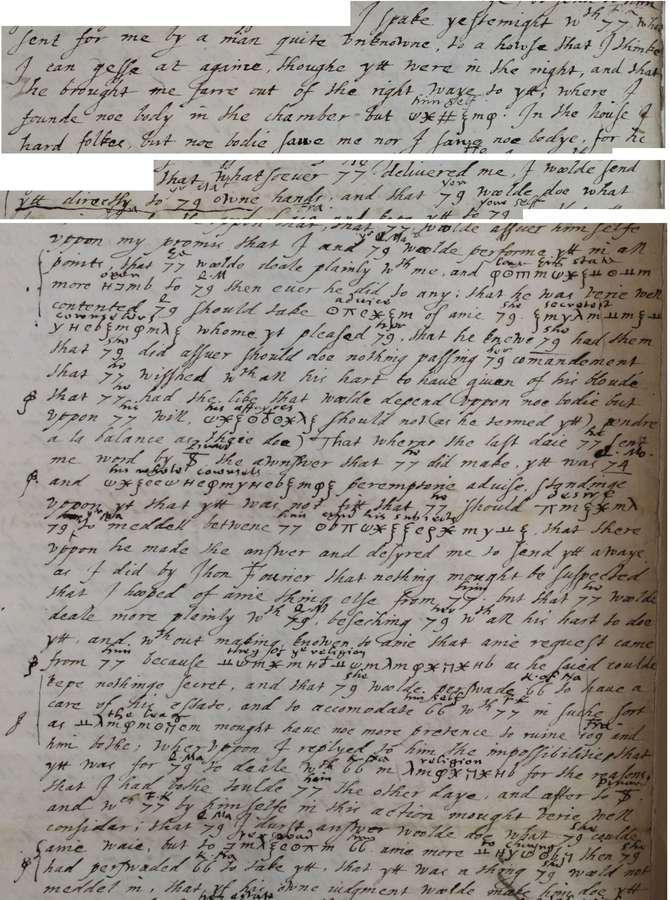
Stafford was the queen’s ambassador to France. Written in the anxious months between the execution of Mary Queen of Scots and the coming of Philip II’s Armada, the letter describes a clandestine meeting with King Henry III of France. Mary Queen of Scots had spent much of her childhood in France, having been married to the Dauphin, Francis. Her execution therefore prompted outrage in that kingdom.
Stafford reports that the French King wishes Elizabeth to persuade his brother-in-law and heir to the throne, Henry of Navarre (the future Henry IV) to convert to Catholicism and so disempower the hard-line Catholic League. This is Elizabethan espionage at its cloak-and-dagger best. He writes proper names in cipher, which Elizabeth’s great spymaster, Sir Francis Walsingham, has deciphered. The latter has also drawn trefoils against certain key passages that he wishes the queen to read.

I spake yesternight with the King, who sent for me by a man quite unknown, to a house that I think I can guess at again, though it were in the night, and that he brought me far out of the right way to it; where I found nobody in the chamber but himself. In the house I heard folks, but nobody saw me nor I saw nobody, for that he brought me tarried not in the chamber. The King began with me… that whatsoever he delivered me, I would send it directly to your Majesty’s own hands, and that you would do what lay in you for the good of France, and keep it to yourself…
uppon my promis that I and your Majesty woolde performe ytt in all points, that he woolde deale plainly with me, and laye his state more open to QM then ever he did to any; that he was verie well contented Q should take advice of anie the secretest cownselors whome yt pleased her, that he knew she had them that she did assure should doe nothing passing her commandement, that he wisshed with all his hart to have given of his bloude that he had the like woolde depend uppon noe bodie but uppon his will, his affayres should not (as he termed ytt) pendre a la balance as theie doe…I hoped of anie thing else from him but that he woolde deale more pleinly with her Majestie, beseching her with all his hart to doe ytt, and without making knowen to anie that anie request came from him because they of ye religion as he saied coulde kepe nothinge secret, and that she woolde perswade the King of Navarre to have a care of his estate, and to accomodate him self with the French King in suche sort as the king mought have noe more pretence to ruine France and them bothe; wheruppon I replyed to him the impossibilitie that ytt was for the Queen’s Majestie to deale with the King of Navarre in religion…that ytt was a thing she woolde not meddel in…’
Sir Edward Stafford to Elizabeth, 25 February 1588. Catalogue reference: SP 78/18 f.52- 52v
The queen would have rejoiced upon receiving this letter from her most celebrated naval commander, in which he announced the flight of the mighty Spanish Armada. The skill of Elizabeth’s navy, coupled with some fortuitous weather, had scattered Philip II’s ships. Many had been lost, and those that survived were blown so far northwards that they could reach neither England nor Scotland.
The defeat of the Spanish Armada catapulted Elizabeth’s kingdom onto the world stage. It also secured the queen’s reputation as the iconic ‘Gloriana’ and her reign as the ‘Golden Age’. Although Drake was only second in command, he grabbed all of the glory. Even Elizabeth’s enemy Pope Sixtus V was fulsome in his praise, exclaiming: ‘Have you heard how Drake with his fleet has offered battle to the Armada? With what courage! Do you think he showed any fear? He is a great captain.’ The Spanish nicknamed him ‘El Draque’, the dragon.

The absence of my Lord Admirall most gratious Soverayne, hath emboldened me, to putt my penne to the paper. On fridaye last, upon good consideracion we lefte the army of Spagne so farre to the northewardes, as they could neither recover England nor Scottland. And within three daies after we were entertayned with a great storme, considering the tyme of the yere, the which storme, in many of our judgmentes hath not a litle annoyedd the enemies army. If the wind hinder it not, I think they are forced to Denmark, & that for diverce causes. Certain it is that manie of their people were sick and not a fewe killed, there shippes, sailes ropes & mastes needeth great reperations for that they had all felt of your Majestie’s force…
Sir Francis Drake to Elizabeth, 8 August 1588. Catalogue reference: SP 12/214 f.108
Elizabeth’s long-standing favourite wrote this letter just a few days before his death, when he was staying at Rycote. This is the house where Elizabeth had lodged on her way to Woodstock after her imprisonment in the Tower in 1554, and she and Dudley had stayed there together in happier times as guests of Sir Henry and Lady Norris. The queen was grief-stricken at the death of her favourite on 4 September 1588. Years later, when she died, this letter was found in a casket by her bed. She had inscribed it ‘his Last lettar’.

‘I most humbly besech your majeste to pardon your poore old servant to be this bold in sending to know how my gratious lady doth and what ease of her late paine she findes, being the chefest thinge in the world I doe prey for & for hir to have good health and longe lyfe/ for my none poore case, I contyndue still your meddycyn [medicine] and finde yt amended much better than with any other thinge that hath byn given me. Thus hoping to finde perfect cure at the bath, with the contynduance of my wontyd preyer for your majesty’s most happy preservacion. I humbly kyss your foote. From your old lodging at Rycott this Thursday morning reddy to take on my Journey.
by your most faythful and obedyent servant. R Leycester.
[postscript] Even as I had wrytten thus much I receyved your majesty’s token by young Tracye.
Robert Dudley, Earl of Leicester to Elizabeth, 29 August 1588. Catalogue reference: SP 12/215 f.114
Elizabeth had an exceptional intellect and had always loved learning for its own sake. From the age of five, she had been taught a range of languages, including Latin and Greek, and she loved to make translations of classical authors. It was clearly an abiding passion because the translation shown here was undertaken by the queen shortly after her 60th birthday.
There is no evidence that it was intended for circulation, but rather for the pleasure that it gave her. She worked on it while staying at Windsor Castle in the autumn of 1593 and began writing it all in her own hand. After a few pages, however, she started dictating the prose sections to her secretary, Thomas Windebank, while continuing to write the verse herself.
Boethius’s work had been written from prison during the closing years of the Roman Empire. It had already been ‘Englished’ by authors such as King Alfred, Geoffrey Chaucer and William Caxton. The following verse, in Elizabeth’s hand, uses the example of Orpheus to show that the light of truth may be lost by returning to darkness.

blist that may of Good
The fontaine Clire behold
happy that Can of weighty
Erthe the bondes to breake
The Tracian profit wons
his wives funeralz wailing
Whan with sorows note
The wavering trees he moved
And stedy rivers made
And hind caused Join
Unfearing Sides to Lion fierce
Nor hare did feare the Looke
Of Cruel dog so plised with Song
Whan ferventar desir the inward
brest more burnt,
Nor Could the notes that al subdued
Pacefie ther Lord
Or Ireful Godz Complaining
The helly house went to…
Elizabeth’s translation of Boethius’s De Consolatione Philosophie (The Consolation of Philosophy), October and November 1593. Catalogue reference: SP 12/289 f.48
Edward de la Zouche, Baron Zouche of Harringsworth, was Elizabeth’s last emissary to James. He was granted an audience with the King of Scots on 15 January 1594, which is probably when this letter was delivered. In it, Elizabeth complains of James’s leniency towards the earls of Huntly, Errol and Angus, who were known to be in league with her chief enemy, Spain.
The earls had also been implicated in the affair of the ‘Spanish blanks’, a Catholic plot by the Scottish Jesuits to welcome 30,000 Spanish troops from the Netherlands in Scotland, 4,000 of which were to establish Catholic control there and the rest were to advance south to England.
The name of the plot derives from the fact that several of James’s Catholic earls had signed blank letters that gave carte blanche to the Spaniards.

My deare brother. To see so much I rue my sight, that viewes the evident spectacle of a seduced king, abusing Councill, and wry guided kingdome. My love to your good, and hate of your ruyne [ruin], breedes my heedefull regarde of your surest safety. If I neglected you I coulde winke at your worste, and yet withstand my ennemyes driftes. But be you perswaded by beguilers, I will advise you voyde of all guyle [guile], and will not stick to tell you that if you tread the path you goe in, I will pray for you, but leave you to your harms. I dowbte whether shame or sorrowe have had the upper hande, when I read your laste lynes to me. Who of judgement that deemed me not simple, could suppose that any aunswears you have writte me, should satisfie nay enter into the opinion of one not voyde of sences leaving out the fifthe? Those of whom you have had so evident proofe by their actuall rebellion in the fielde you present [probably ‘preserve’], whose offers you knew then so large to forraine Princes, And now at laste when plainest of all was taken abowt the Caryer himselfe [George Ker, the messenger in the ‘Spanish blanks’ affair], confessing all afore many Commissioners and divers Councellors because you slacked the tyme till he was escaped, and now must seame deny it though all men knew it, therefore forsoothe no Jury can be found for them. May this blinde me that knowes what a Kings office were to doe? Abuse not your selfe so farre. In deed when a weake bowing and a slacke seat in government shall appeare, then bolde spirites will sturre the sterne, and guide the shippe to greatest wrecke, and will take hart to supply the failer [failure]. Assure your selfe no greater perill can ever befalle you nor any King eels, then to take for payment evill accomptes, for they deride suche and make their pray of their neglect. There is no Prince alive but if he shew feare or yealding, but he shall have Tutors enough though he be out of minoritie. And when I remember what sore punishement these so lewde traytors shall have, then I read again least at first I mistook your mynde, but when the reviewing granted my lecture true, Lord what wonder grew in me that you should correct them with benefites, who deserve muche severer correction. Coulde you please them more then save their lives, and make them shunne the place they hate? Where they are sure their juste deserved haters dwell, and yet enjoy as much their honors and livelihoodes as if for sporting travayle [travel] they were licenced to visite other cuntryes. Calle you this a banishment? To be ridde from whom they feare, and goe to suche they love. Now when my eyes read more then smiled I to see how childish, foolish, and witlesse an excuse the best other three made you, turning their treasons bils [bills] to artificers reckonings; with item for many expenses. And lacked but one billet which they best deserved – An item for so muche for the corde, whose office they best merited. Is it possible that you can swallow the taste of so bitter a drugge more meet to purge you of them; then worthy for your kingely acceptance. I never heard a more deriding skorne and vowe that if but this alone if I were you, they shoulde learne a shorte lesson. The best that I commend in your letters is, that I see your judgement to good to affirme a trothe of their speeche, but that allow they so say. Howbeit I muse how you can want a lawe to suche as whose denyall if it were ever, could serve to save their lives, whose treasons are so plaine as the messenger who woulde for his owne sake not devise it if for trothes cause he had it not in his charge. For who shoulde ever be tryed false if his owne denyall might save his lyffe. In Princes causes many circumstances yealde a sufficient plea for suche a Kinge as will have it knowen, and ministers they shall Lacke none that will not themselves gainsay it. Leave of [off] such cloakes therefore I pray you – they wilbe found to [too] thynne [thin] to save you from wetting. For your own sake play the Kinge, and let your subjects see you respect your selfe, and nether to hyde or to suffer danger and dishonnor. And that you may know my opinion, judgement, and advise, I have chosen this noble man, whom I know wise, relligious, and honest to whom I pray you give full creditte as if my selfe were with you, and beare with all my plainenes, whose affection if it were not more worthe then so ofte not followed...
Elizabeth I to James VI of Scotland, 22 December 1593. Catalogue reference: SP 52/51 f.75
Throughout the winter and spring of 1595–6, great preparations were being made for a combined naval and military expedition against Spain. Although the first Armada had been soundly beaten in 1588, a second was feared imminent.
At the beginning of April, news reached Elizabeth that Archduke Albert of Austria, Governor-General of the Spanish Netherlands, was preparing to lay siege to Calais, which had been held by France since its loss by Elizabeth’s sister Mary in 1558.
The Earl of Essex, Elizabeth’s last great favourite, and Lord Charles Howard, the Lord Admiral, hastened down to Dover to collect all available troops and ships. But the queen, ever averse to expensive foreign wars, hesitated and haggled over the terms on which her help should be given.
On 14 April the noise of the cannonade was heard in London and the order to embark was given. But no sooner had the troops boarded the ships than news came that Calais had fallen.

As distant as I am from your abowde, yet my eares serves me too well, to heare that terrible battery that methinkes sounds for relief at my handes; wherefore rather than for lacke of tymely aide it should be wholly lost, goe you on in God’s Blessed name, as farre as that place where you may soonest relieve it, with asmuch caution, as so great a trust requires. But I charge you without the mere losse of it, doe in no wise perill so faire an Armye for another Prince’s Town. God cover you under His safest winges, and let all perill goe without your Compasse. Believe Cecill in the rest.
From the Due Repulse, where this day I have ben, and render a myllion of thankes to Grove for his precious present.
Elizabeth I to Robert Devereux, Earl of Essex, 14 April 1596. Catalogue reference: SP 12/257 f.46
During the Elizabethan period, the employment of Africans became increasingly common in England. They served in wealthy households as footmen or musicians, and the queen herself retained a Black maidservant. But during the 1590s, Elizabeth issued a series of proclamations ordering the expulsion of black people from her realm. They were increasingly used as scapegoats by the queen and her ministers for the social ills that dogged the later years of her reign. The harvests repeatedly failed, which brought hunger and disease, and sparked a sharp rise in poverty and vagrancy.
Fearing disorder and a breakdown of society, in 1597 Elizabeth passed an Act for the Relief of the Poor. This was followed by a similar act four years later which created a national poor law system for England and Wales.

An open le[tt]re to the L[ord] Maiour of London and th’alermen his brethren, And to all other Maiours, Sheryfes, &c. Her Ma[jes]tie understanding that there are of late divers Blackmoores brought into the Realme, of which kinde of people there are all ready here to manie, consideringe howe God hath blessed this land w[i]th great increase of people of our owne Nation as anie Countrie in the world, wherof manie for want of Service and meanes to sett them on worck fall to Idlenesse and to great extremytie; Her Ma[jesty’]s pleasure therefore ys, that those kinde of people should be sent forthe of the lande. And for that purpose there ys direction given to this bearer Edwarde Banes to take of those Blackmoores that in this last voyage under Sir Thomas Baskervile, were brought into this Realme to the nomber of Tenn, to be Transported by him out of the Realme. Wherein wee Req[uire] you to be aydinge & Assysting unto him as he shall have occacion, and thereof not to faile.
Open letter by Elizabeth I to the mayors of England, 11 July 1596. Catalogue reference: PC 2/21 f.304
In the summer of 1597, Essex led an expedition to the Azores, with Thomas Howard, Earl of Suffolk as Vice-Admiral and the celebrated adventurer Sir Walter Ralegh as Rear-Admiral. The purpose was to capture the gold and silver Spanish fleet of bullion returning from America at the bay of Angra in the Portuguese Azores Archipelago under King Phillipe’s rule. The English fleet was soon battered back by violent winds that inflicted considerable damage upon the ships. When she heard of this, Elizabeth wrote to advise Essex to proceed with caution.
Her superior wisdom is evident in this letter to her impetuous young favourite, who was more than 30 years her junior. But Essex went on to defy his queen’s orders by pursuing the treasure fleet without first defeating the Spanish treasure fleet. His expedition, the last major naval campaign of Elizabeth’s reign, was an utter failure and he returned home in deep disgrace.

Eyes of youth have sharpe sightes, but commonlye not soe deepe, as those of elder age which makes me marvayle lesse, at rashe attempts, and hedstronge Counsayles, which give not leasure to Judgments warning, nor hede advise, but makes a laughter at the one, and dispise with scorne the laste: This have I not herde but seene, and therof can witness beare: yet I cannot be soe lwede of nature, to suppose that the scope was not good, how soe the race was runne, and doe more condemne the graunters then the offerer, for when I see the Admirable worke of the Easterne winde, soe longe to laste beyonde the custome of nature, I see as in a Christall the right figure of my follye, that ventured supernaturall happs uppon the pointe of frenaticall imputacion, but it pleaseth his goodness to strengthen our weakenes, and warns us to use witt when wee have it hereafter: foreseen happs breeds noe wonder, noe more doth your shorte returned poste before his time: But for aunswere, yf your full fedd men weare not more then fytted by your desired rate, that parse [purse] shoulde not be thinned at the bottome, that daylye by lightnes is made to thinn alreadye, but yf more heede weare taken how, then haste what, wee needed not such bye recconinges: Kinges have the honor to be titled earthly godds, and therfore breedes our shame, yf wee disgrace soe much our name, as though to to [too too] farre shorte, yet some peace of properties weare not in us not ever to rewarde desarte by the rule of ther merit, but beare with weakenes, and helpe to life from grounde the well nighe falinge [falling] man: This at this presente makes me like the lunaticke man that keepes a smacker [ie taste] of the remayne of his frenzies freake, helpt well therto by the influence of sol in leone [‘the sun in the lion’ – ie the constellation Leo, during the hottest part of the summer], that makes me yealde for Companye to a longer proporcion, then a wiser in my place woulde ever graunte unto, with this caveate, that this lunaticke goodnes make you not boulde to keepe to manye that you have, and much lesse take in more to heape more errors, to over manye, Allsoe that you truste not to the grace of your crazed [ie cracked] vessell, that to the ocean maye fortune to be to humble, Foresee and prevente it now in tyme, afore to late, you vex mee to much with smale regarde of what I skrape or bidde. Admitt that by miracle it woulde doe well, yet venture not such wonders where such approachfull mischife might betyde you, Ther remaynes that you after your perilous firste attempte doe not agravate that danger with an other in a farder of Clymate, which muste coste blowes of good sstore, let Caracters serve your turne, and be contente when you are well, which hath not ever bene your propertye: of this noe more, but for all my moodes, I forget not my Tenses [ie times – a pun upon moods and tenses in the grammatical sense], in which I see noe leasure for ought but peticions, to fortefie with beste forwardnes the wants of this Armye, and in the same include your safe returne, and graunte you wisdom to discerne betwixte verisimile [probably], and potest fieri [it can be done], Forget not to salute with my greate favoure good Thomas and faythfull Mountjoye [Sir Thomas Baskerville and Charles Blount, Lord Mountjoy, both of whom were serving under Essex]: I am to like the common faction that forgett to give thankes for what I receaved but I was soe loathe to take that I had wellnigh forgot to thank but receave them now with millions and yet the wrest [rest] keepes the deareste.
Elizabeth to Robert Devereux, Earl of Essex, July 1597. Catalogue reference: SP 12/264 f.19
The Elizabethan age was characterised by a vibrant cultural life. The queen loved the arts in all their forms and inspired a host of poets and playwrights, many of whom performed for her at court. Foremost among them was William Shakespeare. Born in Stratford-upon-Avon in 1564, the ‘bard’ had moved to London by the early 1590s. What was probably his first play, Henry VI Part I, was performed in 1592 at the Rose Theatre in Southwark.
Five years later, he and his company, the Lord Chamberlain’s Men, gave a private performance of ‘Love’s Labours Lost’ for Elizabeth I. Many more would follow. Although Shakespeare enjoyed great prosperity as a result of his plays, and their patronage by the queen, he regularly failed to pay his taxes.

St Martyns Outwhiche parishe
Anthony Treavys………viii li ……viii s
Robert Whorewood…….. v li …… v s
St Ellens parishe
Peter Dallila……….. l li ……. l s
William Shackspeare…….. v li…….. v s
Thomas Smythe gent…….. xxx li …… xxx s
William Boyele……….. xxx li …… xxx s
Shakespeare the tax evader: extract from a certificate by London tax commissioners, 1597. Catalogue reference: E 179/146 f.354
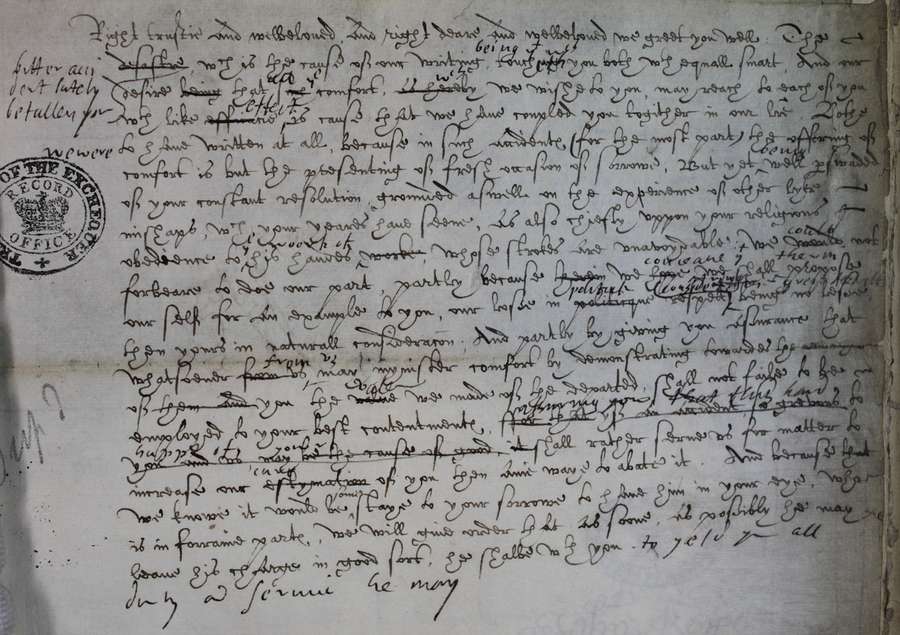
Lord and Lady Norris had suffered badly as a result of Elizabeth’s wars in Ireland. Four of their sons had already died in the queen’s service, most recently Henry and Sir Thomas. Only Sir Edward now survived, and Elizabeth recalled him from Ireland to comfort his grieving parents.

Right trustie and wellbeloved, and right deare and wellbeloved we greet you well. The bitter accident lately befallen you, which is the cause of our writing seeing it touches you both with equall smart, And our desire that all the comfort whiche we wishe to you, may reach to each of you with like effect is the cause that we have coupled you togither in our letter. Lothe we were to have written at all, because in such accidentes (for the most part) the offering of comfort is but the presenting of freshe occasion of sorrowe. But yet being well persuaded of your constant resolution, grounded aswell on the experience of other lyke mishaps, which your yeares have seene, as also chiefly uppon your religious obedience to the work of His handes, whose strokes are unavoydable: we could not forbeare to doe our part, partly because we conceave that we shall therein propose our self for our example to you, our losse in political respect… being no less than yours in naturall consideration; And partly by giving you assurance that whatsoever from us may minister comfort by demonstrating towardes […] of you the value we made of the departed shall not faile to be employed to your best contentmentes; assuring you that this hard happe of yours shall rather serve us for matter to increase our care of you then anie waye to abate it. And because that we knowe it would be some staye to your sorrows to have him in your eyes, who is in forraine partes, we will give order that as soon as possibly he may leave his chardge in good sort, he shalbe with you to yield you all duty and service he may.
Elizabeth I to Lord Henry and Lady Margery Norris, 6 September 1599. Catalogue reference: SP 12.272 f.161
At the time of writing this letter, Essex had been banished from court for his actions as Lord Lieutenant of Ireland. Despite leading the largest expeditionary force ever sent to Ireland, he failed to crush the rebellion and eventually made terms with its leader, Tyrone. He also overstepped the bounds of his authority by conferring numerous knighthoods on his officers. The Irish rebels joked that ‘he never drew sword but to make knights’. Despite pleading for forgiveness from the queen who had held him high in favour for many years, he would never again enjoy her good graces. Frustrated by his loss of power, he staged a badly organised rebellion and was executed in February 1601.

Hast [hasten], paper, to thatt happy presence whence only unhappy I am banished. Kiss thatt fayre correcting hand which layes new plasters to my lighter hurtes, butt to my greatest woond applyeth nothing. Say thou cummest from shaming, languishing, despayring, S.X. [Essex]
Robert Devereux, Earl of Essex to Elizabeth I, 6 September 1600. Catalogue reference: SP12/275 f.102
On 30 November 1601, Elizabeth addressed 141 Members of the House of Commons (including the Speaker) in what would be her last Parliament. Her speech was expected to address their concerns about pricing, based on the recent economic issues facing the country. But to everyone’s surprise, Elizabeth instead used the occasion to express the love she felt for her subjects, and how she viewed her position as their queen.
This version of what became known as the ‘Golden Speech’ was recorded by one who was in attendance. Printed with the royal arms as its frontispiece, it may have been the ‘official’ version of the speech, published under the auspices of the court. It is more of a summary than a transcription, and may have stimulated others who were present to produce their own more detailed accounts of the speech.

Her Majesties most Princelie answere, delivered byher selfe at the Court of Whitehall, on the last day of November 1601: When the Speaker of the Lower House of Parliament (assisted with the greatest part of the Knights, and Burgesses) had presented their humble thanks for her free and gracious favour, in preventing and reforming of sundry grievances, by abuse of many Grants, commonly called Monopolies. The same being taken verbatim in writing by A.B. [possibly Anthony Blagrave] as neere as he could possibly set it downe.
Mr Speaker, we perceive by you, whome we did constitute the mouth of our Lower House, howe with even consent they are fallen into the due consideration of the precious gift of thankefulnesse, most usually least esteemed, where it is best deserved. And therefore we charge you tell them how acceptable such sacrifice is woorthily received of a loving King, who doubteth much whether the given thanks can be of more poise [i.e. weight] then the owed is to them: and suppose that they have done more for us, then they themselves beleeve. And this is our reason: Who keepes their Sovereigne from the lapse of error, in which, by ignorance, and not by intent, they might have fallen; what thankes they deserve, we know, though you may gesse. And as northing is more deere unto us then the loving conservation of our subjects hearts, what an undeserved doubt might we have incurred, if the abusers of our liberality, the thrallers of our people, the wringers of the poore, had not bene tolde us! Which, ere our heart or hand should agree unto, we wish we had neither: and do thanke you the more, supposing that such griefes touch not some amongst you in particular. We trust there resides, in their conceits of us, no such simple cares of their good, whome we so deerly prize, that our hand should passe ought that might injure any, though they doubt not it is lawfull for our kingly state to grant gifts of sundry sorts of whom we make election, either for service done, or merit to be deserved, as being for a King to make choise on whom to bestow benefits, more to one then another. You must not beguile your selves, nor wrong us, to thinke that the glosing lustre of a glistring glory of a Kings title may so extoll us, that we thinke all is lawfull what we list, not caring what we doe: Lord, how farre should you be off from our conceits! For our part we vow unto you, that we suppose Physicians aromaticall favours, which in the top of their potion they deceive the Patient with, or gilded drugges that they cover their bitter sweet with, are not more beguilers of senses, then the vanting [vaunting] boast of a kingly name may deceive the ignorant of such an office. I grant, that such a Prince as cares but for the dignity, nor passes not how the raines be guided, so he rule, to such a one it may seeme an easie businesse. But you are cumbred (I dare assure) with no such Prince, but such a one, as lookes how to give account afore another Tribunal seat then this world affords, and that hopes, that if wee discharge with conscience what he biddes, will not lay to our charge the fault that our Substitutes (not being our crime) fall in. We thinke our selves most fortunately borne under such a starre, as we have bene inabled by Gods power to have saved you under our reigne, from forreigne foes, from Tyrants rule, and from your owne ruine; and doe confesse, that wee passe not so much to be a Queene, as to be a Queene of such Subjects, for whom (God is witnesse, without boast or vaunt) wee would willingly lose our life, ere see such to perish. I blesse God, he hath given me never this fault of feare; for he knowes best, whether ever feare possest me, for all my dangers: I know it is his gift; and not to hide his glory, I say it. For were it not for conscience, and for your sake, I would willingly yeeld another my place, so great is my pride in reigning, as she that wisheth no longer to be, then Best and Most would have me so. You know our presence can not assist each action, but must distribute in sundrie sorts to divers kindes our commands. If they (as the greatest number bee commonly the woorst) shoulde (as I doubt not but some doe) abuse their charge, annoy whom they should helpe, and dishonour their king, whom they should serve: yet we verely beleeve, thatall you will (in your best judgement) discharge us from such guilts. Thus we commend us to your constant faith, and your selves to your best fortunes.
The ‘Golden Speech’, 30 November 1601. Catalogue reference: SP 12/282 ff.137r-141v
This letter is an affirmation of her friendship towards the King of Scots, and also concerns a proposed league of their two kingdoms with France against Spain. The King of France, Henry IV, had sent an ambassador to James that summer to broach the matter.
Although England and France had traditionally been rivals, Henry was a great admirer of Elizabeth, and is reported to have remarked on her superior skill in suppressing rebels against the crown: ‘She only is a king! She only knows how to rule.’ By the closing years of her reign, Elizabeth had finally won not just acceptance but respect as a female sovereign in a man’s world.

My good Brother. Who longest drawes the thryd [thread] of life, and viewes the strange accidents that Tyme makes doth not fynd out a rarer gift than thanckfulnes is, that is most pretious and seldomest found, which makes me well gladded that you me thinkes beginnes to feele, howe necessary a Treasure this is to be imployed where best it is deserved, as may appeare in those lynes that your last letters express, in which your thanckes be great for the sondry cares that of your state and honour my dere friendshipp hath afforded you being ever ready to give you ever such subjects for your wrytinge, and thinckes my self happie, when ether my warnings or counsells may in fittest tyme avayle you. Wheras it hath pleased you to impart the offer that the French King hath made you with a disyre of secresie, believe that request includes a trust, that never shall deceave; for thoughe many exceed me in many thinges, yet I dare professe, that I can ever kepe taciturnity for my self and my freindes. My hedd may faile but my tounge shall never, as I will not say but your self can in your selfe thoughe not to me wytnes: but of that no more, preterierunt illi dies [‘those days will be past’]. Nowe to the Frenche in playne dealing without fraude or guile, if he will doe as he pretends, you shalbe more beholdinge to hym then he is to himself, who within one yeare hathe wyncked at suche injuries and affronts as or [ere] I would have indured that am of weakest sex I should condemne my Judgement, I will not enter into his, And therefore if his verba come ad Actionem [‘words come to action’], I more shall wonder then doe suspect, but if you will needes have my single advice, try hym if he contynue in that mynde; And as I knowe that you would none of suche a league as my self should not be one, so doe I see by his ouvreture, that hymself doth, or if for my assistance you should need of all help he would give it; so as synce he hath so good consideration of me you will allowe hym therein, and doubt nothing but that he will have me willingly for Company. For as I may not forgett howe their League with Scotland was recyproke when wee had warres with them: so is it good reason that our freindships should be mutuall. Nowe to confesse my kind taking of all your loving offers and vowes of most assured oathes that nought shalbe concealed from me, that ether Prynce or subject shall to your knowledge worck against me or my estate; surely (dere brother) you right me muche if so you doe. And this I vowe that without you list, I will not willingly call you in questoon for suche warninges, if the greatnes of your cause may not counsell me thereunto, And do intreat you to thincke that if any accydent so befall you, as ether secrecy or speed shalbe necessary, suppose your self to be sure of suche a one as shall neglect neyther to performe so good a worck; let others promise and I will do as muche with truth as others with wyles, And thus I leave to molest your eyes with my scribling with my perpetuall prayers for your good estate as desyreth your most loving and affectionat syster.
[postscript] As for your good considerations of border causes I aunswere you by my Agent and infinitely thanck you therefore.
Elizabeth I to James VI, 4 July 1602. Catalogue reference: SP 52/68 f.75
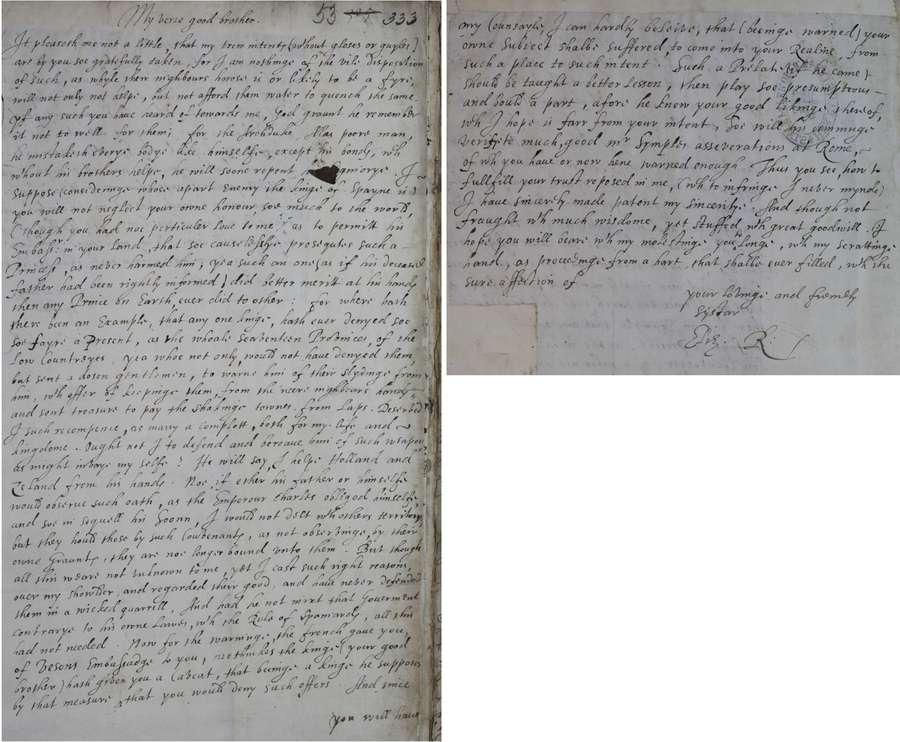
This is the last known letter written by Elizabeth to the man whom she knew would succeed her. Conciliatory in tone, it provides a justification for her foreign policy, notably the defence of the Dutch rebels against Spain – an alliance that she no doubt hoped James would uphold when he became king of England.
Even though Elizabeth herself, and the vast majority of her subjects, knew that James would soon take the throne, even now, in the last few weeks of her life, she refused to name him her heir. Shortly after writing this letter, she retreated to her ‘warm box’, Richmond Palace, to live out her days. Only on her deathbed, when pressed by a minister to formally name the King of Scots as her heir, did she draw a circlet above her head to indicate assent.

My verie good brother.
It pleaseth me not a little, that my trew intents (without gloses or guyles) are by you soe gratefully taken, for I am nothinge of the vile disposition of such,as whyle their nighbours howse is or likely to be a fyre, will not only not helpe, but not afford them water to quench the same. Yf any such you have heard of towards me, God graunt he remember it not to well for them; for the Archduke [of Austria] Alas poore man, he mistaketh everye bodye like himselfe, except his bonds, which without his brothers helpe, he will soone repent… I suppose (consideringe whose apart enemy the kinge of Spayne is) you will not neglect your owne honour, soe much to the world, (though you had noe perticuler love to me) as to permitt his Embassador in your land, that soe cause […] prosequtes such a Princess, as never harmed him; yea such an one as if his deceased father had been rightly informed) did better merit at his hands then any Prince on earth, ever did to other: for where hath there been an example, that any one kinge, hath ever denyed soe soe fayre a present, as the whoale Seaventeen Provinces, of the Low Countreyes, yea whoe not only would not have denyed them, but sent a dosen gentlemen, to warne him of their slydinge from him, with offer of keepinge them from the neere nighbours hands and sent treasure to pay the shakinge townes from […] Deserved I such recompence, as many a complot, both for my life and kingdome. Ought not I to defend and bereave him of such weapons as might innoye my self? He will say I helpe Holland and Zeland from his handes. Noe, if ether his father or himselfe would observe such oath, as the Emperour Charles obliged himselfe and soe in sequell his soonn, I would not delt with others territory but they hould those by such couvenantes, as not observinge, by their owne grauntes, they are noe longer bound unto them. But though all this weare not unknown to me, yet I cast such right reasons, over my shoulder, and regarded their good, and have never defended them in a wicked quarrel, And had he not mixt that Government contrarye to his owne lawe, with the Rule of Spaniardes, all this had not needed. Now for the warning, the Frenche gave you, of Besons Embassadge to you, methinkes the kinge (your good brother) hath given you a caveat, that beeinge a kinge he supposes by that measure that you would deny such offers. And since you will have any counsayle, I can hardly believe, that (beeinge warned) your own subject shalbe suffered, to come into your Realme, from such a place to such intent. Such a Prelate (if he come) should be taught a better a lesson, then play soo presumptuous and bould a part, afore he knew your good liking thereof, which I hope is farr from your intent, soe will his comminge verify to much, good Mr Symples asservations at Rome, of which you have or now here warned enough. Thus you see, how to fullfill your trust reposed in me, (which to infringe I never mynde) I have sincerely made patent my sincerity. And though not fraught with much widome, yet stuffed with great goodwill. I hope you will beare with my molestinge you to [too] longe, with my seratting hand, as proceedinge from a hart, that shalbe ever filled, with the sure affection of your lovinge and frendly systar Elizabeth R:
Elizabeth I to James VI, 5 January 1603. Catalogue reference: SP 52/69 f.53
This collection of documents introduces students and teachers to the reign of Elizabeth I through the original State Papers held at The National Archives. They have been selected and introduced by eminent historian of the period, Tracy Borman. Students and teachers can use the documents to develop their own questions and explore their own lines of historical enquiry on different aspects of Elizabeth’s reign including the marriage question and succession, her style of monarchy, religious and foreign policy, or her relationship with Mary, Queen of Scots.
The documents offer students a chance to develop their powers of evaluation and analysis and support their course work. Alternatively, teachers may wish to use the collection to develop their own resources or encourage students to ‘curate’ their own ‘exhibition’ of the most significant sources on the topic. All documents are supported with some contextual information. Transcripts are provided and more difficult vocabulary is explained in square brackets.
Elizabeth I is one of the most celebrated monarchs in British history. She was also the longest-reigning Tudor. Yet, as the younger of two daughters born to Henry VIII, she was never supposed to be Queen at all.
Elizabeth was just two years and eight months old when her mother, Anne Boleyn, was convicted for treason and executed. Her parents’ marriage had been annulled prior to Anne’s execution, which rendered Elizabeth illegitimate. The birth of her half-brother Edward the following year made her prospects of inheriting the throne even more distant. But thanks to his premature death in 1553 after just six years as king, followed by the short and disastrous reign of her half-sister Mary, Elizabeth at last came into her inheritance in 1558.
There was great rejoicing across the kingdom upon Elizabeth’s accession. Church bells were rung and bonfires were lit, and thousands of people gathered to drink and make merry. Beneath the euphoria, however, lay the deep-seated prejudice against female rulers that had existed for centuries. The vast majority of Elizabeth’s new subjects believed that women were naturally inferior to men in every respect. They had neither the intelligence nor the strength of character to make their own way in the world. Even Elizabeth’s closest adviser, William Cecil, was furious when one of the queen’s messengers discussed with her a dispatch for her ambassador in Paris, exclaiming that it was ‘too much for a woman’s knowledge.’
Whereas Mary Tudor had confirmed such prejudices during her brief but turbulent reign, Elizabeth set out to confound them. Although she shared her male subjects’ views on the inferiority of women, she saw herself as an exception and was determined to stamp her authority upon all aspects of her court and government. She started by refusing to marry – a deeply shocking concept in an age when it was universally accepted that a woman (let alone a queen) could not make her way in the world without the guidance of a husband. But Elizabeth was adamant: ‘I will have but one mistress here, and no master’, she told her courtiers. Although she encountered fierce resistance to this at first, over time her single state became one of the cornerstones of her success: it secured her place as the Virgin Queen of legend.
Another part of Elizabeth’s strategy to win over her misogynistic new subjects was to refer to herself time and again in masculine terms. She was a ‘prince’ who led her people with just as much authority as her formidable father, Henry VIII. But she also knew exactly when to flaunt her femininity. She created a court based upon the principles of chivalric love, with herself at the centre – at turns delighting, frustrating and enslaving the male courtiers who flocked to pay her homage. She would also use her womanly ‘weaknesses’ as an excuse not to take action. When under intense pressure to sign the death warrant of Mary, Queen of Scots, she told a parliamentary delegation that ‘my sex doth not permit it.’
Elizabeth’s first biographer, William Camden, claimed that she had ‘surprised her sex’. This implies that she triumphed in spite of being a woman, whereas in fact she triumphed because of this. Her feminine traits enabled her to stand out in a world dominated by men – and to dominate these men in turn.
The other keynote of Elizabeth’s queenship was her extraordinary self-discipline. She always put the interests of her country ahead of her own private hopes and fears – including the love she bore for her long-standing favourite, Robert Dudley. Her long reign witnessed a number of notable achievements: a new, moderate religious settlement, overseas expansion, great military victories like the Armada and a flowering of cultural life epitomised by Shakespeare. Little wonder that it has been described as a ‘Golden Age’.
But there was another side to the story too. Seen by most of Catholic Europe as a heretical and (thanks to her infamous mother Anne Boleyn) illegitimate usurper, from the very beginning of her reign Elizabeth was beset by rival claimants. The most deadly of them all was Mary, Queen of Scots, who was a thorn in the English queen’s side for almost 30 years. Elizabeth also courted opposition thanks to being notoriously parsimonious when it came to supplying and paying her troops – notably the sailors who won her most celebrated victory in 1588. A succession of failed harvests and economic hardship during the later years of her reign added to the climate of dissatisfaction, and prompted Elizabeth to introduce two new poor laws.
Despite all of this, Elizabeth won widespread adulation among her people as ‘Gloriana’ and ‘Good Queen Bess’, and transformed their attitude towards female rulers. It was a legacy that all subsequent queens had cause to be grateful for – none more so than her namesake, Queen Elizabeth II (1926–2022).
Background information by Dr Tracy Borman, best-selling author and historian, and Chief Curator of Historic Royal Palaces.
Teaching resource
This resource covers key points in the early years of Elizabeth's reign, including the question of her marriage and the tempestuous life of Mary Queen of Scots.
Education session

This workshop, available online and at The National Archives, looks at what we can we learn about Elizabeth I’s ruling style from her letters and speeches.
Education session
This workshop, available online and at The National Archives looks at how seriously rebellions in the Tudor period challenged the authority of the crown.