












Teaching resource
Early modern witch trials: Accusation and trial
This set of documents relates to the witch craze in 17th-century England, focusing on beliefs, behaviours and legal processes.
Teaching resource
This set of documents relates to the witch craze in 17th-century England, and later representations of witches. Students and teachers can use this resource to develop their own questions on what witchcraft allegations reveal about the attitudes of communities and the role of women in society.

Photograph of an oil painting by Decamps titled ‘The Witches in Macbeth’, 30 September 1904. Catalogue reference: COPY 1/477/660
This resource contains references to violence and murder against people suspected of witchcraft. Source 8 contains a very graphic description of violence.
Who was accused of witchcraft in early modern England?
This selection of documents held at The National Archives focuses on attitudes in society and legal processes connected to accusations of witchcraft.
Discover more original documents in our related themed collection Early modern witch trials: Accusation and trial.
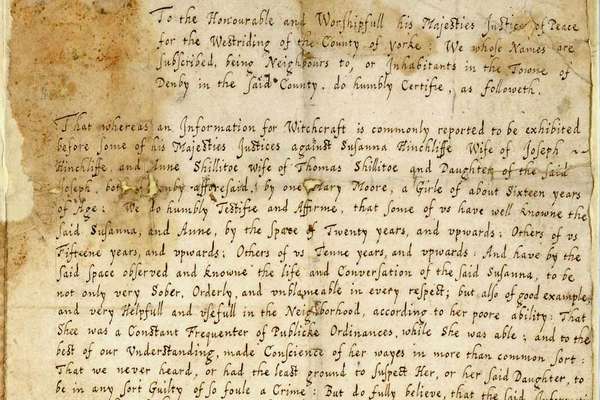
When people were accused of witchcraft within a community, people might either take it upon themselves to take part in the accusations, and seek justice, or to defend the accused. In this source, the neighbours (meaning simply those living in the same town) of Susanna Hinchcliffe and Anne Shillitoe strongly defend them from the accusation of witchcraft, and question the validity of the original accusation.

To the honourable and worshipful his Majesty’s Justices of Peace
in the West Riding of the County of York. We whose names are
subscribed [listed], being neighbours to, or inhabitants in the town of
Denby in the said county, do humbly certify, as follows.
That whereas an Information for Witchcraft is commonly reported to be exhibited
before some of his Majesty’s Justices against Susanna Hinchliffe wife of Joseph
Hinchliffe and Anne Shillitoe wife of Thomas Shillitoe and daughter of the said
Joseph, both of Denby aforesaid, by one Mary Moore a girl of about sixteen years
of age. We do humbly testify and affirm, that some of us have well known the
said Susanna, and Anne, by the space of twenty years and upwards. Others of us
fifteen years and upwards. Others of us ten years and upwards. And have by the
said space observed and known the life and conversation of the said Susanna to be
not only very sober, orderly, and unblameable in every respect, but also of good example,
and very helpful and useful in the neighbourhood, according to her poor ability. That
she was a constant frequenter of public ordinances, while she was able, and to the
best of our understanding, made conscience of her ways in more than common sort.
That we never heard, or had the least ground to suspect her, or her said daughter, to
be in any sort guilty of so foul a crime. But do fully believe that the said information
against them both is a most gross and groundless (if not malicious) prosecution.
And this we humbly certify, as our very true apprehensions, as in the sight and
presence of him, who will judge the secrets of all hearts. And as touching
the said girl who now informs, some of us could say too much concerning her, of
a quite different nature, but that we judge recrimination [arguments between people blaming each other] to be but an indirect way
of clearing the innocent.
[List of dozens of signed names in support]
Defence of Susanna Hincliffe and Anne Shillitoe, 1674. Catalogue reference: ASSI 45/11/1/93
Listen
Defence of Susanna Hincliffe & Anne Shillitoe.
When people were accused of witchcraft within a community, people might either take it upon themselves to take part in the accusations, and seek justice, or to defend the accused. In this source, the neighbours (meaning simply those living in the same town) of Susanna Hinchcliffe and Anne Shillitoe strongly defend them from the accusation of witchcraft, and questioned the validity of the original accusation, 1674.
To the honourable and worshipful his Majesty’s Justices of Peace
in the West Riding of the County of York. We whose names are
subscribed, being neighbours to, or inhabitants in the town of
Denby in the said county, do humbly certify, as follows.
That whereas an Information for Witchcraft is commonly reported to be exhibited
before some of his Majesty’s Justices against Susanna Hinchliffe wife of Joseph
Hinchliffe and Anne Shillitoe wife of Thomas Shillitoe and daughter of the said
Joseph, both of Denby aforesaid, by one Mary Moore a girl of about sixteen years
of age. We do humbly testify and affirm, that some of us have well known the
said Susanna, and Anne, by the space of twenty years and upwards. Others of us
fifteen years and upwards. Others of us ten years and upwards. And have by the
said space observed and known the life and conversation of the said Susanna to be
not only very sober, orderly, and unblameable in every respect, but also of good example,
and very helpful and useful in the neighbourhood, according to her poor ability. That
she was a constant frequenter of public ordinances, while she was able, and to the
best of our understanding, made conscience of her ways in more than common sort.
That we never heard, or had the least ground to suspect her, or her said daughter, to
be in any sort guilty of so foul a crime. But do fully believe that the said information
against them both is a most gross and groundless (if not malicious) prosecution.
And this we humbly certify, as our very true apprehensions, as in the sight and
presence of him, who will judge the secrets of all hearts. And as touching
the said girl who now informs, some of us could say too much concerning her, of
a quite different nature, but that we judge recrimination to be but an indirect way
of clearing the innocent.
Sometimes, people would pretend to be bewitched for their own benefit. In this source Thomas Paman explains his motivations for pretending to be bewitched, and what happened during the course of his supposed bewitchment.

[Page one]
Newmarket The 28 of February 1629
Thomas Paman says
That having long since, some two years gone, some displeasure that he could
not have such means from his father, as he thought he lacked, paying commonly
freely when he was in any company, and having often times threatened upon
any discontent between his parents and himself, that he would not
stay with them, be gone to the low countries or the like (upon the
persuasion of some other fellows) he found himself somewhat ill
in his body, Thursday last was a month, and being not open in his body
thirteen days, his brother went to the physician Mr Ayers in
Bury St Edmonds, the day before Candlemas day. But with all his
ill disposition of his body, his minds being not better disposed, resolved
to deceive his father, and to fain himself Frantic [ill with anxiety], in hope
his father should allow him better maintenance or portion for his
marriage, which he intended with one Elizabeth Waller at
Putnam in Suffolk. To whom he was going, when he
found himself ill (promise being past betwixt them both)
for which match his father was not forward. And being
thus visited in his fained [pretend] disease by divers some whereof did say they
did think he was bewitched, by name one William Owens and
Ambrose Evered, Roger Mountagne and the wife of William Owens
(the first day of his fainting) thereby he took occasion to
change his first project, and to keep them in their opinion to be
bewitched, and having continued so till about Tuesday next after
Candlemas day [Christian holiday on February 2 to mark presentation of child Jesus into the temple] till faining to be dumb, he heard his brother and
divers others say, It would be good, the Justices of peace should
[Page two]
be acquainted with all, he thereupon did write the letter to Sir Martin
And after counterfeited [pretended] to be not able to write anymore some
48 hours. As before he counterfeited to be dumb unless when some
fits were upon him, then he spoke and barked like a dog. The which
when he saw and heard the people to marvel at, he was much pleased
with all. Amongst them the wench that watched him (Anne
Coward) told him, that she was once High Whirled [spun] into a ditch of
water by the spirit. Whereby he took occasion to go the strong on
in that faining &c. Now upon Thursday last was seven-
night, about ten of the clock in the night he let himself
fall out of his bed, to make them that did think and say he
was bewitched (for others were that said he did but counterfeit)
the more assured in their opinions. And Friday the next
day after Alice Read (before called Alice Bird) came in
by the means of Sir Martin Stoutville, to see what he then
would do. Some of the standers by saying, the witch was come,
and the wench that help him, wishing she might not come at him,
for she could kill him, his brother and others saying, it was
her pleasure she should come to him, and many others
saying, that he would tear her and the like speeches. He
thereby induced, came out of his bed and laid hold on her, pulling
her down and pulled off her headgear, and so was taken from
her and laid a bed again. Now being seen for to come
hither, he fell sore afraid, but those that were about him
persuaded him to fear nothing, but to stand to it, to the truth, to
his own and then the two women, Elizabeth Bird and her
daughter, and the old woman’s mother and grandmother
[Page three]
were suspected to be witches (those that said so are John
Parmen & his eldest son John Parman, and others) he came hither
this morning in his bed, without his clothes finding himself weary
and sore, and his keeper saying that he could not suffer his clothes
which his father would have had him put on. And this (he sayeth)
is the plain truth, for the doing whereof he heartily craves
pardon of God and the King promising never to do the like again
but heartily repairing to become a new man. In witness
here of he himself adds this much. That he will
for ever confess that before written, and I do promise
to use the best means that I can to the uttermost of my
poor power to make her recompense for this wrong
By me
Thomas Paman
Confession of Thomas Paman, 28 February 1629. Catalogue reference: SP 16/161 f. 89
Listen
Confession of Thomas Paman.
Sometimes, people would pretend to be bewitched for their own benefit. In this source Thomas Paman explains his motivations for pretending to be bewitched, and what happened during the course of his supposed bewitchment, 28 February, 1629.
Page one:
Newmarket The 28 of February 1629
Thomas Paman says
That having long since, some two years gone, some displeasure that he could
not have such means from his father, as he thought he lacked, paying commonly
freely when he was in any company, and having often times threatened upon
any discontent between his parents and himself, that he would not
stay with them, be gone to the low countries or the like (upon the
persuasion of some other fellows) he found himself somewhat ill
in his body, Thursday last was a month, and being not open in his body
thirteen days, his brother went to the physician Mr Ayers in
Bury St Edmonds, the day before Candlemas day. But with all his
ill disposition of his body, his minds being not better disposed, resolved
to deceive his father, and to fain himself Frantic, in hope
his father should allow him better maintenance or portion for his
marriage, which he intended with one Elizabeth Waller at
Putnam in Suffolk. To whom he was going, when he
found himself ill (promise being past betwixt them both)
for which match his father was not forward. And being
thus visited in his fained disease by divers some whereof did say they
did think he was bewitched, by name one William Owens and
Ambrose Evered, Roger Mountagne and the wife of William Owens
(the first day of his fainting) thereby he took occasion to
change his first project, and to keep them in their opinion to be
bewitched, and having continued so till about Tuesday next after
Candlemas day till faining to be dumb, he heard his brother and
divers others say, It would be good, the Justices of peace should
Page two:
be acquainted with all, he thereupon did write the letter to Sir Martin
And after counterfeited [pretended] to be not able to write anymore some
48 hours. As before he counterfeited to be dumb unless when some
fits were upon him, then he spoke and barked like a dog. The which
when he saw and heard the people to marvel at, he was much pleased
with all. Amongst them the wench that watched him (Anne
Coward) told him, that she was once High Whirled into a ditch of
water by the spirit. Whereby he took occasion to go the strong on
in that faining &c. Now upon Thursday last was seven-
night, about ten of the clock in the night he let himself
fall out of his bed, to make them that did think and say he
was bewitched (for others were that said he did but counterfeit)
the more assured in their opinions. And Friday the next
day after Alice Read (before called Alice Bird) came in
by the means of Sir Martin Stoutville, to see what he then
would do. Some of the standers by saying, the witch was come,
and the wench that help him, wishing she might not come at him,
for she could kill him, his brother and others saying, it was
her pleasure she should come to him, and many others
saying, that he would tear her and the like speeches. He
thereby induced, came out of his bed and laid hold on her, pulling
her down and pulled off her headgear, and so was taken from
her and laid a bed again. Now being seen for to come
hither, he fell sore afraid, but those that were about him
persuaded him to fear nothing, but to stand to it, to the truth, to
his own and then the two women, Elizabeth Bird and her
daughter, and the old woman’s mother and grandmother
Page Three:
were suspected to be witches (those that said so are John
Parmen & his eldest son John Parman, and others) he came hither
this morning in his bed, without his clothes finding himself weary
and sore, and his keeper saying that he could not suffer his clothes
which his father would have had him put on. And this (he sayeth)
is the plain truth, for the doing whereof he heartily craves
pardon of God and the King promising never to do the like again
but heartily repairing to become a new man. In witness
here of he himself adds this much. That he will
for ever confess that before written, and I do promise
to use the best means that I can to the uttermost of my
poor power to make her recompense for this wrong
By me
Thomas Paman
In this source a minister of a Scottish church (where there were lots of witch trials) complained that Parliament was not doing enough to help him prosecute a group of women who were suspected of witchcraft.

Unto the right honourable the High Court of Parliament
The humble supplication of the Presbytery [Scottish church] of Stranrawer
Humble sheweth
That in law it pleased the honourable Lords of the Privy Council to grant Warrants
and Commissions for trying and administering of justice upon Marion Shenon wife to John Jameson
of Drochdoill, Jeneat McKenon wife to Alexander Lowlie in Balmurrey, Africt Blam, wife to John
McLung in Kirkibae, Marion Russell in Glenluce, and Isabel Biggam, in the parish of
Stranrawer, which persons are suspected are guilty of the crime of witchcraft
…
[petitioner complains that those commissioned to try these accused people, have not done anything]
…
Therefore, we humble beseech their highness’s
honourable Court of Parliament that the aforesaid commission may be renewed at least that
a competent number maybe added thereto to supply the place of those whom we conceived
incapable or unwilling…
whereby Justice may be administered
upon the aforesaid suspected persons.
They being put to trial and executions…
if they shall be found guilty or innocent. Conforming to the said commissions
we your supplicants be encouraged to set the advancement of the gospel
and the punishment of vice in our calling and charge. And your honours answer
we expect
My John Crookes minister at the new
Kirk [church] of Glenluce, Commissioner for the
Presbytery of Stranrawe
Letter concerning Scottish witches, 29 June 1649. Catalogue reference: SP 18/2 f. 37
Listen
Scottish Witches.
In this source a minister of a Scottish church (where there were lots of witch trials) complained that Parliament was not doing enough to help him prosecute a group of women who were suspected of witchcraft, 29 June, 1649.
Unto the right honourable the High Court of Parliament
The humble supplication of the Presbytery of Stranrawer
Humble sheweth
That in law it pleased the honourable Lords of the Privy Council to grant Warrants
and Commissions for trying and administering of justice upon Marion Shenon wife to John Jameson
of Drochdoill, Jeneat McKenon wife to Alexander Lowlie in Balmurrey, Africt Blam, wife to John
McLung in Kirkibae, Marion Russell in Glenluce, and Isabel Biggam, in the parish of
Stranrawer, which persons are suspected are guilty of the crime of witchcraft
…
[petitioner complains that those commissioned to try these accused people, have not done anything]
…
Therefore, we humble beseech their highness’s
honourable Court of Parliament that the aforesaid commission may be renewed at least that
a competent number maybe added thereto to supply the place of those whom we conceived
incapable or unwilling…
whereby Justice may be administered
upon the aforesaid suspected persons.
They being put to trial and executions…
if they shall be found guilty or innocent. Conforming to the said commissions
we your supplicants be encouraged to set the advancement of the gospel
and the punishment of vice in our calling and charge. And your honours answer
we expect
My John Crookes minister at the new
Kirk of Glenluce, Commissioner for the
Presbytery of Stranrawe
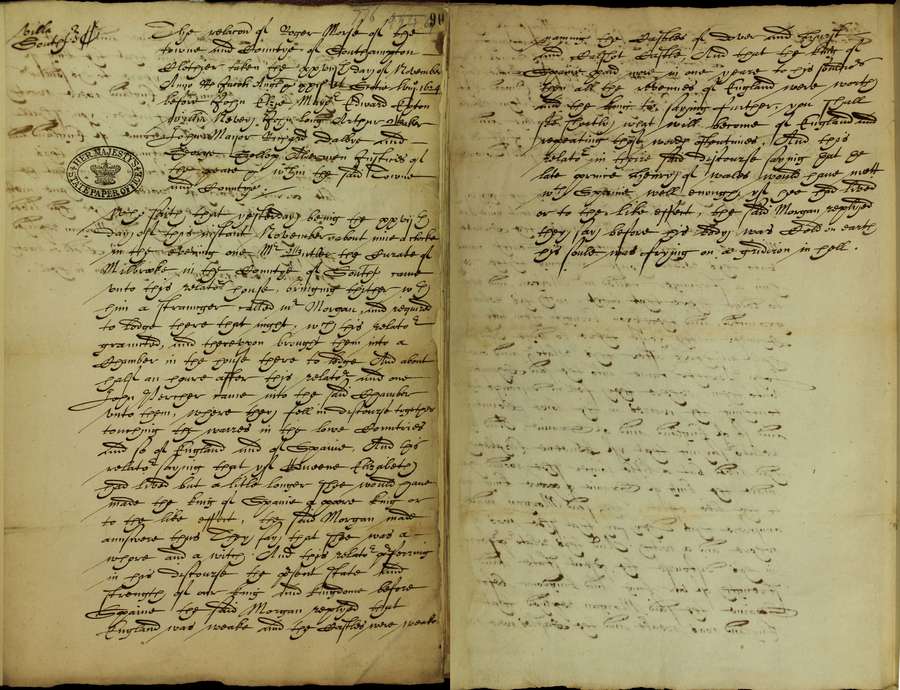
It was not just ordinary people who were accused of witchcraft. Accusing the monarch of being a witch was dangerous, which is probably why this report, where a ‘stranger’ slandered Queen Elizabeth and Prince Henry (the late son of King James I), made its way into the hands of the Secretary of State.

[Page one]
The relation of Roger Morse of the
town and county of Southampton
Clothier taken the xxvij [27th] day of November
1624
Before John Elvie, Mayor, Edward Epton
William Movey, John Long, Arthur Baker
John Mayor, Richard Dalby and
George Gallop Alderman Justices of
the peace within the said town
and county
Morse says that yesterday being the xxviij [28th]
day of this instant November about nine o’clock
in the evening one Mr Butler the curate of
Milbrooke in the county of Southampton came
unto this relator’s house, bringing thither with
him a stranger called Mr Morgan, and required
to lodge there that night, which this relator
granted, and thereupon brought them into a
chamber in the house there to lodge and about
half an hour after this relator and one
John Percher came into the said chamber
unto them, where they fell in discourse together
touching the wars in the Low Countries
and so of England and of Spain. And this
relator saying that if Queen Elizabeth
had lived but a little longer she would have
made the King of Spain a poor King or
to the like effect, the said Morgan made
answer this: They say that she was a
whore and a witch. And this relator performing
in this discourse the present state and
strength of our King and Kingdom before
Spain the said Morgan replied that
England was weak and the Castles were weak
[Page two]
naming the Castles of Dover and Hurst
and Calshot Castle. And that the King
of Spain paid more in one year to his soldiers
than all the revenues of England were worth
…Saying further, you shall
see what will become of England and
repeating those words oftentimes. And this
relator in their said discourse saying that the
late prince Henry of Wales would have met
with Spain well enough, if he had lived
or to the like effect, the said Morgan replied
they say before his body was cold on earth
his soul was frying on a gridiron [a hot grill for cooking] in hell
Report accusing Queen Elizabeth I and Prince Henry of witchcraft, 28 November 1624. Catalogue reference: SP 14/175 f.90
Listen
Accusing Queen Elizabeth I and Prince Henry of witchcraft.
It was not just ordinary people who were accused of witchcraft. Accusing the monarch of being a witch was dangerous, which is probably why this report, where a ‘stranger’ slandered Queen Elizabeth and Prince Henry (the late son of King James I), made its way into the hands of the Secretary of State, 28 November, 1624.
[Page one]
The relation of Roger Morse of the
town and county of Southampton
Clothier taken the 27th day of November
1624
Before John Elvie, Mayor, Edward Epton
William Movey, John Long, Arthur Baker
John Mayor, Richard Dalby and
George Gallop Alderman Justices of
the peace within the said town
and county
Morse says that yesterday being the 28th
day of this instant November about nine o’clock
in the evening one Mr Butler the curate of
Milbrooke in the county of Southampton came
unto this relator’s house, bringing thither with
him a stranger called Mr Morgan, and required
to lodge there that night, which this relator
granted, and thereupon brought them into a
chamber in the house there to lodge and about
half an hour after this relator and one
John Percher came into the said chamber
unto them, where they fell in discourse together
touching the wars in the Low Countries
and so of England and of Spain. And this
relator saying that if Queen Elizabeth
had lived but a little longer she would have
made the King of Spain a poor King or
to the like effect, the said Morgan made
answer this: They say that she was a
whore and a witch. And this relator performing
in this discourse the present state and
strength of our King and Kingdom before
Spain the said Morgan replied that
England was weak and the Castles were weak
[Page two]
naming the Castles of Dover and Hurst
and Calshot Castle. And that the King
of Spain paid more in one year to his soldiers
than all the revenues of England were worth
…Saying further, you shall
see what will become of England and
repeating those words oftentimes. And this
relator in their said discourse saying that the
late prince Henry of Wales would have met
with Spain well enough, if he had lived
or to the like effect, the said Morgan replied
they say before his body was cold on earth
his soul was frying on a gridiron in hell.
This source, which is the testimony of a witness in a witchcraft trial, contains some of the reasons why neighbours might accuse each other of witchcraft. It shows how they could be quite every-day concerns but that they led to very supernatural accusations.

The Information of Richard Jackson of Wakefield
taking upon oath the 7th of June
1656
Who says that he being tenant to Mr Stringer of Sharlston
for a farm called by the name of Bunny Hall near
Wakefield one Jennett Benton and George Benton her son
pretended to have a high way through the grounds
belonging to the said farm which one Daniel Crave,
servant to the said Richard Jackson & by his master
appointed, did endeavour to hinder upon which the said George Benton
cast a stone at him, the said Craven, where with he cut
his lip and broke two teeth out of his chaps. So
an action being brought against the said George Benton
for the trespass, which was submitted unto by him, & endeavoured
to end the difference, which was composed & satisfaction
given unto the said Craven. After which the said Jennett
Benton & George Benton her son did utter these speeches:
that it should be a dear day’s work unto the said Richard
Jackson or to his, before the year went about. Since
which time his wife hath had her hearing taking from
her, a child strangely taken with fits in the night time
Also being formerly of healthful body have
been suddenly taken without probably reason to be given or
natural cause appearing, being sometimes in such extremity
that he conceived himself drawn in pieces at the heart, back
and shoulder and that in the beginning of these fits the first night
he heard a great noise of music & dancing about him.
The next night, about twelve of the clock, he was taken with another
fit & in the middle of it he conceives there was a noise like
ringing of small bells with singing & dancing and sometime
both nights a noise of deep groaning upon which he called of his wife
and asked her if she heard it not & so of his man who answered they
did not he asked them again & again if they heard it not at last
his wife and servant all heard it gave three hard groans and at that instant
dogs did howl and yell and the window as though they would have pulled
them in pieces. He had also a great many swine which broke through
two barn doors, also the door in the house, at that time [clapped] to and
from the boxes and trunks as they conceived was removed, and several
apparitions like black dogs and cats were seen in the house & the informer
further says that since the time that the said Jennett Benton and George
Benton threatened him he hath lost his horses and means and that he
conceives he hath had all the loss by the use and practise of some witch-
craft or sorcery by the said Jennett Benton and George Benton
Testimony accusing Jennet and George Benton of witchcraft, 7 June 1656. Catalogue reference: ASSI 45/5/3/5
Listen
Accusing Jennet and George Benton of witchcraft.
This source, which is the testimony of a witness in a witchcraft trial, contains some of the reasons why neighbours might accuse each other of witchcraft. It shows how they could be quite every-day concerns but that they led to very supernatural accusations, 7 June, 1656.
The Information of Richard Jackson of Wakefield
taking upon oath the 7th of June
1656
Who says that he being tenant to Mr Stringer of Sharlston
for a farm called by the name of Bunny Hall near
Wakefield one Jennett Benton and George Benton her son
pretended to have a high way through the grounds
belonging to the said farm which one Daniel Crave,
servant to the said Richard Jackson & by his master
appointed, did endeavour to hinder upon which the said George Benton
cast a stone at him, the said Craven, where with he cut
his lip and broke two teeth out of his chaps. So
an action being brought against the said George Benton
for the trespass, which was submitted unto by him, & endeavoured
to end the difference, which was composed & satisfaction
given unto the said Craven. After which the said Jennett
Benton & George Benton her son did utter these speeches:
that it should be a dear day’s work unto the said Richard
Jackson or to his, before the year went about. Since
which time his wife hath had her hearing taking from
her, a child strangely taken with fits in the night time
Also being formerly of healthful body have
been suddenly taken without probably reason to be given or
natural cause appearing, being sometimes in such extremity
that he conceived himself drawn in pieces at the heart, back
and shoulder and that in the beginning of these fits the first night
he heard a great noise of music & dancing about him.
The next night, about twelve of the clock, he was taken with another
fit & in the middle of it he conceives there was a noise like
ringing of small bells with singing & dancing and sometime
both nights a noise of deep groaning upon which he called of his wife
and asked her if she heard it not & so of his man who answered they
did not he asked them again & again if they heard it not at last
his wife and servant all heard it gave three hard groans and at that instant
dogs did howl and yell and the window as though they would have pulled
them in pieces. He had also a great many swine which broke through
two barn doors, also the door in the house, at that time [clapped] to and
from the boxes and trunks as they conceived was removed, and several
apparitions like black dogs and cats were seen in the house & the informer
further says that since the time that the said Jennett Benton and George
Benton threatened him he hath lost his horses and means and that he
conceives he hath had all the loss by the use and practise of some witch-
craft or sorcery by the said Jennett Benton and George Benton.
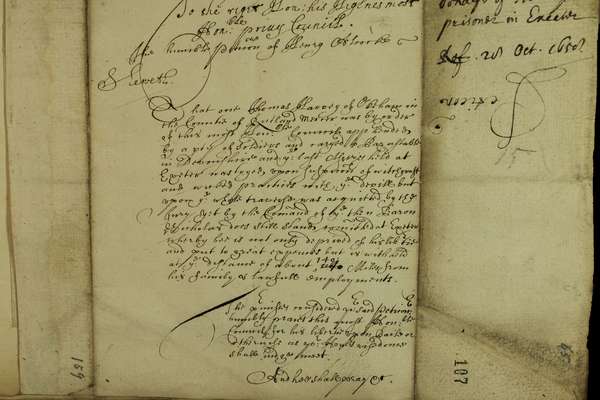
This is a regular piece of correspondence that was sent into the Navy Board, but it contains an unusual detail about what the neighbours of a woman suspected of witchcraft did to her.

[On side of letter]
This day a woman suspected for a witch was put a swimming
by her neighbours for trial until they had drowned her
a piece of such cruelty as I have rarely heard of
[On reverse of letter]
Chatham 13 August 1675
Survey—has seen the
Order about allowing 6 pence
a man a day who works at the
Wrecks—complaining of the
backwardness of their working
–wants timber and plank for the
wharfs—asks directions
about buying Sir Charles Bickerstaff’s
Timber—prays coming to
a speedy resolution—
Trying a woman for a Witch
Drowned her
Letter describing the drowning of a suspected witch, 14 August 1675. Catalogue reference: ADM 106/313/424
Listen
Unnamed witches: a drowned witch.
This is a regular piece of correspondence that was sent into the Navy Board, but it contains an unusual detail about what the neighbours of a woman suspected of witchcraft did to her, 14 August 1675.
[On side of letter]
This day a woman suspected for a witch was put a swimming
by her neighbours for trial until they had drowned her
a piece of such cruelty as I have rarely heard of
[On reverse of letter]
Chatham 13 August 1675
Survey—has seen the
Order about allowing 6 pence
a man a day who works at the
Wrecks—complaining of the
backwardness of their working
–wants timber and plank for the
wharfs—asks directions
about buying Sir Charles Bickerstaff’s
Timber—prays coming to
a speedy resolution—
Trying a woman for a Witch
Drowned her.
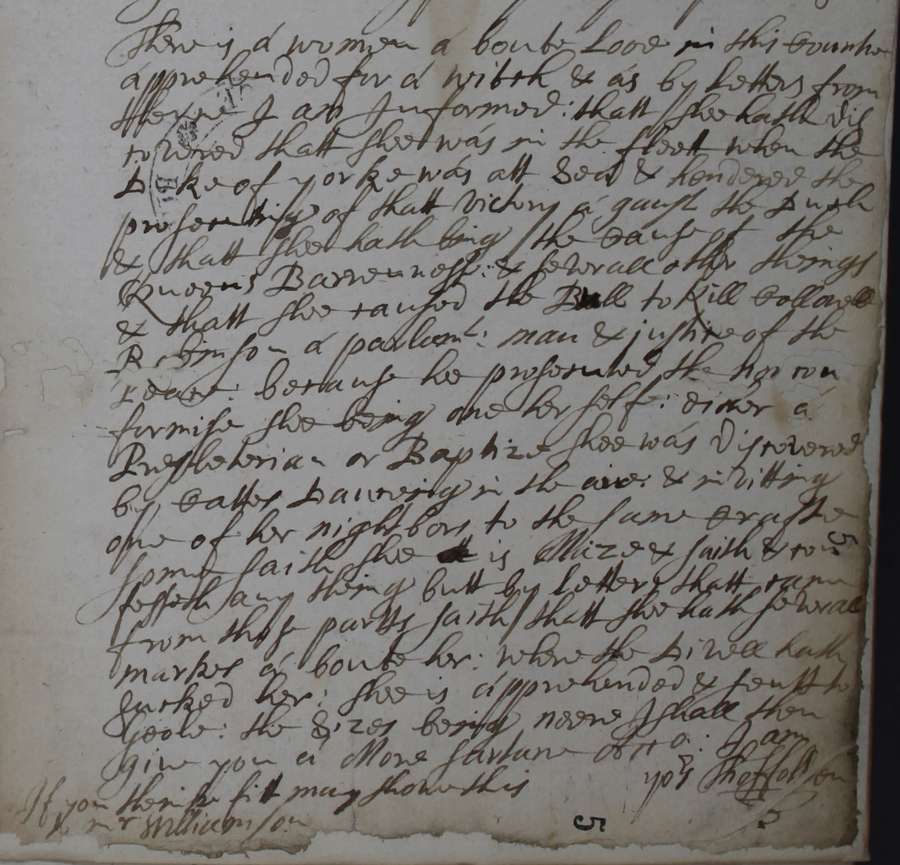
The witch in this source was accused of a range of serious crimes, including causing the Queen’s bareness and the death of an MP. It shows how much witches could be feared and what it was perceived their powers could be.

There is a woman about Looe in this County
apprehended for a witch & is by letters from
[?] I am informed that he hath dis-
covered that she was in the fleet when the
Duke of York was at sea & hindered the
prosecution of that victor against the Dutch
& that she hath been the cause of the
Queen’s barrenness & several other things
& that she caused the bull to kill Colonel
Robinson a parliament man & justice of the
peace because he prosecuted the non con-
formists she being one herself: either a
Presbyterian or a Baptist. She was discovered
by cats bouncing in the air & inviting
one of her neighbours to the same craft.
Some say she is Mize & say & con-
fess anything but by letter that came
from those parts say that she hath several
marks about her where the Devil hath
sucked her. She is apprehended & sent to
Gaol, the Assizes being near I shall then
give you a more certain account.
A suspected witch accused of a range of serious crimes, 27 February 1671. Catalogue reference: SP 29/288 f. 5
Listen
Unnamed witches: a witch at sea.
The witch in this source was accused of a range of serious crimes, including causing the Queen’s bareness and the death of an MP. It shows how much witches could be feared and what it was perceived their powers could be, 27 February, 1671.
Paragraph 3:
There is a woman about Looe in this County
apprehended for a witch & is by letters from
[?] I am informed that he hath dis-
covered that she was in the fleet when the
Duke of York was at sea & hindered the
prosecution of that victor against the Dutch
& that she hath been the cause of the
Queen’s barrenness & several other things
& that she caused the bull to kill Colonel
Robinson a parliament man & justice of the
peace because he prosecuted the non con-
formists she being one herself: either a
Presbyterian or a Baptist. She was discovered
by cats bouncing in the air & inviting
one of her neighbours to the same craft.
Some say she is Mize & say & con-
fess anything but by letter that came
from those parts say that she hath several
marks about her where the Devil hath
sucked her. She is apprehended & sent to
Gaol, the Assizes being near I shall then
give you a more certain account.
This source contains an example of the extreme violence that could be committed against people who were accused of witchcraft.

The man I told you of his name was
Pemberton: an active man in several professions, but a papist and
hath been a teacher over of recusant’s children.[Recusant was English Catholic who refused to attend services of the Church of England]
This man, as the general report is, was
cast out of their Synagogue. Where upon he grew melancholy
seeking by all means to be reconciled again to his former state.
And as it is conveyed (for no man can prove their secret
passages) had conference with a priest, who after many
delays should tell him that there was no means for his
reconcilement [forgiveness] but to procure [get hold of] the heart of a heretic.
Whereupon (as it seems) he gave out in speeches that he
would kill this woman for (says he) she is a witch.
After a while being at work near the place, he was willed
to come to supper, which quoth [said] he: “But I will kill the witch
first, whereof the messenger laughed as at a jest.”
So he went to the house to come in, the doors were shut (for they
were jealous [mindful] of his words) he bade open the door, they would not, for
it was tight. Then he took up a mighty stone and at
serious assault broke it down. The women came out
backward to a neighbour’s house. But he fell first upon the
men & with a whittle like a butcher’s knife gave him fifty wounds.
Then he followed the women, but a maid resisting him got five
great wounds and he would have killed her, unless she told him
where the witch was. Whereof she told him under the bed.
He came into the chamber door, pulled her out, cut her throat
so wide it lay upon her bosom. Ripped down her breast
but could not get his hand in for the bone. Then he ripped
her up the belly, thrust in his arm & caught a piece of her
[?] with his knife in one hand and liver in the other. Bragging
openly he had killed the witch, there was her heart. And
now he cared not what became of him.
Account of the murder of a person suspected of witchcraft, 2 December 1625. Catalogue reference: SP 16/11 f. 5
Listen
Unnamed witches: a murdered witch.
This source contains an example of the extreme violence that could be committed against people who were accused of witchcraft, 2 December, 1625.
The man I told you of his name was
Pemberton: an active man in several professions, but a papist and
hath been a teacher over of recusant’s children.
This man, as the general report is, was
cast out of their Synagogue. Where upon he grew melancholy
seeking by all means to be reconciled again to his former state.
And as it is conveyed (for no man can prove their secret
passages) had conference with a priest, who after many
delays should tell him that there was no means for his
reconcilement but to procure the heart of a heretic.
Whereupon (as it seems) he gave out in speeches that he
would kill this woman for (says he) she is a witch.
After a while being at work near the place, he was willed
to come to supper, which quoth he: “But I will kill the witch
first, whereof the messenger laughed as at a jest.”
So he went to the house to come in, the doors were shut (for they
were jealous of his words) he bade open the door, they would not, for
it was tight. Then he took up a mighty stone and at
serious assault broke it down. The women came out
backward to a neighbour’s house. But he fell first upon the
men & with a whittle like a butcher’s knife gave him fifty wounds.
Then he followed the women, but a maid resisting him got five
great wounds and he would have killed her, unless she told him
where the witch was. Whereof she told him under the bed.
He came into the chamber door, pulled her out, cut her throat
so wide it lay upon her bosom. Ripped down her breast
but could not get his hand in for the bone. Then he ripped
her up the belly, thrust in his arm & caught a piece of her
[?] with his knife in one hand and liver in the other. Bragging
openly he had killed the witch, there was her heart. And
now he cared not what became of him.
It was not just women who were accused of witchcraft. This source, which is the account of some men who lived in the parish of Edmonton, contains the story of them witnessing two men in the act of witchcraft.

May it please your worships to understand that we John Gilbert
and John Holmead servants to Humfrey Weld citizen and grocer of London
being at our master’s house at Southstreet in the parish of Edmonton
the xxj [21st ] day of this instant month of September were commanded
by the constables with others to make search for certain men which
were about the act of witchcraft or conjuring. Which men we found
in the field or close of one Robert Hewes otherwise called Robert Carpenter
which ij [2] conjurers when they espied us one of them fled away, but the other
of them we took with certain Latin books about him, which are to be seen.
Divers [various] others returned to their cabin which they had made under a great
tree in the said close of the said Robert Hewes with certain circles on
the ground within the said cabin and one of the said circles was laid
about with parchment written upon with crosses. And by the said cabin
we found a stool with divers pots by the same stool and a red
cock [chicken] being dead by it, and again by the said stool a fair crystal
stone with this word (Satan) written on it. Also a parchment
written with three or four seals of yellow wax at the same
we found also in the same cabin a Cope (cape worn by churchmen) Sirpler [surplice or church tunic] a Crown
a Sceptre and a fair broad sword ready drawn being set up against
the tree and divers other books and writings and a piece of brass
gilded with divers letters graven upon it, and powders and ratsbane [arsenic]
which the party that fled strewed in the way disappointing thereby
our blood hound. And the party which we took had about him the
picture of Christ on the cross hanging behind his back under his
doublet & on the same string before him the picture of serpents or
such like. And the said party was brought by the Constables before
Mr Justice Clark to be examined, and we understand that the said
conjurer is let go upon security to answer the same at the next
sessions
Account of two men witnessed practicing witchcraft, 20 September 1590. Catalogue reference: SP 12/233 f. 126
Listen
Unnamed witches: the men of Edmonton.
It was not just women who were accused of witchcraft. This source, which is the account of some men who lived in the parish of Edmonton, contains the story of them witnessing two men in the act of witchcraft. 20 September, 1590.
May it please your worships to understand that we John Gilbert
and John Holmead servants to Humfrey Weld citizen and grocer of London
being at our master’s house at Southstreet in the parish of Edmonton
the 21st day of this instant month of September were commanded
by the constables with others to make search for certain men which
were about the act of witchcraft or conjuring. Which men we found
in the field or close of one Robert Hewes otherwise called Robert Carpenter
which 2 conjurers when they espied us one of them fled away, but the other
of them we took with certain Latin books about him, which are to be seen.
Divers others returned to their cabin which they had made under a great
tree in the said close of the said Robert Hewes with certain circles on
the ground within the said cabin and one of the said circles was laid
about with parchment written upon with crosses. And by the said cabin
we found a stool with divers pots by the same stool and a red
cock [chicken] being dead by it, and again by the said stool a fair crystal
stone with this word (Satan) written on it. Also a parchment
written with three or four seals of yellow wax at the same
we found also in the same cabin a Cope (cape worn by churchmen) Sirpler a Crown
a Sceptre and a fair broad sword ready drawn being set up against
the tree and divers other books and writings and a piece of brass
gilded with divers letters graven upon it, and powders and ratsbane
which the party that fled strewed in the way disappointing thereby
our blood hound. And the party which we took had about him the
picture of Christ on the cross hanging behind his back under his
doublet & on the same string before him the picture of serpents or
such like. And the said party was brought by the Constables before
Mr Justice Clark to be examined, and we understand that the said
conjurer is let go upon security to answer the same at the next
sessions
In this source, Agnes Whittenbery is accused of bewitching to death two hogs which were the goods and chattels [possessions] of Francis Combes. It is written in Latin on a piece of parchment.

Indictment charging Agnes Whittenbery with witchcraft, 25 March 1601. Catalogue reference: ASSI 35/45/3
This poster design was registered at Stationers’ Hall under the Copyright Acts in force from 1842 to 1912.

Poster advertising Brock’s Flying Witch fireworks. Catalogue reference: COPY 1/272/1 (30)

Photograph of an oil painting by Decamps titled ‘The Witches in Macbeth’, 30 September 1904. Catalogue reference: COPY 1/477/660

Image captioned ‘Drawing of crest design for albums. An old witch with pointed hat and cloak (with small crosses) and high-heeled shoes on, wand in her right hand, pipe in her hat band, and riding on a broom’, 30 November 1869. Catalogue reference: COPY 1/15/757
Through this set of documents students could explore questions such as how the persecution of witches was instigated, encouraged or enabled by the authorities or communities. How was the church involved? What type of people experienced persecution? Were some people pretending to be witches and why? Were both men and women involved? What was the possible impact of printed material on the witch craze? What general conclusions can students draw from considering this group of documents as a whole? How could study of the topic be extended?
It is hoped that these documents will offer students a chance to develop their powers of evaluation and analysis concerning aspects of popular culture and the witch craze in the 17th century and beyond. They might consider how these aspects have been interpreted in debates between historians and social scientists.
Taking it further students could be encouraged to find out more about the legacy of medieval and 15th-century attitudes, beliefs and reactions to heresy, demonology and witches (e.g. Nider’s Formicarius) and what ultimately prompted decriminalisation.
Finally teachers could also use the collection to develop their own resources or encourage students to ‘curate’ their own ‘exhibition’ of the most significant sources on the topic. Please note that some sources contain sensitive material so use with care. Transcripts have been modernised in terms of spelling, with some additional punctuation added, some words have been defined within the text using square brackets. The lines in the transcripts are numbered to help users find their place when using to the original document.
Edexcel: A Level History:
OCR History A H505 Y312 Unit:
In early modern society there was a genuine fear of witchcraft, and those suspected of consorting with the Devil could be put on trial and executed, occasionally in large numbers. From a modern perspective, the so-called ‘witch crazes’ can be difficult to understand. What sorts of people were accused of witchcraft? Why? How genuine were people’s suspicions? And what evidence was required for somebody to be executed? This resource helps to highlight some of the reasons why people were accused of witchcraft, who they were, and what happened to them as a result.
The fear of witches, witchcraft, and bewitchment originated in the medieval period, when the Roman Catholic Church taught the dangers of witchcraft. Printed texts, such as Malleus Maleficarum, illustrated the horrors of witchcraft. Witchcraft remained within the popular imagination into the early modern period, and after the Reformation it was still perceived to be a threat to the church and a well-ordered society.
In times of uncertainty and upheaval, witchcraft accusations would increase, and so there were often more witchcraft accusations during times of war and famine. General fears of witchcraft within society could also feed into specific accusations that originated within a local community, so that somebody disliked by their neighbours might be more vulnerable to being accused.
In this resource there are lots of examples of ordinary people being accused of witchcraft by their neighbours. One example is Joan Guppie, whose neighbours believed her to be a witch and who took it upon themselves to try to punish her. There were also waves of accusations as groups of people were rounded up and put on trial together, such as the Lancaster witches: a group of women who were tried together 20 years after the famous Pendle witch trials.
Witchcraft was particularly associated with women in the early modern period, and this continued into the modern era. In this resource there are several examples of modern images of witches who were women, often riding on broomsticks with a pointy hat: the image that we most associate with witchcraft today. However, an image of a witch taken from the seventeenth century shows some aspects of this witchcraft stereotype have been around for a long time.
Women were more likely to be accused because of the church’s teaching that women were the weaker sex, seen as more vulnerable to the seductive powers of the Devil. Therefore, accusations of witchcraft became another way for women to be oppressed in early modern society. However, men were also suspected and accused of witchcraft, such as the male witches of Edmonton.
Lots of the sources in this resource are legal documents that relate to witchcraft trials. When a person was accused of witchcraft an Indictment would be drawn up, then witnesses would be called, an examination of the accused would be carried out, and then sometimes a confession drawn out, possibly with torture. Those found guilty would be executed.
Not all accusations of witchcraft were believed, however. Even in this period, people were suspicious of attempts to pretend to be bewitched, or pretending to be a witch, and were aware that not all cases of witchcraft were genuine. For example, in this resource is the case of Katherine Malpas, whose relatives pretended she was a witch for their own financial benefit.
Witchcraft caused great fear within society, but it also often became a function of normal life. Somebody new to a community might be accused of witchcraft because his or her neighbours were suspicious of them. Sometimes a person might pretend to be bewitched because it was a way of making money. People were more suspicious of witchcraft when the harvest failed, as they looked to find a cause. Witchcraft trials became ways for grievances and disputes to be aired, and for people to stand in testimony for or against their neighbours.
In many ways, therefore, understanding the history of witchcraft tells us less about the supernatural than it does about the realities of everyday life for ordinary people in early modern England.
Background information written by Dr Hannah Worthen (University of Hull).
Teaching resource
This set of documents relates to the witch craze in 17th-century England, focusing on beliefs, behaviours and legal processes.
In pictures
Accusations of witchcraft resulted in the trials of thousands of people in the early modern period, mostly women. Our records give descriptions of many cases.
youtube.com
A 30-minute talk featuring some of the documents in this resource by The National Archives' Dr Jessica Nelson.
witches.hca.ed.ac.uk
Use the Edinburgh University Survey of Scottish Witchcraft Database, which includes nearly 4,000 records of accused witches and documents on witchcraft belief.
sourcebooks.fordham.edu
A short collection of primary sources on the witch craze, including an extract from the Papal Bull of 1484 and Nider’s Formicarius.
oldbaileyonline.org
Detailed proceedings (although not entire transcripts) for trials at the London central criminal court. Search for witchcraft cases for the period 1679 to 1772.