Teaching resource
Medieval castles
Use this lesson with original documents to find out more about the role of Framlingham, Portchester, Stokesay, Berwick, Alnwick, and Pevensey castles in medieval society.
- Age range
- Key stage 4 (Ages 14–16)

About this image
Framlingham Castle.
Historic England. English Heritage Trust
About this resource
Time period
- Medieval (900–1485)
Themes
- Local history
- Power, politics and reform
Enquiry question
What can documents tell us about the design and use of medieval castles?
Investigate the sources
-
Source 1: Framlingham Castle demolished 1175
In 1175 a group of carpenters and masons, led by Alnoth the Engineer, travelled to Suffolk to dismantle Framlingham Castle on royal orders. King Henry II ordered that the castle should be knocked down because Earl Hugh Bigod had joined a rebellion against his rule.
-

Transcript
Et in custamento prosternendi castri Waleton’ .XXXj. l. et .viij. s. et. iij. D. per breve regis et per visum Roberti de Willauesham et Ailnođi ingeniatoris. Et pro prosternendo castro de Framingeham .vij. l. et .x. s. et. vj. d. per idem breve et per visum predictorum.
Translation
Payment of £7 10s 6d (seven pounds, ten shillings and six pence) to Alnoth the engineer for dismantling the castle of Framlingham, by order of the king.
Framlingham Castle demolished 1175. Catalogue reference: E372/22, rot. 5, m.1, Pipe Rolls, Henry II, 22, 1175-1176, p. 60
Examine the source
- Do you think this order would have changed Alnoth’s opinion of castles?
- Clue: think about what a castle might represent:
- an intimidating fortress?
- An impressive building?
- An important centre of government?
- A building to be demolished like any other – all part of the day job?
-
-
Source 2: Grant of Portchester Castle by Edward I
In 1273, King Edward I gave Portchester Castle to his mother.
-
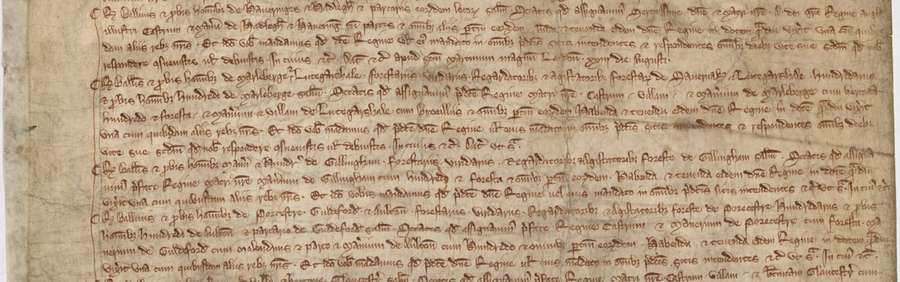
Writ de intendendo [writ of intent] directed to the bailiffs [who kept law and order in a castle], etc. of the following castles manors, etc. assigned in dower [property given by law to a man’s widow in her lifetime] to Eleanor, the king’s mother, queen of England:-
…Bailiffs and good men of Portchester, Guldeford [Guildford] and Aulton [Alton], the foresters, etc. of Porcestre forest, the hundredors and good men of the hundred of Aulton, and the parker of Guldeford – Castle and manor of Porcestre with the forest, manor of Guldeford with the mills and park, manor of Aulton with the hundred [an area of land]…’
Grant of Portchester Castle by Edward I. Catalogue reference: C 66/92 m.5, Calendar of Patent Rolls, 1271-1281, p. 27
Examine the source
- What does Portchester Castle represent for the king?
- What does Portchester Castle represent for Queen Eleanor?
- What does the granting of Portchester Castle mean to the bailiffs of Portchester (the people who worked at the castle)?
-
-
Source 3: Order to arrest spies, 1323–27
This document reveals that King Edward II ordered that Portchester Castle should be garrisoned with soldiers if there was any sign that England might be invaded by forces from abroad. If this were to happen, any people who were suspected of being spies within the castle were to be arrested.
-

To Robert de Hausted, constable of Porchester castle. Order to cause diligent search to be made in all places within his bailiwick [bailiff’s area of control] of all persons entering the realm, and to cause to be arrested all of whom there is probable suspicion that they are entering the realm to spy out the secrets of the realm in order to do certain things prejudicial to the king and his realm, and to certify the king from day to day of the names of those whom he shall thus arrest, as the king learns upon trustworthy information that many armed men, Englishmen and others, coming from parts beyond sea, are entering the realm in the port of Portesmuth [Portsmouth] and in other places on the sea coast in Robert’s bailiwick, and are wandering about secretly in divers [various] parts of the realm for the purposes aforesaid, and no search or arrest has hitherto been made by Robert or his men… 1326. March 10. Merevale.
Order to arrest spies, 1323-27. Catalogue reference: C 54/143 m. 11d., Close Rolls 1323-1327–19 Edward II Membrane 11d – cont. p. 551
Examine the source
- What does Portchester Castle represent to the king?
- What does Portchester Castle represent to the constable?
- What does Portchester Castle represent to foreign spies?
-
-
Source 4: Order to protect Portchester in times of war, 1323-27
King Edward II ordered that Portchester Castle should be garrisoned with soldiers if there was any sign that England might be invaded by forces from abroad.
-

To him who supplies the place of the treasurer and to the barons of the exchequer and to the chamberlains. Order to provide with all speed, by the advice of Adam de Lymbergh, king’s clerk, 100 crossbows with windlass for two feet, 200 crossbows for one foot, with the baldricks and quarells sufficient for the same, 100 hand-bows with 1,000 cords for the same, 1,000 arrow-heads, 20 lbs. of glue, 100 lbs. of thread suitable for the strings of crossbows, and of catgut as much as shall suffice, and to cause them to be taken to Portchester castle, so that they be there by Sunday the morrow of the Decollation of St. John the Baptist next at the latest, to be delivered to those whom the king shall depute to receive them, giving credence to what Adam shall tell them in this matter on the king’s behalf.’ 1326. Aug. 18. Clarendon
Order to protect the castle in times of war, 1323-27, catalogue ref: C 54/144 m. 10., Close Rolls 1323-1327 – 20 Edward II Membrane 10 – cont. p. 603
Examine the source
- What does Portchester Castle represent to King Edward II?
- What does Portchester Castle represent for foreign invaders?
-
-
Source 5: Building works at Portchester Castle, 1396
This document records that, during the last three years of the reign of King Richard II, at lot of building work took place at Portchester Castle. A new range of domestic buildings – hall, kitchen, chambers and offices – was constructed.
-

Appointment of John Cook of Wykenham and Peter Geveyn to repair all defects in the castle of Porchestre, and to pay by view and control of William Hursel, prior of Suthwyk [Southwick, Hampshire], masons, carpenters and other workmen their wages at the king’s charges. By bill of treasurer. Mandate to the said prior in pursuance. 1396, April 29. Westminster.
Building works at Portchester Castle, 1396, catalogue ref: C 66/343 m.15. Calendar of Patent Rolls, 1391-1396, p. 700
Examine the source
- What does Portchester Castle represent to King Richard II?
- What does Portchester Castle represent to John Cook and Peer Geveyn?
- What does Portchester Castle represent to the masons and carpenters employed to work on the castle?
-
-
Source 6: Forced labour and threat of imprisonment, 1396
This document reveals that those given the responsibility of overseeing the repair and expansion of Portchester Castle struggled to find craftsmen and labourers to work on the project. The King gave them the authority to ‘arrest’ people and force them to work on the castle. If anybody who was arrested refused to work on the castle, they were to be imprisoned.
-

Appointment of John Cook of Wykehamm, Peter Geveyn, Walter Walton, mason, Walter Weston and Thomas Clevere, carpenter, to arrest the masons, carpenters, sawyers, artificers and labourers necessary for the repair and fortification of the castle of Porchestre and set them to work at the king’s chargers, also to provide the necessary stone, lime, lead, boards, tiles, cinders, timber and materials, with power to imprison contrariants. By bill of treasurer. The like of John Grenford, John Wrythoke and Thomas Clopton, for the works at Calais. 1396. April 29. Westminster.
Forced labour and threat of imprisonment, 1396. Catalogue reference: C 66/343 m. 14, Calendar of Patent Rolls, 1391-1396, p. 702
Examine the source
- Compare this document to Source 5.
- Does this change your impression of what Portchester Castle represented for John Cook and Peter Geveyn?
- Does this change your impression of what Portchester Castle represented for the masons and carpenters employed to work on the castle?
-
-
Source 7: Licence to build Stokesay Castle, 1291
The wool merchant Laurence of Ludlow, who had become one of the richest men in England, was granted a licence to fortify his home with a stone wall and ‘crenellations’ [rectangular gaps at intervals along the wall that allowed defenders to shoot arrows/missiles from within the castle].
-

Licence for Lawrence de Lodelawe to strengthen his dwelling-house of Stoke Say, co. Salop, with a wall of stone and lime, and to crenellate the same. 1291. Oct. 19. Hereford.
Licence to build Stokesay Castle, 1291. Catalogue reference: C 66/110 m. 2 continued, Calendar of Patent Rolls, Edward I, 1281-1292, p. 450
Examine the source
- What does Stokesay Castle represent to Lawrence of Ludlow?
- Do you think he wanted to build fortifications around his home?
-
-
Source 8: Pardon for murder, 1326
William Perheved asks to be pardoned for murder because he served in the king’s army at the sieges of several castles.
-

William Perheved requests a grant of pardon regarding the death of William le Sotheren, on account of his service to the king at the sieges of Berwick and Leeds, at Burton upon Trent and in Scotland.
Pardon for murder, 1326. Catalogue reference: SC 8/266/13290
Examine the source
- What do you think castles represented for William Perheved?
-
-
Source 9: Reward for fighting in a siege, 1330
John de Leycestre asks the king to follow up on his promise to reward John for his service in the king’s army during the siege of Berwick.
-

John de Leycestre states that he has served the king as sergeant-at-arms [a type of soldier] in their wars in Scotland, and is still ready to serve him. He asks that he might be given some bailiwick or office in aid of his sustenance, as the king promised to reward him at the siege of Berwick.
Reward for fighting in a siege, 1330. Catalogue reference: SC 8/261/13034
Examine the source
- What does the castle of Berwick represent to John de Leycestre?
-
-
Source 10: The siege of Alnwick, 1474
Following the death of her husband at the siege of Alnwick, lands that belonged to Anneys Wynslow’s family were taken forcibly by a man called Richard Croftus, who then held the lands for ten years. In this document, Anneys asks the Prince of Wales to use his legal power to intervene on her behalf and help her family regain her lands.
-
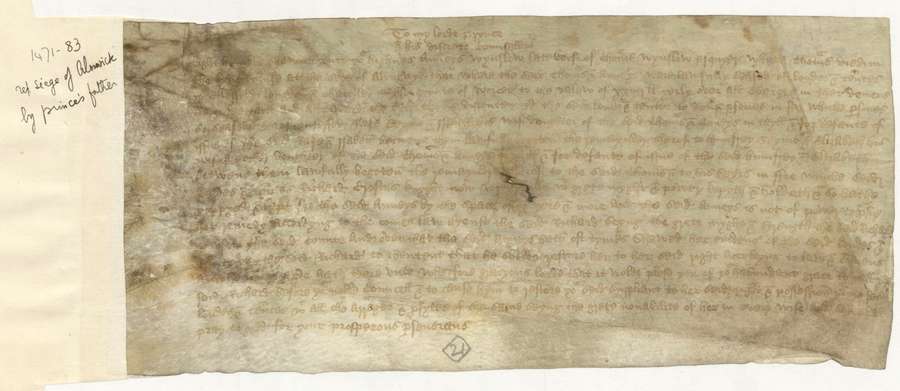
Anneys Wynslow states that her husband, Thomas Wynslow, died in the king’s service at the siege of Alnwick and shows that they were both seised lawfully of land and tenements in Eldersfield, Longdon and Chaceley Hole in fee tail, and afterwards Thomas Wynslow granted the same to certain people in fee, who, when seised, enfeoffed Ralph and Isabel Seymour with the same in tail with remainder to Humphrey and Elizabeth Seymour, and then the right heirs of Thomas. But now Richard Croftus wrongfully holds the same by his might and strength for ten years or more, and Anneys is of insufficient power to pursue her remedy by the common law, and Croftus refuses to restore the same despite Anneys having showed her evidences. Wynslow requests that Croftus be sent before the prince’s council and cause him to restore her to her right and possession in all the lands and tenements with all the arrears and profits.
Woman is robbed of lands following the death of her husband at the siege of Alnwick, 1474. Catalogue reference: SC 8/344/E1309
Examine the source
- What does Alnwick Castle represent to Anneys?
- What does Alnwick Castle represent to Richard Croftus?
-
-
Source 11: Farmers of Pevensey castle petition for a survey for repairs, 1307
This document records the request of the tenant farmers of Pevensey castle as they attempt to maintain the castle buildings.
-

Sussex. To the Treasurer of our lord the king and to the barons of the Exchequer, John Fillol and William Goldyng, farmers of the king’s castle of Pevensey, show that in the said castle there are several serious defects and that if repair is not made in due course then it is about in large part to fall into disrepair, wherefore, for the profit of our lord the king, they pray that a writ be sent to any of the king’s council that he will view and certify this place concerning the defects.
[Endorsement] Sussex. Pevensey. To the treasurer. John Abel is to be assigned by writ under the great seal to survey the castle and the defects, and he is to certify the treasurer and barons.
Farmers of Pevensey castle petition for a survey for repairs, 1307. Catalogue reference: SC 8/331/15663
Examine the source
- What does Pevensey Castle represent to the King?
- What does Pevensey Castle represent to John Fillol and William Goldyng?
- What does Pevensey Castle represent to John Abel?
-










Teachers’ notes
The purpose of this resource is to allow students to explore documents relating to the general function of castles. Did some people find them intimidating? Did a king view a castle in the same way as a peasant? Did a queen think about a castle in the same way as a builder?
The questions provided with each source act as prompts for students to answer the overarching question: What was the purpose and significance of castles?
The records used cover a range of material including royal grants, extracts from pipe rolls and the Calendar of Patent Rolls, royal orders, licences and pardons. We hope that these documents will offer students a chance to develop their powers of evaluation and analysis. All sources have been provided with a transcript and, as the language may prove challenging, we have also provided a simplified version with more difficult words defined within the text. Each source is captioned and dated to provide a sense of what the document is about. Alternatively, teachers may wish to use the sources to develop their own lesson in a different way or combine with other sources.
Connections to the curriculum
Key stage 4 (Ages 14–16)
AQA GCSE History: Britain: Power and the people: c1170 to the present day
OCR GCSE History: Castles: Form and Function c1000-1750
Extension activities
- Carousel activity: compare a range of different castles you have researched.
- Design a castle that suits the needs of the document writers.
- Create a timeline of the 'life' of a castle.
Background information
Norman introduction of castles
The castle as we know it today was introduced into England in 1066 during the Norman invasion led by William the Conqueror. After their victory at the Battle of Hastings, the Normans settled in England. They constructed castles all over the country to control and defend their newly won territory and to pacify the Anglo-Saxon population.
Motte and bailey castles
These early castles were mainly of motte and bailey type. The ‘motte’ was made up of a large mound of earth with a wooden tower on top, while the ‘bailey’ was a large ditch and bank enclosure which surrounded the motte. These timber castles were quite cheap and very quick to build. However, the timber castles did have disadvantages. They were very vulnerable to attacks using fire and the wood would eventually start to rot. Due to these disadvantages, King William ordered that castles should be built in stone. Many of the original timber castles were replaced with stone castles.
Purpose of castles
Over time, stone castles were built in different architectural styles as builders experimented with castle-building techniques. In their infancy, castles were primarily military fortifications used to defend conquered territories from attack. The strategic location of the castle was paramount. However, once the Normans began to consolidate their control over England, castles began to take on a variety of different roles. Castles could serve as a centre for local government, administration and justice. They were also used by powerful lords to display their wealth and power through lavish architectural styles and decoration. Castles were not only built and used by the crown.
Castles and lordship
Most castles were granted by the king to his loyal lords and nobles along with large areas of land. In return for these grants, the king expected his nobles to control and administer these lands on his behalf. The castle itself also represented a whole group of people who contributed to its function including constables, masons, blacksmiths and servants