











Education session
Propaganda: the art of persuasion
This session for key stage 2 students looks at how the British government encouraged people to support the Second World War.
Teaching resource
Sources in this resource include government posters and information leaflets to help students build a picture of how people in Britain prepared for war.

Dig on for victory, 1939-1949. Catalogue reference: INF 3/96
How did people prepare for the war at home?
These are from a series of posters designed to encourage people to grow their own food.

Dig for plenty
Grow food in your garden or allotment.
Dig for Plenty poster, 1939–1946. Catalogue reference: INF 3/98

Dig on for victory poster, 1939–1946. Catalogue reference: INF 3/96

Don't do it mother
Leave your children in the safer areas
Issued by the Ministry of Health
[Hitler] 'Take them back! Take them back! Take them back!...'
Don’t do it, Mother – Leave your children in the safer areas poster. Catalogue reference: INF 13/171
These were leaflets produced during the war.

Gas Raid Quiz No.17
Issued by the Ministry of Home Security
Will you be in great danger if a gas raid comes when you are in a train?
ANSWER
Not if you have your gas mask with you and put it on immediately. The Guard of the train would take charge and decide what was best for the passengers.
Never set out on a journey without your gas mask.
(This space is provided by Whitbread & Co, Limited.)
Gas raid quiz. Catalogue reference: HO 186/2247

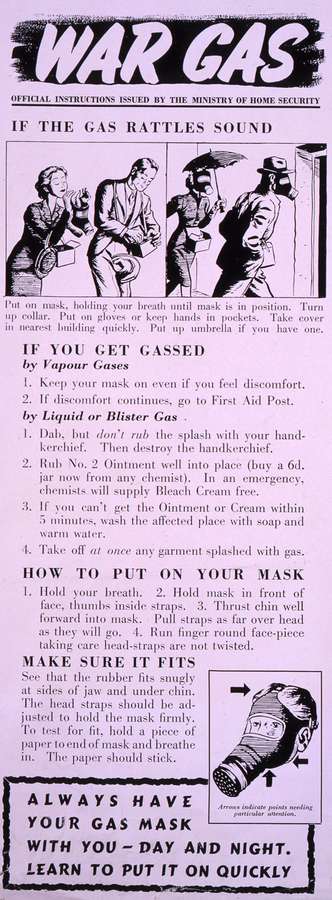
WAR GAS
OFFICIAL INSTRUCTIONS ISSUED BY THE MINISTRY OF HOME SECURITY
IF THE GAS RATTLES SOUND
Put on mask, holding your breath until mask is in position. Turn up collar. Put on gloves or keep hands in pockets. Take cover in nearest building quickly. Put up umbrella if you have one.
IF YOU GET GASED by Vapour gases.
By Liquid or Blister gas.
HOW TO PUT ON YOUR GAS MASK
MAKE SURE IT FITS
See that the rubber fits snugly at sides of jaw and under chin. The head straps should be adjusted to hold the mask firmly. To test for fit, hold a piece of paper to end of mask and breathe in. The paper should stick.
Note with picture of gas mask: Arrows indicate points needing particular attention.
ALWAYS HAVE YOUR GAS MASK WITH YOU - DAY AND NIGHT. LEARN TO PUT IT ON QUICKLY
Gas mask leaflet. Catalogue reference: HO 186/2247.

What to do about GAS
Hints to mothers
In a gas attack, first put on your own mask, then you will be better able to help baby.
MAKE SURE YOUR FAMILY HAVE THEIR GAS MASKS WITH THEM NIGHT & DAY
Gas mask leaflet. Catalogue reference: HO 186/2247

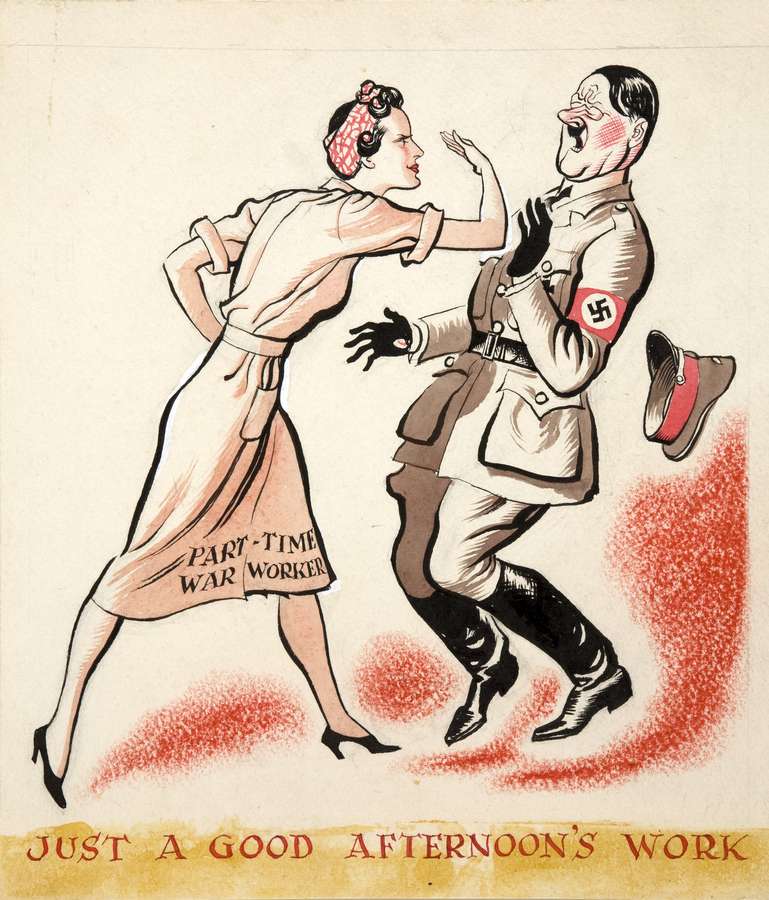
Just a good afternoon’s work poster. Catalogue reference: INF 3/400

AIR RAID PRECAUTIONS
The A.R.P. Warden’s Post for your Sector is:
The nearest First Aid Post is:
These two posts will always be manned during air raids Help or advice upon A.R.P. matters will be given by the local wardens.
The nearest SENIOR WARDEN is:
Ask him for the name and address of your nearest local Warden and make a note of it here: Mr Greenbury 10 Granham Place, Clarence Street Get to know him now and note any changes in the names and addresses given here.
IN CASE OF INJURY
Wounded and gas contaminated casualties who can walk should go direct to the nearest First Aid Post. If you suspect that your clothing has been contaminated by liquid gas, remove the affected garment immediately and place it outside the house, then wash yourself thoroughly. Stretcher cases will be taken to hospitals
GAS MASKS
TAKE CARE OF YOUR GAS MASK. Learn how to put it on and take it off and how to store it properly. Keep it ready for immediate use. If you have no gas mask, or if your mask does not fit or seems out of repair, speak to your Warden about it at once.
LIGHTING RESTRICTIONS
All windows, doors, skylights or openings which would show a light must be screened so that no light can be seen from outside. Do not use a light in a room unless the blind or curtain is drawn and remember that a light at the back of the house is just as visible from the air as one at the front.
AIR RAID WARNING SIGNALS
*WARNING SIGNAL Warbling or intermitent sound on siren. Whistles blown by police and wardens. GAS WARNING Rattles sounded. *RAIDERS PASSED Continuous sound on siren. *ALL CLEAR Handbells ring. When you hear the WARNING Signal TAKE COVER AT ONCE and stay there until you hear the continuous sound on the siren or the ringing of a handbell. Have your Gas Mask with you. If RATTLES have been used warning you of gas, do not come out until you hear HANDBELLS.
FIRE PRECAUTIONS
Be ready to deal with an incendiary bomb. Clear all lumber from your attic NOW, and see tha tyou have easy access to the attic or roof space. Provide two buckets filled with water and, if possible, a stirrup pump with two-purpose nozzle, either producing a spray for dealing with the bomb itself, or producing a jet for tackling the resulting fire. Have a reserve supply of water in buckets or tubs. Leave used water in bath.
If you have no stirrup hand pump, have two buckets of sand or dry earth near the top of the house, and a shovel with a long handle for putting sand on the bomb. After covering the bomb with sand place it in a bucket which has a few inches of sand in the bottom and remove it from the house. Scrape up every particle of burning metal. The resulting fire will have to be extinguished. Buckets of water or a folded blanket kept wet from a bucket of water might be used.
On no account throw water on the bomb or an explosion may result. If you cannot put out the fire send for help to
HANG THIS CARD IN A PERMANENT AND PROMINENT POSITION
Air Raid Precautions card. Catalogue reference: HO 186/2247.
This is a telephone conversation between Mr Cleave and Captain Denaro – a mine laying specialist – in 1940.

Digest of conversation that took place over the ‘phone when Captain Denaro rang me up on Sunday the 22nd of September 1940 at 9.45 a.m.
Hullo. Is that Mr Cleave. Yes, who is that speaking? I am Captain Denaro of the Royal Engineers. Oh yes. About your letter. He said he would not remove the mines. I replied, surely they could be removed to a safer position? He said, he would have the position surveyed. I told him the matter was most urgent, and had counted 13 strewn over the foreshore immediately opposite my house, laying loose and washed about by the tide, and further said, when his men were laying the mines, I pointed out the position in which they were being set would prove a menace, as the battering they would receive from a high tide, and a strong wind, coupled with the further risk of any flotsam and jetsam striking them, would explode them. He said I did not understand the position, and he intended to guard the whole coast. I replied I quite agreed and understood about taking every precaution against an enemy, but he surely did not seriously anticipate, out of the hundreds of miles surrounding the British Isles, the enemy would pick on my 200 feet of foreshore for his invasion plan, and even if he did, the mines would be no deterrent, as they would have already exploded and have done their damage, not to Jerry, but to me. He laughed, and said, they may land anywhere. I replied, yes, but surely the end you are endeavouring to attain, could be so attained without having my property periodically damaged. He asked if I was nervous. I said no, and had yet to learn that objecting to one’s house and home being blown up was a symptom of nervousness, but was apprehensive of having my home blown to blazes. I told him on two separate occasions mines had exploded, and it was not altogether enjoyable expecting at every high tide for more to go off, and I did most strongly object to being blown up by my own people. He suggested I should let the matter drop, and say no more about it, to which I replied, I most certainly did not intend to let the matter drop. He said my letter had threatened him, and although he did not like turning people out of their homes, if I persisted, he would ask for a compulsory evacuation. I replied we had been asked to stick it, and we were going to stick it, and the leaving of the premises would in no way prevent more damage as the matter was at present. I again urged that the mines be removed from the immediate vicinity, and failing this, could they not be properly secured to prevent accidental explosion, but because I lodged a legitimate complaint, to threaten me with expulsion, was only burking the question, and to adopt such an attitude was quite untenable. He again said he would have the position surveyed.

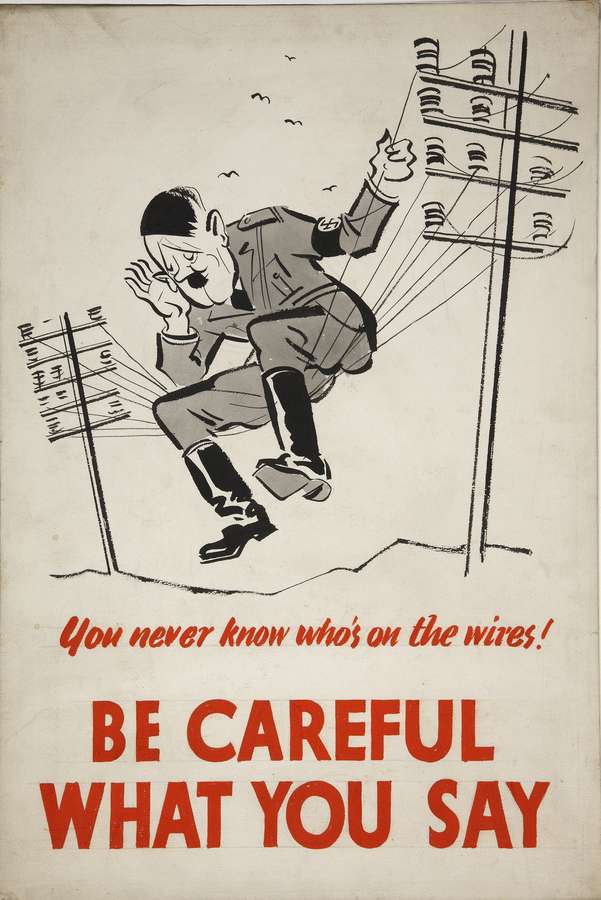
Be careful what you say poster. Catalogue reference: INF 3/232
In this lesson, students look at a series of posters, pictures and leaflets designed to persuade the public to support the war effort on the home front. Teachers may wish for the students to work in pairs or small groups on individual sources and report back to the group.
Source 1 is a ‘Dig for Plenty Poster’ to encourage people to grow their own vegetables to support the war effort. This would help to prevent food shortages as Britain could not import food easily during wartime.
Source 2 is a poster warning against the danger of not evacuating children. The government started a policy of evacuation to send children away from the cities, ports and industrial areas which were bomb targets to safer rural areas.
Source 3 is a series of leaflets about gas masks. These include instructions on how to put them on, why and when they must be carried and what to do if you are injured by different types of gas.
Source 4 is a poster used to encourage women to work during the war because it will help to defeat Hitler.
Source 5 concerns air precautions. There is an information leaflet which explains how to protect yourself during air raids, warning signals for air raids and information about where to get help.
Source 6 is an extract of a telephone conversation between a member of the public; Mr Cleave and a mine laying specialist in 1940. Mines had been laid on the beach to protect the coastline very near his home and he felt that there was danger of his house exploding by accident. The final source is a reminder to the public that careless talk is dangerous. Conversations can be overheard.
Literacy
Political and social reform
The Second World War
Britain started to prepare for the Second World War at least a year before it started. In 1938, the government began to build new warships and increase its armaments. However, this war would not just involve soldiers. The government expected the war to disrupt and threaten the lives of civilians left at home.
Between 1938 and 1939, the government started to take precautions. The population was encouraged to plant vegetables on any spare land to supplement the rationing. People were recruited into a variety of essential positions such as Air Raid Wardens and the Home Guard. Everyone was asked to think about their safety, and the government spent a great deal of time educating people on what to do in situations such as an air raid, or a gas attack, as well as providing information on how to make rations stretch further and how to keep healthy.
Evacuation plans had been in preparation well before the outbreak of war. Small-scale evacuation of women and children were carried out in September 1938, but the real evacuation began in September 1939. The government had planned to evacuate about three million people but in the end only one million left their homes. Soon after war was declared on 3 September 1939, almost all of them had been evacuated from the danger areas to the reception areas.
The biggest danger came from air raids. Air raids meant both danger and disruption. 60,595 civilians died because of enemy action in the UK. Homes, workplaces and public buildings were destroyed. Streets were subject to the ‘blackout’ – lighting restrictions – and the ban on street lighting caused a huge rise in car accidents. Volunteers were needed to be trained in civil defence duties. These included firefighting, first aid and ambulance driving. Civilians were instructed in how to protect themselves against poison gas attacks and issued with gas masks, which they were encouraged to carry on all journeys. Fortunately, poison gas was never used as a weapon in Britain. They were also given materials to build air raid shelters in the backyards. Strong buildings were also prepared for use as air raid shelters.
The working lives of most of the adult population changed with the outbreak of war. To fight the war, men aged between 18 and 41 were needed in the navy and army. This would take them away from their jobs in factories and farms. To fill the shortage, women were recruited for jobs previously done by men. Women worked in the factories, constructing weapons and many others joined the Land Army to work on farms.
Much of the food, clothes and fuel which Britain needed came from abroad. The war disrupted and prevented these supplies from arriving. This meant shortages of the essentials to keep life going. In 1940, rationing was introduced in Britain. The ration book became indispensable for every man, woman and child, ensuring a fair distribution of what meagre essentials were available. The government also tried to encourage people to grow food on every available piece of land.
Another danger was from invasion. When in 1940 the Channel Isles fell into German hands and it looked as though the RAF was loosing the Battle of Britain, the government called on volunteers to join the Home Guard – Dad’s Army – to help defend Britain from attack.
Education session
This session for key stage 2 students looks at how the British government encouraged people to support the Second World War.
In pictures
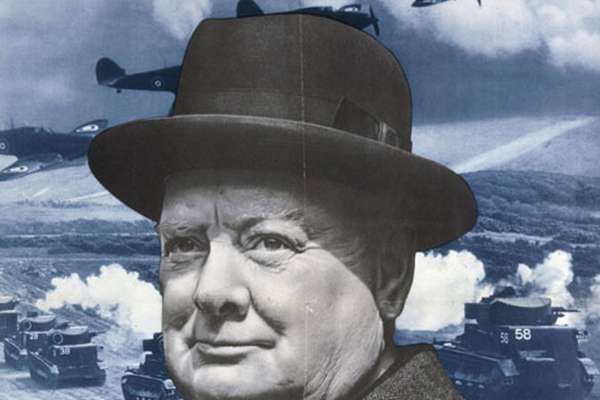
This picture gallery features ten further examples of British Second World War propaganda posters from our collection.