Main section
Tabs Navigation
Tabs
Diversity in collecting
There has been very little change in the main types of records collected since we started analysing this data in 2016. Material related to the church, schools, parishes and councils dominate descriptions. ‘Family’ and ‘war’ also feature prominently as key word terms.
Regional and archive-type variations suggest that diversity-focused collecting is strongest in university and specialist archives, particularly in the South West and South East, but it is still limited. There were less than 100 collections by Black and Minority Ethnic creators or that related to religious traditions outside Christianity, such as Islam, Judaism, Hinduism, Buddhism, or spiritualist movements.
In contrast, there were more than 1000 church-related collections, primarily Anglican parish records. This disparity suggests that ethnic and religious diversity is still significantly underrepresented in archival collecting. Given the demographic makeup of the UK, where ethnic minorities account for around 18% of the population and non-Christian religions are practiced by over 8%, the archival representation falls short of reflecting these communities proportionally. The picture is slightly better for collections related to LQTBQ+ themes but remains limited.
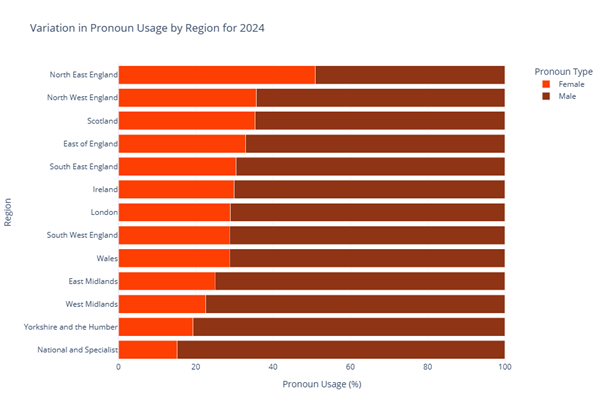
There continues to be an imbalance in gender representation in the data. When considering pronouns in the dataset, 72% are male compared to 27% female. This is a slight widening of the gender gap compared to 2023 when 33% of record creators were identified as being female or using female pronouns.
Moreover, the dominance of church, school, council, and parish records – many of which are institutional and administrative – suggests that archives still lean heavily toward documenting formal structures rather than lived experiences of diverse communities, although there are signs of this changing.
New burdens funding
The New Burdens funding programme was established to support UK archives in collecting and preserving eligible public records following the transition from the 30-year rule to the 20-year rule for transferring these records to places of deposit. This legislative shift accelerated the rate at which records became eligible for transfer, placing increased demands on local and regional archives. The programme aimed to support these institutions in managing the influx of records.
Over its 10-year duration, the programme enabled the accession of over 14,374 linear meters of public records and distributed more than £6.6 million in funding to 98 participating archives across England and Wales. 20 places of deposit did not report accessioning eligible public records or did not engage with the programme.
In 2024, the last year of the scheme, 55 archives collected 2780.61lm of eligible public records, the highest volume since the scheme began, receiving £237.35 per linear metre. Glamorgan Archives accessioned the largest quantity in 2024, consisting mainly of magistrate court records, receiving £132,512.5.
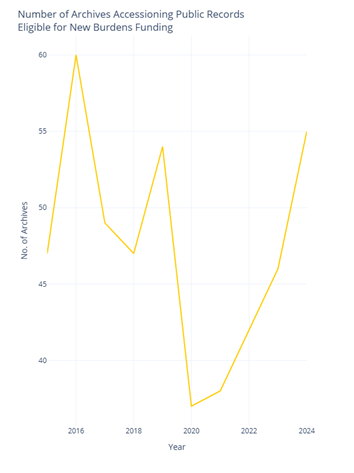
From the 98 places of deposit that participated, only 8 took in eligible public records for all 10 years that the programme was active. The number of participating archives varied annually, with a peak of 60 archives in 2016 and a low of 37 in 2020, likely impacted by the COVID-19 pandemic. North West England had the highest number of participating archives (17), followed by Yorkshire and the Humber (14) and then the West Midlands and Wales (each with 12). In terms of funding, archives in the West Midlands and the South East collectively received the most at over £900,000 for each region.
The top 5 archives by total payment received were The London Archives, Birmingham Archives, Glamorgan Archives, West Yorkshire Archive Service in Wakefield and Derbyshire Record Office, which collectively received more than 25% of the available funding.
Coroner courts were also able to benefit from New Burdens funding to cover the increased activity during the transition from the 30-year to 20-year rule. During this period, 50 coroner courts transferred just over 1970 lm of records to places of deposit, of which 353.7lm was transferred in 2024. Only one court, Yorkshire West Western transferred material every year of the programme, but Birmingham and Solihull transferred the most records overall, receiving £61,586.69 in funding. 37 coroner courts did not participate in the scheme.
The New Burdens programme played an important role in helping archives and coroner courts adapt to the accelerated transfer of public records under the 20-year rule. However, excluding magistrate court material, the rate of transfer and accession of public records remained low. Relatively few organisations engaged with the programme every year, resulting in the top 10 collecting or transferring institutions gaining more than half the total funding.
Public records
Over the last ten years, Magistrates Court records have consistently made up the largest quantity of public records transferred to archives, accounting for over 10,100 linear meters—more than 70% of the total volume of public records accessioned. Regionally, these records have been widely collected, with the West Midlands, Wales, and North West England leading in volume. Places of deposit in London have also contributed significantly, taking in over 1,100 linear meters of Magistrates Court records.
Coroner Court records formed the second largest category collected, totalling nearly 1,970 linear meters. Archives in Yorkshire and the Humber and the West Midlands have been the most active in accessioning these records, each collecting nearly 500 linear meters. NHS records followed closely, with 1,961 linear meters accessioned, and South East England has emerged as the leading region in this category, reflecting the density of healthcare institutions in the area.
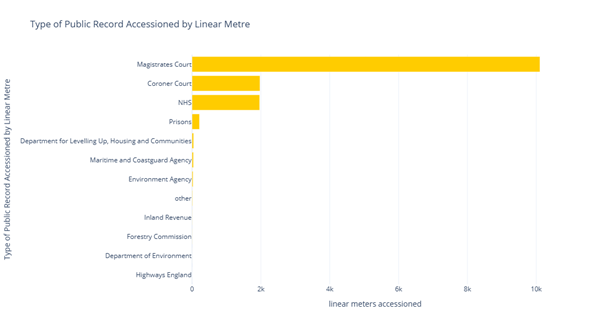
Smaller collections have come from Prisons (213 lm), the Department for Levelling Up, Housing and Communities (43 lm), and the Maritime and Coastguard Agency (37 lm). The South West region has been particularly active in acquiring maritime records, while the East of England and South East England has led in records from the Department for Levelling Up. Regionally, the West Midlands has consistently led in total volume, particularly for Magistrates and Coroner Court records.
Over time, the volume of public records accessioned has fluctuated significantly. There was a steady increase, peaking in 2016 and 2019, before a sharp decline in 2020 due to the COVID-19 pandemic. 2024, the final year in which archives could claim New Burdens funding, saw a considerable resurgence, with nearly 2,800 linear meters accessioned—the highest of any year since 2015. This surge was driven primarily by a collection spike of Magistrates Court records, which more than doubled compared to the previous year.
At the institutional level, Birmingham Archives has accessioned the most Magistrates Court records, while West Yorkshire Archive Service in Wakefield has led in Coroner Court records. The Centre for Buckinghamshire Studies has been the top archive for NHS records, reflecting its strategic focus on health-related collections.
Digital records
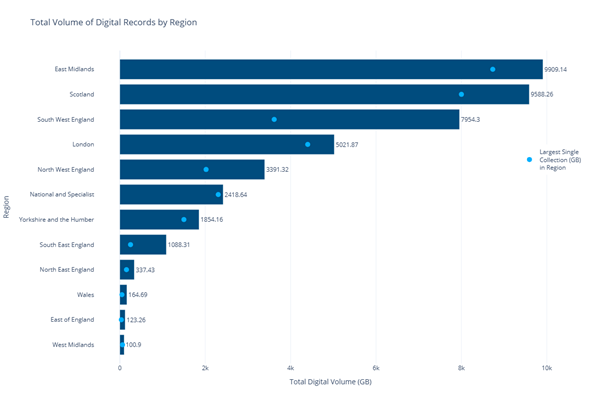
Digital collecting in 2024 was more substantial than in previous years, with more than 40 TB of material accessioned across 840 collections. This is a considerable increase from 2023 when archives collected 17.2 TB of digital material across 762 collections. This remains small compared to analogue records, but the volume and distribution suggest growing capacity and interest in digital preservation – especially among university and local archives.
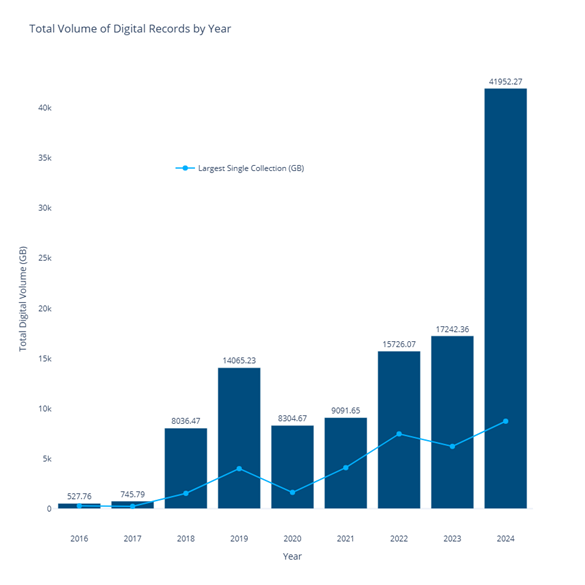
Digital collecting varied widely across regions, with archives in some areas such as Wales, East of England, and North East England collecting under 500 GB overall. Repositories in the East Midlands, by contrast, collectively acquired nearly 10 TB of digital records – the highest digital volume – and Scottish archives collected just over 9.5TB. 7.9 TB of records were collected by institutions in the South West, and 5.1 TB by archives in London. However, much of this relates to a few large deposits.
Leicester University Library, Special Collections accessioned the largest digital collection, 8.73 TB of internal transfers from the University of Leicester, which accounts for more than 80% of the total volume of reported digital records accessioned in the East Midlands. This is followed closely by Edinburg City Archives, which took in 8 TB of material related to Transport Initiatives Edinburgh Ltd (TIE Ltd).
A significant proportion of digital records from the South West relate to two large deposits from the Geospatial and Aerial Survey teams to the Historic England Archive. Similarly, the Bishopsgate Institute in London took in 4.3TB of digital images and video taken by multidisciplinary artist Orlando Myxx.
Although the picture is improving, just a small number of repositories are still accessioning large digital collections, with the majority collecting only small amounts of digital material and some collecting no digital records at all.