There is huge variation in the types of material collected by archives every year and reported through the accessions survey. These can include medieval manuscripts, community and oral history projects, family and estate papers, archives of businesses and institutional records. Here are some highlights from the 2024 survey:
Kent Archives and Local History Centre
Folio of a register of quittances for ordnance, munitions and field carriages supplied to Dover Castle, expenditure authorised by Privy Seal letters of 4 Oct 1625.
Dover Castle was last used by royalty when French princess Henrietta Maria stayed there in June 1625 on her way to marry the newly crowned Charles I. The Duke of Buckingham, George de Villiers, made some alternations and renovations around this time but the castle had an insignificant role in the English Civil War. It was briefly held by Royalist troops before surrendering to Parliamentarians in 1642.
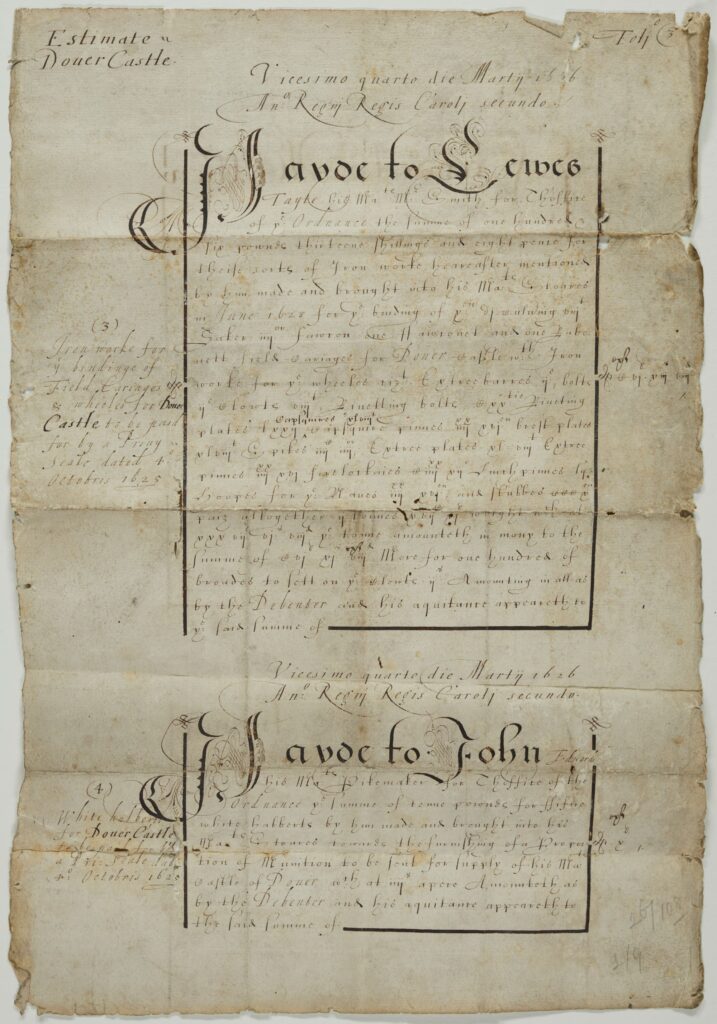
Image credit: Kent Archives and Local History Centre, ref: U1647
Kresen Kernow
Petition to the King, Charles I, to offer to ‘maintain and defend, with their lives and fortunes, [the king] … against all persons whatsoever, according to the oaths of supremacy and allegiance’, subscribed at Lostwithiel, with response dated 1642.
Much of Cornwall was aligned with the Royalist cause during the English Civil War (1642-1651), with the county playing a significant part in the conflict. The provenance of the petition is unknown. The Record Office purchased the document from eBay sold by a charity shop.
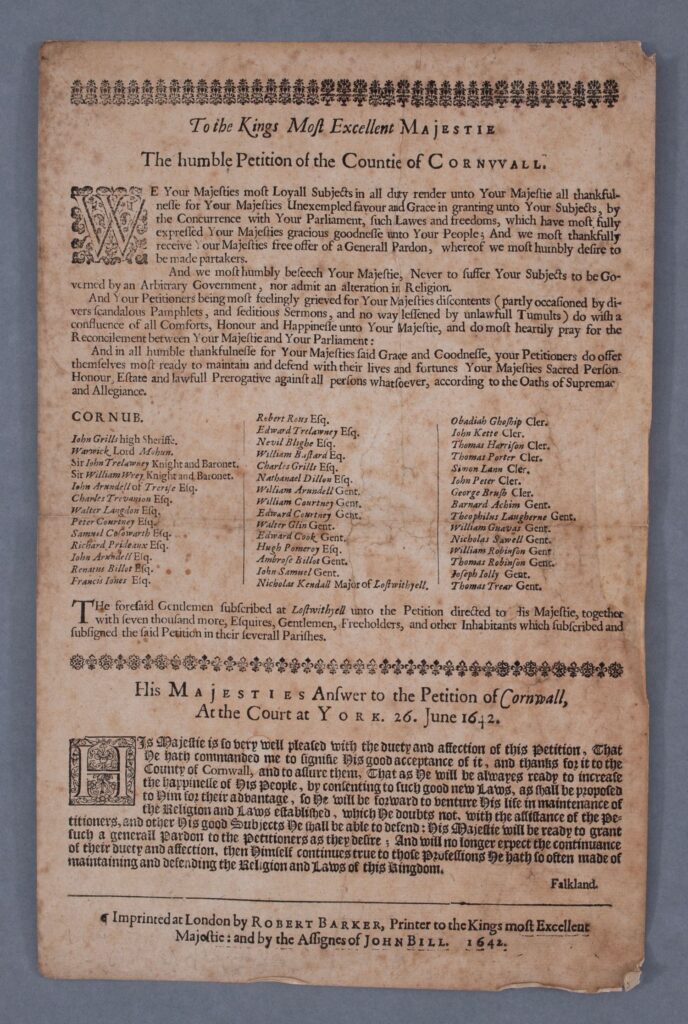
Image credit: Kresen Kernow, ref: AD3274/1
Worcestershire Archive and Archaeology Service
Captain James Hind (c1616-1652), highwayman and Royalist rabble-rouser during the English Civil War: Declaration of Captain James Hind, English Civil War pamphlet, printed for G Horton, 1651, London.
Hind was eventually caught and accused of treason rather than highway robbery because of his expressed Royalist loyalty. He was hanged, drawn and quartered at Worcester in 1652. Several pamphlets depicted his exploits, and he became something of a folk hero, reflecting social grievances at the time. (17019)
National Library of Wales
Department of Collection Services: A volume compiled 1683-1686, and again in 1693/4, at the office of the Master of Rolls in Philadelphia, recording sales of lands to Welsh Quakers in the area called the Welsh Tract, in Pennsylvania.
The original settlers negotiated with William Penn in 1684 to constitute the Tract as a separate county whose local government would use the Welsh language. William Penn (1644 –1718) writer, theologian, religious thinker, and influential Quaker, founded the Province of Pennsylvania during the British colonial era. The volume contains hundreds of indentures granted by various agents of Penn to numerous families and individuals both in Wales and in the Province of Pennsylvania.
Of the 81 transactions recorded, some 56 indentures detail sales by six of the Welsh Original Purchasers (who bought land directly from William Penn) to 56 Under Purchasers in six Welsh counties, the majority being lands sold by John ap, Thomas of Llaithgwm and Edward Jones of Bala, both in Merioneth, and Richard Davies of Welshpool, Montgomeryshire.
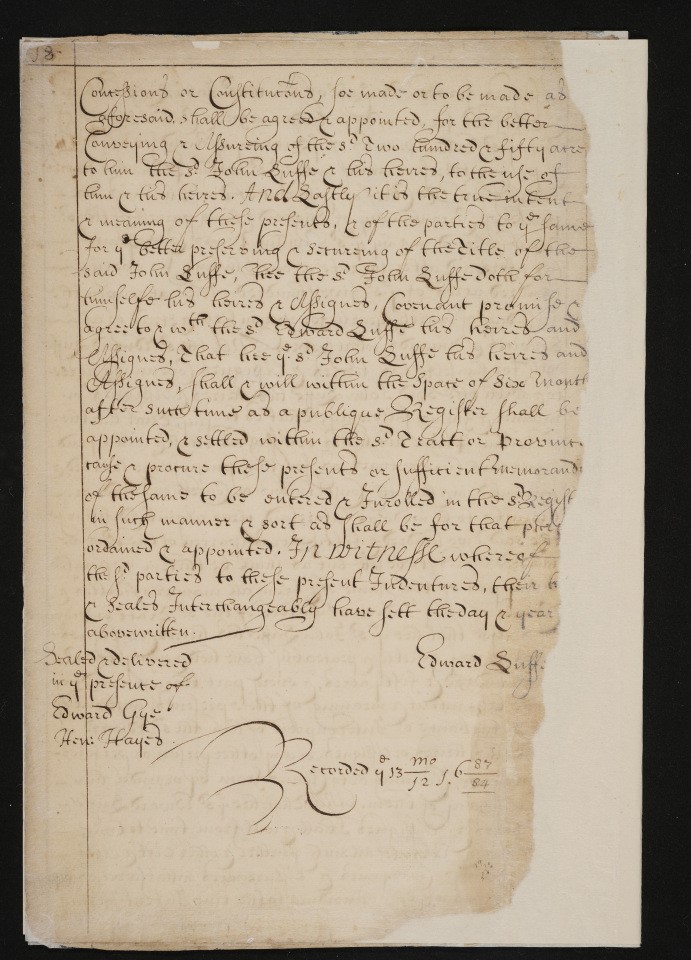
Image credit: National Library of Wales, ref: MS 24209
Public Record Office of Northern Ireland (PRONI)
William Robb of Coleraine: A paper rectifying compass, c.1750, possibly made based on ‘The Mariner’s Compass Rectified’ by Andrew Wakely, originally published in 1694.
The compass is an illustrated navigational document with movable dials called volvelles. The document, which is brightly coloured on both sides was possibly intended to be the latest thing in “show-off gadgets”, its main concern being time keeping. The volvelles had appeared in Peter Apian’s sixteenth century printed book on Cosmology. It is likely the document was never used at sea, but rather as an educational device by Robb.
The compass forms part of the Papers of the Robb family from Coleraine (D4926) comprising genealogical papers and papers pertaining to William Robb.
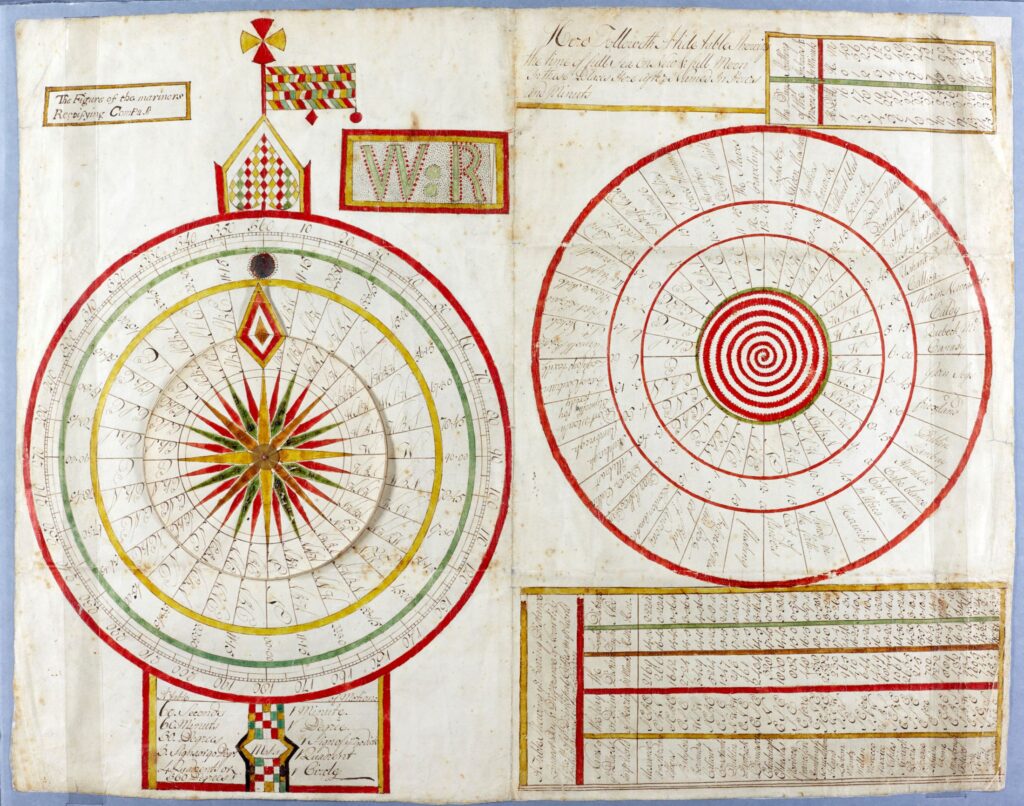
Image credit: PRONI, ref: D4926/1/1
National Army Museum Templer Study Centre
Handwritten Manual on Platoon Exercise: This instruction book from 1760 details the commands and drum movements required for Manual and Platoon Exercises for a battalion of Foot Guards. Manual Exercises were the sequence of movements by which a soldier learned how to handle his musket, perform bayonet drills, and to carry out ceremonial movements. In Platoon Exercises, a soldier learned the drill for loading his musket and for firing in volleys.
An inscription inside the book informs us that it was gifted to Captain George Sutherland, 14th of Forse. In 1760 George Sutherland was appointed Captain in the Earl of Sutherland’s Highlanders (First Sutherland Fencibles), in which he served until 1763.
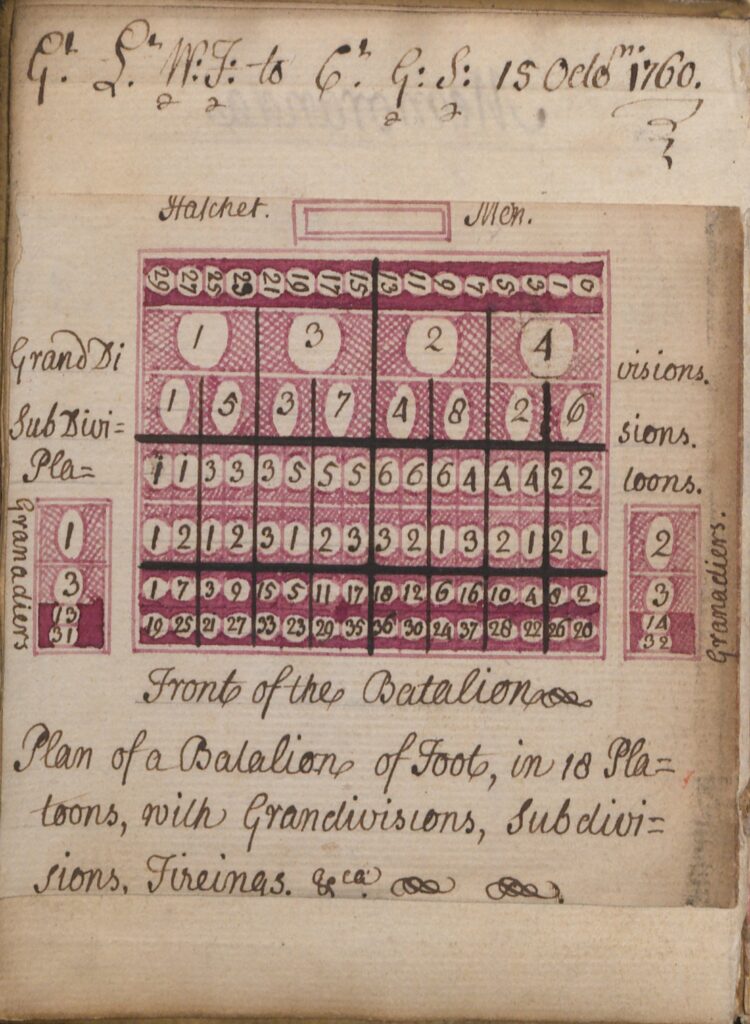
Image credit: National Army Museum, ref: NAM. 2024-12-26-1
Nottinghamshire Archives
First World War sketchbook, belonging to an unknown soldier, containing notes, poems and drawings by different soldiers, presumably while resident at a convalescent home during the war. Some of the sketches are humorous, others depict life as a soldier or regimental symbols.
The sketchbook came to the archive via a local regimental museum where it had been donated a few years earlier. The book may have belonged to someone with the surname Massey whose father was a shoemaker. The soldier is thought to have survived the war, later living in Mansfield. (10752)
Buckinghamshire archives
Cuttings album relating to Belgian Refugees in the First World War. This cuttings album was compiled by Lady Julia Inglefield in Beaconsfield. During the First World War, Inglefield worked with the Anglo-Belgian Lace Association and was part of the Beaconsfield Belgian Refugee Committee, providing work and accommodation for refugees who were staying in the county. She was married to Rear Admiral Edward Fitzmaurice Inglefield, son of Arctic explorer Edward Augustus Inglefield. She was later awarded the OBE for her wartime work.
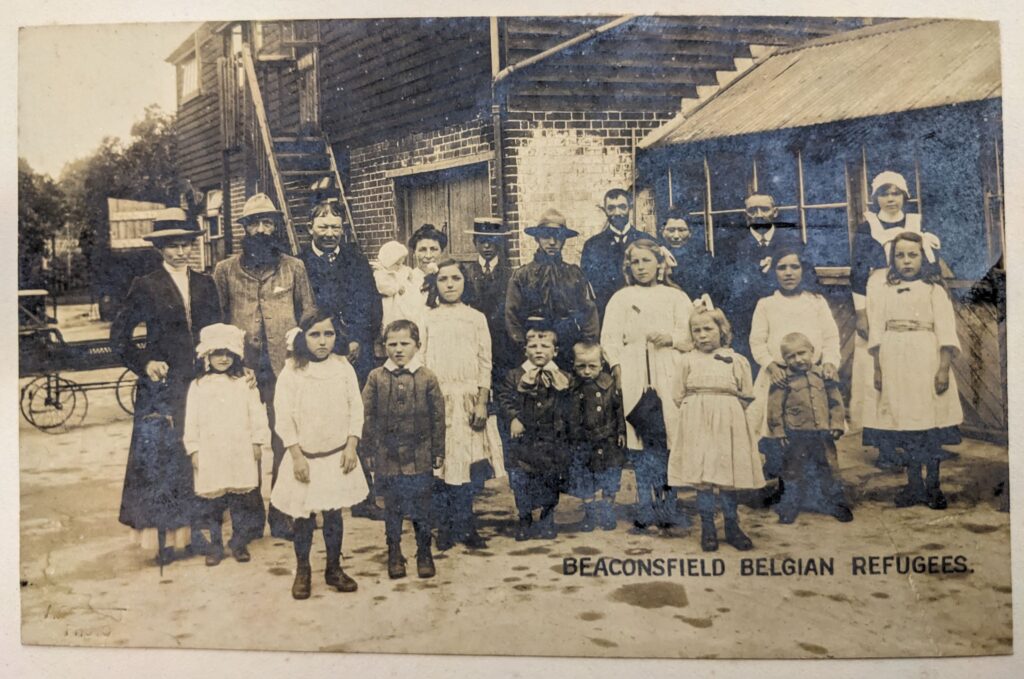
Image credit: Buckinghamshire Archives, ref: D-X 2365
Cumbria Archive Centre, Carlisle
Paintings by Spanish children staying at the hostel for Basque refugees in Brampton, made under the supervision of Winifred Roberts (later Nicholson), painter and daughter of Charles and Cecilia Roberts.
The material forms part of family papers relating mainly to the life and work of Charles, Cecilia and their son Wilfred. Cecilia was an active political campaigner. Charles was a politician, both nationally as Undersecretary of State of India during WWI) and locally as Chairman of Cumberland County Council). Charles and Cecilia led the organisation of the hostel for Basque child refugees in Brampton. The collection contains a significant quantity of original documentation relating to the operation of the Brampton colony and its satellite hostel at nearby Ambleside.
Following the destruction of Guernica during the Spanish Civil War, Republican authorities in Spain began arranging the evacuation of children, often referred to as ‘Basque refugees’, although they included non-Basques. They were embarked in Bilbao and sent to various countries including Britain.
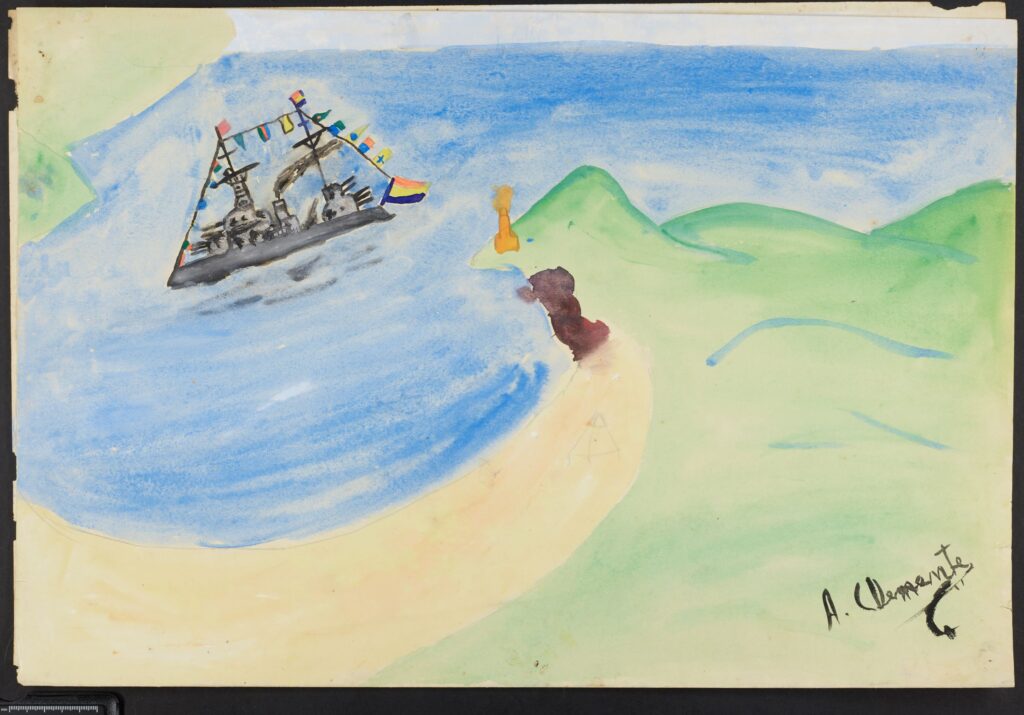
Image credit: Cumbria Archive Centre
Record Office for Leicestershire, Leicester and Rutland
Pardon and transportation token for William Walker of Leicester, prisoner of the York prison-ship.
William Walker of Barkby Lane, Leicester, was convicted at Leicester on 22 March 1824 for stealing goods belonging to William Sherwin of Coleorton. He was sentenced to transportation for 14 years as the theft was deemed a felony. Walker was imprisoned on the York prison hulk until 19 July 1834, when he was granted a pardon for having served 10 years with good conduct. Included with the pardon notice is a transportation token – a smoothed down keepsake coin which is hand-decorated with William’s initials on one side and the year 1838 (which would have been his year of release) on the other.
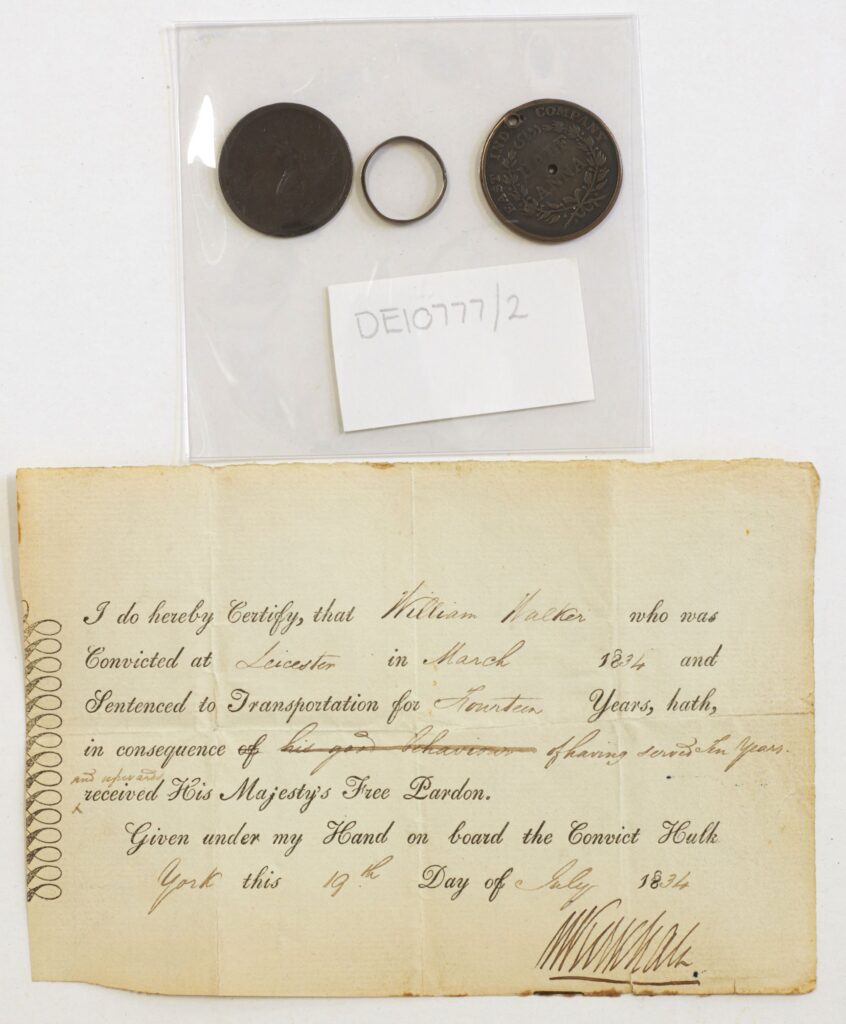
Image credit: Record Office for Leicestershire, ref: DE10777
National Museums Liverpool: Maritime Archives and Library
James Rowe/Wroe, Oldham immigrant to America: Letters, to his wife and children, describing the voyage on the ship Emerald Isle with his son Hilton (who died 14 May 1855 from ‘ship fever’). His wife and other children were in Oldham, and his wife was pregnant. The letters are dated 26 April, 6 May 1855 from Tamaqua, Pennsylvania, 18 May 1855 via his friend James Shaw and 9 June 1855 from Chicago, Illinois, United States of America.
Despite the large numbers that passed through the port, emigrants have left little trace in Liverpool, so there are relatively few documents showing the experience and dangers of emigration. These letters show evidence of chain migration. Along with his son, the father has followed his brother and other men from Oldham and is writing to encourage his wife to follow with their other children. The fact the son died of ‘ship fever’, probably typhus, emphasises the dangers involved.

Image credit: National Museums Liverpool: Maritime Archives and Library, ref: DX/2722
Newcastle University: Special Collections
Marine Technology, School of Engineering, Newcastle University: the Marine Technology Special Collection has been curated over several decades by dedicated academic staff in the University’s School of Engineering. In September 2024, ownership and physical management of the collection was transferred to the University Library’s Special Collections and Archives Team. Since then, work has been ongoing to update the physical management and cataloguing of the collection.
The collection charts the rise, peak, and decline of shipbuilding activity in the northeast and more widely from the late 19th to late 20th centuries. It also contains records of several shipbreaking businesses, which is a unique strength of the collection.
The archive portion of the collection contains a range of material relating to shipbuilding with a focus on technical areas such as ship plans, test records and data sheets. The geographical focus of the archive is on Northeastern shipyards and shipbreakers, though the archive does include archival material from businesses throughout the UK.
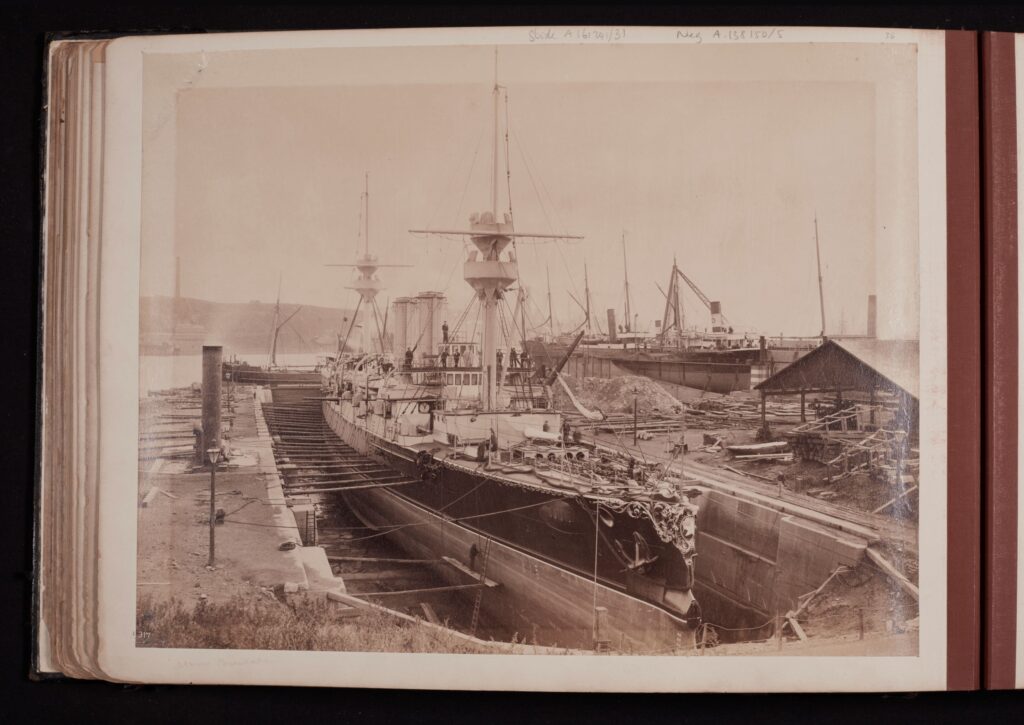
Image credit: Newcastle University: Special Collections, ref: MTSC/04975/03/36