Background
Yorkshire Film Archive (YFA) is a registered charity with the mission to find, preserve, and make accessible the moving image content of the region. In 2021, YFA was awarded a cataloguing grant from the Archives Revealed programme to carry out vital cataloguing work on the Ukrainian Video Archives Society collection (UVAS), taking the next step to make this unique collection accessible.
The UVAS collection was made by first and second-generation immigrants with the express mission to record the life of the Ukrainian community in Bradford, and other parts of the UK, to pass on to future generations. The society was set up in 1983, and filming for over 30 years, the collection grew to contain over 600 VHS and Betamax tapes, running approximately 750 hours in total.
UVAS was a diaspora organisation in every sense and saw itself through this lens. Their films capture cultural activities of every variety, including dance ensembles, award-winning choirs, church openings, activities organised by the Ukrainian Women’s Society and Youth Association, and visits by Ukrainian Presidents and religious leaders, alongside everyday life in the community.
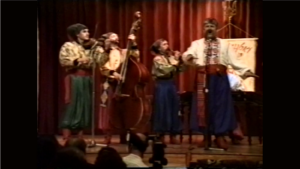
YFA Culture Customs and Choirs
The Project:
Thanks to the Archive Revealed funding, a Project Archivist was employed from 2022-2023. We were fortunate to recruit a talented archivist who was also a third-generation British Ukrainian and bilingual. Given her own background and experience, we had the advantage of an excellent starting point in understanding this complex collection.
YFA is strongly committed to increasing access to diverse collections, especially from communities currently under-represented within its collection. The UVAS collection presented a prime opportunity to do this, a highlight of the project being the ethical collaboration, working closely with the depositor-filmmakers. Their inclusion on the steering group was fundamental to this success. They have been involved with decision making every step of the way, including managing access to culturally and politically sensitive material. The combination of professional skills from the Archivists and the lived experience of the depositor-filmmakers means YFA will be able to correctly structure access to material. This continues the good practice with the depositor-filmmakers and sets a precedent for working with other community groups.
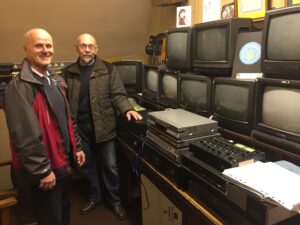
Bodhan Lanovy and Michael Fedyszyn – UVAS
Unforeseen Circumstances:
Our project officially started on 1st February 2022, and Russia launched a full-scale attack on Ukraine on the 21st of the same month. This significantly changed the context of the collection and the project. Much of the early war reporting focused on destruction of Ukrainian art, culture and heritage, bringing the need for inclusive practice and decolonisation of collections into sharp focus for the Project Archivist and Collections Manager.
This period captured on video, the diaspora community life was focused on campaigning and advocating for an independent Ukraine, celebrating and elevating Ukrainian culture. The Project Archivist noted, “The full-scale invasion peeled back 30 years of Ukrainian independence, pushing back to a place where the diaspora felt it their primary job to uphold Ukrainian culture at all costs. To view the films through this lens was initially very traumatic, but it gave a new urgency and purpose to the project.”
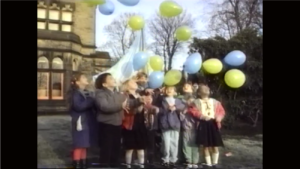
YFA Bradford Ukranian Community Life
Final Report:
Thanks to the funding from the Archives Revealed grant, we were able to create and publish 84 full descriptive records available for public search on YFA’s catalogue (www.yfanefa.com). In addition, records documenting the whole collection are searchable onsite at YFA.
Context for this collection is key, and working with and learning from the filmmakers brought an accuracy and richness to the cataloguing and curation. We were able surpass original expectations and add substantial contextual information and interpretation to our records, reinforcing the collection’s significance and giving a better understanding of its complexities.
On behalf of ourselves and UVAS, we would like to express our very grateful thanks to The National Archives, the Pilgrim Trust and the Wolfson Foundation for supporting this important and extremely timely project through the Archives Revealed programme.