Scientific instruments and facilities
Discover our scientific instruments and analytical specialisms.
Our specialised laboratory spaces are designed to enhance our research capabilities and provide facilities for hosting conservation workshops and training. We have four laboratories onsite at Kew:
- Analytical lab
Hosts advanced, non-light sensitive analytical techniques which provide insights into the composition and characteristics of historical materials.
- Dark lab
Designed to optimise conditions for sensitive measurements, this lab features a partition to ensure minimal light interference.
- Wet lab
Provides facilities for wet chemistry, conservation workshops and training.
- Dry lab
Offers a dedicated area for material preparation, conservation workshops and training.
Our analytical capabilities are defined by the instruments we invest in. This section lists our instruments and outlines what they can do. Our instruments are organised by types of analysis.
Ageing and stability
Ageing chamber
Artificial ageing using an ageing chamber is a controlled method that accelerates the natural deterioration of materials by exposing them to factors like light, heat, humidity, and pollutants.
In the archive and library sectors, this technique is used to simulate the long-term effects of environmental conditions on paper, parchments, inks, bindings, and other materials. By predicting how items may degrade over time, conservators can assess the durability of materials and make informed decisions on preservation strategies, ensuring the long-term protection of historical documents and artefacts. It can also be used in preventive conservation projects, helping heritage professionals better understand long-term effect of climate on historical documents.
Microfadometry (MFT)
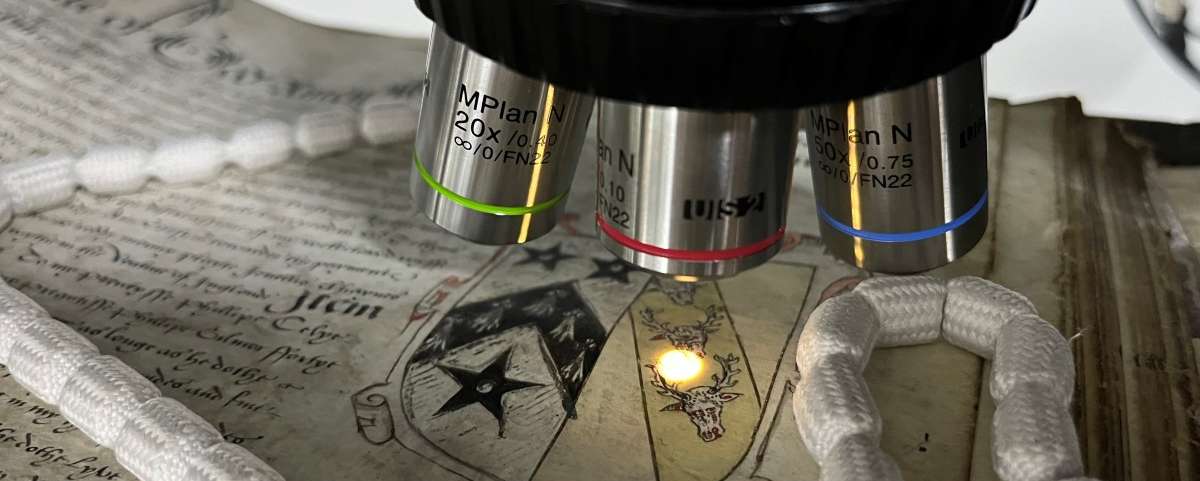
Microfadometry is a non-invasive technique used to assess the light sensitivity of materials such as inks, dyes, and pigments, by exposing a tiny area to controlled light while monitoring any colour changes.
In the archive and library sectors, it helps heritage professionals evaluate the risk of fading in historical documents, manuscripts, or any coloured artwork, guiding decisions on display conditions, lightning and storage to ensure long-term preservation. This method allows institutions to protect fragile items without causing damage, balancing access with conservation.

Light fastness testing with microfadometry.
Molecular analysis
Fibre Optic Reflectance Spectroscopy (FORS)
FORS is a non-invasive technique used to analyse the optical properties of materials by measuring how light reflects off surfaces.
In the archive and library sectors, FORS is employed to survey pigments, inks, and surface coatings in historical documents, manuscripts, and artworks. Its portability and ability to work without physical contact make it ideal for fragile items, providing valuable insights into the composition and condition of materials, which aids in conservation and preservation efforts.
Raman Spectroscopy
Raman spectroscopy is a non-invasive and non-destructive technique used to identify the molecular composition of materials by measuring the scattering of light.
In the archive and library sectors, it is invaluable for analysing the chemical structure of pigments, inks, and dyes in historical documents and artworks.
Variants like Surface Enhanced Raman Spectroscopy (SERS) and Spatially Offset Raman Spectroscopy (SORS) expand its capabilities, allowing for the identification of organic dyes or identifying materials through opaque layers.
These techniques enable more detailed and sensitive analyses, helping heritage professionals diagnose and preserve fragile items in archives and libraries.
Fourier Transform Infrared Spectroscopy (FTIR)
FTIR is a powerful analytical technique used to identify the molecular composition of materials by measuring how they absorb infrared light.
In the archive and library sectors, FTIR helps the heritage professionals analyse the chemical makeup of paper, inks, adhesives, and other materials and their degradation products in historical documents, books, and other artefacts. This information is crucial for understanding the condition of items, diagnosing degradation processes, and selecting appropriate conservation treatments, all while being non-destructive and non- (or minimally-) invasive to the objects being studied.

FTIR analysis on a Board of Trade volume in our collection.
Elemental analysis
X-Ray Fluorescence (XRF)
XRF is a non-invasive analytical technique used to determine the elemental composition of materials by detecting the characteristic X-rays emitted when elements are exposed to an X-ray source.
In the archive and library sectors, XRF is commonly applied to identify pigments, inks, metals, and other materials in historical records and objects. It provides valuable insights into the materials used in cultural heritage objects without causing any damage. The technique can also be used in imaging mode, known as X-ray Fluorescence Imaging (XRF Imaging), which maps the spatial distribution of elements across the object’s surface. XRF Imaging reveals additional details such as hidden layers, corrections, or compositional changes in manuscripts, artworks, and other items. This enhanced capability allows conservators to better understand the structure and history of objects, supporting more informed conservation and restoration decisions.

XRF imaging can visualise the condition and elemental composition of enclosed seals without unwrapping them.
Imaging
Photogrammetry
Photogrammetry is a technique that creates accurate 3D digital models by analysing photographs taken from multiple angles.
In the archive and library sectors, it is used to document and preserve the physical characteristics of fragile historical documents, books, and artifacts. By capturing detailed surface and structural data, photogrammetry aids in monitoring changes over time, such as wear or damage, without handling the items. It also allows for the creation of digital replicas, enhancing access for research and virtual exhibitions while supporting long-term preservation efforts.
It can also be used to create 3D models that can be used for 3D printing replicas, which can be used for training or education purposes.
Reflectance Imaging Spectroscopy (RIS)
RIS is a non-invasive technique that captures images across a range of wavelengths to analyse the surface composition of materials.
In the archive and library sectors, RIS is used to detect and map pigments, inks, and other materials in historical documents, manuscripts, and artworks. By revealing details not visible to the naked eye, such as hidden layers or faded text, RIS helps conservators and researchers understand the condition and composition of objects, aiding in preservation and restoration efforts without causing damage.
Multispectral Imaging (MSI)
MSI is a non-invasive technique that captures images of an object across different wavelengths of light, from ultraviolet to infrared.
In the archive and library sectors, MSI is used to reveal hidden details in historical documents, manuscripts, and artworks, such as faded text, underdrawings, or erased annotations. By analysing the way materials react to various wavelengths, MSI helps conservators and researchers identify materials, assess damage, and guide preservation strategies, all without physically impacting the objects being studied.

Multispectral imaging from top left to bottom right: visible light, near infrared reflected, infrared reflected false colour, UV reflected false colour.