
Qatar in 1914
- Overview
- The war
- Key documents
Overview
Qatar occupies a peninsula that extends from the Al Hasa region of the Arabian mainland (now part of Saudi Arabia). Its lands are desert and generally flat; its climate hot and humid.
Qatar came to the attention of Britain in 1867 when a dispute between Bahrain and the people of Qatar escalated into a major confrontation. In the ensuing war, the Qatari capital of Doha sustained severe damage.
Britain intervened as the supervisory power of the 1835 maritime truce in the Gulf, and in 1868 signed an agreement recognising Muḥammad ibn Thani as ruler of Qatar. Prior to this, Britain had viewed Qatar as a Bahraini dependency.
The expansion of Ottoman power in eastern Arabia increased Qatar’s vulnerability. Qasim ibn Muhammad Al Thani, Muḥammad ibn Thani’s son, was more accepting of Ottoman influence than his father had been and accepted Ottoman rule in 1871.
The relationship soon disintegrated however, with hostile action on both sides culminating in the Ottoman defeat at the Battle of Al Wajbah in March 1893. The declining Ottoman Empire gave up its claim on Qatar in 1913.
The war
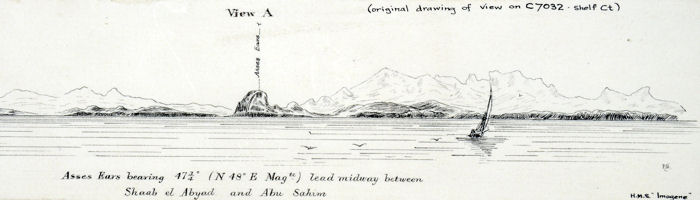
Sketch of Saudi Arabian west coast 'Asses Ears' ADM 344/1179
In 1916 Britain signed a treaty with Qasim ibn Muhammad’s son, Abd Allah ibn Qasim Al Thani. This resembled earlier agreements with other Gulf states, with the ruler of Qatar promised the same rights as other ‘friendly Shaikhs’.
Under the terms of the treaty, Qatar gave up control over external relations. In addition, Qatar agreed to co-operate with the abolition of the slave trade and of piracy, and to maintain maritime peace.
The treaty also protected the commercial rights of British merchants and allowed for the establishment of a Post Office and a Telegraph installation.
In return the British government offered protection against any seaborne attack, and diplomatic assistance (known as ‘good offices’) to find a peaceful settlement in the event of a land assault. (FO 141/817/20).
Although this agreement increased Abd Allah ibn Qasim’s security against external threats, it did little to help against rival tribes and ambitious family members. The Qatari ruler continued to try to strengthen ties with Britain, but without success.
Key documents
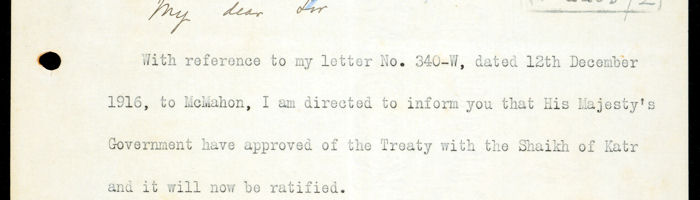
Treaty between the British Government and Sheikh Abdullah bin Jasim bin Thani, Sheikh of Qatar FO 141/817/20
- Treaty between the British Government and the Sheikh of Qatar, 3 November 1916. FO 141/817/20