
Kuwait in 1914
- Overview
- During the war
Overview
By the end of the 19th century, Kuwait was an important port: it linked the trade of the Persian Gulf with Mesopotamia. It was also an important centre of the pearl fishing industry. Kuwait fell under the Ottoman Empire but its leader, Mubarak I, sought closer relations with Britain in a bid to become independent of Turkey.
From 1899, Kuwait became a British protectorate and the British government sent a political agent to represent its interests there.
Kuwait remained loyal to Britain and its allies throughout the war, although fears that Kuwait might provide a means of enabling supplies to reach enemy troops caused Britain to blockade the port.
During the war
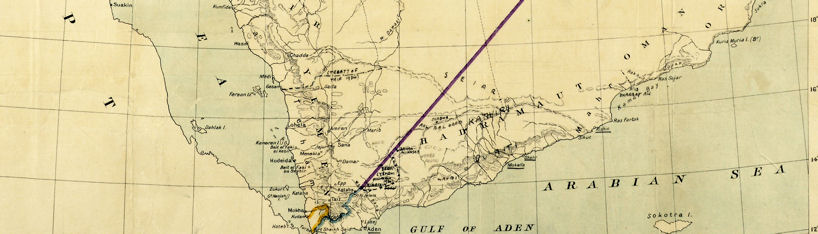
Sketch map of Persian Gulf and Arabia, showing limits of inner Koweit (Kuwait) MFQ 1/56
Before the Turkish declaration of war on 29 October 1914, the British government was already planning a possible campaign in Mesopotamia. British officials believed that they would need to ensure the support of regional Arab leaders and, given its position as a port at the north of the Persian Gulf, Kuwait assumed great strategic significance. It was also a possible source of supplies for enemy forces.
Kuwait’s ruler, Mubarak Al-Sabah (Mubarak I), was offered recognition of Kuwait’s independence as a principality, protection for expelling Turkish garrisons and possession of date gardens on the Turkish bank of the Shatt-Al-Arab in exchange for his support (FO 371/2143, file 54139).
Britain opened the Mesopotamia campaign front in the Basra area to launch an attack on the Ottoman Empire from the south. Although allied forces enjoyed initial success, they were unable to win a decisive victory. Mubarak Al-Sabah retained his pro-British stance and sent troops to support the British effort (FO 371/2144, file 61439).
However, Mubarak died in November 1915. The British government had seen him as a loyal ally, but was unsure of the attitude of his successor, Jabir II Al-Sabah. It was also feared that Jabir’s brother, Salim, might contest the succession. Officials were reassured, when Jabir affirmed Kuwait’s support and Britain’s political agent in Kuwait, Sir William George Grey, reported that Jabir was actively suppressing anti-British opinion. (FO 371/2766B, files 4636, 4650).
Nevertheless, in 1916, British officials believed that goods imported through Kuwait were reaching enemy forces and imposed a blockade. The rule of Jaber II was short lived and he died of ‘acute gastric fever’ in February 1917. (FO 371/3049, file 28603). He was succeeded by his brother Salim Al-Mubarak (Salim I).
The Mesopotamia front remained active until the end of the war. The new British political agent, Lieutenant-Colonel Robert Hamilton, was concerned that the profitable trade with the interior might be difficult to control under Salim. The blockade therefore remained in place until the end of the war. (FO 371/3402, file 49888).
Immediately after the First World War, Kuwait fought a war against the troops of Ibn Saud, who was in the process of founding the Kingdom of Saudi Arabia. The borders of Kuwait were demarcated in 1922, at the end of the Kuwait-Najd War.