Barbados in 1914
- Overview
- Threat to Barbados
- Defence forces
- British West Indies Regiment
- Key figures
- Key documents
Overview
Barbados was a British colony in 1914. It had been occupied by England since 1625 and privately governed until the Crown took control in 1662. The island had a population of 176,000 at the outbreak of war in 1914, with 17,000 in the capital Bridgetown.
Barbados generally prospered financially during the First World War, due to the high demand for its key product: sugar.
Threat to Barbados
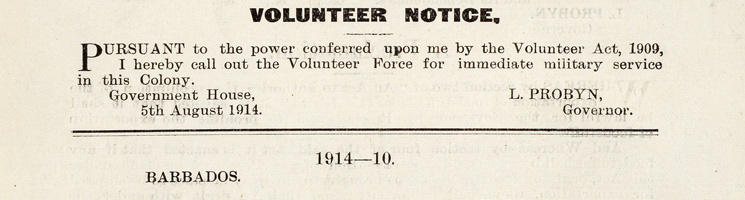
Call to duty on outbreak of war, Barbados Gov Gazette, 5 August 1914 CO 32/51
At the beginning of the war, there was no full garrison on the island of Barbados. The island’s defence fell to the police, a force of 316 men, and a small volunteer force of 197 men. As with other Caribbean countries, one of the first responses to the declaration of war was to increase the size of the volunteer force on the island. By the end of August, the number of volunteers had risen to 269 (CO 32/51).
The port of Bridgetown was a prosperous merchant trading point in 1914, and it was undefended. A large amount of coal was held at the port, as re-fuelling visiting merchant ships was a key industry for the island. At the declaration of war, the port was seen as vulnerable, as it could feasibly be a target for enemy raids for the precious fuel.
The German ship Karlsruhe in particular posed a threat in the Caribbean waters. The ship sank 16 merchant ships off the Brazilian coast in her pursuit of coal. In November 1914, the ship turned her attentions to Barbados and the shipping lines between it and Trinidad.
However, on 4 November 1914, an explosion on board the Karlsruhe destroyed the ship and many of the crew died. The British forces did not learn of the destruction of the ship until March 1915, and so her perceived threat continued to overshadow the Caribbean islands long after the sinking.
Defences were built at the entrance to the port of Bridgetown, which were designed to delay any enemy vessels long enough for the volunteer forces to prepare themselves for resistance. Throughout the war however, there were no attempted raids on the port. Several alarms were raised, and on one occasion the approach of an unidentified but eventually neutral ship brought out the local defence forces, but this was the extent of their involvement.
The barriers remained until August 1917, when a naval patrol and heavy guns were put in place in response to the perceived threat of German submarines.
Defence forces
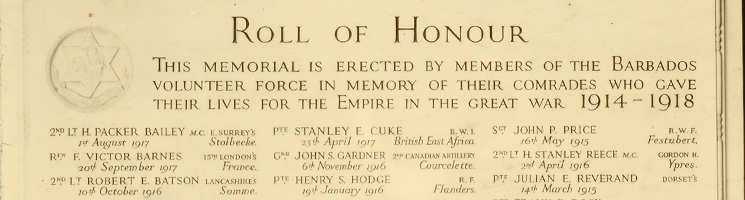
Barbados Volunteer Force Roll of Honour, 1914-1918. CO 1069/245/25
The Barbadian local defence force was made up of the police and volunteers. At the beginning of the war they were mostly needed to operate the wireless, cable and look-out stations on the island, increasing their presence whenever an enemy vessel was known to be in the Atlantic. Their main objective was training to guard against surprise attacks, and to be prepared to resist any attempted enemy landings.
In 1917, British concerns over the size of the German submarine fleet led to the strengthening of defences at ports across the Caribbean. Motor launches were introduced to patrol the Caribbean waters and two were assigned to Barbados. The water-boat Lady Hay joined from Barbados and undertook mine sweeping three times per week, although no mines were discovered.
At the beginning of the war in August 1914, Barbados offered the imperial government £20,000 in either money or sugar on top of military support. This was accepted in sugar and as a result 1,000 tonnes was shipped to England. This contribution was repeated every year in either cash or sugar throughout the war, totalling £80,000 in cash and £20,000 in sugar (CO 28/294/1).
Various charitable causes also raised money, and surgical dressings and other hospital goods were prepared and sent for wounded soldiers at the front. In total, between £28,000 and £30,000 was raised and contributed by Barbadian charities for the war effort.
British West Indies Regiment
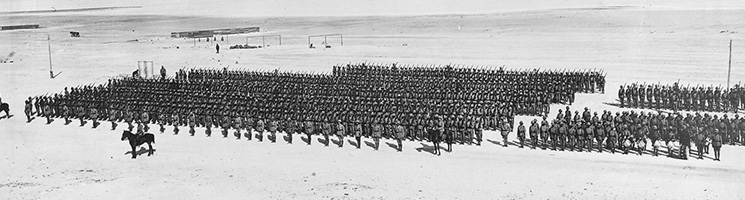
1st Battalion British West Indies Regiment in Egypt, May 1916 CO 1069/369 1st
As with other Caribbean countries such as Jamaica and Trinidad and Tobago, some Barbadian men left the colony to sign up in Britain and Canada. However, not all could afford the journey and in 1915, the ‘Citizens’ Contingent Committee’ was set up to provide funds for any men wishing to join up overseas who couldn’t afford to do so.
Increasing pressure in Jamaica for a separate West Indies unit led to the formation of the West Indies regiment in 1915. In August 1915 a Recruiting Committee was appointed in Barbados and over 2,000 men signed up, more than the initial agreed quota required from the island. Of these, 831 officers and men were selected and embarked as the Barbadian contribution to the British West Indies Regiment.
In 1918, a petition was sent to the Recruiting Committee by 12 members of the British West Indies Regiment. It protested that pay increases were being withheld from the regiment and commissions to ‘coloured West Indies’ were being refused. The signatories had left Barbados in the early contingents of the regiment with the promise that they would be treated in the same way as other British regiments.
Following further similar appeals, according to a telegram dated February 1919 from the Secretary of State for the Colonies, members of the British West Indies regiment from Barbados and other listed Caribbean countries were granted the same increases as other regiments (CO 28/294/24).
One of the signatories, Private J C Hope received the DCM for conspicuous gallantry. His recommendation read: ‘For conspicuous gallantry and devotion to duty. When wounded in four places, including a broken arm, he displayed the most conspicuous courage and determination in assisting another man, who was also wounded, to return to camp, a distance of over a mile’ (WO 372/10/31724).
Key figures
Sir Leslie Probyn
Governor of Barbados (1914-1918)
Sir Charles O’Brien
Governor of Barbados from 1918
Rear-Admiral C H Simpson
Commodore of the West Indian Patrols
Private J C Hope
Signatory of petition against the different treatment of members of the West Indian regiment
Key documents
- Petition, addressed to the Recruiting Committee by Private J C Hope and 11 others of the British West Indies Regiment, protesting about withholding of pay increase and refusal to grant commissions to 'coloured West Indians'. No 173, folios 109-121. 14 September 1918 CO 28/294/24
- Despatch regarding the recruitment of West Indians desiring to help in the war effort. 31 August 1914 CO 28/283/72
- Reporting the number of West Indian men despatched to enlist in the army for period of war. 27 October 1914 CO 28/284/17
- Reports that legislature has voted a further gift of £20,000 to the British government 'to assist in the prosecution of the war to a victorious conclusion'. 1 August 1918 CO 28/294/1
- Medal card of Private J C Hope, British West Indies Regiment WO 372/10/31724
- No 65 call to duty on outbreak of war, Barbados Government Gazette. 5 August 1914 CO 32/51
- Protests against the British West Indies Regiment being debarred from benefits under Army Order 1 of 1918. Includes a printed copy. West Indian Contingent Committee, folios 266-288, 30 December 1918 CO 318/347/51
- Defence of West Indies and establishment of patrol and minesweeping service, 1916-1919 ADM 116/1703
- 1st Battalion British West Indies Regiment war diaries, 1915-1919 WO 95/4433, 4732, 4410, 4427