
Sweden in 1914
- Overview
- Outbreak of war
- Allied blockade
- The Baltic
- Key documents
Overview
Sweden was the largest and most powerful of the Scandinavian states at the beginning of the 20th century, but the country had been badly affected by the dissolution of the union with Norway in 1905. This accentuated existing trends in the foreign policies, with Norway moving closer to Britain and Sweden strengthening ties with Germany. Despite this, and Sweden’s centuries old enmity with Russia, the country declared its neutrality in 1914, a position it held throughout the war.
Sweden’s geographic position meant that although it was neutral it was still greatly impacted by the events in Europe, especially the British blockade. The blockade caused regular crises in the relations between the countries and forced Sweden to the brink of war.
Outbreak of war
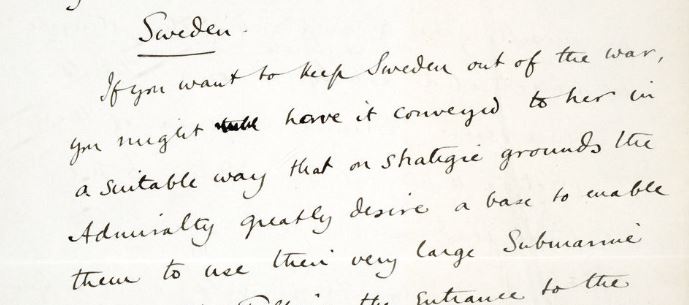
Winston Churchill's letter to the Prime Minister on keeping Sweden out of the War ADM 137/500
Sweden was an interested bystander in the July Crisis of 1914. For much of the time it did not appear that the country would be directly affected. This changed suddenly when in late July it became clear that Britain might become involved on the Entente side.
The Swedish government warned their British counterparts that such a development might force Sweden to side with Germany, largely because of their fear of Russia. In the end Russian assurances to respect Swedish sovereignty so long as she stayed neutral proved sufficient and the Swedish government declared its complete neutrality (FO 438/2; FO 371/2162).
The neutrality of the country did not prevent the Swedish press and population at large from taking a strongly pro-German stance. In particular, the press could not comprehend Britain’s siding with the ‘Latins and Slavs against her own kinsmen the Germans’. It was viewed as ‘an act of treachery to her own kith and kin. The general feeling, therefore, is undoubtedly hostile to England’ (FO 438/2).
Swedish public opinion would remain largely pro-German throughout the war, assisted by the strong connections between the royal families and conservative elites in the two countries. Any initial enthusiasm for entering the war on the side of the Central Powers did, however, quickly subside and there was little risk of Sweden being drawn directly into the conflict. This did not stop the Swedish government from exploiting fears of Swedish intervention, particularly on the part of the Entente, to try to improve the country’s difficult diplomatic situation.
Allied blockade
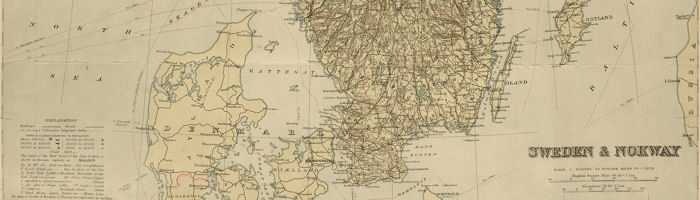
Sweden and Norway. London Atlas Series FO 925/39014
In August 1914 Britain established a blockade of the Central Powers attempting to cut them off from the rest of global trade. One of the key aspects of this policy was stopping goods flowing into the neutral countries surrounding Germany, from where they could be shipped on to feed the German war machine. As such, from the outset of the war Britain attempted to limit the import of goods into Sweden for fear that they were being redirected to Germany. This, unsurprisingly, caused considerable anger in Sweden as they considered it to be interference in their peaceful commerce. Swedish protests initially led to pressure from British diplomats to loosen the blockade for fear of driving Sweden into joining the Central Powers (FO 368/1098).
As the war progressed it became apparent that Swedish imports of key goods were many times higher than they had been prior to the outbreak of war and that these were being sold on to Germany, frequently for a great profit. This led to a gradual tightening of the blockade particularly from 1916. The economic pressure quickly began to show and by the end of 1916 there were shortages of key commodities and rationing of bread had been introduced.
The Swedes attempted to negotiate an agreement with Britain but the process quickly broke down. Disgruntlement over food restrictions and the Swedish government’s handling of the situation led to rioting and it eventually brought down the Conservative administration (FO 371/3037; FO 382/1466).
With the entry of the USA into the war in April 1917 Sweden lost a crucial ally in its attempts to resist British economic power. Sweden was eventually forced to sign an agreement limiting its exports to Germany in return for (more) food imports being allowed through the Allied blockade.
The Baltic
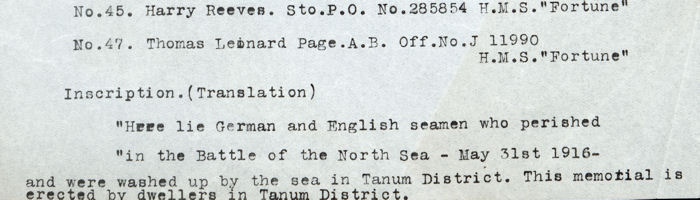
War grave for victims of the Battle of the North Sea FO 818/29
Sweden’s position, bordering the North Sea and the Baltic, meant it was on the frontline of the British and German naval confrontation, something that placed regular stresses on Sweden’s neutral position.
On the outbreak of war the Swedish government and press were very concerned that Britain would attempt to force a passage into the Baltic. In such a circumstance both Britain and Germany would be likely to violate Swedish territorial waters and could easily have forced the country to take sides (FO 371/2097). The British did not send surface ships into the Baltic, but they did start sending submarines through using Swedish territorial waters. This unsurprisingly led to German demands that Sweden follow Denmark’s lead and mine its territorial waters. The Swedish government eventually succumbed to this pressure in July 1916.
In 1917 the Swedes became convinced that the Norwegian government were about to agree to British demands for the use of a naval base close to the entrance of the Baltic. This led to a further crisis in which Sweden mobilised its reserve forces called the neutrality guard on the Norwegian border. The crisis passed with an agreement between the Swedes and the Norwegians assisted by assurances from the British that they were not intending to establish any such base(FO 371/3021; FO 371/3023).
Sweden also became the final resting place for a number of the sailors from both sides killed in the only major fleet action of the war, the Battle of Jutland. The battle, which took place north west of the Jutland peninsula, saw heavy casualties on both sides, and bodies were washed on to the Swedish coast. A number of memorials were erected to these men all along the coast FO 818/29.
Key documents
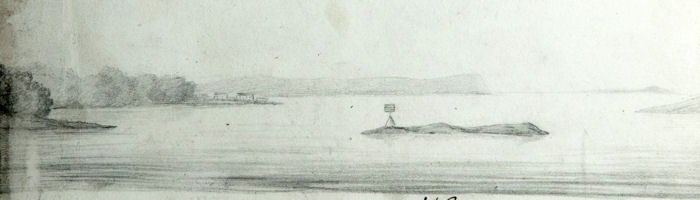
Faro Sound, Sweden ADM 344/474
- Further correspondence respecting World War I. Part II. Document reference FO 438/2
- Scandinavia. Code 130 Files 65928 – 68255. Document reference FO 368/1098
- Spain and Portugal (War). Code W41 / Code 41W File 4979-246161; Sweden. Code 42 Complete. Document reference FO 371/3037
- Scandinavia (War). Code W30 / Code 30W Complete. Document reference FO 371/2097
- Scandinavia (War). Code W30 / Code 30W File 202-7413 (to paper 187350). Document reference FO 371/3021
- War graves: correspondence and photographs. Document reference FO 818/29