
Spain in 1914
- Overview
- Background
- During the war
- Aftermath
- Key documents
Overview
Spain remained neutral throughout the First World War. Successive conservative and liberal party regimes were in power for too short a time and with too small a majority to impose reforms and establish programs that would favour either the Central or the Allied Powers. Spain had no major economic or political need to intervene in the war, and public opinion remained divided throughout its course. Spain exported large amounts of raw materials and agricultural produce to both sides during the war, although the profits remained in the hands of industrialists.
Social unrest continued throughout the war as wages failed to keep up with the rising cost of living and shortages of fuel and food caused widespread disturbances (FO 371/3370).
Background
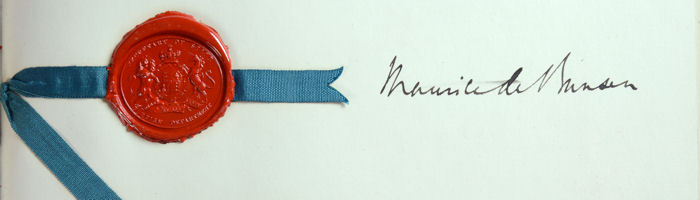
Commercial Treaty between Great Britain and Spain (1917) FO 93/99/52
In 1898 Spain was defeated in the Spanish-American War, losing its colonies of Cuba, Puerto Rico, Guam and the Philippines. In the following year, Spain sold its Pacific colonies to Germany, leaving Spain’s holdings in and around Africa as its last remaining imperial possessions.
By the time of the First World War Spain was in turmoil. The Liberal Party Prime Minister José Canalejas y Méndez had been assassinated by an anarchist in November 1912 (FO 371/1475) and an attempt had been made on the life of King Alphonso XIII in April 1913 (FO 372/459). When war broke out, Spain was in no position politically, economically or militarily to enter into a large-scale conflict. On 4 August 1914, both the King and Prime Minister Eduardo Dato announced that Spain intended to stay out of the war (FO 372/564).
During the war
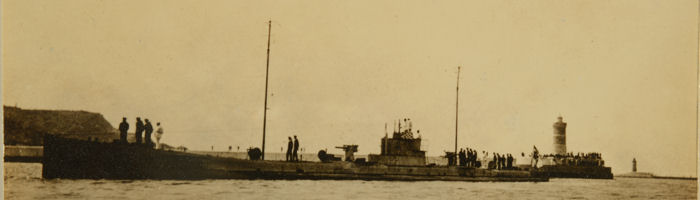
Submarine at Cartenega. June 1916 ADM 137/3883
Spanish governments came and went in quick succession throughout the war. The Conservative government of Eduardo Dato was replaced in December 1915 by the Liberal government of Álvaro de Figueroa y Torres, Count of Romanones. Romanones resigned in April 1917 and was briefly succeeded by Manuel Garcia Prieto before being replaced by a new Conservative government under Eduardo Dato. Dato’s regime lasted only until November 1917 when Prieto returned to power.
In March 1918 a Conservative government was formed under Antonio Maura y Montaner but by that November Prieto’s Liberal Democrats were back in power. This regime proved to be even shorter lived and in December 1918 Romanones became Prime Minister once again.
Press reaction to the war was divided. While newspapers such as Correo Español, Nacion, ABC and El Dia put forward a pro-German viewpoint and were financed by German interests, El Liberal, España and Herald de Madrid carried articles that were more in favour of the Entente (FO 371/3033). Even the Spanish court was divided in its support of the Central and Allied Powers. While King Alfonso XIII maintained the policy of strict neutrality held by the Spanish government, the Queen Mother, Maria Christina of Austria, was pro-German and Queen Ena (Victoria Eugenie, granddaughter of Queen Victoria and cousin of George V) was pro-British.
In February 1915 German U-boats began to sink merchant vessels in the Atlantic and Mediterranean and this had a disastrous effect on Spanish trade. Prime Minister Count Romanones issued a protest to Germany which resulted in an apology in May 1916, although the attacks became more frequent when Germany announced the use of unrestricted submarine warfare in January 1917 (FO 371/3033). In August 1918 Antonio Maura warned Germany that the tonnage of any further vessels lost would be replaced by German and Austro-Hungarian ships docked in Spanish ports. Germany responded with an announcement that the seizure of any of its vessels would be deemed an act of war. By the end of the war Spain had lost an estimated 140,000 tons of shipping to German U-boat activity.
In December 1916 the British Embassy reported that Dutch national Margaretha Gertrude Zelle, better known as Mata Hari, was staying in the Ritz Hotel in Madrid and was under observation by the French Bureau. She was given a visa to France, where she was arrested and executed in 1917 on suspicion of spying for Germany (KV 2/1).
Germany put forward several offers to Spain to join the Central Powers, including ceding Gibraltar and Tangier and offering political control of Portugal and French Morocco (FO 371/2468). From the British perspective Spain had very little to contribute militarily, and the only offer that could be made to tempt Spain to become an ally was of the cession of Tangier, which represented far less than Germany was promising. The British Government estimated that if Spain joined the war, the Spanish Army could raise about 300,000 men, with a further reserve of about 180,000 trained or partially trained men, but decided that with a shortage of heavy artillery and gun ammunition, Spain would be increasingly reliant on her allies (CAB 24/7). After Italy joined the Entente in May 1915 Spanish intervention was of little importance to the Allied Powers, and British and French policy focussed on ensuring that Spain remained neutral.
Even though Spain remained neutral, King Alfonso used his position as head of state to attempt to improve conditions for prisoners of war from both sides and to transmit letters between prisoners and their families. Enquiries by the King of Spain on behalf of British prisoners of war in Germany were initially discouraged by the British Government (FO 383/294), but the Foreign Office decided in 1917 that letters of enquiry by British families to the King of Spain should be allowed to proceed (FO 383/352).
The King also made representations to the German Government about reprisals on prisoners of war (FO 383/307). Alfonso used his influence to obtain permission for Spanish delegates to visit prisoner of war camps in occupied territory (FO 383/290). In 1917 an exchange of German and Belgian prisoners of war was affected through his intervention (FO 383/303). The King also tried to arrange for prisoners of war suffering from tuberculosis to be exchanged or interned in neutral countries (FO 383/210).
In April 1917 Britain and Spain signed a commercial treaty granting licenses for the export of 150,000 tons of coal per month to Spanish ports in return for an undertaking by the Spanish government not to prohibit exports or to levy duty on iron ore, pyrites and lead to Britain and France. The Spanish government also agreed to export 30,000 tons of potatoes and 30,000 tons of forage to the UK per month (FO 93/99/52).
Aftermath
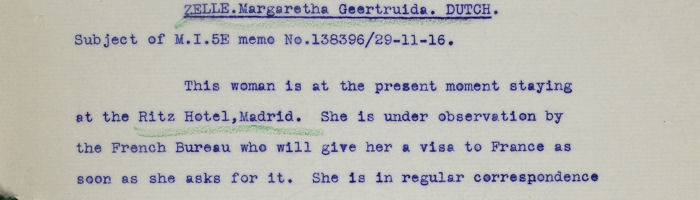
Mata Hari in Madrid. December 1916 KV2/1 (1024)
At the end of the war, Spain was given a seat at the Executive Council of the League of Nations (FO 608/243/16). However as a neutral power Spain was not represented at the Paris Peace Conference, unlike its neighbour Portugal which had joined the allies in 1916. As a result little time at the Conference was given over to Spanish Morocco and other Spanish foreign interests (FO 608/123/4, FO 608/176/1). Spanish claims to Gibraltar were discussed by the Gibraltar-Ceuta Committee without Spanish representation, resulting in a victory for the British policy of maintaining the status quo (FO 608/123/5). As compensation for shipping losses, six German warships were temporarily transferred to Spain (FO 608/223/5). The financial crisis in Spain was dealt with not by German reparations, but by loans from the Entente Powers, such as the Anglo-Spanish Loan Agreement (FO 608/248/3). The ‘Comitè Pro Catalunya’ also submitted a statement to the Peace Conference on the status of Catalonia but this was largely ignored (FO 608/123/8).
The term Spanish Flu was used to describe the outbreak of influenza that spread across the world between 1918 and 1920 and was responsible for more than 50 millions deaths. The pandemic was largely ascribed to Spain because wartime censorship limited the amount of reporting among the warring nations, whereas the Spanish press had no such restrictions. The high profile illness of King Alfonso XIII undoubtedly helped to foster the misconception (FO 371/3374).
Key documents
Commercial Treaty between Great Britain and Spain (1917) FO 93/99/52
- Spanish declaration of neutrality 1914. Document reference FO 372/564 (341/78390/5370)
- Commercial treaty between Great Britain and Spain, 1917. Document reference FO 93/99/52
- Spanish PM Romanones’ statement that there was no intention of Spain abandoning its policy of neutrality but that he wished neutrality to be benevolent to allies. 1917. Document reference FO 371/2761 (W41/182208/189923)
- Intelligence Bureau, Department of information: weekly report on Spain no. 1 (1 June 1917). Document reference CAB 24/15
- Disturbances in Spain on account of food shortage. Document reference FO 371/3370 (W41/15906/1648/18)
- Riots in Palma on account of fuel shortage. Document reference FO 371/3370 (W41/38069/1648/18)
- Indisposition of the King of Spain. Document reference FO 371/3374 (W41/61212/18)
- Representation on the League of Nations, 1919. Document reference FO 608/243/16