
Roumania in 1914
Now Romania
- Overview
- The outbreak of war and neutrality
- Entry into the war
- Military defeat and peace
- Key documents
Overview
The Romanian state was a product of the gradual collapse of the Ottoman Empire in Europe over the course of the 19th century. A key part of the extremely volatile Balkans region, Romania’s primary concern in the pre-war period was to maintain its territory in the face of encroachment from both Russia and Austria-Hungary. At the same time a growing nationalist movement from the late 19th century sought the creation of a “Greater Romania” something that would see the country expanded at the expense of most of its neighbours. Romania remained neutral until 1916 and then, despite suffering a crushing military defeat, managed to achieve most of her pre-war political ambitions, in large part due to the collapse of Austro-Hungarian and Russian influence in the region.
The outbreak of war and neutrality
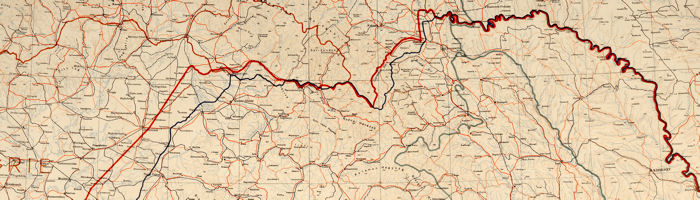
Detail of map showing the boundaries of Romania in 1914 MPKK 1/20/1-2
The Romanian diplomatic situation at the outbreak of the First World War was complex. Since the Congress of Berlin in 1878 and the resulting loss of Romanian territory there had been strong antagonism towards Russia, and Bucharest was nervous about the intentions of her powerful neighbour. This had led to the agreement of a defensive alliance between Romania and Austria-Hungary in 1883, which was renewed every ten years, most recently in 1913 (FO 371/1900). This arrangement caused problems of its own, particularly as nationalist sentiment grew in Romania in the early 20th century. Over three million ethnic Romanians lived in territory controlled by the Austro-Hungarian Empire, whose government was less than sympathetic towards their nationalist feeling. The Balkan Wars in 1912 and 1913 strengthened the Romanian diplomatic position and led to increasing divisions between the governments in Bucharest and Vienna.
In the weeks following the outbreak of war the position of Romania was uncertain. The Romanian king, Carol I, a German by birth, was keen for Romania to enter the war on the side of the Central Powers. However, this was strongly opposed both by the political elite and a majority of the Romanian people (FO 371/1900). This led to a flurry of diplomacy on the part of the British and the French in an effort to get Romania to join the Entente powers. In particular they offered considerable financial assistance to the Romanian government. Towards the end of August this was rejected by Bucharest due to ‘opposition of the King, to distrust of Bulgaria, and to her desire to see respective military situations a little more clearly’ (FO 371/1900).
Over the following months Romania continued to move towards the Entente powers, helped by the death of Carol I in October. The Romanian government made it clear to the Entente that either Italian entry into the war, or a Russian attack on Bulgaria, would enable them to declare war on Austria-Hungary (FO 371/1901). This policy was helped by a growing nationalist feeling that the time had come to push for the formation of a Greater Romania, even if this required a national sacrifice (FO 371/2241).
Entry into the war
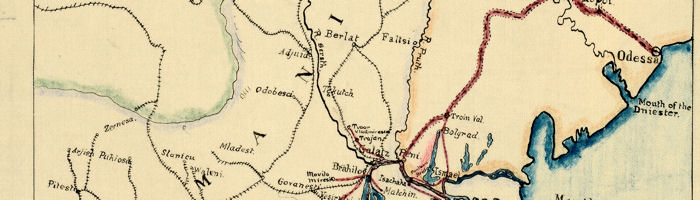
Map of Eastern Romania showing routes taken by the British Armoured Car Division 1916-1917 MPI 1/10
Romanian entry into the First World War on the side of the Entente was the product of long and tortuous negotiations primarily with the Russians over territorial demands and military support.
It was clear to all parties that Romanian interests lay primarily with the Entente powers. Her government, led by Ion Brătianu, were desperate to get the best possible deal in return for her support, and interest waxed and waned in response to the performance of the Entente military forces.
In May 1915, Brătianu set out his terms for joining the Entente, which included territorial claims extending far beyond the ethnic Romanian areas of Transylvania (FO 371/2245). These terms were initially rejected by the Russians, but as the military situation on the Eastern Front deteriorated and the Anglo-French operation against Gallipoli bogged down, the Entente powers gradually withdrew their opposition to Romanian demands (FO 371/2245). However, these same events had a sobering effect on Brătianu, who decided that the time was not right for Romania to enter the war (FO 371/2245).
The situation remained deadlocked until the successful Russian offensive led by General Brusilov helped to convince the Romanians that they were supporting the right side and negotiations restarted. The Entente powers, heavily engaged on both fronts in the summer of 1916, were desperate for Romania to join and on the 17 August a treaty was agreed. Ten days later Romania declared war on Austria-Hungary and on the 28 August Germany declared war on Romania, shortly followed by Bulgaria.
Military defeat and peace
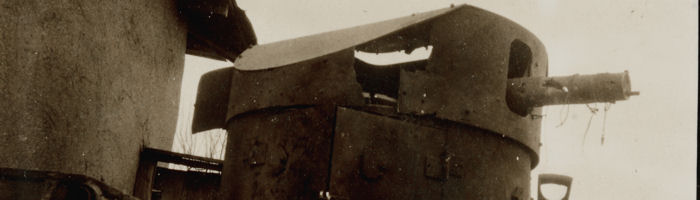
Armoured car used by Lieutentant Ingle at the Battle of Panteleimon Ustin, December 1916 ADM 116/1626
Romania launched its military offensive with a drive north into Transylvania, the territory she was most intent on seizing from the Austro-Hungarian Empire. The Central Powers responded quickly, with the Germans reinforcing the Austrians in the north and a combined German and Bulgarian force attacking Romania from the south. It quickly became clear that the Romanian Army was not capable of defending their long frontiers with Bulgaria and Austria-Hungary, particularly as Entente support was not forthcoming. The Romanian Army retreated, and following the decisive failure of a Romanian counter offensive in the autumn of 1916, the majority of the country became occupied by the Central Powers (FO 371/2886). The rump of the Romanian Army, together with the government, held onto an enclave in Moldavia strongly supported by Russian troops and a squadron of British armoured cars (WO 106/1127; ADM 116/1626).
Over the course of 1917 the Romanian position deteriorated further. They were relying heavily on their Russian allies, and as the Russian war effort collapsed into revolution, the Romanians were left extremely vulnerable (FO 371/2892). Initially the remaining Entente powers were desperate for the Romanians to continue fighting. However, once the Russians concluded a separate peace it became apparent that this was unrealistic and an armistice was agreed in December 1917 (FO 371/2895). Following the armistice there continued a strange period of phoney war, in which the Entente powers attempted to prevent the Romanians from agreeing their own peace. This eventually collapsed in March 1918 and the Romanians agreed to the Central Powers punitive peace terms in the Treaty of Bucharest, signed on 7 May 1918 (FO 371/3141).
Romanian withdrawal from the war did not last long. In the autumn of 1918 the strength of the Central Powers in Eastern Europe collapsed. Bulgaria and the Ottoman Empire signed armistices in September and October respectively, leaving the Romanians in a newly strengthened position. At the same time the Entente were keen to re-enlist the support of the Romanian Army, which had improved markedly following its initial defeats, in particular to prevent the spread of Bolshevism in south-east Europe (FO 371/3141). This led to Romania re-joining the war on 10 November 1918, with just a day of the war remaining.
Romanian re-entry into the war posed a major diplomatic problem for the Entente powers and their American allies after the armistice on 11 November 1918. The Romanian government naturally believed that their re-entry meant that the Entente powers should abide by the agreement made up in August 1916 promising Romania large territorial concessions and a seat at the Paris Peace Conference (FO 371/3141). The British and French governments did not agree and argued that the Romanian withdrawal from the war invalidated the agreement. Questions surrounding Romania were strongly debated both prior to and at the Paris Peace Conference and, although the British and French did not abide by all of the terms of the August 1916 agreement, Romania came out of the First World War with many of her initial war aims fulfilled.
Key documents
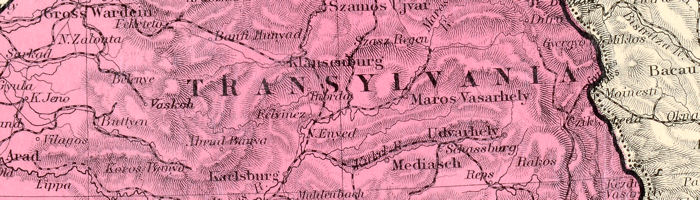
Transylvania highlighted on map of Eastern Europe to show its transfer from Austria-Hungary to Romania under the Agreement of 17 August 1916 MFQ 1/350/3
- The war, Austria-Hungary and the Balkans. Document reference FO 371/1900
- Internal history of Roumania from date of entry into the war. Document reference FO 371/2886
- Roumania and the Russian situation. Document reference FO 371/2892
- Roumanian peace. Document reference FO 371/3141 (82345/629/W19)
- British Government's attitude towards Roumania. Document reference FO 371/3141 (192849/629/W19)