
Netherlands in 1914
- Overview
- Dutch neutrality
- Wartime economy
- End of war
- Key documents
Overview
In 1914, the Netherlands was a constitutional monarchy under the rule of Queen Wilhelmina I, with a population of approximately 6.2 million people. The Prime Minister, between 1913 and July 1918, was the liberal politician, Pieter Cort van der Linde.
The Netherlands had a substantial agricultural economy, with a smaller industrial sector. It was a trading nation dependent on imports and had strong links with Germany. Its North Sea coast and major ports at Amsterdam and Rotterdam made it a strategically important country.
Dutch neutrality
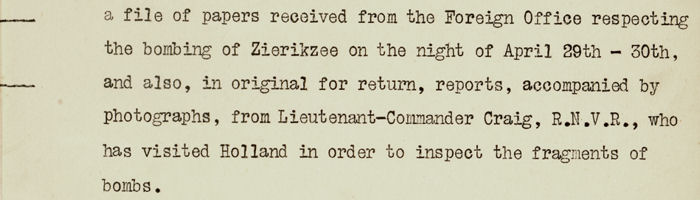
Photo of letter about Bombing of Zeirkzee ADM 156/167
As war approached, the Dutch maintained strict neutrality. The British government considered this to the advantage of Germany rather than the allies and put diplomatic pressure on the Dutch government. It was also thought that the Netherlands might enter the war on the German side (ADM 1/8407/494).
The Dutch Army mobilised on the 1 August under its Chief of Staff, Lieutenant J. C.Snijders. The Dutch government feared that the German Army might march through Limburg in the southern Netherlands to invade Belgium and to seize the Belgian port of Antwerp, a view shared by the British authorities (FO 371/2054, for example, file 84998). In fact, the Germans advanced through Belgium, the Netherlands was not invaded and the country maintained armed neutrality throughout the war.
At the beginning of October, Britain’s Royal Marine Brigade assisted the Belgian
Army at Antwerp, where it had withdrawn in the face of the German advance. The Brigade was under orders to resist the German siege, but to cross the River Scheldt and escape to the west if capture became likely. However, the First Royal Naval Brigade failed to receive orders to withdraw on 8 October. The Brigade found itself isolated and decided to move north and cross into the Netherlands (ADM 137/1010).
As the Netherlands was a neutral country, the government interned these 1,500 British marines, who were detained in the ‘English camp’ at Groningen in the northern Netherlands. The episode was subsequently investigated by the Court of Enquiry (ADM 116/1814).
By the end of the war, over 1,700 British troops had been interned by the Dutch government. Many Belgian civilians and soldiers also crossed the border into the Netherlands at the time of the fall of Antwerp and over 30,000 Belgian soldiers were interned there in the course of the war (FO 383/83, FO 383/445, FO 383/446).
In spite of its neutrality throughout the war, the Netherlands was sometimes subject to direct military action, particularly aerial bombing. The most serious incident occurred at Zierikzee on the night of 29/30 April 1917. A British airplane on a mission to attack the port of Zeebrugge became disorientated and mistakenly bombed the small town of Zierikzee, killing three people. Subsequently, the Netherlands government ordered their army to fire at foreign planes flying over Dutch territory (ADM 156/167, CAB 17/142, AIR 1/65/15/9/94, AIR 93/15/9/237).
Undeterred by fears that it might cause the Netherlands to join the war, the Allies seized Dutch merchant ships lying in British and American ports on 20 March 1918. This caused widespread outrage in the Netherlands and, to make matters worse, the country was forced to pay compensation to Germany for not taking effective action against the Allies (CAB 24/45/4) FO 395/ (might have to look this up again).
At the end of the war, despite the policy of neutrality, the Netherlands government permitted the retreating German Army to pass through Limburg province (CAB 24/150/3).
Wartime economy
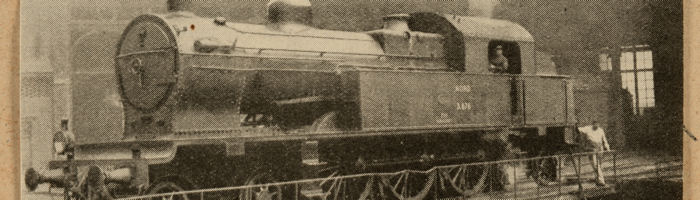
Photo of Locomotive no 3876, for Netherlands State Railway, commandeered by the War Office for ROD service ZSPC 11/670
Although the Netherlands did not participate in the war, it wrought severe economic consequences for the country. From the beginning of the war, the British Royal Navy established a blockade in the North Sea to prevent merchant ships from reaching Germany with supplies and food.
In 1914, the British government passed a Trading with the Enemy Act, which forbade trading with individuals and companies based in enemy territories. On 22 August 1914, the British ordered that any goods designated as contraband (virtually all ship-borne material) should not be exported to Germany. In 1915, the act was extended to include to those in neutral territories with enemy connections (CAB 42/1/23, CAB 37/136/21).
The Netherlands, an importer of goods and foodstuffs, had strong trading links with Germany and the British government believed that the Dutch might provide a supply of strategic materials to Germany (FO 368/1026). Accordingly, the importation of goods into Dutch ports was not allowed as the Dutch government was unwilling to rule out exports to Germany.
The British Commercial Attaché, Sir Francis Oppenheimer, played a key role in negotiating a solution to this problem. Towards the end of 1914, a number of Dutch businessmen set up the Netherlands Overseas Trading Company to import goods into the Netherlands and to guarantee that these would not be smuggled into Germany.
Throughout the war, the Netherlands Overseas Trading Company brought in goods to the Netherlands, with merchants required to guarantee that the goods would not be exported to Germany. Apart from a brief posting to Switzerland, Oppenheimer remained in the Hague throughout the rest of the war and was an important figure in maintaining commercial relations between the two countries (BT 11/8/2, Foreign Office confidential prints, FO 368/1023-1050, FO 368/1334-1391).
Nevertheless, the Netherlands was hard hit by these measures and in the course of the war the country suffered severe food shortages. The economic difficulties endured by the Dutch population had important economic and social consequences.
Queen Wilhelmina’s Royal Relief Commission was set up in 1914 but economic hardship led to demands for constitutional change. In December 1917, a new constitution based on universal male suffrage (from age 25) and proportional representation was established. This was extended to women in 1925.
The months before the end of the war saw army mutinies, riots and the calling up of the militia. In November 1918, Pieter Troelstra, the leader of the Social-Democratic Workers Party called for a socialist revolution, but this had little popular support and was countered by a campaign in support of the Monarchy (FO 371/3254-3256).
End of war
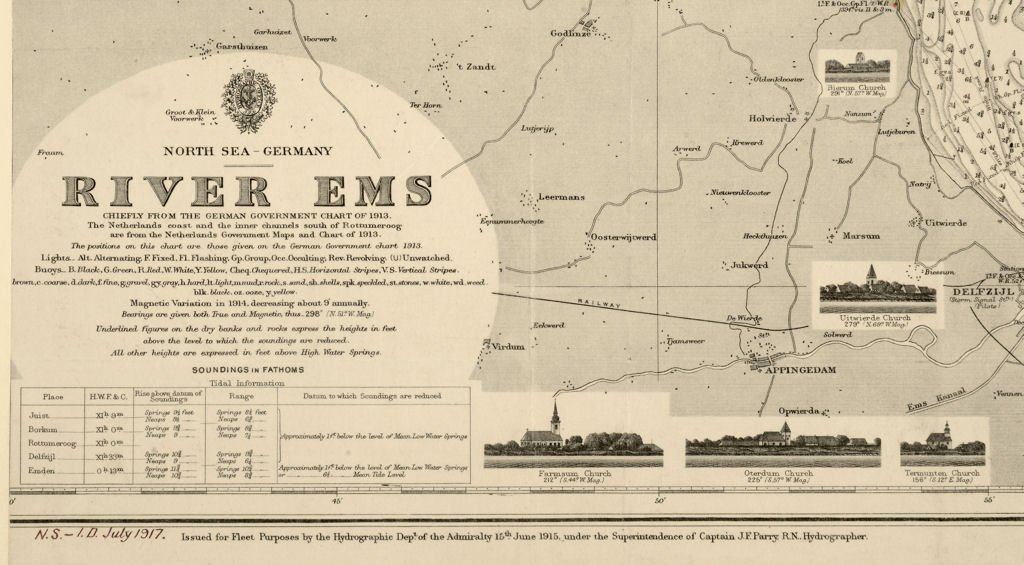
Chart of the River Ems MFQ 1/323
Charles Ruijs de Beerenbruick of the Roman Catholic State Party became Prime Minister in September 1918, leading the Netherlands into the immediate post-war period and the Versailles Peace Conference. The Belgian government pressed for a renegotiation of the 1839 treaty and requested the annexations of the Dutch province of Limburg and Dutch Flanders and the Scheldt. The Dutch government successfully resisted these claims, while experiences of the First World War caused it to revoke its policy of neutrality, so that the country joined the League of Nations in 1920 (FO 608/120/14).
Following the declaration of Germany as a republic on November 9 1918, Kaiser Wilhelm II crossed the border into the Netherlands, on 10 November. The Treaty of Versailles included a clause to enable the prosecution of Wilhelm for his role in the war. Nevertheless, Queen Wilhelmina refused to permit his extradition and he remained in exile in the Netherlands until his death in 1941 (FO 608/144/3).
Key documents
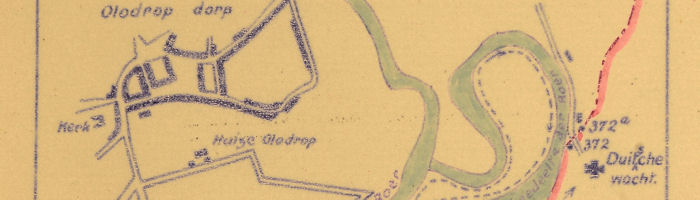
Map showing route for prisoners FO 83/293
- Holland - Attitude regarding the War;. Holland as an enemy and as an ally. Document reference ADM 1/8407/494
- Netherlands (War). Code W29 / Code 29W. Document reference FO 371/2054
- Antwerp Expedition, 1914. Document reference ADM 137/1010
- 1st R.N. Brigade, R.N.D. - Internment in Holland - Court of Enquiry. Document reference ADM 116/1814
- Netherlands and Russia: Prisoners. Document reference FO 383/83
- Netherlands: Prisoners. Document reference FO 383/446
- Netherlands: Prisoners. Document reference FO 383/446
- Court of Enquiry into bombing of Zierikzee, Holland, 24 July 1917. Document reference ADM 156/167
- Violation of Dutch neutrality, 1916. Document reference CAB 17/142
- Violation of Dutch neutrality, 14 June - 1 Nov, 1918. Document reference AIR 1/65/15/9/94
- Alleged violation of Dutch neutrality, 27 Feb 1918. Document reference AIR 93/15/9/237
- Alleged violation of Dutch neutrality, 27 Feb 1918. Document reference AIR 93/15/9/237
- Requisitioning of Dutch Shipping;. Ppossible Action by Holland, March 1918. Document reference CAB 24/45/4
- Western and General Report No. 97, 4 December 1918. Document reference: CAB 24/150/3
- Trading with the Enemy, 25 Jan 1915. Document reference CAB 42/1/23
- Memorandum by Mr Nugent on certain aspects of the proposal to extend the prohibition of trading with the enemy to neutral countries, 18 Oct 1915. Document reference CAB 37/136/21
- Netherlands Code 129 File 38184 (to paper 50244), 1914. FO 368/1026
- Netherlands Contraband Control - UK Agreement and Netherlands Overseas Trust functions, 1915. Document reference BT 11/8/2
- Foreign Office confidential prints, on supplies to the Netherlands. Document references FO 881 (various)
- Foreign Office, Commercial and Sanitary Department, General Correspondence 1915. Document references FO 368/1023-1050
- Foreign Office, Commercial and Sanitary Department, General Correspondence, 1915. Document references FO 368/1334-1391
- Foreign Office: Political Department: General Correspondence, Netherlands. Code 29 / Code W29 File 292-297. Document references FO 371/3254-3256
- Peace Conference, British Delegation, Correspondence and Papers relating to neutral countries. Holland, Belgian frontier. Document reference FO 608/120/14
- Peace Conference, British Delegation, Correspondence and Papers relating to Germany, Treaties (Special Instrument). Extradition of the Kaiser, ex-Emperor of Germany. Document reference FO 608/144/3