Malta in 1914
- Overview
- Home Front
- Military hospitals
- Key figures
- Key documents
Overview
Situated in the Mediterranean Sea, the Maltese islands of Malta, Gozo and Comino have a land area equal to twice the size of Dublin. The population of the islands in 1914 was approximately 217,000, nearly a third of which were concentrated in the capital Valletta. Due to its central position in the central Mediterranean and its role as a naval base, Malta has been strategically important since Roman times.
Home Front
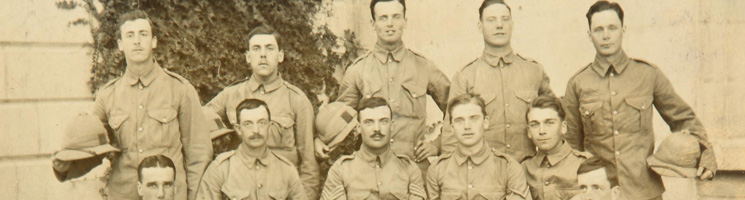
EW Bratchell and Group, Malta, 3rd London Regiment, 1915-1918 RAIL 253/516 (4)
When war was declared, the garrison on Malta totalled 6,000 servicemen of all ranks. These forces came under the command of the governor, General Sir Leslie Rundle, who was replaced in 1915 by Field Marshal Lord Methuen. Many Maltese who fought in the war joined the armed forces of Canada and Australia as well as the British Army.
In January 1917, 95 Maltese officers served outside of Malta with a further 13 serving as surgeons on British hospital ships. Locally raised units included the King’s Own Malta Regiment of Militia with a strength of 3,393, the Royal Malta Artillery with a strength of 1,032 and the Royal Engineer Militia which a contingent of 136 men. None of these units served at the front but by taking part in garrison duty they allowed British troops to be deployed overseas (WO 33/3279).
The total number of Maltese from Malta who served in the army in any capacity during the war is estimated at 15,000, with the Maltese Labour Corp accounting for 7,000. One battalion unloaded ships at Gallipoli with a further two battalions serving at Salonika. A further 1,500 Maltese were employed in the motor transport work of the Army Service Corps. The number of men killed and injured in the Labour Corps totalled 300. Maltese also served at various Royal Naval establishments with 10,000 employed at the Dockyard Naval Ordnance Depot, 2,400 in coaling, 1,300 on sea-going service and 200 in mine sweeping. A number of Maltese also served aboard British ships at Jutland with 778 employed by the Royal Air Force (ADM 137/4672).
Military hospitals
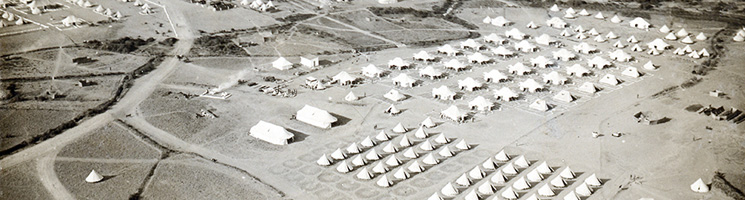
RNA Seaplane base, Malta, 1917-1918 AIR 1/629/17/118/5
Malta’s most significant contribution to the war was its role as a military hospital base. Following the first landings in Gallipoli in April 1915, a total of 4,000 wounded servicemen were treated in hospitals in Malta. By June over 6,000 beds were made available and the end of September 13,000 men were under treatment in hospitals, camps and schools. At its height, the number of wounded reached 20,000, with dysentery and typhoid accounting for the same number of casualties as gunshot wounds (MH 106/433).
As a result of the Gallipoli campaign alone, approximately 2,500 officers and 55,400 other ranks received treatment in Malta. To deal with the casualties, the size of the Royal Army Medical Corps increased to 334 medical officers, 913 nurses and 2,032 other ranks. In July 1915, Sir H R Whitehead was appointed Surgeon-General. He was succeeded in March 1916 by Surgeon-General Sir Thomas Yarr. Women assisted the injured via the Voluntary Aid Detachment, the Red Cross and the Church Army. Private subscriptions to the British Red Cross and St. John Ambulance amounted to £18,562. Due to its role in tending the war-wounded Malta became known as the nurse of the Mediterranean (WO 95/5448).
Key figures

Sir Leslie Rundle
General
Detail of NPG x84647 , Sir (Henry Macleod) Leslie Rundle, © National Portrait Gallery, London.

Field Marshal Lord Methuen
Governor (1915-1919)
Sir H R Whitehead
Surgeon-General

Sir Thomas Yarr
Surgeon-General
Detail of NPG x66269 , Sir Thomas Yarr, © National Portrait Gallery, London.
Key documents
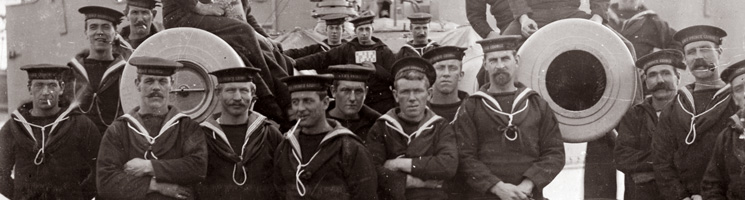
Sailors on HMS Prince George, Malta, 1917-1918. AIR 1/629/17/118/5
- Original correspondence, 1914-1918 CO 158/384-407
- Sessional papers, 1914-1918 CO 161/108-115
- Government Gazettes, 1914-1918 CO 162/48-51
- Unit war diaries W0 95/5447-49
- Records used for Official History, First World War ADM 137/9/5, ADM 137/12/10