
Greece in 1914
- Overview
- The national schism
- Joining the war
- Salonika
- Key documents
Overview
At the outbreak of war Greece endeavoured to remain neutral. However disagreements between the King, Constantine I, and his Prime Minister, Eleftherios Venizelos quickly led to political divisions and constitutional crises.
On 27 June 1917 Greece finally joined the war on the Allied Powers’ side, with units organised under British control. Franco-British troops had, in fact, landed two years earlier at Salonika (now Thessaloniki), and the King had abdicated in favour of his son Alexander I.
Greece’s brief participation in the war and the Allied victory resulted in substantial territorial compensation for the nation.
The national schism
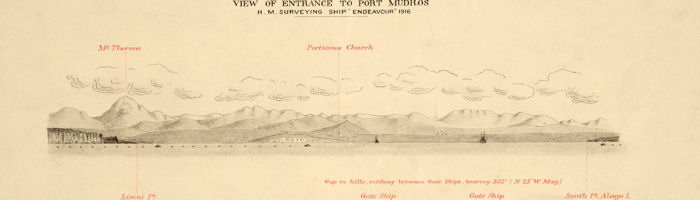
Sketch of Lemnos sweapt channel ADM 344/751
King Constantine’s sympathies leant towards Germany (FO 371/2099). He had studied at Heidelberg, graduated from the Berlin War Academy, and his wife Sophia was the Kaiser’s sister. When war broke out he refused to join the war, and declared Greece as neutral, despite letters from the German Emperor urging him to join the Central Powers (FO 371/2099).
Prime Minister Venizelos, on the contrary, was in favour of joining the Entente. However, he was not prepared to do so without obtaining strong guarantees that Bulgaria would not gain Greek territories (FO 371/2145). Bulgaria was negotiating its entry into the conflict based upon the offers of new territories and was trying to secure Salonika and the Thrace region in the north-east of Greece (FO 371/2099). Greece therefore felt under threat. Furthermore, with the heavy losses of the Balkan Wars fresh in his mind, Venizelos was also reluctant to declare war on the Ottoman Empire again (FO 371/2140).
At the beginning of 1915, Venizelos wanted Greece to join the Allies in the Dardanelles Campaign, but the King was against it. Venizelos resigned on 6 March. A new government, closer to the King, was formed and presented more claims to the Allies in exchange for Greece’s help (FO 371/2255). After Gallipoli, the Allies were intent on securing Greek support, but the government stalled the negotiations and ‘boasted that they would obtain better terms than Venizelos’ (FO 371/2243).
In October 1915, Venizelos was back in power and insisted French and British troops should be allowed into Macedonia to assist the retreating Serbian army. This was approved by the Greek Parliament but King Constantine dismissed him again. As Venizelos and his supporters refused to take part in the December election, the King’s party obtained a very large majority (FO 371/2269).
The Anglo-French presence in Salonika and the entry of Romania into the conflict prompted some civilians and officers to form a ‘Committee of National Defence’ on 31 August 1916. Venizelos arrived in the city in October and turned the committee into a ‘government of national defence’.
Greece was then divided into three zones by what came to be called the ‘national schism’. In the south, a zone controlled by the King and the government of Athens; in the north, a zone controlled by the provisional government with Salonika as a capital; between them a ‘buffer zone’ controlled by the Anglo-French forces to avoid a civil war (FO 371/2619).
Joining the war
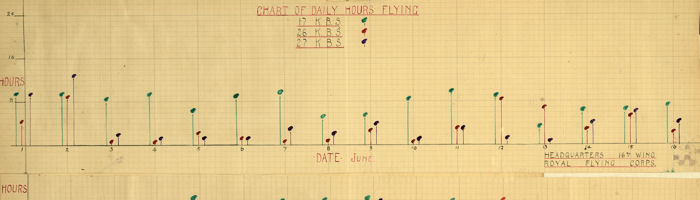
Salonica Baloon flying chart AIR 1/1694/204/120/68
Greece’s entry into the war was complicated. The Entente was initially reluctant to recognise Venizelos’ new government as they were afraid to set a precedent of supporting an unofficial government (FO 371/2627). Venizelos, however, entered the war on the side of the Entente on 7 December 1916 while the government of the king was increasingly pro-German (FO 371/2632). Constantine I finally abdicated in June 1917, and Venizelos returned to Athens as Prime Minister of Greece.
As the Central Powers did not recognise the Salonika government, Venizelos had to declare war again. The situation was further complicated as the army had been dismantled in 1916 and the country was in deep financial troubles. Having obtained a loan from the Entente Powers, Greece officially mobilised on 2 January 1918 (FO 371/2889).
The first major involvement of Greek troops in the war was the battle of Skra-di-Legen, on 30 May 1918, when Greek forces under French General Adolphe Guillaumat defeated the Bulgarian army.
Salonika
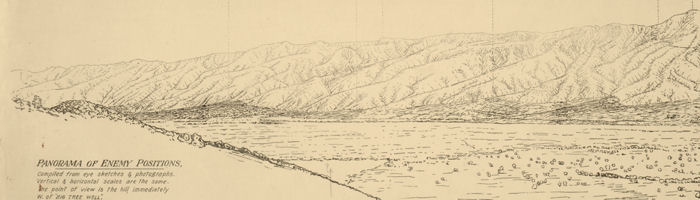
Enemy positions, Belasica WO 153/1345 (7)
‘It is common knowledge,’ the Chief of the Imperial General Staff WR Robertson wrote in 1917, ‘that the Salonika expedition has been a failure from the start’ (CAB 24/48/49). This rather harsh judgement was shared by many politicians and officers at the time. A captain even stated: ‘There is an absolute lack of vision in the situation at Salonica; there is not even military imagination and far too little military direction.’ (CAB 24/8/50).
Anglo-French forces arrived in Salonika to assist Serbia in October 1915. They failed to achieve this particular objective and Great Britain suggested the troops should be withdrawn. The French, however, thought Salonika could be an important rear base for military action in the Balkans. By mid 1916 about 300,000 troops (British, French, Italian, Serbian, Russian) were stationed at Salonika and a lot of trench work had been carried out. A British general even noted: ‘whilst admirably energetic with their picks and spades, [the French] seem to have quite lost sight of their other weapons of war’ (WO 106/1347).
Having prepared Salonika for defence, the troops started moving up country and conducted a series of operations which led to the capture of Monastir in November 1916. With the exception of a British offensive against Bulgaria at the Battle of Doiran in April and May 1917, the front line didn’t move until September 1918 when the British attacked Doiran again (WO 106/1347). The campaign led to the surrender of Bulgaria on 30 September 1918 (WO 106/1367).
Key documents
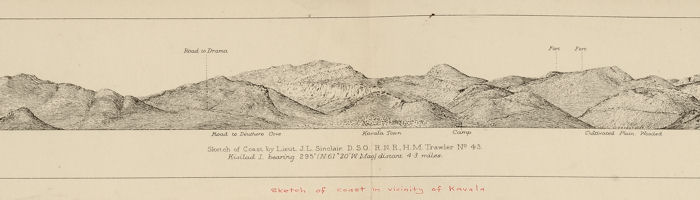
Sketch of coast in vicinity of Kavala, Greece ADM 344/708
- Foreign Office general correspondence for Servia. Code 39 File 3507-79314. 1914. FO 371/2099
- Foreign Office general correspondence for Turkey (War). Code W44 / Code 44W File 64913-67673. 1914. FO 371/2145
- Situation at the front and in Salonika: Seven reports by British Military Representatives. 1916 Feb.-1919 Feb. WO 106/1347