Gibraltar in 1914
- Overview
- Home Front
- Submarine threat
- Coal haulers' strike
- Key figures
- Key documents
Overview
Gibraltar was one of the smallest colonies in the British Empire, with an area of just under 2 square miles and a population of around 18,000. The colony was nevertheless very important due to its strategic location commanding the entrance to the Mediterranean. Its harbour was a vital base for the Royal Navy, and it was a focal point for maritime trade coming from the Mediterranean and South Atlantic.
Gibraltar was geographically isolated from the war, being a peninsula only bordering neutral Spain. However, from 1915 German U-boats operated in the waters off the colony. Due to its strategic importance and a labour shortage, Gibraltarians were not encouraged to join up, but the Gibraltar Volunteer Corp was established to help with the defence of the colony.
Home Front
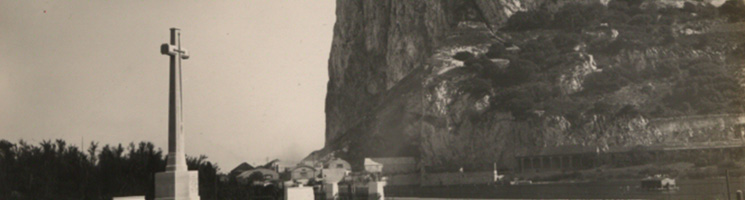
Photographic views of Gibraltar, Cross of Sacrifice (2), with rock in the background, First World War CO 1069/709/139
The Governor Lieutenant General Herbert G Miles was warned about the strained relations in Europe on 30 July 1914 by the War Office in London, and defensive steps were taken. The outbreak of war was reported by a telegram at 2:30 am on 5 August and was there was a public announcement (WO 284/133).
The colony was immediately placed under martial law and emergency measures were put in force. As all food had to be imported, the food supply was a major issue. Spain, which was strictly neutral, stopped exports of food to the colony, whilst the increased demands from Royal Navy ships placed considerable strain on supplies. The authorities quickly put restrictions on food imports and introduced price controls. Travel to Gibraltar was also restricted to ensure that the population did not increase (CO 91/456).
On 14 August the two infantry battalions within the garrison were withdrawn and the defences were taken over by the Royal Engineers and the Royal Garrison Artillery (WO 95/5445). By early 1915 troops from the Royal Garrison Artillery were withdrawn to serve in France, and men were recruited locally to replace them. At the same time, the Governor reported a strong local desire to participate in the war effort and felt ‘it most desirable that the local enthusiasm is encouraged’ (CO 91/457).
As a result, the Gibraltar Volunteer Corps was formed on 3 July 1915 and by 4 August it consisted of 17 officers and 319 rank and file (WO 95/5446). In 1917, the Colonial Office raised the question of compulsory service, but the Governor said that it would raise less than 500 men and would be very disruptive. As such there was no conscription in the colony (CO 91/464).
Economic life on Gibraltar was initially affected by the sudden drop off in trade caused by the outbreak of war. An increase in works and other war-related government expenditure rapidly compensated for this (CO 91/458). As the war progressed, Gibraltar greatly benefited from being the assembly point for convoys and a focus of coastal Mediterranean trade.
A large outbreak of influenza, commonly referred to as the Spanish Flu, brought a different threat to the colony in 1918. In two separate outbreaks in the summer and autumn approximately 30% of the population of the colony were infected, and 75 people died (CO 91/468).
Submarine threat
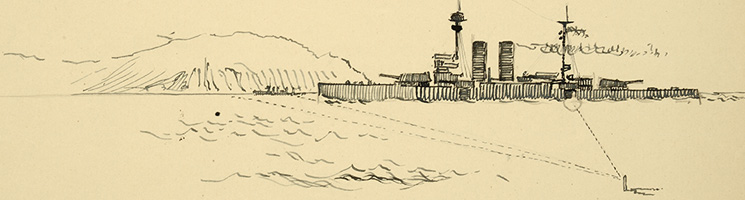
Sketch of HMS Britannia with U-boat periscope and torpedo tracks, 1918-1919. ADM 137/3337 ( f1349)
Gibraltar’s position as a major port controlling the entrance to the Mediterranean meant that the waters around the colony became an important hunting ground for German submarines. From 1915 U-boats entered the Mediterranean, passing through the Straits and the concentration of merchant and naval vessels around Gibraltar provided a range of targets. On the night of 31 December 1915, the Royal Garrison Artillery batteries defending the colony engaged one, or possibly three submarines, which were attempting to enter the harbour. The garrison believed they had successfully destroyed at least one of the submarines, although this was not confirmed (CO 91/463).
The threat from German U-boats continued throughout the war. On 9 November 1918, HMS Britannia became the last Royal Navy ship to be sunk. The battleship was passing the Straits when she was torpedoed by UB-50 and sank with the loss of 50 lives (ADM 137/3337).
Coal haulers' strike
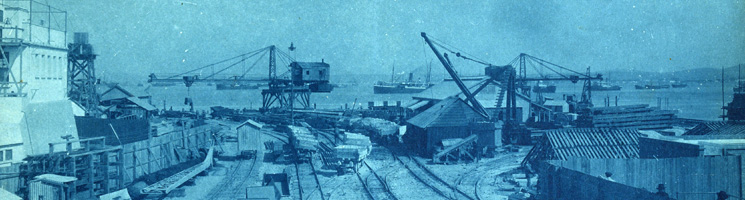
View of yard looking North-West, Gibraltar ADM 195/43 Folio 16
Gibraltar’s small size and its importance as a port meant that there was a constant shortfall in labour. This was made up by people crossing from the Spanish settlement of La Línea into Gibraltar to work.
The coal haulers, who helped refuel the naval and merchant ships which called at the port, were particularly important to the Gibraltarian war effort. Over the course of the war 1,655,000 tons of coal was supplied to ships, and much of it needed to be physically manhandled.
In January 1917, 1,200 Spanish coal haulers went on strike, seriously threatening the British war effort in the region. The Royal Navy looked at different options including using German prisoners of war, who were held in Morocco, to replace the Spanish (ADM 1/9215). The strike was resolved, but the underlying issues around pay, representation and conditions remained.
In August 1918 the strike was renewed, and eventually the British gave way on the key demands for recognition of the workers’ representative body. Throughout this period, the British were concerned that the strike movement might be exploited by German agents in Spain. However, no evidence of this was ever uncovered (CO 91/466 , CO 91/467, CO 91/468).
Key figures

Lieutenant General Herbert G Miles
Governor (1913-1918)

General Sir Horace Smith-Dorrien
Governor (1918-1923)

O/C Gibraltar Volunteer Corps
Key documents
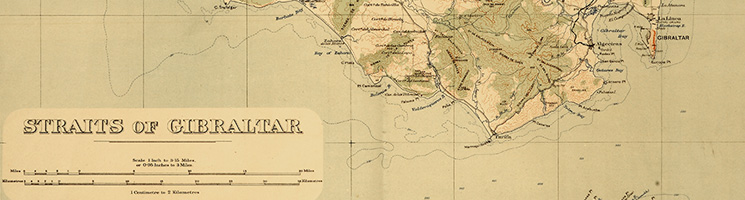
Map of the Straits of Gibraltar 1919 FO 925/30115
- Loss of HMS Britannia ADM 137/3337
- Despatches, 1 July 1914-31 December 1914 CO 91/456
- Offices and Individuals, 1914 CO 91/457
- Gibraltar: Headquarters, branches and services, general staff WO 95/5446