
Germany in 1914
- Overview
- Prelude to war
- The Front Line
- Home Front
- Armistice and Aftermath
- Key documents
Overview
Situated in Central Europe, the German Empire was one of the Central Powers in the First World War. The Empire had been established in 1871 following the unification of the German states under Chancellor Otto von Bismarck.
Germany rapidly expanded its navy and army and in 1914 planned to defeat both France and Russia in a show of military strength. The strategy relied on a quick and decisive victory but the war on the western front soon became a stalemate. The allied blockade of German ports began to result in shortages of food. The arrival of American troops in 1917 compounded Germany’s difficulties.
Prelude to war
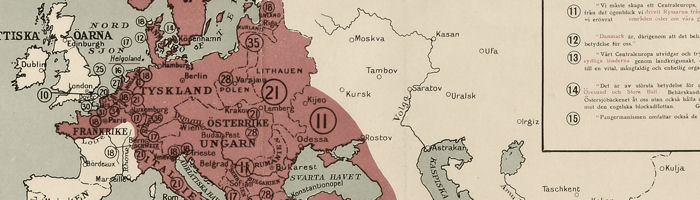
European detail from a Swedish global map of Germany's demands as expressed by leading German thinkers FO 925/30229
Germany, a latecomer to Great Power status, feared encirclement by France and Russia and resented Britain’s naval supremacy. France was an ally of Russia, and Germany did not wish to conduct a protracted war on two fronts. To avoid this, the German high command devised a military plan to first knock out France in the West while containing Russian forces in the East, before turning the full weight of the German military machine to the Russian front (CAB 103/533).
The assassination of Arch Duke Ferdinand by Serbian nationalists in Sarajevo in June 1914 provided the pretext for the Central Powers to put these plans into action. In response, on 28 July 1914 Austro-Hungary declared war on Serbia. This led to the counter mobilisation of the Russian army which in turn led Germany to declare war on Russia on 1 August 1914. Two days later Germany declared war on France and demanded free passage of its troops through Belgium. The Belgium government refused and on 4 August Belgium was invaded. On the same day, Britain announced its intention to guarantee Belgium neutrality and declared war on Germany (FO 371/2161).
At the beginning of 1914 the German army comprised of 700,000 men divided into 25 army corps. Following the declaration of war and the mobilisation of the reserves, the strength of the German army totaled 3.8 million men (WO 33/3078).
The Front Line
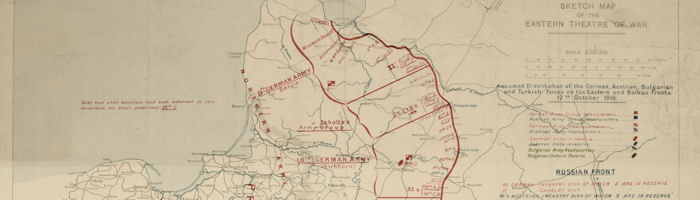
Detail from a sketch map of the Eastern Theatre of War WO 153/788
On 3 August 1914, Germany declared war on France. The German war plan was based on a quick victory over the French army before turning their forces eastwards to attack Russia. To achieve this German forces planned to advance on Paris by moving their army through neutral Belgium. German forces soon overran Belgium and began a series of reprisals against civilians suspected of assisting the Belgium army. The victims included women and priests and caused outrage in the British press.
The French with the aid of British forces halted the German advance at the Battle of Marne on 5-10 September 1914 (WO 95/1280/3). The battle was a success for the Allies and halted any prospect of a rapid German victory. It also initiated four years of trench warfare on the Western front. As both sides sort to outflank each other they eventually became locked in a ‘race to the sea’ which resulted in a set of opposing trenches stretching from the North Sea to Switzerland (CAB 45/163).
The war was not confined to the Western Front. On 1 August 1914, Germany declared war on Russia in support of its ally Austro-Hungry. In response, the Russian army invaded East Prussia. After initial successes, the Russian army was defeated in a series of battles collectively known as the First Battle of Tannenberg (17 August – 2 September) (WO 208/686). In February, the German army launched a surprise attack against the remaining Russian forces and advanced 70 miles within a week. The Second Battle of Masurian Lakes (17-22 February 1915) ended the German offensive and prevented them from advancing far into Russia.
The Eastern front also saw the first large-scale use of poison gas with German forces employing eighteen thousand gas shells against Russian forces during the Battle of Bolimów in 1915 (WO 158/122). The gas caused minimal casualties as it froze in the winter conditions rendering it largely ineffective. German troops were also involved in military engagements in German East Africa and Lake Tanganyika.
In an attempt to break the stalemate on the western front, the Germans launched a large scale offensive against French forces stationed at Verdun. The onslaught began in February 1916, with a 10-hour artillery bombardment along a front 30 km long. In a series of attack and counter-attack lasting 299 days both sides attempted to overwhelm their opponents by pushing more men and equipment to the front (WO 33/770). The battle ended in stalemate with both sides losing many men.
In July, a subsequent offensive, resulting in greater loss of life, occurred farther north at the Somme. The battle of the Somme was one of the largest battles of the First World War in which more than 1 million men were wounded or killed (WO 158/322-331).
In combination with a Russian offensive in the east under General Brusilov, the Germany army began to lose morale. This was compounded in 1917, with the entry into the war on the allied side of the United States. The Russian revolution followed by the Treaty of Brest-Litovsk in March 1918, ended the war in the East.
The German high command realised that its last chance of success lay in defeating both Britain and France before they could be reinforced by American forces. To achieve this, the German army mounted a spring offensive. After initial success, the German army began to be pushed back following the Battle at Marne (WO 153/306). The German retreat marked the start of the allied ‘Hundred Days Offensive’ that broke the Germany army’s strength and culminated in the Armistice with Germany which was signed on 11 November 1918.
Home Front
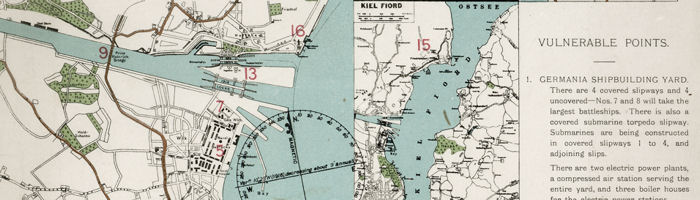
Detail from a map of Kiel Harbour showing vulnerable points AIR 1/2125/207/76 (55A)
The majority of the German people supported the war which they believed would be short and victorious. This confidence was soon undermined with the realization that the conflict was fast becoming a war of attrition with slaughter on an industrial scale.
In the expectation of a short war, Germany had no stockpiles of food or munitions and no plans for mobilising its civilian economy to support the war effort. The naval blockade imposed by the Royal Navy compounded these shortages. Bread rationing was introduced in 1915 with food shortages reported in many urban areas (CAB 37/129/7). To prevent the population from starving hundreds of soup kitchens were established.
The winter of 1916-17 was known as the ‘Turnip Winter’ as poor weather and a lack of farm laborers, led to a poor potato harvest forcing the people to eat turnips usually fed to livestock. Hunger and disease claimed thousands of civilian and wounded soldiers lives.
The famine and hardship of the Turnip Winter sapped morale and laid bare the perilous state of the German economy under the duress of the war (CAB 1/21/34). To prevent a black market developing, the government implemented maximum prices on essential food stuffs and established a war food office. To combat the decrease in availability of food, the population were encouraged to adopt ‘meatless’ food days.
The increasing death toll in the trenches resulted in further conscription to the German army. The lack of male workers meant that German industry became reliant on women. By December 1917, munitions factories were mainly staffed by female workers with many more working in metal foundries, chemicals works and machine tools. The laws protecting women in the workplace were relaxed with cities attracting many women who had previously worked on the land (MUN 4/3643).
The lack of food, low morale and growing realisation that Germany was unlikely to win the war led to social unrest. In October 1918, units of the German Navy refused to set sail and mutinied. By 3 November, the uprising had spread to a number of other German cities which soon came under the control of councils comprised of workers and soldiers. In Munich a ‘Workers’ and Soldiers’ Council’ forced the last King of Bavaria, Ludwig III, to abdicate. Meanwhile, Hindenburg and the senior army commanders had lost confidence in Kaiser Wilhelm II and his government. The Kaiser fled into exile in the Netherlands with a German Republic declared on 9 November 1918 (FO 371/3224).
Armistice and Aftermath
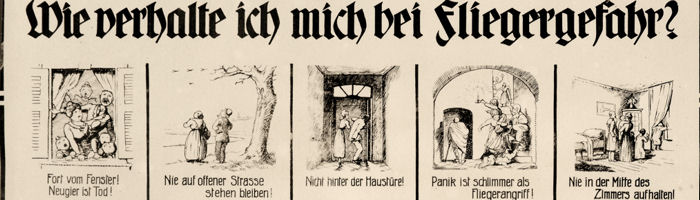
German cartoon on keeping safe during air raids AIR 1/1998/204/273/267
In early October 1918, with the army in retreat and Austro-Hungary close to collapse, the German government sought to end the conflict on favorable terms and proposed an armistice with immediate effect. As a precondition for negotiations, the allies called for the withdrawal of Germany forces from occupied territories, the cessation of submarine activities and the abdication of the Kaiser. In subsequent negotiations, the Germans were handed a list of Allied demands and given 72 hours to agree. The Armistice was agreed at 5am on 11 November 1918 and came into effect at 11 am Paris time (CAB 23/14).
The terms of the Armistice were harsh and amounted to total German demilitarization. Following the Armistice American, Belgian, British and French forces occupied the Rhineland in western Germany. The allied armies did not enter Berlin and did not demand the complete surrender of the German army. These factors enabled military leaders to spread the story that the army had not been defeated but betrayed by politicians and traitors.
Under Article 231 of the Treaty of Versailles, Germany had to acknowledge responsibility for all the loss and damage to which the Allied and associated governments and their nationals have been subjected to as a consequence of the war imposed upon them by German aggression. The Treaty imposed punitive reparations with Germany required to pay 132 billion gold marks (US$33 billion) to cover civilian damage caused during the war.
The German people saw reparations as a national humiliation and came to see themselves as victims. The widespread acceptance of the ‘stab-in-the-back’ theory coupled with the uncompromising terms of the Versailles treaty undermined the legitimacy of the newly elected Weimar government. This opened it to attack from the extreme right and left. Communist, nationalist and fascist movements in Germany grew in strength and began to enjoy a new level of popularity. The denunciation of the Versailles Treaty was one of the platforms that gave Hitler’s Nazi Party credibility with mainstream voters in the early 1920s and early 1930s (FO 954/10A/150).
Key documents
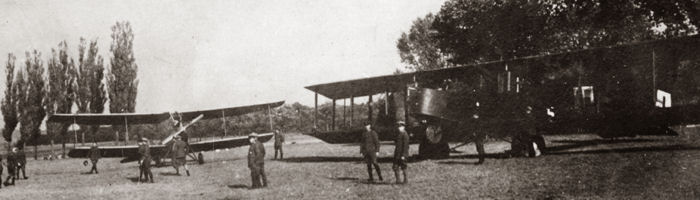
German troops and aircraft AIR 1/1998/204/273/265
- Reports on general conditions in Germany, 1915-16. Document reference ADM 137/3861-62
- Trade Division Records: enemy trading, shipment of stores to Germany, supply of food and miscellaneous papers. Document reference ADM 137/2913
- Committee of Imperial Defence minutes 1912-23. Document reference CAB 2/3
- War Cabinet Conclusions, 1914-18. Document reference CAB 23/1-14
- Diplomatic Correspondence for Germany, 1915. Document reference FO 371/2366-2368
- Diplomatic Correspondence for Germany, 1916. Document reference FO 371/2678-2680
- Peace Conference: British Delegation correspondence and Papers, 1918-1920. Document reference FO 608/1-312
- Maps and Plans of the Western Front showing German strength, 1914-17. Document reference WO 153/1259-62
- Intelligence Summaries, 1915-1918. Document reference WO 157/1-47