
Cyprus in 1914
- Overview
- Political status
- Military base
- Intelligence
- Key figures
- Key documents
Overview
The location of Cyprus at the eastern end of the Mediterranean meant that it was strategically and diplomatically important for the campaigns against the Ottoman Empire. The island saw no military action, but it was at the centre of diplomatic efforts to bring Greece into the conflict. Cyprus was also an important base for intelligence and counter-intelligence operations.
Political status
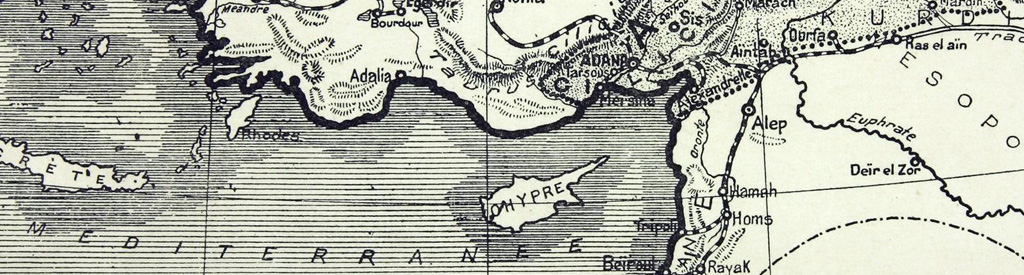
Armenia, Ottoman Empire CAB 24/144 (127)
Britain and the Ottoman Empire signed a defensive alliance following the Russo-Turkish War of 1877-1878. This included an agreement that the Ottoman Sultan ‘consents to assign the Island of Cyprus to be occupied and administered by England’ (FO 93/110/27B). Despite this, the island remained officially part of the Ottoman Empire.
In November 1914, the Ottoman Empire entered the war on the side of the Central Powers, and on 5 November Cyprus was formally annexed as a British Imperial possession. Under the terms of the annexation, all Ottoman subjects born in Cyprus would automatically become British subjects. Those born outside Cyprus were given one year to leave the island if they wished to remain Ottoman subjects (CO 70/9 ).
In early 1915, the Allies planned a naval campaign against the Ottoman Empire through the Dardanelles. The Foreign Secretary, Sir Edward Grey, was keen to bring Greece into the war on the Allied side, and suggested that Britain hand over Cyprus to Greece in return for Greek support against the Ottomans (FO 800/91, FO 371/2241). The British Cabinet did not agree to the proposal, on the grounds that Cyprus might prove strategically useful (CAB 37/123/33).
By the autumn of 1915, the Allied situation in the eastern Mediterranean had worsened. The fighting in Gallipoli was at a stalemate, and in October Bulgaria joined the war on the side of the Central Powers, and launched an invasion of Serbia.
The British Government renewed its efforts to get Greece to enter the war on the Allied side. On 16 October, Grey wrote to the British ambassador in Athens instructing him to offer Cyprus to Greece, in return for Greece giving ‘immediate and full support with her army to Serbia’. The Greek government rejected the offer, declaring that it would be ‘courting disaster to go to help Serbia’ (FO 371/2273). At the end of the war, the possibility of ceding the island to Greece was raised once again, but was rejected because of its importance as a potential military base.
Military base
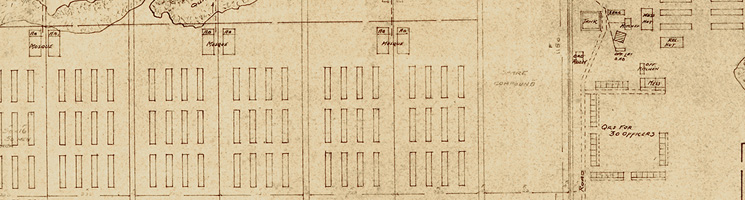
Famagusta, Cyprus Prisoners of War Camp, plan showing Barracks, cells, hospital etc. 1916 MFQ 1/443/8
In 1917, the Allies considered mounting an Anglo-French amphibious operation targeting Ottoman supply lines in Syria. General Foch proposed using Cyprus as a forward base, but the British opposed this, arguing that the island did not have suitable harbour facilities. The operation never went beyond the planning phase (WO 106/723).
A prisoner of war camp was established at Famagusta for Turkish detainees (MFQ 1/443/8).
Intelligence
Imperial Overseas Intelligence 1918: Cyprus section and appendices. KV 1/18
Cyprus’s location close to Ottoman Syria, and its mixed Greek/Turkish population, meant that it was a focus of both intelligence gathering and counter-intelligence operations. Interest in the island started in 1916, after it was placed under the control of the Eastern Mediterranean Special Intelligence Bureau (EMSIB), which was based in Alexandria.
The initial concern focused on the large Turk population, who had been Ottoman subjects up until the outbreak of war. The EMSIB declared that the counter espionage situation was ‘unsatisfactory’. Over the course of 1917, the British became convinced that the island was being used as a staging post to send intelligence back to the Ottoman mainland. There were also concerns that local Turks were establishing supply depots on the island’s remote coasts, which were helping to sustain the German U-boats operating in the area.
The EMSIB sent a number of officers to the island to investigate the suspected espionage, but their efforts were hampered by the resistance of the civil authorities. It appears that the High Commissioner, Sir John Clauson, was concerned about the impact that arresting individuals for espionage would have on the tense relations between the various communities on the island.
Cyprus was also used as a base from which British and French agents were sent into Ottoman-held territory, and as a means through which their information was sent back to Alexandria (KV 1/18).
Key figures

Sir John Clauson
High Commissioner 1915-1918

British Foreign Secretary 1906-1916

Eleftherios Venizelos
Greek Prime Minister 1910-1915, 1917-1920
Key documents
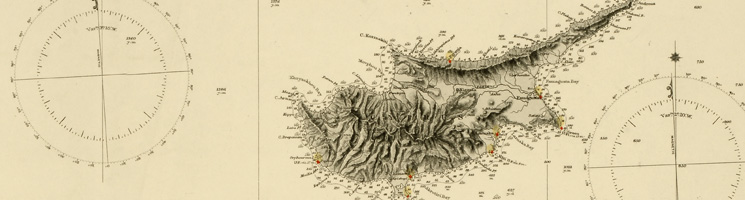
Eastern Mediterranean Candia to Alexandretta, 1914. CO 1047/362
- Government Gazette, 1912-1915 CO 70/9
- Sir Edward Grey's Correspondence with the Colonial Office FO 800/91
- Foreign Office papers on the war in the Balkans, 1915 FO 371/2273
- Intelligence report on Cyprus KV 1/18
- Admiralty Chart 2606: `Mediterranean-Eastern Portion: Candia to Alexandretta' CO 1047/362