Straits Settlements in 1914
Now Singapore and parts of Malaysia
- Overview
- Home Front
- Armed forces
- Singapore Mutiny
- Key figures
- Key documents
Overview
The Straits Settlements was a British colony formed from islands and coastal regions in and around Malaya (now Malaysia). The capital and focal point of the Straits Settlements was the island of Singapore, separated from the southern tip of the Malay peninsula by the Straits of Johore.
Moving up through Malaya, the colony included Malacca, a sultanate to the north west of Johore. Further north, the group included the Dindings, an island off the western coast of Malaya which also had jurisdiction over a mainland strip. The last three settlements consisted of the island of Pangkor, situated above the Dindings, Penang, an island lying off the north west of Malaya and the Province of Wellesley, a mainland strip to the east of the island of Penang, by whom it was administered. The Governor of the Straits Settlements was also the High Commissioner of the Federated Malay States.
Home Front
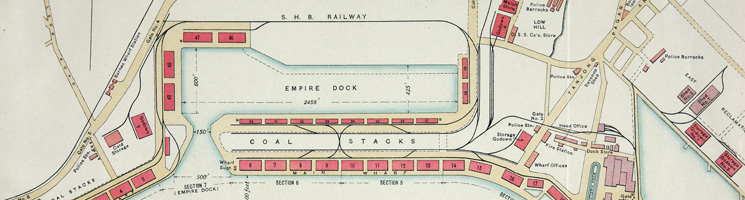
Plan of Tanjong Pagar Section by Singapore Harbour Board: page 3 CO 1069/557
Throughout the war the Governor of the Straits Settlements was Sir Arthur Young, who was based in Singapore. He was assisted in Penang and Malacca by a British Resident Political Officer, who acted as an adviser to the sultans of those regions. Revenues in the Straits Settlements increased annually from 1914 to 1919, with sharp increases in 1916 and 1917, largely due to the demand an increase in the price of rubber.
But this did not necessarily lead to increasing prosperity. The costs of the war, in maintaining volunteer forces and harbour defences at all ports in Singapore and Penang, together with the costs of censorship and holding enemy aliens, all had to be paid for by the Straits Settlements government.
In March 1916 the Straits Settlements Legislative Council voted to contribute a war gift of £400,000 to the British government over and above the statutory contribution. In June 1916 it voted to increase the annual contribution to £200,000 (CO 275/97). From January 1917 an income tax, or war tax, was introduced, which raised £400,000 in 1917, rising to £475,000 in 1918 and £525,000 in 1919.
To raise extra money war loan bonds were offered to the public at 6% interest in 1916, raising £4,939,000. Another floatation in 1918 raised a further £3,341,000. In addition to this, £50,000 was raised for the King’s Fund for Disabled Soldiers and Singapore, Penang and Malacca also raised money for the Prince of Wales Relief Fund. Altogether, the Straits Settlements contributed £15,480,690 towards the cost of the war (CO 276/85).
Armed forces
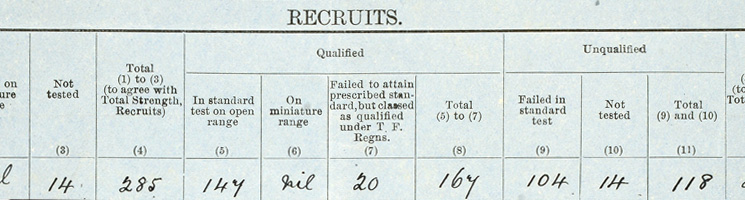
Penang Volunteer reports, 1914. CAB 11/167 (1 of 4)
Before the war, Singapore was defended by a regular garrison of British Army troops including a Royal Garrison Artillery unit, a corps of Royal Engineers and two infantry battalions, one European and one Indian. In addition, there was a Singapore Volunteer Corps, which consisted of 29 officers and 607 men, a Singapore Volunteer Artillery unit, Singapore Royal Engineers, a Singapore Volunteer Ambulance and a Maxim Gun Company.
The Singapore Volunteer Force took over many of the duties of the regular garrison, including guarding docks, reservoirs and cable stations, manning the coastal artillery defence and working the searchlights. This allowed the majority of the regular artillerymen to be released for war service. The deployment of the Singapore Volunteer Engineers also allowed many of the Royal Engineers to be posted overseas and the Maxim Gun Company was given the duty of guarding prisoners of war, releasing further regular soldiers.
In October 1914 an additional European company was formed called the Singapore Volunteer Rifles, and a similar company was raised in Penang. In November 1914, a Veterans’ Company was raised, for Europeans over the age of 40. A unit of Malacca Volunteer Rifles was established in August 1915 and the Province of Wellesley Volunteer Rifles was formed in November 1915 (CAB 11/167). The Coast Defence Volunteers was raised in 1917 in Singapore and Penang and consisted of nine officers and 200 men (CO 275/97).
In addition, the Reserve Force and Civil Guard Ordinance of 1915 was introduced to enlist every healthy European male of military age not already signed up. Although resources were limited, not all soldiers were restricted to service within the Straits. 258 Europeans joined the British Army from the Straits Settlements and hundreds more paid for a ticket to England and joined up there. Some members of the Singapore Volunteer Artillery also joined Royal Artillery units. In addition, some Indians formed part of an Anglo-Indian battalion, which was deployed to the north-west frontier of India. Around 250 Chinese citizens in Singapore enlisted in a unit of the Chinese Labour Corps and were sent to Basra in 1916, and some Chinese and Malay citizens also were also employed for civilian work in East Africa.
Singapore Mutiny
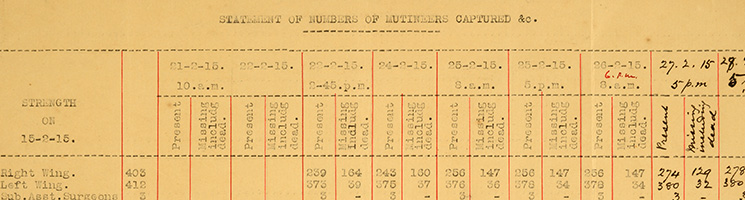
Singapore Mutiny record of sentences passed on mutineers, 1915. FCO 141/16535
A mutiny broke out on 15 February 1915 involving nearly half of the 850 soldiers of the 5th Indian Light Infantry, who were serving at the Singapore Garrison. At 3.30 pm four Muslim companies of the battalion overran the Alexandra barracks, where they were quartered, killing two British officers. A detachment of 100 mutineers then made for the Tanglin barracks to collect ammunition, shooting 13 officers and men, wounding three others and releasing German prisoners of war.
Elsewhere in the city, at Keppel Harbour, the jail and the central police station were attacked and 20 Europeans were killed. Many Europeans and local civilians were wounded. A third group of mutineers besieged the house of Lieutenant Colonel E V Martin, commander of their battalion, but were beaten back by a detachment of the Malay States Volunteer Rifles (FCO 141/16532). The Mountain Battery of the Malay States Guides were also quartered at Alexandra barracks when the mutiny broke out, but few of the men, who were all Sikhs, took part in the mutiny and most made their way back across the Straits of Johore, to return to their headquarters in Taiping (Kedah) (CO 273/423).
At 6:30 pm martial law was declared, and the drill hall and central police station became the focal point for the defenders. A small force of Marines from HMS Cadmus drove back a section of the mutineers from the docks. In the evening 150 men of the Johore Volunteer Rifles, led by the Sultan of Johore, arrived in Singapore. On 17 and 18 February shore parties from French, Russian and Japanese cruisers landed to help in the defence and on 18 February six companies of the 1st and 4th battalion King’s Shropshire Light Infantry arrived in Singapore and helped round up the last of the mutineers. The mutiny lasted for nearly seven days and resulted in the deaths of 47 soldiers and civilians. On 23 February, a court of enquiry was held which lasted until 15 May 1915. More than 200 soldiers were tried by court martial, of whom 47 were executed, 64 were deported and 73 were given prison sentences (FCO 141/16535).
Key figures

Sir Arthur Henderson Young
Governor of the Straits Settlements (1911-1920)
Detail of NPG x66372 , Sir Arthur Henderson Young, © National Portrait Gallery, London.
Dudley Howard Ridout
General Officer Commanding the Troops in the Straits Settlements (1915-1921)
Key documents
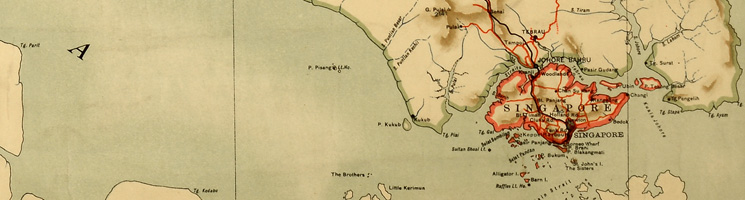
British Malaya, Straits Settlements and Malay States, 1917. CO 1047/900
- Colonial Defence Committee: Singapore and Penang Volunteers reports, 1915 CAB 11/167
- Original Correspondence: Governor’s Despatches, July - October 1915 CO 273/423
- Straits Settlements: Sessional Papers, Legislative Council, 1916-1917 CO 275/97
- Straits Settlements: Government Gazettes, January-June 1919 CO 276/85
- Foreign Office: Migrated Archives: Singapore: Mutiny of the 5th Native Light Infantry (Singapore Mutiny) report and notes of evidence of Court of Enquiry; remarks of the General Officer Commanding, 1915 FCO 141/16532
- Foreign Office: Migrated Archives: Singapore: Mutiny of the 5th Native Light Infantry, 1915 FCO 141/16535