Malaya in 1914
Now Malaysia
- Overview
- Home Front
- Armed forces
- HMS Malaya
- Key figures
- Key documents
Overview
Malaya (now Malaysia) is below Thailand in the South China Sea and is separated from Sumatra by the Straits of Malacca. At the time of the First World War it was made up of four Federated Malay States, Perak, Pahang, Selangor and Negri Sembilan, five Unfederated Malay States, Perlis, Kedah, Kelantan, Trengganu and Johore and the Straits Settlements.
Each of the Malay States was ruled by a Sultan or Rajah. In the Federated Malay States there was a Federal Council in which the Sultans represented their country and were advised by a British Political Resident. In the Unfederated Malay States the Sultans ruled independently. The Governor for the Straits Settlements, Sir Arthur Young, served as High Commissioner for all the Malay States.
Home Front
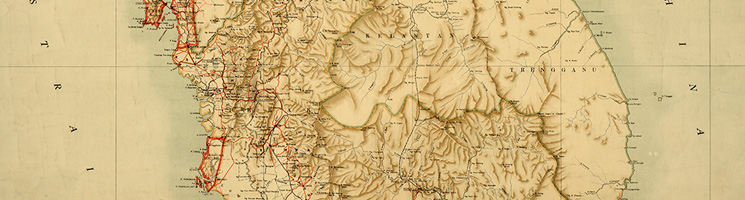
British Malaya, Straits Settlements and Malay States, 1917. CO 1047/900
Revenues fell slightly across all of the states in 1914, but they improved in 1915 and increased quickly from 1916 to 1918. This was largely due to the high demand for rubber and tin. Over the course of the war the Federated Malay States donated a little over £13,500,000 to the British government. £2,925,532 was raised through war loans and war saving certificates. £7,616,609 was raised through Exchequer and war bonds. A further £2,969,667 was raised through gifts, taxes and contributions to charitable funds such as the King’s Fund for Disabled Soldiers, the Prince of Wales’ National Relief Fund, the Auxiliary Hospital Fund, the British Red Cross and various other war relief funds (CO 574/22).
In the Unfederated Malay States, Johore donated £31,500 in gifts and aeroplanes and £30,000 to war charities (CO 653/2). Kedah donated £2,356 in gifts and aeroplanes and £39,000 to war charities (CO 716/1) and also invested $500,000 Straits Dollars in the Straits Settlements War Loan. Kelantan donated £2,785 in gifts and voluntary income tax (CO 827/1). In Perlis the Rajah donated a small amount of money for the Red Cross ‘Our Day’ in 1917 (CO 716/1) and at similar events in Trengganu $18,600 SD was raised (CO 840/1), in Kedah $52,000 SD was raised (CO 716/1) and in Johore $164,000 SD was donated (CO 653/2). The Chinese and Indian communities in Malaya also gave generously. The Malayan Air Squadron Fund led to 36 planes being donated by the Federated Malay States, while the Sultan of Johore paid for a further 16 and the Sultan of Kedah paid for one more.
Armed forces
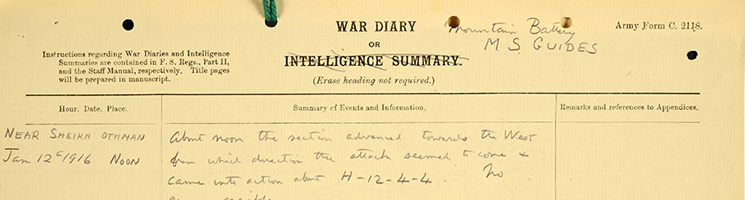
Record of the death of Captain Leslie near Sheikh Othman, Aden, 1916. WO 95/5438
The Malay States Guides consisted of Indian born troops, with officers from the British and Indian Armies. They were responsible for the internal defence of the Federated Malay States. At the start of the war the force was made up of 900 men across six companies of infantry, a depot company and a mountain battery of artillery.
In February 1915, at the time of the Singapore Mutiny, 100 men of the Malay States Mountain Battery were based at the Alexandra Barracks, where the mutiny broke out. A few of the men, who were all Sikhs, took part in the mutiny and most made their way back across the Straits of Johore, to return to their headquarters in Taiping (Kedah). In April 1915 they were posted to Kelantan to contain an uprising at Pasir Putch. Following this in September 1915 the Mountain Battery was transported overseas and served in the Aden Field Force until 1 May 1919 (WO 95/5437).
The Federated Malay States Volunteer Force was made up of four infantry battalions of Malays, Chinese, Anglo-Malays and Tamils. There was one battalion in each of the four states of Perak, Selangor, Negri Sembilan and Pahang. These were supplemented by a Volunteer Signals Battalion, a Volunteer Light infantry Battalion, a Volunteer Reserve Motor Transport Company and Field Ambulance units.
In addition, five companies of Malay States Volunteer Rifles were formed of Europeans and numbered 23 officers and 586 men. During the course of the war over 5,000 men joined the Federated Malay States troops. To supplement the forces, on 18 November 1915 the Reserve Force and Civil Guard Ordinance was passed and European men aged between 18 to 40 were conscripted into the Reserve Force, while those aged 40 to 55 joined the Civil Guard (CO 574/14).
Johore was the only one of the Unfederated Malay States to have a military force at the beginning of the war. The Johore Army consisted of 220 regulars and 300 volunteers, a unit of 65 Indian artillerymen and a 58 piece military band. The Sultan of Johore was Colonel-in-Chief of the Johore Army. When war broke out, the Sultan of Johore placed himself and his forces at the disposal of Dudley Howard Ridout, the General Officer Commanding Straits Settlements. In February 1915 the Sultan of Johore arrived in Singapore with about 150 men to help suppress the Singapore Mutiny and with rounding up the mutineers.
During the course of the war volunteer units increased the number of soldiers available in the Unfederated Malay States. The Johore Volunteer Engineers were formed and volunteer forces were also raised in Kedah and Kelantan. In addition, in 1915 the Johore Volunteer Rifles was formed from Europeans resident in Johore, and a similar force was later raised in Kelantan. Hundreds of Europeans in Malaya became officers in the British Army or in the Indian Reserve of Officers and many other British residents also left Malaya for service at the front. 345 men joined British forces from the Federated Malay States, 44 joined from outside the Federation and a further 185 departed for the United Kingdom to sign up there. There were also Malays in the Royal Naval Reserve and in the Merchant Navy, and an Anglo-Indian battalion from Malaya fought on the North-West Frontier of India.
HMS Malaya
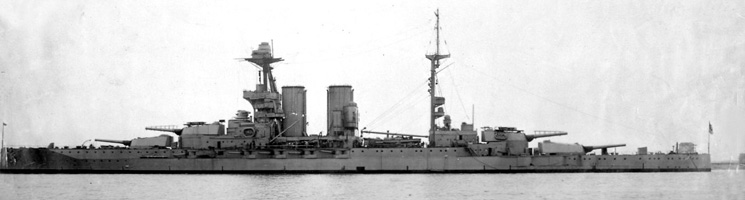
Admiralty ship Malaya launched, 1915. ADM 176/982
Before the war, the government of the Federated Malay States donated nearly £3,000,000 to the Royal Navy for the construction of a battleship, which was named HMS Malaya in recognition of the gift. The ship was completed on 1 February 1916, and formed part of the 5th Battle Squadron of the Grand Fleet. She took part in the Battle of Jutland on 31 May – 1 June 1916, the largest naval battle of the First World War, flying the flag of the Federated Malay States. HMS Malaya was severely damaged during the battle, receiving eight hits from enemy shells (ADM 137/302/3). 63 crew and two civilians lost their lives either during the battle or later from their injuries. After the battle, HMS Malaya put into the Invergordon dockyard in Scotland for repairs which took eight weeks to complete.
Key figures

Sir Arthur Henderson Young
High Commissioner for the Malay States (1911-1920)
Detail of NPG x66372 , Sir Arthur Henderson Young, © National Portrait Gallery, London.
Muhammad Shah
Ruler of Negri Sembilan (1888-1933)
Mahmud Shah (1909-1917) and Abdullah al-Mutassim (1917-1932)
Sultans of Pahang
Idris (1887-1916), Abdul Jalil (1916-1918) and Iskandar (1918-1938)
Sultans of Perak
Syed Alwi IV
Raja of Perlis (1905-1943)
Sulaiman
Sultan of Selangor (1896-1937)

Ibrahim II
Sultan of Johore (1895-1959)
Detail of NPG x128040 , Sir Ibrahim, Sultan of Johore, © National Portrait Gallery, London.
Abdul Hamid
Sultan of Kedah (1881-1943)
Muhammad IV
Sultan of Kelantan (1900-1920)
Zainal Abidin III (1881-1918) and Muhammad Shah (1918-1920)
Sultans of Trengganu
Key documents
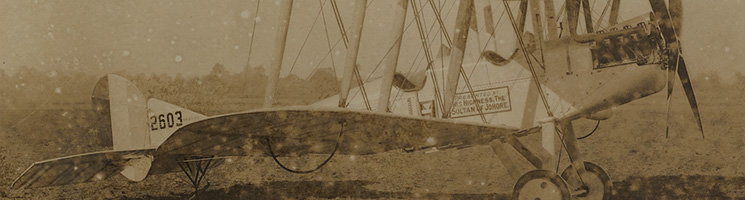
Two aeroplanes presented by the Sultan of Johore to the Royal Flying Corps. Singapore. 1916. FCO 141/16107
- Straits settlements correspondence CO 273
- Federated Malay States Government Gazettes CO 574
- Johore Government Gazettes CO 653
- War diaries: Malay states guides mountain battery, September 1915-May 1916 WO 95/5437