
India in 1914
Now India, Pakistan, Bangladesh, Burma, Bhutan and Nepal
- Overview
- Indian Army
- Victoria Cross
- Key figures
- Key documents
Overview
In 1914 British-ruled India was also known as the Indian Empire or the British Raj. Within its borders were modern-day Pakistan, Bangladesh, Burma and loosely, the Kingdoms of Bhutan and Nepal, as well as what we know today as India (with the exception of Goa, which was then a Portuguese colony, and French-run Pondicherry, which did not become part of India until 1954).
According to the census of 1911, the total land mass was 1,802,192 square miles, an area greater than the whole of Europe excluding Russia. The population of the British Raj was 315,132,537, or about one fifth of the world’s population. 244,267,542 people lived in directly administered British Indian territory and 70,846,995 lived in the Native States, which were areas that were governed by a local ruler under the authority of the British Crown (India Office List, 1914).
Indian Army
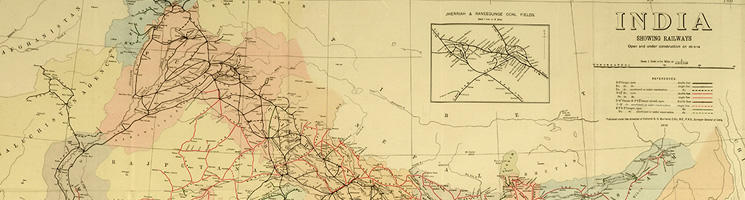
Map of India published by Surveyor-General of India, 1914, from Administration Report of Railways in India RAIL 1057/3392
Soldiers from India fought in every theatre of conflict in the First World War. This included France, Belgium, Gallipoli, Salonika, Palestine, Egypt and the Sudan, Mesopotamia, Aden and the Red Sea coast, Somaliland, The Cameroons, East Africa, north-west Persia and Kurdistan, south Persia, the Gulf of Oman, East Persia, central Asia, north China and the north-west and north-east frontiers of India (MUN 5/176/1143/16).
Before the start of the war, the Army in India was made up of 76,953 British soldiers, 193,901 Indian soldiers and 45,660 non-combatants (MUN 5/176/1143/16).
When war broke out in August 1914, India sent an expeditionary force to France under the command of General Sir James Willcocks. It was made up of two infantry divisions, accompanied by four artillery brigades and two cavalry divisions. These were the troops that were the most prepared for war, meaning that this was a considerable sacrifice on behalf of India. In addition to the Indian Expeditionary Force, a mixed force amounting to 12 Indian Army battalions was immediately sent to East Africa to guard the Zanzibar and the Mombasa-Nairobi railway. An infantry brigade was sent to the Persian Gulf, and this was increased to a complete division after war was declared with Turkey in November 1914. A force amounting to six infantry brigades was also sent to Egypt (MUN 5/176/1143/16).
By the end of 1914, three infantry divisions, eight infantry brigades, one mixed force including three infantry battalions, two cavalry divisions and one cavalry brigade had been sent overseas from India. This amounted to 23,500 British and 78,000 Indian soldiers. 32 regular British Infantry battalions and the majority of the regular horse, field and heavy artillery batteries were sent back to England for redeployment. They were replaced by hastily trained and poorly equipped territorial units from England, reducing the Army in India by 21 regiments of cavalry, 204 mobile guns and 69 battalions of infantry (MUN 5/176/1143/16).
In the spring of 1915 two more infantry brigades and another cavalry brigade were sent from India, bringing India’s contribution up to two Indian Army Corps, seven infantry brigades, one mixed force including three infantry battalions, two cavalry divisions and two cavalry brigades (MUN 5/176/1143/16).
16,241 railway workers were released from the Indian railways or were specially recruited for military duty or military railway work overseas (MUN 5/176/1143/16). Various Mechanical Transport Units were raised in India including six Ford Van Companies, eight Mechanical Transport Sections, one Lorry Section, one Motor Ambulance Convoy and one Advanced Repair Workshop, covering nearly 2,000 personnel. The Mechanical Transport training school in Rawalpindi trained 2,113 drivers who were despatched overseas. A school was established at Meerut for training drivers for service in India. 77,444 supply and transport personnel were sent overseas from India during the war.
Over 130,000 men were recruited into the Labour Corps and saw service in France, Mesopotamia, Salonika, Egypt, East Africa, South Persia, East Persia and India.
During the course of the war 1,440,437 soldiers were recruited, allowing for 1,381,050 soldiers to be sent overseas. In addition, by the end of December 1919 172,815 animals (including horses, mules and camels) and 3,691,836 tons of supplies and stores had been despatched from Indian ports (MUN 5/176/1143/16).
Victoria Cross
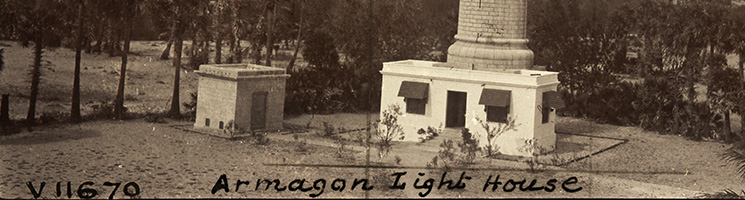
Armagon Lighthouse, Andhra Pradesh, India, 1918. ADM 344/1103
The Victoria Cross is the highest decoration for valour awarded to British and Imperial (now Commonwealth) Army forces. Although Indian Army officers had been eligible for the Victoria Cross since 1857, Indian Army troops did not qualify for the award until 1911. Eleven Indian nationals were awarded the Victoria Cross during the First World War, along with seven Indian Army officers. Only British, Canadian, Australian and Irish nationals received greater numbers of this highest honour.
The following Indian Army soldiers were awarded the Victoria Cross for conspicuous gallantry during the First World War:
Naik Darwan Singh Negi, 1/39th Royal Garhwal Rifles, date of act of bravery 23/24 November 1914, date of award 7 December 1914 (WO 98/8/119)
Sepoy Khudadad Khan, 129th Duke of Connaught’s Own Baluchis, date of act of bravery 31 October 1914, date of award 7 December 1914 (WO 98/8/120)
Frank Alexander de Pass, 34th Prince Albert Victor’s Own Poona Horse, date of act of bravery 24 November 1914, date of award 18 February 1915 (WO 98/8/132)
Lieutenant John George Smyth, 15th Ludhiana Sikhs, date of act of bravery 18 May 1915, date of award 29 June 1915 (WO 98/8/159)
Jamadar Mir Dast, Indian Frontier Force, date of act of bravery 26 April 1915, date of award 29 June 1915 (WO 98/8/160)
Captain Eustace Jotham, 51st Sikhs, date of act of bravery 7 January 1915, date of award 23 July 1915 (WO 98/8/170)
Captain George Godfrey Massy Wheeler, 15th Ludhiana Sikhs, date of act of bravery 12 April 1915, date of award 1 September 1915 (WO 98/8/190)
Rifleman Kulbir Thapa, 2/3rd Queen Alexandra’s Own Gurkha Rifles, date of act of bravery 25 September 1915, date of award 18 November 1915 (WO 98/8/227)
Lance Naik Lala, 41st Dogras, date of act of bravery, 21 January 1916, date of award 13 May 1916 (WO 98/8/248)
Captain John Alexander Sinton, Indian Medical Service, date of act of bravery, 21 January 1916, date of award 19 June 1916 (WO 98/8/249)
Sepoy Chatta Singh, 9th Bhopal Infantry, date of act of bravery 13 January 1916, date of award 19 June 1916 (WO 98/8/250)
Naik Shahamad Khan, 89th Punjabi Regiment, date of act of bravery 12 April 1916, date of award 26 September 1916 (WO 98/8/295)
Major George Campbell Wheeler, 2/9th Gurkha Rifles, date of act of bravery 23 February 1917, date of award 8 June 1917 (WO 98/8/340)
Lance Dafadar Gobind Singh, 28th Light Cavalry Indian Army, date of act of bravery 1 December 1917, date of award 11 January 1918 (WO 98/8/487)
Rifleman Karanbahadur Rana, Gurkha Rifles, date of act of bravery 10 April 1918, date of award 21 June 1918 (WO 98/8/539)
Key figures

Robert Offley Ashburton Crewe-Milnes
1st Marquess of Crewe, Secretary of State for India (1911-1915)

Sir (Joseph) Austen Chamberlain
Secretary of State for India (1915-1917)
Detail of NPG x45260 , Sir (Joseph) Austen Chamberlain, © National Portrait Gallery, London.
Edwin Samuel Montagu
Secretary of State for India (1917-1922)

Charles Hardinge
1st Baron Hardinge of Penshurst, Governor-General and Viceroy of India (1910-1916)

Frederic John Napier Thesiger
1st Viscount Chelmsford, Governor-General and Viceroy of India (1916-1921)
Detail of NPG x166517 , Frederic John Napier Thesiger, © National Portrait Gallery, London.
General Sir James Willcocks
Commander of the Indian Corps in France (1914-1915)
Sir Mir Osman Ali Khan Siddiqi Asaf Jah VII
Nizam of Hyderabad (1911-1948)
Key documents
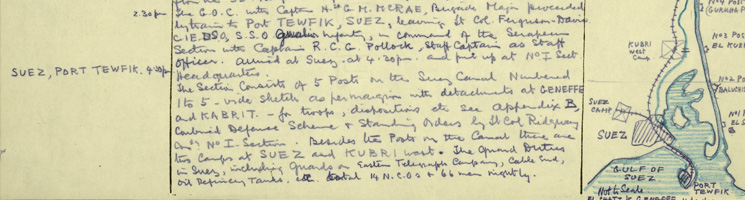
Sketch of Suez no 1 sector, August 1915. WO 95/4423
- Memorandum on India's contribution to the War in men, material and money, August 1914-November 1918 MUN 5/176/1143/16
- Victoria Cross Register, February 1900-September 1944 WO 98/8
- Official annual publication of the India Office and Indian Civil Service India Office List, 1914-1919