Ceylon in 1914
Now Sri Lanka
- Overview
- Home Front
- Action overseas
- Key figures
- Key documents
Overview
Ceylon (now Sri Lanka) is an island that lies off the southern coast of India in the Indian Ocean. At the time of the First World War the island was home to a wide variety of religions and languages and was composed largely of Sinhalese Buddhists, Tamils, Muslims, Malays and European colonists.
Home Front
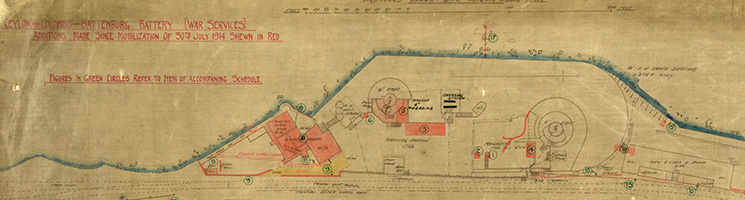
Battenberg Battery, Colombo, Ceylon, 1915. WO 78/4377
On the Home Front Ceylon was largely untroubled by the First World War. On 3 August 1914 the Governor of Ceylon, Sir Robert Chalmers (CO 58/176), called out the Ceylon Engineers Volunteers – the first of the Ceylon Defence Force units to be mobilised. The Ceylon Defence Force was commanded by Brigadier-General R B Fell and was quickly bolstered by the mobilisation of the Ceylon Artillery Volunteers, the Ceylon Light Infantry, the Ceylon Mounted Infantry and the Ceylon Volunteer Medical Corps. The volunteers were composed almost entirely of British colonists, and these forces were supported by troops from the 28th Punjabi Regiment and a regular Artillery and Engineer company (WO 95/5440).
On 31 May 1915, riots broke out between the Sinhalese and Muslim communities in Colombo and the surrounding area. The flashpoint arose on 29 May when members of the Muslim community objected to the passage of a Buddhist procession close to a mosque in a Muslim area. A Sinhalese mob burned down a mosque in the area and began attacking Muslim homes and shops. Martial law was imposed on 2 June and troops were deployed from the Ceylon Volunteer Force and the Town Guard. The riots were not contained until 6 June, and some of the suspected looters and arsonists were shot without trial by the Volunteer forces and Town Guard (FCO 141/2088, FCO 141/2089).
The only threat to territorial waters came from the German cruiser SMS Emden, which had been operating in the Bay of Bengal from 5 September 1914. SMS Emden sank or captured 25 Allied ships before she was tracked down off the Cocos Islands by the Australian light cruiser HMAS Sydney, and run aground on 9 November 1914.
After this period, the only trouble to the shore and harbour defences came from British and Allied shipping ignoring regulations and not signalling properly when entering the port of Colombo. Warning shots were fired from the harbour defences (WO 95/5440). The war diaries also make clear that Ceylon’s raw materials, mostly the supply of tea and rubber, played a key role in the war effort.
Action overseas
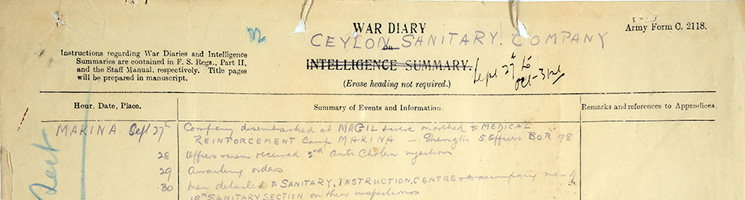
War diary page for Ceylon Sanitary Company, September 1917. WO 95/5036
A little over 2000 volunteers from the Ceylon Defence Force sailed to England to join the British Army. In addition, around 230 officers and men formed the Ceylon Planters Rifle Corps (CPRC), which was made up almost entirely of young British tea or rubber planters. The Corps was commanded by Major John Hall Brown, and a contingent of officers and men left Ceylon for Egypt in October 1914 on board SS Worcestershire.
The unit was attached to the Wellington Battalion of the New Zealand Infantry Brigade, part of the 1st Australia New Zealand Army Corps (ANZAC). Their role was to defend of the Suez Canal until March 1915 (WO 95/4352), when the ANZACs were mobilised for an invasion of Turkey. Around half of the CPRC became officers in other regiments, while the other half were attached to the 1st ANZAC headquarters and landed at Anzac Cove, Gallipoli, in April 1915 (WO 95/4288). Upon the evacuation of Gallipoli, the Corps was broken up and most of the remaining CPRC soldiers became officers in regiments across the British Army.
The Ceylon Sanitary Company also carried out valuable overseas war service. They were attached to the Royal Army Medical Corps (RAMC) and served in the Mesopotamian front (Iraq) from 27 Sept 1917 – 31 January 1919 (WO 95/5036). The unit consisted of around 100 men and 5 officers of Ceylonese and British origin. They disembarked at Magil and operated around Makina (Basra), Baghdad and Hinaidi. Their main tasks included cleaning up foreshores and areas designated for army encampment, water testing and pumping, disinfection and pest control. A small number of men also joined various British and Indian Army units, while others served in the Merchant Navy
Key figures

Sir Robert Chalmers
Governor (1913–1916)

Sir John Anderson
Governor (1916–1918)
Detail of NPG Ax39043 , Sir John Anderson, © National Portrait Gallery, London.

Brigadier-General Robert Black Fell
Commandant, Ceylon Defence Force (1913-1919)
Detail of NPG x66667 , Robert Black Fell, © National Portrait Gallery, London.
Ceylon Planters Rifle Corps (1914-1916)
Key documents
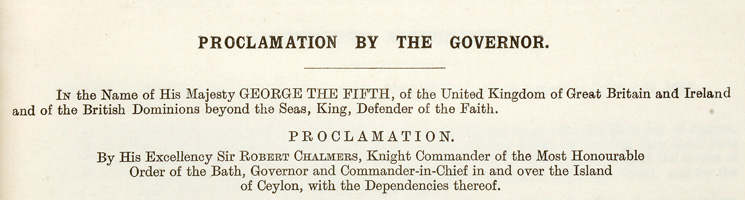
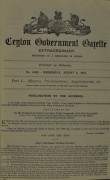
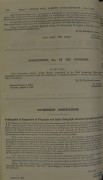
Ceylon Government Gazette call for active service, 7 August 1914. CO 58/176 (1)
- Ceylon Gazette 1914 CO 58/176
- Governor's reports on Ceylon Race Riots 1915 FCO 141/2088
- War diaries 1st ANZAC HQ 1915-1916 WO 95/4288
- War diary: New Zealand Infantry Brigade, Wellington Battalion 1914-1915 WO 95/4352
- War diary: Ceylon Sanitary Company 1917-1919 WO 95/5036
- War diaries: Ceylon Home Forces troops WO 95/5440