
Burma in 1914
- Overview
- Home Front
- Armed forces
- Key figures
- Key documents
Overview
Burma is a country in South-East Asia. It is bordered by India in the west and north-west, Tibet in the north, China in the north and east, French Indo-China (now Laos) in the east and Siam (now Thailand) in the south. In 1914, the colony of Burma covered over 230,000 square miles and was divided into three provinces, Upper Burma, Lower Burma and Central Provinces, eight commissioner’s divisions and 37 districts.
The colony was represented by a Lieutenant Governor, who reported to the Secretary of State for India. According to the 1911 census the population of Burma was 12,115,217, of whom only 1,127,975 lived in towns, with 293,316 living in the capital, Rangoon. The vast majority of the population lived in rural villages as farmers and artisans and were unaffected by developments in the First World War. Over 10 million of the population were Buddhists (India Office Lists, 1914-1919).
Home Front
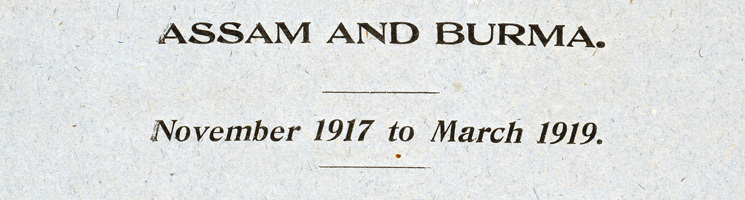
Operations against the Kuki tribes of Assam and Burma, 1917-1919. WO 106/58
From 1914 there were small annual increases in revenue from the export of staples such as rice, grains, pulses, cotton, tobacco, rubber, oil seed and timber, as well as petroleum and minerals such as tin, tungsten, gold, rubies, jade, amber and coal. To offset the cost of raising and maintaining local forces a land tax was enacted and a poll tax was introduced in Upper Burma. Excise duties were increased on opium and alcohol and stamp duties and customs duties were also raised (India Office Lists, 1914-1919).
In December 1914, rumours of an uprising amongst the Kachin people of north-east Burma began to circulate. This was fuelled by the withdrawal of regular Army troops and experienced Burma Military Policemen to fight on the Western Front. On 2 January 1915 a raiding party of Kachins rustled a herd of buffaloes in the Hukawng Valley, which was under the jurisdiction of the Myitkyina Battalion of the Burma Military Police. When a force from the battalion set out to recover the animals they were beaten back with several casualties. Between January and February 1915, punitive operations were undertaken against the Kachins by the Burma Military Police and regular Army troops under the command of Major General Sir Henry Raitt. Villages were burned and many of the leaders were killed or exiled (ZJ 1/634).
In November 1917 there were riots by the Kuki tribes, in the Chin Hills in Burma and neighbouring Assam in India. It was the result of a strong objection amongst the hillmen to the possibility of being sent overseas in Labour Corps. In Burma the Military Police and regular Army units were deployed against them. The Kukis surrendered in September 1918 and swore their allegiance at a ceremonial gathering in Homalin.
In January 1919 there was a sudden rising of the Kukis in the northern and central sub-areas of Burma. Punitive measures were taken under the command of Lieutenant-General Sir Henry D’Urban Keary. The leaders were captured and rebels in the area were disarmed. Cultivation was forbidden, threatening the harvest, until the fugitive chiefs surrendered themselves and their arms. Farming was then resumed in time for the harvest (WO 106/58).
Armed forces
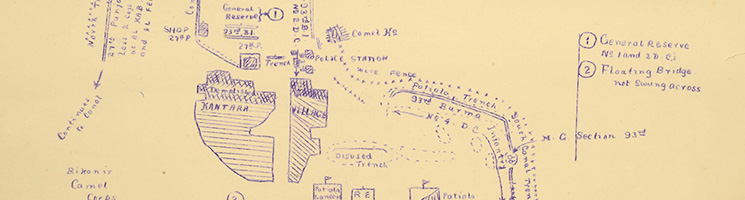
Positions at perimeter camp, Kantara, Suez, 3 December 1914. WO 95/4422
The Burma Military Police was a colonial police force comprising Indian recruits and ethnic Burmese. Several battalions were raised during the First World War across the whole of the country. The units were tasked with handling internal security such as frontier watches and containing local uprisings. In the First World War the Burma Military Police was drafted in to support regiments in various places including France and Flanders. Nine members of the Burma Military Police have their names on the Menin Gate Memorial to the Missing in Belgium.
By 1914 there were already a number of volunteer units in Burma, including Burma Railways Volunteers Corps, Moulmein Volunteer Artillery Corps, Moulmein Volunteer Rifle Corps, Rangoon Port Defence Volunteers, Rangoon Volunteer Rifle Corps and Upper Burma Volunteer Rifles. In 1917 the Indian Defence Force was established to free up regular troops, so that they could be deployed overseas. The Indian Defence Force Act led to the conscription of all European males between the ages of 15 and 50 in British India, including Burma. The following Indian Defence Force units were established in Burma: 14th Tenassarim Battalion, 18th Rangoon Battalion, 21st Burma Railway Battalion and 34th Upper Burma Battalion.
The 93rd Burma Infantry, made up of four companies, arrived in Suez on 16 November 1914 and were ordered to guard various strategic positions along the Suez Canal. (WO 95/4422). In September 1915 they were sent to France and took part in the Battle of Loos (25 September – 18 October 1915), seeing action at La Bassé Road, Le Hamel and La Calonne (WO 95/3942/3).
In December 1915 they were sent to Mesopotamia and on 17 January 1916 they were ordered to attack Turkish trenches on the right bank of the River Tigris. Further attacks on Turkish positions on 17-18 April 1916 and 24 April 1917 resulted in 17 officers and 153 men either killed, wounded or missing. Seven soldiers were recommended for the Indian Distinguished Service Medal, including Sepoy Mohammed Hassan for carrying a wounded Havildar over 2,000 feet of open country under heavy fire (WO 95/5111). The 93rd Burma Infantry remained in Mesopotamia until May 1918, when they were sent to Palestine. On 20 September 1918 the regiment was in action at Baka, near Jerusalem, where they captured 250 prisoners, including many Germans. They remained in Palestine until April 1920 (WO 95/4703).
The 22nd Derajat (Upper Burma) Mountain Battery was sent to East Africa to fight against the Germans, arriving on 18 December 1916. They were involved in fighting at Tanganyika and Uganda and remained in Africa until the end of the war (WO 95/5337, WO 95/5321, WO 95/5322, WO 95/5324, WO 95/5326, WO 95/5327).
In September 1917 the 70th Burma Rifles was raised. The first battalion was sent to Egypt in May 1918 as part of the Egypt Expeditionary Force. The battalion consisted of 13 British Officers, 18 Burman Officers, 853 men and 42 followers. From 14 May 1918 to 8 June 1918 they were based around Suez, guarding strategic positions at Tel-el-Kebir and Kantara. From 9 June to 30 October 1918 they were sent to Palestine, to Deir el-Belah, Rafa and Gaza. The battalion returned to Egypt in November 1918 and remained there until November 1919 (WO 95/4732, WO 95/4689).
In July 1917 the 85th Burma Rifles was raised at Mandalay from the Burma Military Police. A force of 1,025 Indian officers and men comprising four companies were sent to Mesopotamia, arriving in Basra on 15 August 1918. The Battalion, despite its name, was composed of Indians of different races and religions, with Burmans forming part of C Company. They remained in Mesopotamia until December 1918 (WO 95/5021).
Key figures

Charles Hardinge
Lord Hardinge of Penshurst, Viceroy and Governor-General of India (1910 - 1916)

Frederic John Napier Thesiger
1st Viscount Chelmsford, Viceroy and Governor-General of India (1916 -1921)
Sir Harvey Adamson
Lieutenant-Governor of Burma (1910 - 1915)

Sir Spencer Harcourt Butler
Lieutenant-Governor of Burma (1915 - 1917)
Detail of NPG x165378 , Sir (Spencer) Harcourt Butler, © National Portrait Gallery, London.
Walter Francis Rice
acting Lieutenant-Governor of Burma (1917 - 1918)

Sir Reginald Henry Craddock
Lieutenant-Governor of Burma (1918 - 1922)
Detail of NPG x166797 , Sir Reginald Henry Craddock, © National Portrait Gallery, London.
Major-General Sir Henry Raitt
General Officer Commanding Burma Division (1914-1918)
Lt-General Sir Henry D’Urban Keary
General Officer Commanding Burma Division (1918- 1919)
Key documents
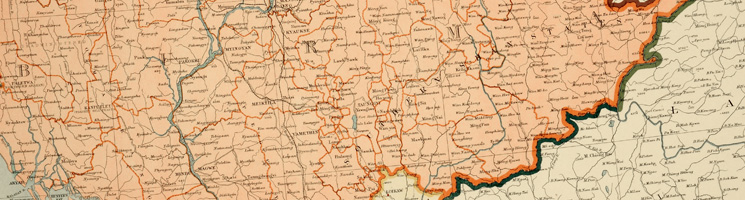
Burma, 1914. CO 1047/1092
- London Gazette: Despatch by General Sir Beauchamp Duff, Commander-in-Chief, India, 4 July 1916 ZJ 1/634
- War Office: Report on Operations against the Kuki Tribes, November 1917 – March 1919 WO 106/58
- War Diaries: 1/70 Battalion Burma Rifles, April 1918 – February 1919 WO 95/4732
- War Diaries: 85 Battalion Burma Rifles, July 1917 – November 1918 WO 95/5021
- War Diaries: 93 Burma Infantry, September – December 1915 WO 95/3942/3
- War Diaries: 22nd Mountain Battery, January – March 1917 WO 95/5337