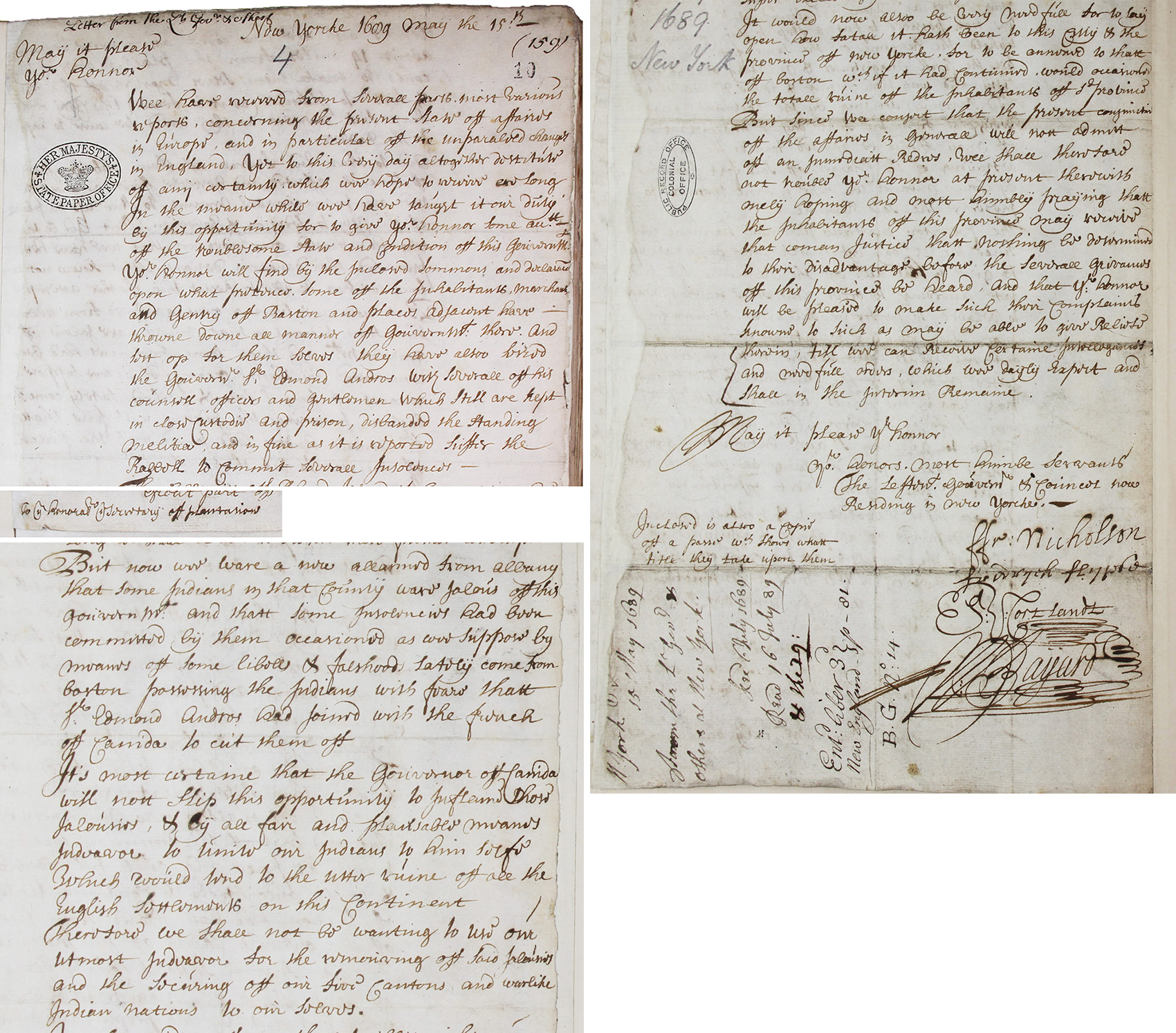
Extracts from a ‘Letter concerning responses to the Glorious Revolution and the unrest in the colonies’, May 15 1689. Catalogue ref: CO 5/1081 f.10-11
Events in England impacted the colonies in the Americas. The consequences of the Glorious Revolution varied in each colony from a peaceful transfer of power to civil war, as royal governors previously appointed by James II were replaced by new representatives who were loyal to William III. This letter is written by the governors in New York who had been loyal to James II.
Transcript
Letter from the Governor and others
To the Honourable Secretary of Plantations
New York 1689 May 15th
May it please your honour.
We have received from several parts most various reports, concerning the present state of affairs in Europe, and in particular of the unparalleled changes in England, yet to this very altogether destitute of any certainty, which we hope to receive erelong. In the meanwhile, we have sawest it our duty by this opportunity for to give your honour some account of the troublesome state and condition of this government. Your honour will find by the enclosed summons and declaration upon what pertained. Some of inhabitants, merchants, and gentry of Boston and places adjacent have thrown down all manner of government there and set up for themselves they have also [tried?] the governor Sir Edmond Andros with several of his council, officers, and gentlemen which still are kept in close custody and prison, disbanded the standing militia, and is fine as it is reported suffer the rebel to commit several insolences.
The colonies of Rhode Island and Connecticut have followed their superiors, and as it is reported have chosen for themselves also new governors, in so much that this part of the dominion was only inclined to rest at peace and quiet till orders do arrive and would undoubtedly so continue unless the seed of sedition had been blown from thence to some of the outward shire of this province.
…
But now we heare a new alarms from Albany that some Indians in that county ward jealous of this government and that some insolences had been committed by them occasioned as we suppose by means of some libels and falsehoods lately come from Boston possessing the Indians with fear that Sir Edmond Andros had joined with the French of Canida [Canada] to cut them off.
It is most certain that the governor of Canida will not slip this opportunity to inflame those jealousies, and by all fair and plausible meanes endeavour to [limit?] our Indians to him selfe. Which would meane to the utter ruin of all the English settlements on this continent.
Therefore we shall not be wanting to use our utmost endeavour for the removing of said jealousies and the securing of our five cantons and warlike Indian nations [i.e. Iroquois] to ourselves.
…
It would now also be very needful for to lay open how fatal it hath been to this city in the province of New York; for to be announced to that of Boston which if it had continued would occasion the total ruin of the inhabitants of the said provinces. But since we consent that the present consideration of the affairs in general will not admit of an immediate redress, we shall therefore not trouble your honour at present therewith only hoping and most humble praying that the inhabitants of this province may receive that common justice that nothing be determined to their disadvantage before the several grievances of this province by heard, and that you honour will be pleased to make such these complaints known to such as may be able to give relief therein, till we can receive certain intelligences and mindful orders, which we daily expect and shall in the interim remaine.
May it please your honour
You honours most humble servants
The lieutenants, governors and councillors now residing in new York.
Francis Nicholson
Frederick Philpse
Stephanus van Cortlandt
Nicholas Bayard
Enclosed is also a copie [copy] of a passe which shows what title the take upon them
- What concerns the writers of this letter?
- What has happened in the American colonies?
- How are the French characterised in this letter?
- What does this suggest about Anglo-French relations in the colonies in this period?
The letter refers to tensions between the English, French, and indigenous peoples [the Iroquois] in the colonies.
- Why is it important to consider what is missing from these extracts describing contact between indigenous peoples and European colonists?
- The document comes from the Colonial Office collection. Why does The National Archives hold these records?