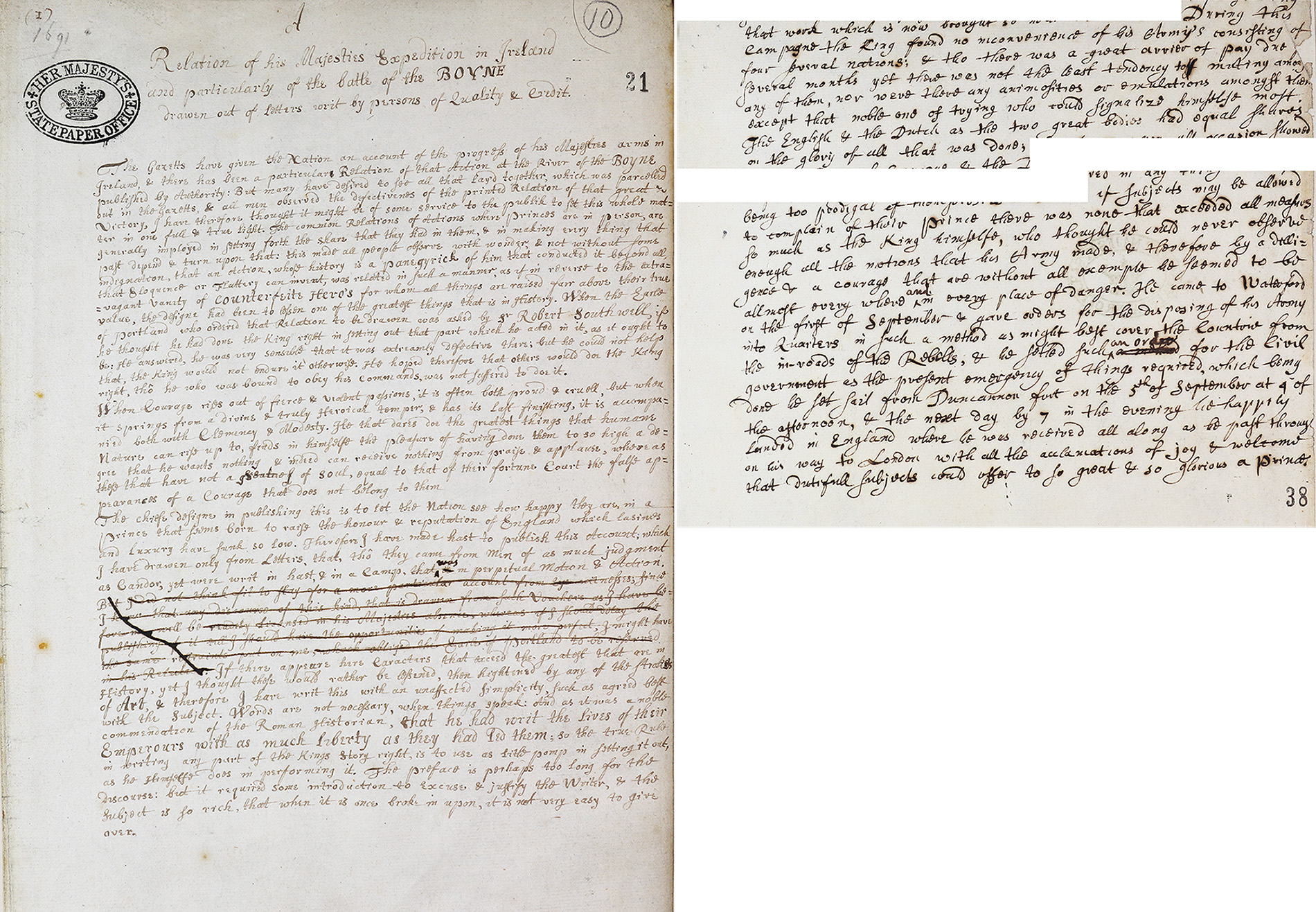
Extracts from a report entitled ‘Relation of his Majesty’s Expedition in Ireland and particularly of the Battle of the Boyne drawn out of Letters writ by ‘Persons of Quality’. Catalogue ref: SP 8/11/11 f21& f39
This document provides a substantial account of William of Orange’s expedition in Ireland and the Battle of the Boyne on 1 July 1690. When William arrived in England in 1689, James II fled to France. However, he was determined to take up the conflict in Ireland, arriving in the country in March 1689. James II was supported by a population who were largely Catholic. An army sent by William III arrived in Ireland in August 1689 to regain control. Fighting ensued until the Battle of the Boyne, after which James fled from Ireland, and William consolidated his rule there in the following twelve months. Historically, the Battle of the Boyne has been seen as a decisive moment in Irish history that secured the domination of Anglican Protestantism in Ireland.
Transcript
Relation of his Majesty’s Expedition in Ireland and particularly of the Battle of the Boyne drawn out of Letters writ by Persons of Quality and Credit.
The Gazette have given the Nation an account of the progress of his Majesties arms in Ireland, and there has been a particular relation of that action at the river of the Boyne published by authority: but many have desired to see all that laid together, which was parcelled but in the gazette, and all man observed the defectiveness of the printed relation of that great victory, I have therefore thought it might be of some service to the public to set this whole matter in one full and true light. The common relations of actions where princes are in person, are generally employed in setting forth the share that they had in them, and in making everything that past depend and turn upon that: this made all people observe with wonder, and not without some indignation, that in action, whose history is a panegyric [public speech of praise] of him that conducted it beyond all, that eloquence or flattery can invent, was related in such a manner, as if in reverse to the extravagant vanity of counterfeit hero’s for whom all things are raised far above their true value, the design had been to x one of the greatest things that is in history. When the Earl of Portland who ordered that relation to be drawn was asked by Sir Robert Southwell, if he thought he has done the king right in setting out that part which he acted in it, as it ought to be soe answered, he was very sensible that it was extremely defective there: but he could not help that, the king would not endure it otherwise. He hoped therefore that others would do the King right, though he who was bound to obey his commands was not suffered to do it.
When courage rips out of fierce and violent passions, it is often both proud and cruel, but when it springs from a divine and truly heroical temper, and has its last finishing, it is accompanied both with clemency and modesty. He that does doe the greatest things that humans nature can rise up to, feeds in himself the pleasure of having done them to so high a degree that he wants nothing and indeed can receive nothing from praise and applause, whereas he that have not a greatness of soul, equal to that of their fortune court the selfe appearances of courage that does not belong to them.
The chief design in publishing this is to let the nation see how happy they are of a prince that was born to raise the honour and reputation of England, which laziness and luxury have sunk so low. Therefore I have made hast to publish this account, which I have drawn only from letters, that, though they came from the men of as much judgment, and candour, yet were writ in hast, and in a camp, that was in perpetual motion and action.
It there appear here characters that accede the greatest that are in History, yet I thought these would rather be opened, then heightened by any of the strokes of art, and therefore I have writ this with an unaffected simplicity, such as agreed best with the subjects. Words are not necessary, when things speak: and as it was a noble commendation of the Roman Historian, that he had writ the lives of their Emperors with as much liberty as they had led them; so the true relation in writing any part of the Kings story right is to use as little pomp in putting it out, as he himself does in performing it. The preface is perhaps too long for the discourse: but it required some introduction to excuse and justify the writer, and the subject is so rich, that when it is once broke in upon, it is not very easy to give over.
…
During this campaign the king found no inconvenience of his army’s consisting of four several nations; and though there was a great arrear of pay due several months yet there was not the least tendency of mutiny amongst and of them, nor were there any animosities or emulations amongst them except that noble one of trying who could signalize himself most. The English and the Dutch as the two great bodies had equal shares of the glory of all that was done.
[…]
If subjects as may be allowed to complain of their prince there was none that exceeded all measures so much as the king himself, who though he could never observe enough all the notions that his army made, and therefore by a diligence and courage that are without all exemption He seemed to be almost ever where and every place of danger. He came to Waterford on the first of September and gave orders for the disposing of his army into quarters in such a method as might best cover the country from the inroads of the Rebels, and he sorted such an order for the civil government as the present emergency of things required, which being done he set sail from Duncannon fort on the 5th of September at 4 o’ Clock in the afternoon, and the next day by 7 in the evening he happily landed in England where he was received all along as be past through on his way to London with all the acclamations of joy and welcome that dutiful subjects could offer to so great and glorious a prince.
- What was the Gazette? Find out when it was established.
- What reasons does the writer provide for writing this document?
- In what circumstances does the writer claim this account was written?
- The writer mentions historical figures ‘heightened by any of the strokes of art’. What does he mean by this?
- What are there any tensions or contradictions in the writer’s declaration to provide an unvarnished account of events in Ireland and the way the William III is described?
- In our study of history, how does narrative or storytelling complicate a search for objectivity?