1. Why use this guide?
Use this guide if you are looking for records of an Appeal Case heard in the House of Lords, or other records relating to the judicial function of the House of Lords. The records cover 1680 to 2009.
2. What was the judicial function of the House of Lords?
The House of Lords was the highest court in the land from medieval times until 2009. It acted as the final court of appeal on points of law for the whole of the United Kingdom (England, Wales, Northern Ireland and Scotland) in civil cases, and for England, Wales and Northern Ireland in criminal cases. Its decisions bound all courts below.
The judicial function of the House of Lords can be traced back to the 14th century, to the royal court which advised the monarch. Following the restoration of the monarchy and the House of Lords in 1660, the Lords asserted its right to hear petitions for redress of grievances, including cases appealing decisions of lower courts in England and Wales. These lower courts included Chancery, Exchequer, Queen’s/King’s Bench, and Common Pleas. The Court of Appeal was set up in 1875, after which most appeals to the Lords from England and Wales came from there.
Appeals from the Court of Session, the highest civil court in Scotland, came to the House of Lords following the Act of Union with Scotland in 1707. However appeals from the High Court of Justiciary, the highest criminal court in Scotland, only came to the Lords between 1713 and 1781.
Appeals from Irish courts came to the House of Lords following the Act of Union with Ireland in 1801. Following the partition of Ireland in 1921 and the establishment of the Irish Free State, Northern Ireland became a distinct jurisdiction within the UK legal system, and appeals from its Courts came to the House of Lords.
3. Who were the law lords?
Originally, House of Lords appeal cases were heard by the Lord Chancellor and by other senior judges who either sat in the Lords, or attended the Lords as necessary. By the 1830s the role of judges had become increasingly professionalised, and lay members of the Lords ceased to play any part in judicial proceedings.
However there was a shortage of judges in the Lords from the 1850s, leading to much debate over reform. The result was the Appellate Jurisdiction Act 1876, which allowed two Lords of Appeal in Ordinary (colloquially known as law lords) to be created. These were professional judges who worked full-time on House of Lords judicial business. Numbers of law lords increased gradually over time as workloads increased; by 2009 there were twelve.
By convention, appeal cases were heard by the whole House of Lords and proceedings held in the House of Lords chamber until 1948, when the law lords were forced by building works to move to a committee room. At this point the Appellate Committee was established, the committee of law lords with power to hear appeal cases.
4. How did appeal cases come to the House of Lords?
Generally, appeals from England, Wales and Northern Ireland needed to be given leave to appeal either from the court below or from the House of Lords, in order to be heard in the House of Lords.
Petitions for leave to appeal against the decree of a lower court were presented to the House of Lords and considered by the House or (after 1812) by an Appeal Committee of the House of Lords. The criterion was to grant permission to appeal for applications which raised an arguable point of law of general public importance, bearing in mind that such cases would have already have been the subject of judicial decision and may have already been reviewed on appeal.
Leave to appeal was not normally required for Scottish appeals, which proceeded directly to an Appellate Committee provided that two counsel certified the reasonableness of the appeal.
If leave to appeal was granted, the appeal case proceeded to the House of Lords, or (after 1948) to a House of Lords Appellate Committee, for a full hearing. During hearings, legal counsel made cases on behalf of each side, typically over several days. Law lords would subsequently consider the case, and give a judgment which affirmed, reversed or otherwise altered the decree complained of.
The last hearings and judgments in the House of Lords took place on 30 July 2009, after which the judicial functions of the House of Lords transferred to the new Supreme Court. The Supreme Court opened on 1 October 2009.
5. What are these records?
The main records are the Judgments and the Appeal Cases.
- The Judgments comprise the opinions of the law lords who heard the case, and their formal judgment which affirmed, reversed or otherwise altered the decree complained of. The opinions are statements written by each individual law lord, explaining their findings and giving a comprehensive argument supporting their ruling.
- The Appeal Cases may include the Judgments but also additional material. This additional material varies over time but from the mid/late 19th century usually includes the text of the petition for appeal; case for the appellant and case for the respondent (the argument and interpretation put by their legal counsel); and appendices. The appendices are the evidence consulted by the law lords for the case. They vary hugely in size and scope but may include transcripts of hearings in lower courts, correspondence and other paperwork submitted by the parties, and published material.
There are also other records relating to the judicial function of the House of Lords, including:
- Original petitions for leave to appeal, which were laid on the table of the House of Lords, in YHL/PO/JO/10.
- The House of Lords Journal, YHL/PO/JO/2 the formal minute of proceedings of the whole House of Lords, including judicial proceedings.
- Records of the Appeal Committee, which scrutinised petitions requesting the right to appeal and decided which ones to grant leave to appeal. In particular memoranda YHL/PO/JU/1 (from 1916 to 2009) and minutes YHL/PO/JU/17 (from 1844 to 1992).
- Records of the Appellate Committee, YHL/PO/JU/14 the committee(s) of law lords which heard appeal cases (from 1948 to 2009).
- Records of the Judicial Office, YHL/PO/JU a department of the House of Lords which administered judicial functions and existed from 1854 to 2009.
Transcripts of judicial proceedings were very rarely made. The few that do exist can be found on the catalogue by searching for the name of Appeal Case. There are no records made of public or private discussion or debate by the law lords on appeal cases.
Transcripts of judicial proceedings were very rarely made. The few that do exist can be found on the catalogue by searching for the name of Appeal Case. There are no records made of public or private discussion or debate by the law lords on appeal cases.
A fuller history and description of records can be found in the catalogue.
6. Online records
All House of Lords Judgments from 14 November 1996 to 30 July 2009 may be found on the Parliament website.
Selected House of Lords judgments from 1709 to 2009 may be found on the BAILII (British and Irish Legal Information Institute) website.
Other published House of Lords judgments may be found in subscription-based law website and databases available in law libraries, such as Westlaw and Lexis.
7. How to search for records
You will need to search the catalogue to identify records. To view them you will need to visit The National Archives at Kew or pay for copies to be sent to you.
To search the catalogue, you need to know the name of the House of Lords appeal case you are looking for, and at least an approximate date; there is no subject index. Use the online catalogue to search for the name of the case, and narrow by date if necessary.
If the case was heard by the Lords, you will find the relevant records by searching for the name of the case. Almost all House of Lords judicial records start with the Parliamentary Archives reference YHL/PO/JU. The most significant series are:
- Judgments YHL/PO/JU/18
- Appeal Cases YHL/PO/JU/4/3
Original petitions for leave to appeal are not catalogued among judicial records because they were laid on the table of the House of Lords, so can be found in House of Lords Main Papers, YHL/PO/JO/10. Other early (pre-1700) judicial material may also be found in the Main Papers. Again, search the catalogue for the name of the case to find them.
To find out what happened with a particular appeal case, the starting point should always be the House of Lords Journal YHL/PO/JO/2 volume for the year the case came to the Lords, which will document the formal proceedings from presentation of petition for leave to appeal through to final judgment. The name of the case will be in an index at the back of the Journal volume, or in the general index YHL/PO/JO/3 to the Journals. This may be supplemented by the records of the Appeal Committee and Appellate Committee.
If a petition for leave to appeal was presented but the Lords refused to hear the case, you may find the original petition by searching the catalogue for the name of the case, but no other records. Consult the House of Lords Journal for proceedings, and follow up in Appeal Committee records for further detail, if any.
8. Records marked as not available in the catalogue
Appeal Cases less than 100 years old may be marked as not available on the catalogue. This may be because they contain sensitive personal data, such as the names of minors or victims.
Other House of Lords judicial records may be marked as not available if they are recent (less than 30 years old).
You can apply for access by clicking on the link for submitting a Freedom of Information request to UK Parliament.
9. Other sources
You may find copies of House of Lords Appeal Cases at Lincoln’s Inn Library, The Advocates Library in Scotland and the Library of Congress in Washington, USA.
Individual law lords may have kept their own papers, for example the Parliamentary Archives collections at TNA includes notebooks of Lord Reid YREI in hearing appeals in the House of Lords and other courts. Search Discovery for locations of personal papers in archives across the UK.
Supreme Court judgments since 2009 can be found on the Supreme Court website.
10. Further reading
Louis Blom-Cooper, Gavin Drewry and Brice Dickson (eds), ‘The Judicial House of Lords: 1876-2009’ (2009).
Maurice Bond, ‘Guide to the Records of Parliament’ (1971), pp.106-126.
Glenn Dymond, ‘The Appellate Jurisdiction of the House of Lords’, House of Lords Library Note (2007).
1. Why use this guide?
Use this guide if you are looking for the official report of Parliamentary debates held in the House of Commons and the House Lords. The records are commonly known as ‘Hansard’ and cover 1803 to the present.
2. What is Hansard?
Hansard is an edited verbatim report of what is said in the House of Commons and House of Lords Chamber, Westminster Hall, and Grand Committee. The speeches are recorded and then edited to remove repetition and obvious mistakes but always ensure that this does not take away from the meaning of what was said. Written statements are also included.
Parliamentary Debates are known as Hansard after Thomas Curson Hansard, the first printer and publisher of the reports. In 1803 it was an unofficial report which compiled reports of speeches from press reporters. This means Hansard during the 19th century is not a complete record of what was said because it omitted much parliamentary business deemed to be of less public interest by newspapers, and not all speakers were fully reported even for debates on important issues.
In 1909, Hansard was established as the Official Report of Parliament, with all speeches and debates now recorded. Reporters and editors were employed in both the House of Lords and the House of Commons. At first, the official report was known as the ’Parliamentary Debates, Official Report’ but in 1943 the title ‘Hansard’ was restored.
Hansard also includes records of votes, known as divisions, although as with debates, these are selective before 1909. In older volumes only the numbers of ‘ayes’ and ‘noes’ in the House of Commons and ‘contents’ and ‘not contents’ in the House of Lords are counted. Later on it was recorded how each individual Member or Peer voted. After 1909 all divisions are included in Hansard, including how each individual Member or Peer voted.
3. Parliamentary Debates pre-1803
Before Hansard, William Cobbett compiled records of parliamentary debates and speeches from 1066 to 1803 in his publication “Parliamentary History of England”. However, it is less comprehensive than the later official Hansard reports. You can find all 36 volumes digitised by the Bodleian Library.
The British History Online website also has several smaller volumes that are less extensive than Cobbett’s collection, but may contains more detail for the time periods covered. These volumes are:
- Simonds d’Ewes, ‘The Journals of All the Parliaments During the Reign of Queen Elizabeth’ (Shannon, Ire, 1682) Dates: 1559-1601
- Heywood Townshend, ‘Historical Collections: Or, An Exact Account of the Proceedings of the Four Last Parliaments of Q. Elizabeth’ (London, 1680) Dates: 1589-1601
- Chandler, ‘The History and Proceedings of the House of Commons’ (London, 1742) Dates: 1660-1739
- Anchitell Grey, ‘Grey’s Debates of the House of Commons’ (London, 1769) Dates: 1667-1694
Various other collections of debates were published in the late 18th century, of which the most significant is ‘The Parliamentary Register’ for the period 1743-1803. The Parliamentary Archives collections held at TNA include a set of ‘The Parliamentary Register’ covering 1743-1793, YREG.
Historians have also collected and published unofficial records of early division lists, of which the most significant is Donald Ginter’s, ‘Voting records of the British House of Commons, 1761-1820.’ See Further Reading below.
4. Online records
Hansard can be found online as follows:
- Parliament website, 22 November 1803 to the present, apart from 2004-2006 (for which see the archived databases linked below). This includes content from the Historic Hansard website plus more recent debates. It can be searched and browsed, and search results filtered, for example by name of Member. Alternatively if you know the series, volume and column number you want, you can go directly to the relevant Hansard content.
- Historic Hansard website, 22 November 1803 to 17 March 2005. The search functionality on this website is very limited, however the website remains very useful for its indexes, which include by Volume, People, Constituencies, Offices, Bills, Acts and Divisions.
- Archived databases of House of Commons debates, 1988–2016, and House of Lords debates, 1995-2016. Useful where there are gaps on other websites.
- Proquest UK Parliamentary Papers. This is a subscription website you can access on TNA computers by visiting us at Kew. You may also be able to access it via a large reference library such as a university library. It enables you to search Hansard content alongside other published Parliamentary Papers.
- House of Commons Standing Committee/General Committee Debates, 1997-2015. Standing Committees became known as General Committees from 2006.
Please be aware that Hansard pre-2010 is historical content that was digitally scanned from physical copies and may contain errors in the text or odd formatting.
Most importantly, there are also known gaps in the historical content (i.e. when volumes are missing), particularly before 1918. These are most easily identified by the Volume index on the Historic Hansard website – click on each series to see a list of volumes, the dates they cover, and whether they were successfully loaded onto the website or not. If a volume is missing, you will need to consult a printed volume.
House of Commons Standing Committee debates before 1997 are not currently available online, and printed volumes should be consulted.
Volumes for 1919-2002 can be found at YHC/OF/SC
Universities and large reference libraries may also hold printed copies of Hansard.
5. Hansard – Printed volumes
The original hard copy volumes of Hansard include some information not in the online Hansard. There are lists of peers and MPs, members of the Government and some senior staff given at the start of a Parliament or session. There were also extensive tables of contents, person and subject indices, and composite index volumes.
Hard copy volumes of Hansard are available as orderable documents. To view them you will need to identify the reference of the volume you need using the catalogue and request the volume in our reading room, or pay for copies to be sent to you.
To search the catalogue, you will need to know the date of the debate you are looking for, or at least an approximate date, each Hansard volume covers approximately 20 days of debate sessions.
If you only know the year of the debate, you can use the Index for that year. The Index is sorted by subject and speaker and will provide a volume number and column number where the speech can be found.
The House of Lords and House of Commons debates were collated into the same bound volumes from 1803 until 1908. But after it became the official report in 1909 they were separated into individual series for each House.
House of Commons and House of Lords combined volume series:
- First series (22 November 1803 – 28 February 1820) YHAN/1
- Second series (21 April 1820 – 23 July 1830) YHAN/2
- Third series (26 October – 5 August) 1891 YHAN/3
- Fourth series (9 February 1892 – 21 December) 1908 YHAN/4
House of Commons only volume series:
- Series five (16 February 1909 – 12 December 1980) YHC/OF/S5
- Series six (16 March 1981 – 18 November 2004) YHC/OF/S6
House of Lords only volume series:
- Series five (16 February 1909 – 17 March 2005) YHL/PO/OF/S5
House of Commons Standing Committee debates:
- 1919-2002 YHC/OF/SC
Universities and large reference libraries may also hold printed copies of Hansard.
6. Other sources
‘The Mirror of Parliament’ was a competitor to Hansard between 1828 and 1841, which employed Charles Dickens as a parliamentary reporter. It is a publication which may be found in large reference libraries.
‘The Penguin Hansard’ was published during the Second World War to make Parliamentary debates more accessible to the public. For more information see the Commons Hansard blog, The Penguin Hansard.
House of Commons division records are recorded fully from 1836 as part of Votes and Proceedings. They may be useful particularly before Hansard becomes a full record in 1909. Search the series YHC/CL/JO/6 for ‘Divisions’.
The Journals of the House of Lords, YHL/PO/JO/2, and House of Commons, YHC/CL/JO/2, are the formal record of proceedings in each House. They do not generally contain debates and speeches (with some exceptions, such as evidence taken on divorce bills in the House of Lords, and speeches by the monarch). However they do contain much transactional information not found in Hansard, such as the formal readings of each stage of a bill (which will only be in Hansard if there was debate) and papers laid on the table. To trace a bill through Parliament, the Journals should always be consulted alongside Hansard.
7. Further reading
Maurice Bond, ‘Guide to the Records of Parliament’ (1971)
William Cobbett, ‘The Parliamentary History of England, from the earliest period to the year 1803.’
Hansard Writing Team, ‘The Hansard Story’ (House of Commons, 2018)
John Vice and Stephen Farrell, ‘The History of Hansard’ (House of Lords Library,
Donald E Ginter, ‘Voting records of the British House of Commons, 1761-1820’ (1995)
J . Sainty and D Dewar, ‘Divisions in the House of Lords : an analytical list, 1685 to 1857’ (1976)
Parliamentary Archives blog, Jargon Buster: Hansard and the Journals
The Victorian Commons, Accessing Hansard online: a research guide
1. Why use this guide?
This guide provides information on records transferred to The National Archives (TNA) from the contents of the Merlin Database.
The transfer of the Merlin Database records from the Atomic Weapons Establishment (AWE) to The National Archives started in September 2025 and the Ministry of Defence (MOD) and AWE anticipate that it will take them a year to transfer the records to The National Archives. This guide will be updated as records are transferred to The National Archives and are made available via our online catalogue, Discovery.
This guide sets out the context for historical records which formed part of the Merlin Database that was compiled by AWE between 2006 – 2008 at the request of the MOD. It also provides details about other material that relates to nuclear testing and that is held by The National Archives and other organisations.
2. Where to go for further support, if you have been affected by the content of these records
Records from the Merlin Database include content that some people may find distressing. If you have been affected by these records, you can find useful advice on looking after your mental health and wellbeing on the NHS Every Mind Matters website and from the mental health charity Mind.
3. What was the Merlin database?
Between 1952 and 1967, around 22,000 Armed Forces personnel, as well as scientists and civilians, took part in the UK’s nuclear testing programme in Australia and the Pacific to develop the UK nuclear deterrent.
In 2005 approximately 1,000 armed forces veterans of these British atmospheric nuclear tests launched legal proceedings against the MOD, seeking compensation for injuries.
The Merlin Database was created and compiled between 2006 and 2008, by AWE at the request of the MOD, to enable its Veteran’s Policy Unit (subsequently the Armed Forces Compensation Team), the Deputy Chief of Defence Staff, Personnel and Training, and the Treasury Solicitor (subsequently the Government Legal Department), to quickly identify relevant factual documentary evidence/records about the nuclear testing programme relevant to the litigation.
The litigants seeking compensation set out 12 areas in which the MOD (and its predecessors) were alleged to have been negligent. The database was designed to compile relevant records on those 12 areas.
The 12 areas covered the following subjects:
- Research/information prior to and during the testing period (pre-1950s until 1960s), in respect of effects of participation in testing.
- Research/information prior to and during the testing period, in respect of exposure to ionising radiation.
- Knowledge of the MOD during the 1950s-1960s in respect of the effects of participation including effects of ionising radiation.
- Consideration given by the MOD to the risks of participation, including risk assessments.
- Provision of protective equipment against risks, including details of nature and availability.
- Guidelines on the use of protective equipment, and whether such equipment was mandatory.
- Guidelines relating to safe distances, during or in the aftermath of detonation.
- Details of distances that individuals were positioned during or after detonations, if differing from above.
- Warnings given to participants prior to participation as to potential health risks.
- Guidance given to participants before and after participation as to damage likely to result, and guidance to minimise or alleviate that damage.
- Monitoring of health, safety and well-being of participants during and after tests and programmes.
- Medical Studies conducted by MOD or any other organisation pre-1950s to date, which prove or disprove a link between exposure to ionising radiation or participation in nuclear tests and experimental programmes, and any of the conditions listed in Section 4 of the Claimants’ solicitors’ letter dated 15 November 2005.
Within the database there was also a category number 13 created to account for any other relevant material that the AWE staff found when reviewing material relevant to the litigation.
4. What are these records and how can they be searched?
The database, known as the Merlin Database, consisted almost entirely of scanned and indexed PDFs of individual papers from AWE registered files, and other documents in the possession of AWE, which relate to the 12 topic areas of litigation. The National Archives are treating these scans as “born digital” records and separate to the paper records from which they were copied. They are being transferred in tranches from AWE to The National Archives. They will be made available to search and download from Discovery.
The database also included scans of individual correspondence folders. These contain copies of correspondence held by AWE, between Nuclear Test Veterans and/or their family members, various government departments, and AWE itself. These were primarily where the Veteran had requested further information relating to their participation at the tests.
In many cases the papers scanned were from material that the UK Government had shared publicly with The Royal Commission into British Nuclear Tests in Australia (the McClelland Commission) held in 1984-1985, or were papers generated by that Commission. Much of this material has previously been declared as a public record under the Public Records Act and transferred to The National Archives by AWE, MOD or other Government Departments. There are also records from AWE corporate, nuclear science, and analytical science departments.
Key information (metadata) from the Merlin Database has been included and incorporated into the Merlin collection on Discovery. The metadata from the Merlin Database is in its original format and has not been updated or corrected (save for formatting). It is known that the metadata is in some cases incomplete or inconsistent – this is preserved so as not to alter the collection as a record.
- Author is included where that information existed within the Merlin Database.
- Keywords indicate topics (and often sub-topics) within the document. For example: “Sites – Maralinga”. This enables you to search for an entire topic, or a specific element.
- The “Treasury Solicitor Questions” Keyword refers to the 13 subject areas outlined in Section 3, above. “Veterans01” to “Veterans13” reference the individual subject area.
- The Merlin Record Number is a sequential numerical Unique Identification Number (UIN) that was used within the database. Its only purpose is to identify a specific record.
Document dates are included where that information existed within the Merlin Database. Due to data formatting limitations, where the document has only a partial date, or a date range, the metadata has been transformed to reflect the last possible date. For example, where a document is dated ‘1955’, or ‘1952-1955’, the metadata will display ‘1955 Dec 31’.
The file names are not always indicative of the content of the scanned document. In many cases, PDFs were named using only sequential file numbers. More detailed information of the contents can be found in the ‘Description’ field of the catalogue entry.
Consistent, reliable metadata for the names of individuals is not available in the database. Outside of the name appearing in the filename itself, or in the ‘author’ field, there is no reliable way to search for names.
The National Archives have included in this guide an example of how an individual catalogue entry will look on Discovery.
Example catalogue entry for ES 38
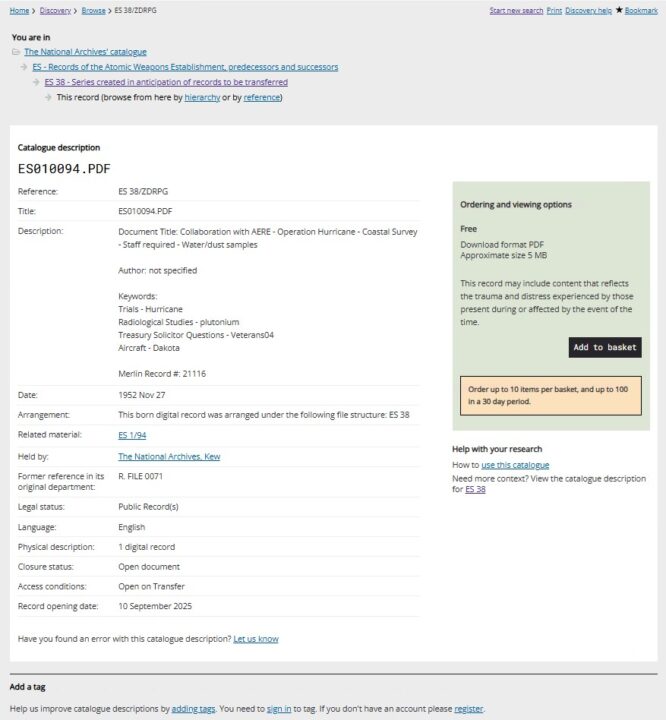
Researchers should note that some of the catalogue descriptions contain inaccuracies originating from the source system, such as poorly indexed document titles (for example, ‘qwertyuiop’). This data has been transferred ‘as is’ without correction to preserve the integrity of the original record.
5. Supporting sensitivity and transparency
As part of preparing the Merlin Database records for transfer to The National Archives, the MOD and AWE have undertaken a review of the contents to ensure that any redactions are in line with information rights legislation and, where applicable, national security requirements. All records transferred in the first tranche, are OPEN on transfer to The National Archives and are accessible via The National Archives catalogue Discovery.
A member of the public will be able to submit an FOI request to The National Archives by submitting a request directly from the catalogue entry on Discovery or by following the instructions on this form. When The National Archives receives an FOI request, we will consult with MOD/AWE under section 66 of the FOIA.
The National Archives also operates a Takedown and Reclosure Policy. Should a member of the public (or a government department) consider that material available on open access should be closed they should submit a request following this process.
6. How to access records held at The National Archives
The records from the Merlin Database can be accessed using The National Archives’ online catalogue. The records are held in digital format, and the first tranche of records are available online.
Born-digital records (such as the Merlin Database records) can be downloaded free of charge. Members of the public can download 10 digital documents at a time. This is limited to 100 records in a 30-day period where you sign into a TNA account. If you do not sign into a TNA account, there is no limit on the volume of records you can download, although they will still need to be processed in batches of 10 at a time. If you are in our reading rooms, you can view and download digital documents on our computers for free, or email copies to your own devices.
The National Archives’ online catalogue will indicate the format of the record. If you need further help using our catalogue, please consult Discovery help.
This guide will be updated as records are transferred by AWE and published by The National Archives.
The Merlin Database records are catalogued within the ES 38 series.
Search or browse descriptions in our catalogue.
7. Other records relating to nuclear testing and the Atomic Weapons Establishment held at The National Archives
Records of AWE can be found in the ES department series and include records relating to a variety of aspects of its work, including policy, reports, and nuclear testing.
Records of the UK Atomic Energy Authority can be found in the AB department series.
Photocopies of evidence given to the Australian Royal Commission into United Kingdom Nuclear Weapons Testing in Australia can be found in DEFE 16 and FCO 1.
8. Records in other archives and organisations
The National Archives of Australia holds records relating to nuclear testing including records of the Royal Commission into British Nuclear Tests in Australia during the 1950s and 1960s. There is also a “guide to records of nuclear tests at Maralinga“.
Included in this guide are recent government announcements relating to the contents of the Merlin Database and Nuclear Test Veterans. Written Ministerial Statements:
https://questions-statements.parliament.uk/written-statements/detail/2025-06-30/hcws748
https://questions-statements.parliament.uk/written-statements/detail/2024-05-21/hcws486
Included in the written Ministerial statement of 21st May 2024 the following list was published: https://www.gov.uk/government/collections/atomic-weapons-establishment-awe-records-relating-to-nuclear-test-veterans
A directory of UK archive services can be found on The National Archives website: https://discovery.nationalarchives.gov.uk/find-an-archive.