Archives and records can be invaluable resources in charities for raising brand awareness, highlighting the long-term commitment to charitable causes, and highlighting the legacy to stakeholders. For many charities and voluntary organisations, anniversaries are important points to reflect on their history using archives.
In 2024, the Royal National Lifeboat Institution (RNLI) celebrated its bicentenary. In the case study, we hear from the RNLI Heritage Team about how they have used archives and heritage collections as part of the anniversary celebrations.
The RNLI is a national charity whose main mission is to save lives at sea. Founded in 1824 by the philanthropist Sir William Hillary, the RNLI has become one of the largest and most recognisable charities in the UK. Today, the RNLI can be seen across the coastlines of the UK and Ireland. It manages over 230 lifeboat stations, and its crew are available 24/7 and whatever the weather. The work of the RNLI is made possible by its frontline services, which are made up of over 9,000 volunteers of both lifeboat and shore crews.
About the archive
The RNLI has a long history of managing its own heritage and making it available to audiences. On 22 March 1937, members of the Eastbourne Ladies’ Life-boat Guild opened the first permanent museum part of the RNLI, which remains open to this day. Just 16 months later, the second museum, the Grace Darling (Memorial) Museum, opened in Bamburgh on 21 July 1938.
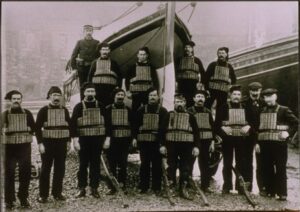
Volunteers at Abersoch Lifeboat Station, c.1890. Image courtesy of RNLI Archive.
The RNLI Archive and Library can be traced back to 1986 after Barry Cox, the RNLI’s first archivist, started volunteering for the charity. Cox was honoured with a British Empire Medal (BEM) in Queen Elizabeth’s 2016 Birthday Honours list. Since then, the heritage service has continued to grow and now has collections in over 16 museums in Britain and an archive and library reading room at the RNLI Headquarters in Poole.
In 2024, the RNLI celebrated its 200th anniversary and was recognised by the United Nations Educational, Scientific and Cultural Organisation (UNESCO). As part of this celebration, the RNLI launched the 200 Voices podcast, the Coast to Cobbles time capsule in the North West, ran numerous successful events and even Daniel Craig donated his motorbikes from the James Bond franchise as part of the anniversary. One of the final parts of the RNLI’s anniversary celebrations was the launch of their partnership with Ancestry to make their crew and rescue files available online for free.
“We are very excited to be making parts of our extensive archive collection available to the public for the very first time. Opening access will mean many will discover their family connection to the RNLI and explore records of their ancestors in our collection.”
David Welton, Heritage Manager at RNLI
Challenges and opportunities
The RNLI Heritage Team run a busy service that is open to the public and is used by internal teams. As such, there are many day-to-day challenges the team have to work around, including:
- Working as a small team in a large and busy organisation, and juggling a busy archives service – both from internal and external audiences – whilst ensuring the delivery of an excellent overall archive and heritage service.
- Balancing heritage with the RNLI’s core mission, and finding ways that heritage can support and enhance the work of the charity to save lives at sea.
- Raising funds to be less reactive and more proactive, and generating income to undertake strategic work to improve the archives service rather than just business-as-usual activities.
Nevertheless, the RNLI Heritage Team have been able to increase the visibility of the RNLI Archives using a range of methods. The main opportunities include:
- Raising the profile of the archives internally by advocating for archives and records as organisational resources that can be used to celebrate anniversaries, support fundraising and marketing, and inspire merchandise.
- Improving access to records, through a partnership with Ancestry that celebrates the contributions of volunteers to society in the UK and Ireland.
- Celebrating major milestones, and centring the contributions of its volunteers to society in the UK and Ireland over 200 years.
What can we learn from the RNLI Archive?
The RNLI’s 200th anniversary highlights the wide range of opportunities that can be taken advantage of as part of anniversaries. By working closely with fundraising, marketing and communications teams, a range of high-quality outputs, from books to podcasts, can be created that both raise awareness of the organisation’s history and support current organisational missions.
“The 200th was an incredible opportunity to raise the profile of the archive and to support all aspects of the anniversary programme. Content from the collection was used in innovative ways across the campaign as well as at partner exhibitions and events. Sharing the unique history of the RNLI was key in raising awareness and fundraising, helping to secure the future of the organisation.”
Hayley Whiting, Archivist and Research Manager, RNLI
What’s next for the RNLI Archive?
The archive is building on the success of the 200th and continuing to raise the profile of the collection. In 2024, the RNLI was awarded a grant from the National Lottery Heritage Fund to research and share stories of the RNLI during the Second World War, and this will be the focus for the next two years. Outside of the project, the archive team continue to catalogue and digitise the collection and work alongside our colleagues in wider RNLI departments to engage supporters with the history of the charity.
Find out more
Learn about the history of the RNLI
Take a look at the RNLI archive and library
Search RNLI records on Ancestry