The Many Lives of Cardboard project is an Arts and Humanities Research Council (AHRC) funded collaboration between The National Archives, the University of Edinburgh, and the University of the Highlands and Islands.
This multi-disciplinary project investigates the pasts, presents, and futures of a commonplace material that is often hidden in plain sight. It follows the biographies of cardboard from its production to recycling and beyond. We will be connecting cardboard histories from The National Archives with collections, people, and institutions from across the UK.
Cardboard in the archive
Any encounter in the archive usually begins with cardboard. It is the archive’s necessary material infrastructure, enclosing records in files and boxes and enabling the storage and organisation of documents, and their movement from repository to reader.
Outside the archive, cardboard is usually much more transient. It brings online purchases to our doors; we send it out again with good intentions of recycling; it lies discarded in the streets. Where might we find evidence of the many lives of cardboard in the historic records of government? When, how, and why might the state have taken an interest this mundane material?
But before we get into these questions: what do we mean by cardboard?
The term ‘cardboard’ originated in the late eighteenth century, meaning a thick, stiff paper, and it was often interchangeable with ‘pasteboard’, a much older term dating back to at least the fifteenth century, which described a sturdy material made by pasting sheets of paper together, or compressing pulped paper. Other methods of strengthening were later developed, including lamination, folding and fluting, and sandwiching honeycomb structures between layers of paper to create the particularly strong corrugated cardboard of contemporary packaging. Modern cardboards, in all their varieties, are therefore related to a wider historic family of strengthened paper-based or paper-like materials, all ultimately made from cellulose fibres derived from organic sources.

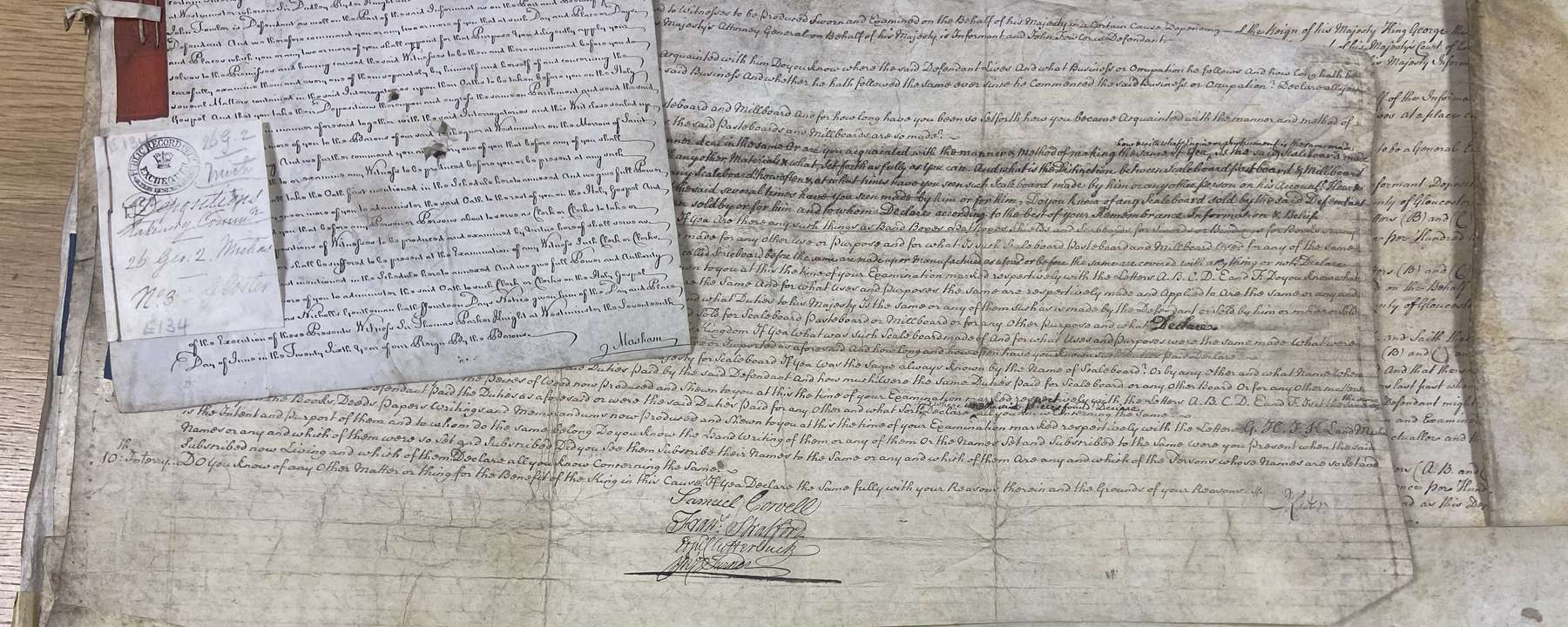
[are you] Acquainted with the manner and method of making Pasteboard and Millboard and
[...] [in what] manner and with what materials and for what uses the said Pastboards and
[...] Scaleboard or buy or sell or in any other & what manner deal in the same or
[…] Ropes or with all each or any & which of them or with any other Materials &
[…] or any other Person for him or upon his Account make any Scalebord how often
[…] made & of what Materials And what quantities at the said several times
[…] What Quantities & at what times have you seen sold by or for him
[…] Uses and Purposes for which such Scaleboard is made If Yea are there any
[…] things made of such Scaleboard Or is such Scaleboard made for any other
[…] or no are the thin Boards or Slices of any & what Wood Scaleboard or called Scalboard
[…]Pieces of Wood and Other Materials now Produced and Shown to you at this
[…] respectively distinguigsed or known by. If yea Declare the same
[…] and what Denomination liable to the Payment of any and what Duties
[…] is it such as is Generally Manufactured and Bought and Sold for Scal[...]
[…] Imported or made and Bought or Sold in this Kingdom[…]
An extract from E134/26Geo2/Mich3.
Cardboard in court
Legal records at The National Archives shed some light on the entanglement of the material histories of cardboard and its predecessors with the history of paper. In 1712 the Stamp Act introduced taxation on paper made in or imported into Britain. The Act was expansive in scope, applying to printed paper of all kinds, as well as paper-based products, including pasteboard and millboard, and also to other kinds of board not made from paper, such as scaleboard, which was made from thin pieces of wood (but sometimes covered with paper). A document from the Court of Exchequer about a tax dispute offers insights into the effects of this legislation, and a surprisingly detailed glimpse of the material histories of cardboard’s ancestors.
The Court of Exchequer was one of the three central courts in London – originally a common law court, but by the middle of the sixteenth century, it dealt with matters of equity as well. E134/26Geo2/Mich3 records depositions (witness testimonies) taken in 1752 in Gloucestershire for the Attorney General on behalf of the Crown. John Fowler, a victualler (a keeper of an eating-house or tavern), has been accused of making and selling scaleboard without paying the relevant duty. Witnesses, including excise officers and papermakers, answer interrogatories (agreed questions) on ‘the manner and method of making Pasteboard and Millboard […] and with what Materials and for what uses the said Pasteboards and Millboards are so made…’ and, in reference to scaleboard, ‘the manner & method of making the same. If yea how & with what Engine or Instrument is the same made’.
The depositions give a detailed picture of these materials and their uses, often referencing the practical knowledge and expertise of those speaking. John Durham, a papermaker for over thirty years, states that ‘past Board and Mill Board are made upon Wire Frames from Cable ropes Small Cordages [cords or ropes] and Coarse Linnen Ragges or any of them and that the same are used for Book Covers by Bookbinders in the way of their Trade and for Bandboxes [a small cylindrical box for stiff collars, or ‘bands’] Wigboxes and Hattboxes’. Like modern cardboard, all of these boards are made from recycled waste and eventually become the packaging and boxes essential for other trades.
The witnesses are also asked to ‘Look upon the several Pieces of Wood and Other Materials now Produced and Shown to you’ and to state if they know ‘what name or Titles the same are respectively distinguished or known by’. In the deposition process, these everyday packaging materials become important pieces of evidence: old rags and ropes are transformed yet again, from humble pasteboard into legal exhibits. These exhibits play a lively part in the proceedings, prompting witnesses to reveal more detail about their uses, from ‘packing of Cheese for Carriage by Land and to be sent abroad into Forreign parts’, to binding books and repairing sugar moulds. While some exhibits from Exchequer cases survive in the archive, these examples do not. Although this was disappointing for my purposes, it also seemed appropriate that after their interrogation these scraps should be silently subsumed back into the world – unremarkable stuff once again.

Members of the project team look at records related to the history of cardboard from The National Archives' collection, including E134/26Geo2/Mich3.
Tax evasion
John Fowler’s case is that while he does sell thin wooden boards to cheesemongers and others, he does not consider these boards to meet the definition of scaleboard. His activities are legitimate, his witnesses claim, and he does not attempt to hide them in ‘any private or concealed Shop, workhouse, or other place for Cutting or making such thin Boards’ but ‘Does it in a Publick manner’, in ‘open and publick places’. However, in the final decree for the case (E126/27), the Court finds that John Fowler has been defrauding the Crown: ‘he ought to have paid said Duty which he hath neglected and hath not paid any Duty tho’ requested by his Ma[jes]tys officers’. He has used ‘some private place for making and keeping scaleboard without making any Entry thereof pe[rtin]ant to s[aid] Statutes wherein great quantities of scaleboard were privately made of which no officer had any Notice or account’. Unsurprisingly, in the context of a tax dispute, this is also a record about the importance of accurate record-keeping and the documentation that creates accountable relationships between the individual and the state.
Material flows
As a procedural document E134/26Geo2/Mich3 is entirely formulaic, but in placing these antecedents of cardboard under scrutiny, it also offers us a rich incidental picture of matter in motion: of recycled rags and ropes, of books and clothes, cheese and sugar, of making and mending and selling and transporting stuff in the local environs of Gloucestershire as well as further afield, to ‘Forreign parts’. In many ways this is a familiar picture of everyday consumption in which humble packaging materials play an unexciting but important role.
Yet while the globalised manufacturing and supply chains of contemporary capitalism distance us from cardboard’s origins today, in the pre-industrial context of a small Gloucestershire village we find a much more localised picture. E134/26Geo2/Mich3 reveals the first-hand expertise and detailed knowledge of those involved in making these packaging materials, and the personal connections between practitioners of different trades. In this record, the predecessors of modern cardboard are artisanal products, like the cheeses they wrap, participating in very immediate cycles of matter and waste.
As we embark on the research for The Many Lives of Cardboard, we look forward to what other encounters with cardboard will reveal about matter, place, and more. Through our multi-disciplinary investigation of the history, culture, and materiality of a substance that is so often hidden in plain sight, we hope to uncover new avenues of research, collaboration, and practice within and beyond the galleries, libraries, archives and museums (GLAM) sector, and arts and humanities disciplines.
gtr.ukri.org
Discover more about The Many Lives of Cardboard project
Explore the project in more detail on the UKRI's website.
