At first glance, this set of fifty-nine cotton and silk textile samples look like ordinary swatches of fabric. They come from the records of the High Court of Admiralty and the only clues about their origins are in a note left by conservators in the 1930s. It states that they were originally part of a collection of papers taken from the American ship Illustrious President, which sailed from Suriname to Amsterdam in 1795.

The small, brightly coloured samples raise two research questions.
- Where were they made?
- What and for whom were they intended?
During a three-month placement at The National Archives, I worked to address these questions by assessing the colours and patterns of the textile samples. These, in turn, speak to the role that colonial exchanges played in shaping Suriname’s textile traditions.
Uncovering global histories in the Prize Papers Project
My placement was undertaken as part of the Prize Papers Project, a 20-year collaboration with University of Oldenburg, Germany. The project is working to sort, catalogue, and digitise around 500,000 documents and objects taken from ships captured by the British between 1652 and 1815.
Britain was frequently at war during this period, and its navy and privateers seized foreign vessels suspected of carrying enemy cargo. The High Court of Admiralty in London would determine whether the vessel could be declared a ‘prize’ and sold for profit.
Frequently, the cargo included personal letters written by ordinary people to family far from home, logbooks, receipts and bills, written in dozens of languages. Occasionally, there are unexpected items like these textile samples.
In pictures
The Prize Papers

This vast collection of letters, papers and objects came from ships captured around 1600–1860. It is a unique source on seafaring and many other areas of life.
We know from court documents relating to the Illustrious President that these textiles began their journey in Paramaribo, in the Dutch colony of Suriname, South America, in 1795. The ship's cargo included sugar, coffee, cocoa, and cotton cultivated by enslaved people of African and indigenous descent. Together with the goods for export and thousands of letters, the textiles were intended for Amsterdam.
However, the ship never reached Amsterdam. On 20 April 1795, the Illustrious President was captured off the coast of Dover by the British privateer Flora, whose crew carried it into London. Its contents, including these fabrics, were transferred to London and absorbed into the High Court of Admiralty’s prize records.
Despite all the information we have about the Illustrious President, we know little about the textiles. Separated from the original letters they were contained in during the 1930s, the fabrics were severed from their narrative context.
Clues from colour, fibre and pattern
The fabric samples themselves still carry clues as to their origins and production. During my placement, I worked with The National Archives’ Collections Expertise and Engagement and Collection Care teams to conduct scientific analysis of the textiles. We used high-resolution imaging and colour analysis to learn about the samples without damaging them.
Immediately, lots of information emerged:
- 56 samples were printed cotton
- 3 samples were woven textiles, possibly silk
- The motifs included geometric zigzags, diamonds, and stylised florals
- Several designs resembled Indian chintz and Indonesian batik
- Some were crisply produced, while others showed drips, smudges, or uneven printing

Ten of the Surinamese textile samples, labelled with their catalogue references.
| Fabric sample catalogue reference | Motifs | Material | Technique | Resembles |
|---|---|---|---|---|
| HCA 65/8/04 | Floral (leaves, flowers, vines) | Cotton | Printed | Indian chintz (floral design, block printed) |
| HCA 65/8/02 | Floral (leaves, flowers, vines) | Cotton | Printed | Indian chintz (floral design, block printed) |
| HCA 65/8/01 | Floral (leaves, flowers, vines) | Cotton | Printed | Indian chintz (floral design, block printed) |
| HCA 65/8/21 | Floral (leaves, flowers, vines) | Cotton | Printed | Indian chintz (floral design, block printed) |
| HCA 65/10/01 | Geometric (diamond, chevrons, stripes) | Cotton | Printed | Indonesian ikat (geometric designs, block printed) |
| HCA 65/8/11 | Geometric (diamond, chevrons, stripes) | Cotton | Printed | Indonesian ikat (geometric designs, block printed) |
| HCA 65/10/18 | Geometric (diamond, chevrons, stripes) | Cotton | Printed | Indonesian ikat (geometric designs, block printed) |
| HCA 65/8/18 | Geometric (diamond, chevrons, stripes) | Cotton | Printed | Indonesian batik (resist techniques) |
| HCA 65/8/19 | Geometric (diamond, chevrons, stripes) | Cotton | Printed | Indonesian batik (resist techniques) |
| HCA 65/8/30 | Geometric (diamond, chevrons, stripes) | Silk | Woven | European traditions |
Clues from colour: dye analysis
Using Fibre Optic Reflectance Spectroscopy (FORS), a non-invasive technique that measures how light reflects off the coloured surface, we were able to gain insight into the colours present.
There were two reds. On the printed cotton we found a plant-based red, possibly from a redwood tree which is common in Suriname. We also found an insect-based red in the woven samples, characterised by the double absorption bands at 525 nanometres (nm) and 565 nm.

Analysis of reflectivity of the red dyes found
The blues also presented some variations. We found indigo (characterized by a maximum absorbance at 660 nm) on most of the samples which is not surprising as it was the most common blue colourant. However, a combination of indigo and Prussian blue, a synthetic blue pigment developed in 1724 and increasingly common in the late 18th century, was inferred in a subset of these textile samples. This shows a quick adoption of new materials alongside traditional ones.

Analysis of reflectivity of the blue dyes found
Colour analysis shows that the textiles draw on both local Surinamese dye sources and imported materials, linking them to the global networks of the Dutch colonial world.
Knowledge about 18th-century Surinamese textile fashions is scarce. However, what the samples suggest is that the printed cottons, dyed with locally available plant colourants, may have been intended for the clothing of enslaved people or the wider Surinamese market.
The woven silk textiles, possibly dyed with imported insect red, were perhaps destined for plantation owners’ families, or for individuals within the enslaved community who held positions of elevated status.
The textiles help to paint a picture of complex social hierarchies but also cultural exchange along the Dutch trade routes, and influences from all over the colonial world. An image comes to mind of the bustling port of Paramaribo, where both enslaved and free peoples would have seen the colours and patterns from across the world and interpreted them within their own communities.
Echoes of a colonial past in Surinamese fashion today
What is striking is how much of the colonial legacies we see in the textile fragments continue to the present day in Suriname’s distinctive fashion.
The koto, a wide skirt or dress of printed cotton, is often heavily starched using cassava and water to create a wide silhouette denoting abundance and status. However, the emergence of the koto style in 1879 followed a Dutch colonial decree mandating chest coverings and gowns for women.
The koto is worn with a short jacket and angisa, a headcloth of the same printed cotton as the koto (for more information on the koto, see the Wereldmuseum in Amsterdam's website). Symmetrical layouts, floral abstractions, and rhythmic borders found in the fragments in the Prize Papers reflect stylistic elements seen in both historical and contemporary Surinamese dress, suggesting continuity across time and cultural context.
There are hundreds of ways of tying the angisa and each is encoded with a hidden meaning, vestiges of a clandestine means of communication between enslaved women.
Image 1 of 2

Drawing of Affie Anna Terzol by Jacob Marius Adriaan Martini van Geffen in Suriname, in or after 1859.
Rijksmuseum, Netherlands (Public Domain)
Image 2 of 2
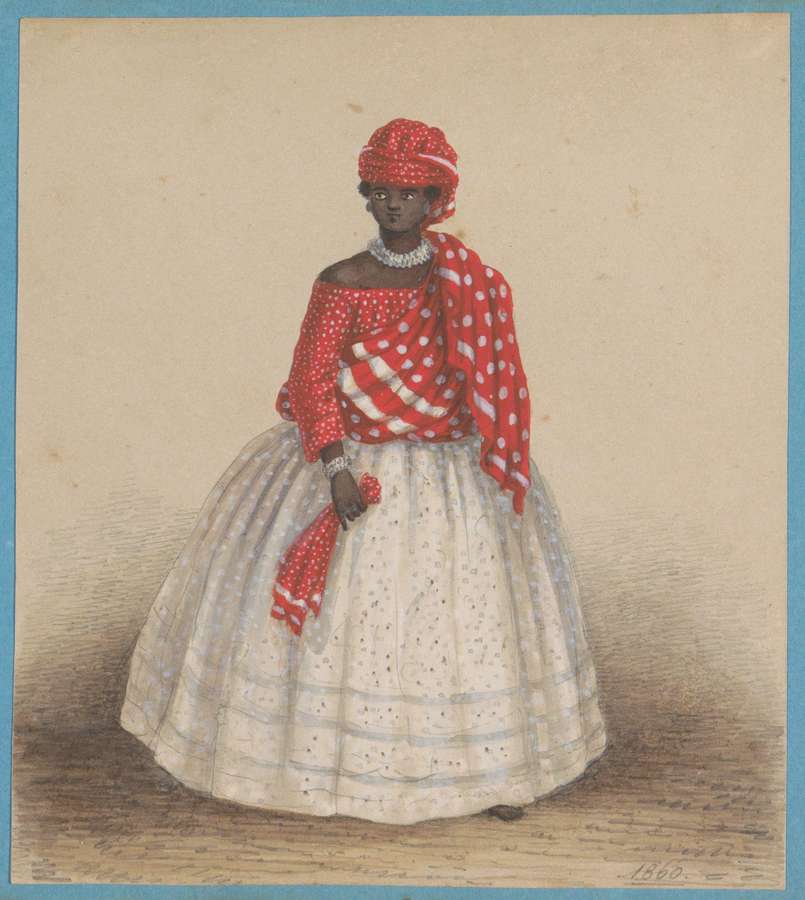
Drawing of a woman in a kotomisi by Jacob Marius Adriaan Martini van Geffen in Suriname, 1860.
Rijksmuseum, Netherlands (Public Domain)
New insights into overlooked textile histories
The textiles in the Prize Papers collection are rare and have survived because they were protected within an archival collection. They have been cared for within a stable environment with regulated temperature, humidity and the absence of damage from light exposure. Combined with systematic cataloguing and digitisation undertaken by the Prize Papers Project, the textiles will be seen by the public in almost the same conservation condition as when they were created in 1795, preserving the stories that many other 18th‑century textiles have lost.
By opening up these materials, the Prize Papers Project not only safeguards the past but actively shares it, offering the public a vivid and tangible connection to Suriname’s textile history and to the global networks that shaped it.
The samples also challenge the longstanding belief that Suriname had no textile production in this period, instead pointing toward local industry, hybrid influences, and wide-reaching trade connections. They reveal how much more there is still to uncover in Suriname’s material history.
Further testing will refine our understanding of their fibres, origins, and uses, but even now, these colourful samples illuminate the resilience, creativity, and cultural expression of Suriname’s people in the 18th century.
About the author
Viveca is doing a collaborative PhD with Royal Holloway, University of London and the Economic Botany Collection at Royal Botanic Gardens, Kew. Her research connects Kew’s colonial era collections of Indigofera tinctoria from India to contemporary indigo production and dyeing in West Bengal, India.
She uses film as a research method to visualise the knowledge and skills embedded in the craft of dyeing with natural indigo, and to show how embodied practices can cultivate human-plant relationships.