Important information
This blog includes examples of historic terminology and use of language that is offensive, pejorative or dehumanising to various marginalised communities. This reflects the nature and content of some of the historical records held at The National Archives as well as past cataloguing practices.
The National Archives' catalogue, Discovery, holds more than 37 million descriptions of records held by The National Archives and more than 3,500 archives across the country.
It reflects many years of work by hundreds – if not thousands – of people. As a team, we are constantly adding to and improving its content.
Collection blog
Catalogue Week 2025

Explore a small selection of our cataloguing activity from 2025.
Underpinning our cataloguing work is the desire to be true to the past, helpful in the present and sustainable for the future. This is not always an easy task.
One area we are working to improve is how we treat historic offensive terminology within catalogue descriptions. Archives spanning a thousand years inevitably contain language that reflects the attitudes and biases of their time – in our case often the perspective and biases of the state. Past generations of cataloguers often perpetuated such attitudes by repeating offensive or pejorative words from the original sources.
The presence of such words in the catalogue can serve to reflect the historical realities documented within the archives. Additionally, researchers looking into marginalised histories and challenging or uncomfortable topics can find past terminology useful for locating relevant material. If we use substitute terms in our catalogue, this may make it harder for users to research ‘hidden histories’ in our collections.
Nevertheless, users have told us that encountering offensive terms within the catalogue can be jarring or upsetting, especially when lacking context or qualification. It can be especially problematic where cataloguers from past decades used language that was not contemporary to the original record or acceptable today usage. Such descriptions are neither accurate nor helpful from today's standpoint.
The National Archives is not alone in considering how to address this language. For example, Archives Wales carried out a project to review and revise archival descriptions. Of course, not all archives have taken the same approach, and some have revisited past descriptions more thoroughly than others.
Discovery includes a lot of information about other UK archives' collections as well as our own. Users may notice variation across Discovery due to the different approaches used by other archives.
Our approach
Our documented approach to the use of offensive terminology in catalogue descriptions focuses on clarity and context.
You can watch Senior Archivist Grace van Mourik's talk from 2021 for more information about how this approach was developed.
Our documented approach
Learn about The National Archives' approach to addressing offensive language within its catalogue.
This approach incorporates pre-existing practices that have been unevenly implemented across the catalogue:
- When quoting offensive or outdated language from the original record, make that clear, typically with quotation marks
- Avoid such language where it does not appear in the record itself
In recent months we have made a more concerted effort to identify and improve past cataloguing that does not conform to our agreed practice.
For example, our predecessors very rarely used advisory notes within the catalogue for additional context or clarification. We are now starting to experiment with these notes.
Underlying all of this is a wish to be respectful of:
- The authenticity and integrity of our collections
- People whose past experiences are documented in the records
- People using the records now and in the future
Identifying pejorative and dehumanising terms
Looking for offensive terminology is not as simple as 'finding all the bad words'. What is offensive can be subjective and personal. How words are used and in what context, rather than just their presence, are also key factors. Although I have used the phrase 'offensive terminology' in this blog post, 'offence' does not reflect the impact that such words can have. Problematic terms can also be dehumanising, pejorative or derogatory.
Clicking the below link will take you directly to a catalogue description that includes a highly offensive racial term. Reader discretion is advised.
In some instances, there is a clear consensus that a word is offensive or upsetting. One example is the Colonial Office file CO 875/18/5 which is about people objecting to the use of a particular anti-Black racial slur during the 1940s.
For this record, including the offensive word is intrinsic to providing an accurate catalogue description.
Our starting point for identifying potentially offensive terms is the protected characteristics covered by the Equality Act 2010: age, disability, gender reassignment, marriage and civil partnership, pregnancy and maternity, race, religion or belief, sex, and sexual orientation. These are not comprehensive as they do not cover, for instance, terms reflecting prejudices based on perceived social class. Despite this, they provide a baseline for investigating derogatory language.
Our Cataloguing team’s collective experience suggests that we are most likely to encounter problematic terms related to the following within catalogue descriptions:
- Race and ethnicity
- Disability
- LGBTQ+ people
Descriptions of older records may include misogyny and pejorative language relating to religion.
Practical examples of addressing offensive terminology
Below, I share examples of offensive language my team has uncovered within our catalogue and the changes we have made to address them.
Record STAC 5/B11/13 is one of several late 16th century records from the Court of Star Chamber to use the term 'blackamoor' (meaning a person of African heritage) in relation to Edward Swarthye or Swarthy.
In the description, we have marked the word 'blackamoor' clearly as a quotation. We have chosen to reinforce this with an advisory note in square brackets.
Another small change was to how the word 'Negro' was used in the record, as an alternative surname for Edward.
Image 1 of 2

The previous catalogue description for STAC 5/B11/13
Image 2 of 2

The revised catalogue description for STAC 5/B11/13.
Record MH 148/190 is from a set of files relating to possible impacts of the fluoridation of water supply. It uses the term 'Mongolism', which is a superseded and offensive term for Down's syndrome.
As the word 'Mongolism' appears on the file cover, we have chosen to keep it in the catalogue description, but we have added the current term for clarity and searchability. We have also added an advisory note.
This description is also an example of how 'correct' current terminology can be uncertain. While some people prefer the form 'Down syndrome', others use 'Down's syndrome'. We have used the latter, following the NHS and the Down's Syndrome Association in the UK's writing style.
Image 1 of 2

The previous catalogue description for MH 148/190.
Image 2 of 2
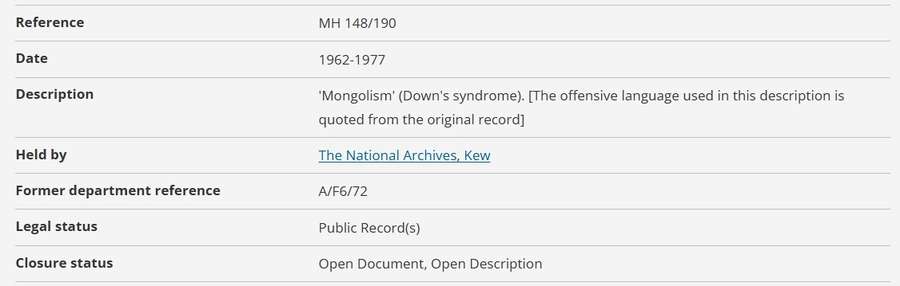
The revised catalogue description for MH 148/190.
We have also come across examples where past cataloguing used historic terminology incorrectly.
The previous catalogue description for the early 17th century manuscript, SP 9/201/12, included the term 'papist', a pejorative term for a Roman Catholic person.
This word does not appear in the record itself, which is written in French. We have corrected this to 'Catholic' in the description.
Image 1 of 2

The previous catalogue description for SP 9/201/12.
Image 2 of 2

The revised catalogue description for SP 9/201/12.
The catalogue description for record HO 44/26/14 previously described Lavinia Edwards, a 19th century Irish actress, as a 'hermaphrodite'. This implies that she had both male and female physical characteristics, referred to today as being intersex. However, the record itself does not state or imply that she was intersex.
The record does not tell us how Lavinia perceived her own sex and gender, only how she was seen by others, most of whom had not met her while she was alive. It does state that she presented herself as a woman and it is consistent with her being what we would now recognise as transgender.
For the revised description, we chose not to use a modern term that might seem anachronistic. Instead, we have chosen to quote relevant text from the record that reflects how Lavinia's contemporaries perceived her.
Image 1 of 2

The previous catalogue description for HO 44/26/14.
Image 2 of 2

The revised catalogue description for HO 44/26/14.
As these examples illustrate, there is not one right approach to follow in every case. There is certainly not always a single correct answer to the question of how a record should be described. This means that work tends to progress slowly, requiring thought and reflection by colleagues working on a case-by-case basis.
Currently, we are still in the early stages of our explorations. Our catalogue includes millions of descriptions and scaling up to make faster progress will be an additional challenge.
Suggesting corrections
The National Archives has long encouraged our catalogue users to report errors in catalogue descriptions. Every year, we make about 5,000 corrections thanks to these suggestions.
If you come across examples of offensive terminology in ways that do not follow our approach, you can report these to us.
To do this, please use the dedicated form at the bottom of every catalogue entry. This could support our journey to improve the catalogue, helping everyone to access the archives more effectively.

Have you found an error with this catalogue description? Let us know.
Which field contains the error?
Select from list.
What is the error?
What is the correct information?
Have you seen this error elsewhere? Please provide reference details (optional).
Suggesting a correction in Discovery, our catalogue.
