This blog includes brief mentions of conflict during the First World War.
Imagine an archive, and you may well think of rows of cardboard boxes arranged on shelves, protecting their contents. I have long been interested in the history of the archive as a history of boxes. Lately I wondered what a search for ‘box’ in Discovery, The National Archives’ catalogue, might lead to in the historic records of the UK government.

D.MS.R. 419
Ministry of Munitions
No minutes to be made anywhere on this cover.
Date when registered: Jan 199
Boxes
of 18 pdr. Ammunition
The cover of a record from The Ministry of Munitions series. Catalogue reference: MUN 4/3078.
The Ministry of Munitions
My search in Discovery brought up many references to records in the MUN series. This series contains records of the Ministry of Munitions and its successors, relating to the supply of munitions during the First World War (1914–1918). The Ministry of Munitions was created by the Munitions of War Act 1915, in response to the critical shortage of munitions on the front lines in France. The new department controlled the entire process of weapons and military equipment production, from research and development to the securing of materials and the running of newly-created national factories.
The Ministry of Munitions was the most innovative department of the British government during this time, mobilising the entire economy for the war effort. While this department was relatively short-lived (after the war, its functions were taken over by other departments) the records of the Ministry of Munitions reveal the urgency and scale of its work, and the challenges it had to navigate.
I am not a military historian, and in many ways these records felt unfamiliar. The MUN series consists of thousands of documents, in hundreds of files, which show the necessary bureaucracy behind a war fought with new technologies and on an unprecedented scale.
In committee minutes, reports, correspondence, and statistics, the records tell us about the planning of labour forces and supply chains, the organisation of wages and welfare, and the logistics of production and transport. The records are filled with acronyms and specialist terminology and as routine, dry traces of administration they offer a striking contrast with what we now know about the huge loss of life during this conflict.
Munitions infrastructures
Collectively, the records of the Ministry of Munitions give us a sense of the large scale of its activity, but individually they provide glimpses of this work in detail – of the specific concerns, problems, and challenges of resourcing the front lines.
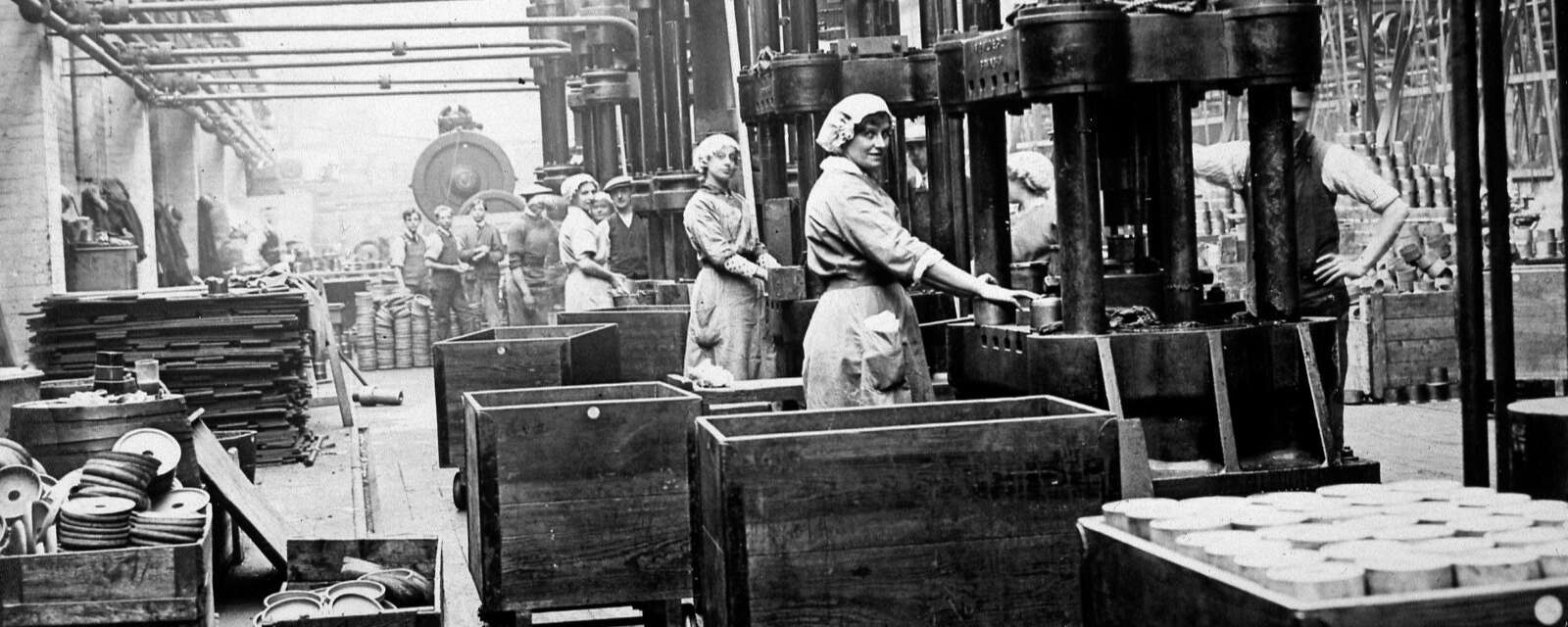
My search in Discovery directed me to many records on ammunition boxes (for storage and transportation of ammunition). Made in large quantities in the National Box Factories, these were important munitions infrastructure and crucial to the flow of supplies to and from the front lines. Their appearance in the archival record is often, I realised, when there is a problem. These objects demanded the attention of government officials when they were wrongly marked, insufficiently packed, or incorrectly filled.
the practice of packing fuzes and tubes in the same box appears reprehensible
Military official from The Ministry of Munitions. Catalogue reference: MUN 4/3078.

G.A. F. (R)
Copy of D. of A’s A.I./53/17 of 12th February
1917, regarding failure to obliterate former numbers
on A.A. Ammunition boxes is attached for action and any
observations you may have to make.
A similar minute is being sent to D.G. I. M.
[signature]
for D.M.R.S.
D.M.R.S.
15 2.17.
C.S.O.F
Please arrange to have former marks properly
obliterated when re-issuing old boxes.
[signature]
Director.
G.A.F. (R).
17.2.17.
G.A.F (R)
It has been the practice
here to obliterate these marks
and this point will be
specially watched in future.
[signature]
for C.S.O.F
5.3.17
A minute sheet addressing marking on ammunition boxes. Catalogue reference: MUN 4/3078.
Another of these problems led to my surprise discovery. In December 1916, the Director of Ordnance Services for the British Armies in France wrote to the Director of Artillery at the War Office, reporting that:
a large number of boxes of 18-pr Ammunition are being received, the lids of which are closed with 1“ screws, and as there are no wire fastenings, many boxes arrived with loose lids and in some cases without lids
Director of Ordnance Services for the British Armies in France. Catalogue reference: MUN 4/3078.
This prompted correspondence around the need to fasten boxes securely when they left the filling factories, with reference to a ‘specimen screw’. Intrigued, I then found pinned to the documents a small pink envelope containing a single 1-inch screw, wrapped in a scrap of paper, and now slightly rusted.

A screw pinned to a Ministry of Munitions record. Catalogue reference: MUN 4/3078.
This was an unexpected discovery in this file of paper records: I had not anticipated such a tangible encounter with munitions in the archive. The screw had become part of the historical record, as evidence of a particular practical problem.
By its startling presence, the screw also drew my attention to other materialities of the archive. A few examples include: the bandage‑like scrap of paper it was wrapped in; the rusted metal pin used to hold the envelope; the screw, preserved in its precise location in the file; and the grey dirt that came off on my fingers.
The presence of this tiny object strengthens our sense of connection to official exchanges, grounding them in the very practical challenges of supplying the front lines. Here in the records, the screw shrinks the distance between Whitehall and France, between then and now, and between the material infrastructures of conflict and the material infrastructure of an archive.
