The Northern Ireland Digitisation Project represents a significant and transformative step in improving access to UK Government records relating to the Northern Ireland Troubles. This is one of the most complex, contested and deeply studied periods in modern Irish and British history.
For the first time, thousands of UK Government files regarding the conflict will be available online, free of charge. These records were previously accessible only in person at The National Archives in Kew, London or via our paid search service. By making these records available online, the project opens new opportunities for research, education and public understanding. Additionally, it recognises the responsibilities involved in working with material that reflects profound loss, division and sensitivity.
The records digitised through this project hold histories of government, communities and everyday life during the conflict. Together, they document how decisions were made, how policies evolved and how government responded to events during a period of sustained political upheaval and violence.
We recommend that users take care when accessing these records due to the violent events they may discuss. The content may be distressing to some readers.
About the Northern Ireland Digitisation Project
The Northern Ireland Digitisation Project focuses on digitising records held at The National Archives that were created in, or relate directly to, Northern Ireland during the conflict. By transforming physical files into high-quality digital copies, the project aims to remove geographical barriers to access and to make these records available to a wide audience.
In particular, the project is intended to support:
- members of the public with a personal or community connection to Northern Ireland
- academic researchers
- students and educators
- family historians
- local history groups
Making these records available online increases transparency and helps to broaden engagement with the national collection. In doing so, it supports those who may not otherwise be able to view the records in person.
This work forms part of a broader non‑legislative Northern Ireland Legacy initiative that were formally announced in April 2025. It reflects a renewed emphasis on openness, accessibility and informed engagement with the archival record of the Troubles.
The Northern Ireland Digitisation Project builds on earlier work undertaken by The National Archives to improve access to records relating to the Troubles. An initial project took place in 2023, when a selection of documents were digitised to mark 25 years since the Belfast (Good Friday) Agreement. These records were brought together for the first time on the Northern Ireland: Pathways to Peace and Reconciliation landing page.

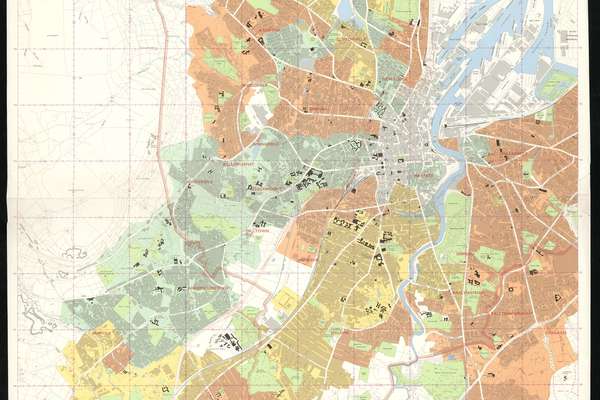
A map showing the Belfast religious areas, 1971. Catalogue reference: DEFE 259/2813
Why this project exists
The Troubles remain one of the most complex and divisive periods in modern Irish and British history. Spanning more than three decades, the conflict shaped political structures, communities and individual lives across Northern Ireland and beyond. Understanding this history requires careful engagement with evidence, including official records that document how government understood events and responded to them.
This project aims to increase accessibility to government records relating to the conflict. In doing so, it aims to enhance transparency around policy and decision‑making, while enabling research and education on this area of history. By making official records available online, the project seeks to support informed understanding, dialogue and scholarship.
Why digitisation matters
Digitisation is not simply a technical process. It reshapes how people encounter and engage with archives.
For Northern Ireland collections, this work has particular importance. Making records available online allows users to search across collections, compare material and incorporate primary sources into research, teaching and public engagement. It also helps to preserve original documents by reducing physical handling while ensuring their content remains accessible for future generations.
Digital access supports a range of uses, from academic scholarship and journalism to education and community-led projects. Additionally, digitisation facilitates remote access and reduces barriers to engaging with records.
The collections: What will be digitised
The National Archives holds thousands of records relating to the Troubles, transferred from a range of UK Government departments. Records included in the project cover the period from around 1966 to 1998, spanning the emergence of the Troubles through to the Belfast (Good Friday) Agreement.
The records selected for digitisation reflect the cross-cutting nature of the Troubles and the range of government activity that occurred during this period.
| Government department name | What their records include |
|---|---|
| The Northern Ireland Office | Northern Ireland policy |
| The Cabinet Office | Collective government decision-making |
| The Prime Minister’s Office | Correspondence and briefings for successive Prime Ministers |
| The Home Office | Security and policing matters |
| The Foreign, Commonwealth & Development Office | Anglo-Irish relations and international dimensions |
| The Ministry of Defence | Military operations and security policy |
| The Ministry of Justice | Justice and legal administration matters |
Many of these files were difficult to locate or navigate due to their distribution across departments and the limitations of searching through file titles alone. Digitisation brings this material together and allows users to explore it more coherently.
The records span a wide range of dates and formats and reflect Northern Ireland’s administrative, political, social and economic history during the conflict. They document the operation of the state, policy formulation, security responses and the lived experience of individuals and communities over time. The records demonstrate the British Government’s official perspective on events, policies and negotiations. They do not represent all voices from the conflict, but they form a vital part of the historical record. Therefore, they are central to understanding how government operated during this period.
All records selected for digitisation were already open to the public, but until now the majority were only available in hard copy at The National Archives. The project also incorporates newly transferred open records that have not previously been accessed in person at the archives.
Image 1 of 2

File on the banning of Republican Clubs. Catalogue reference: HO 284/48
Image 2 of 2
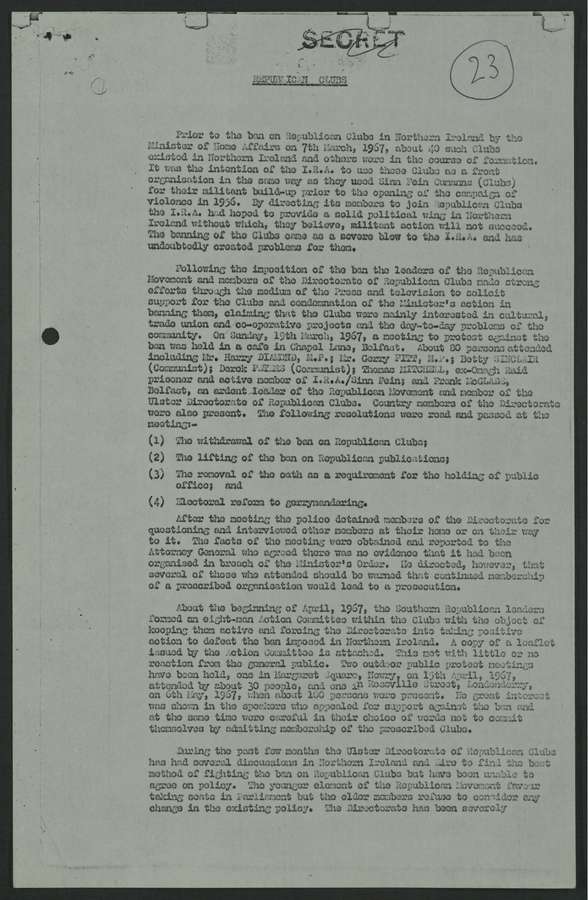
A document within this file providing context on Republican Clubs.
Key themes in the first release
The first release of documents within the Northern Ireland Digitisation Project makes around 1,000 records available online. These files largely date from the late 1960s to 1972 and document the emergence of the Troubles and the early development of the UK Government’s response.
Three broad themes run through this first release:
1. The Roots of the Crisis in Northern Ireland and the Civil Rights Campaign
Records under this theme document events in the 1960s. This includes the revitalisation of republicanism, the rise of Paisleyism (the ideology, leadership style, and electoral influence of Ian Paisley and his party, the Democratic Unionist Party), and the Civil Rights movement that emerged in Northern Ireland and reactions to it. They include material relating to public demonstrations, campaigning and the Government’s assessment of calls for reform in areas such as housing, employment and voting rights.
These files illuminate how civil rights activism was understood, monitored and reported by different parts of government. They also provide insight into how events on the ground were interpreted and responded to. This gives readers essential context for understanding the social and political pressures that preceded the outbreak of widespread disorder.

March, 1972
Civil Rights Organisations in Northern Ireland
There are now two major organisations operating in the civil rights field in Ireland – the Northern Ireland Civil Rights Association (NICRA) and the Northern Resistance Movement (NRM).
Received in registry No. 11
27 MAR 1972
VM 7/1
Northern Ireland Civil Rights Association
NICRA emerged around 1967 as an amalgam of many small organisations, including housing associations and social justice committees in minority areas, which had been formed earlier in the 1960s to seek solutions to some of the genuine grievances of the Catholic community. It even had some Unionist support, one of its Council members being Robin Cole, a member of the Young Unionist Council. In 1969 reforms of the sort of which NICRA originally campaigned were proposed by both the Westminster and Stormont governments. The result was a series of new laws enacted by the Northern Ireland administration during 1970-1971, including electoral reform, the reorganisation of the police, and new methods of housing allocation. But by this time the character of the NICRO had changed as a result of infiltration by militants whose aim was to gain power for their own political ends and it rejected the reforms as inadequate.
[...]
‘Civil Rights Organisations in Northern Ireland’ is a document that has been digitised as part of theme one. These organisations' collective activism marked a decisive turning point in Northern Ireland, helping to shape the political and social conditions that followed. Catalogue reference: FCO 168/6544
2. The Outbreak of Conflict
This theme covers the period in which rising tensions developed into sustained violence, prompting significant security responses. The records trace the outbreak of unrest and the circumstances surrounding the deployment of the British Army in Northern Ireland.
Included are documents reflecting the challenges faced by government departments as conditions changed rapidly, along with contemporary assessments of security, public order and community relations. Together, these records offer insight into early decision-making and the evolving role of the Army during the initial phase of the conflict.
3. The Formation of the Northern Ireland Office and the Introduction of Direct rule
Following the suspension of Stormont (Northern Ireland’s Parliament) in 1972, responsibility for Northern Ireland’s governance shifted significantly. Records within this theme document the creation of the Northern Ireland Office and the introduction of direct rule.
These files reflect the policy and practical considerations involved in establishing new governance arrangements. They also highlight the broader implications of how Northern Ireland was administered during a period of instability and violence. Due to this, they are central to understanding how structures of government adapted in response to the developing conflict.
Image 1 of 2

A file from the Northern Ireland Office. Catalogue reference: CJ 3/106
Image 2 of 2

A document from the file regarding contingency planning. Catalogue reference: CJ 3/106
Types of records and formats
The digitised material includes a wide range of record types and formats, allowing users to engage with different aspects of decision-making and administration during the Troubles.
These include:
- Cabinet papers, including minutes and memoranda
- Ministerial correspondence, including letters and briefing notes
- Policy briefings and internal reports on security, political negotiations and economic issues
- Communications between governments, including correspondence with the Irish Government and international actors
- Maps of Operation Banner, including military mapping used during the deployment of the British Army

Map of Londonderry religious areas, 1971. Catalogue reference: DEFE 259/2630
How the project will work
The Northern Ireland Digitisation Project will run for four years, releasing records in thematic batches on a twice-yearly basis. This phased approach allows material to be published as soon as it is ready, rather than waiting for the entire collection to be digitised.
All digitised records are available free of charge via The National Archives website through Discovery, our online catalogue. Each release will be accompanied by updated research guidance, blog posts and contextual material to support users in navigating the collection. This will also help with understanding the records within their historical context.
Our roles and responsibilities
The National Archives recognises that records relating to the Troubles reflect difficult and contested histories. The conflict caused immense suffering and loss, and its legacy continues to have real significance today.
Our approach to digitisation is grounded in respect for that history and its continuing impact. It includes careful decisions about what is digitised, how records are described and how they are presented online.
Providing access to records goes hand in hand with providing context. The project is informed by archival best practice and research expertise, with a commitment to supporting responsible and informed use of the material. While the records reflect the British Government’s perspective, they are intended to be read alongside other sources as part of a broader engagement with the Troubles.
Looking ahead
Digitisation is not the end of the story; it is the beginning of greater access. Over the next four years, further thematic releases will expand the digital collection, offering insight into later phases of the conflict and the political processes that contributed to peace.
In addition to online access, public workshops, podcasts and educational materials will be developed to support engagement with the digitised records. As the project progresses, we will also share more detail about individual collections and highlight records that shed light on both everyday life and broader historical change.
We invite researchers, educators and members of the public to explore the first release of digitised records through the Discovery catalogue and to consult the Troubles Research Guide for further context and resources.
Collection blog
Accessing the digitised Northern Ireland Troubles records
Explore how to access material related to the Troubles online through The Northern Ireland Digitisation Project.