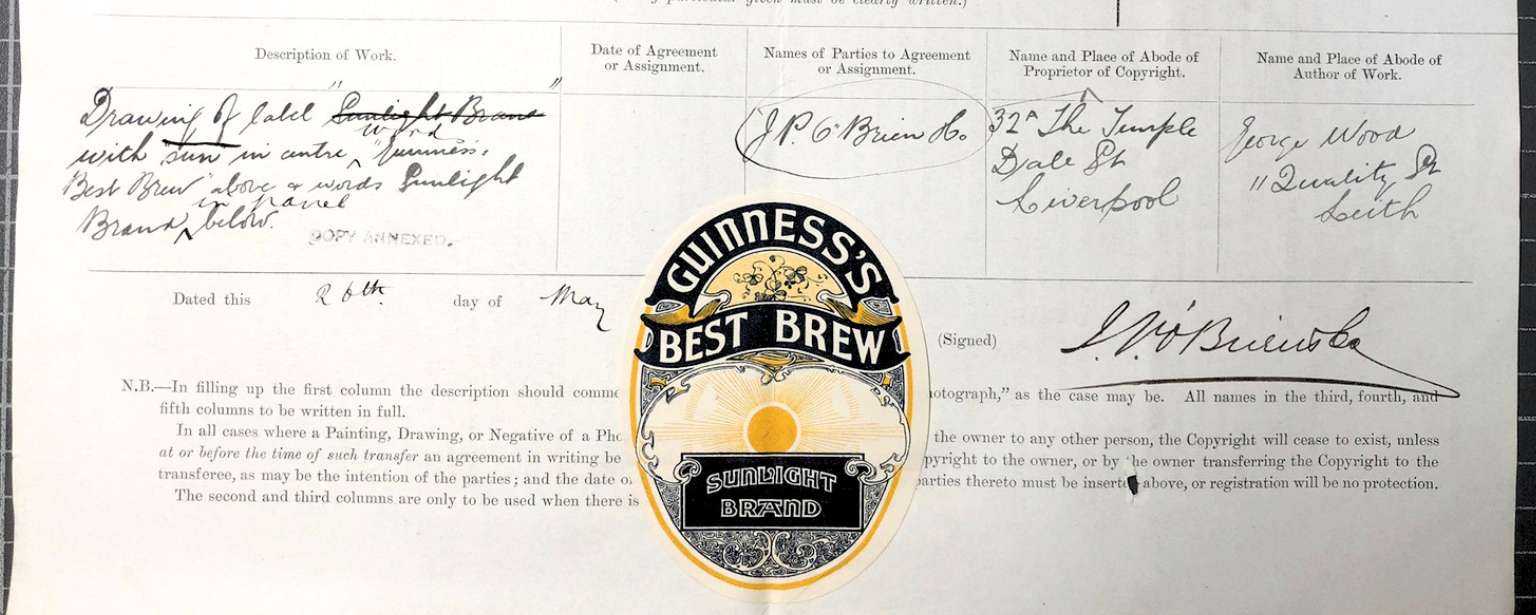
The National Archives holds thousands of entry forms for paintings and drawings registered for copyright protection with the Stationers’ Company. Over the last seven years, a team of dedicated volunteers has transcribed these entry forms into Discovery, our online catalogue. Together, they have created over 35,000 new item-level descriptions, which is an incredible achievement.
Users are now able to search the information in Discovery using keywords and names to find items registered between 1892 and 1900, including the work of famous artists, designers and publishers.
A visual treasure trove
This collection began with the Fine Arts Copyright Act of 1862. Before this time, it was not possible for most visual arts to be protected under copyright law. The new Act opened the copyright system to paintings, drawings and photographs for the first time. It required people and companies to present their works for registration at Stationers’ Hall in London.

Stationers’ Hall in St Pauls, London today.
To make the registration, they would complete an entry form with:
- details of the work being registered
- the name and address of the artist/designer
- the name and address of the person or company making the registration
- an attached copy of the work (in most cases)
These are the crucial details that volunteers have been transcribing for Discovery. The improved access to this information is widening opportunities for research into late-nineteenth-century visual culture as well as social, art and business history.

Copyright owner of work: J. P. O’Brien & Co. 32A The Temple, Dale Street, Liverpool.
Copyright author of work: George Wood, 11 Quality Street, Leith.
29 May 1900.
A copyright entry form for Guinness's 'best brew' (1900). Catalogue reference: COPY 1/160/279
Artists, companies and publishers
These records list each image’s copyright owner and author. A copyright owner is the person or company with the legal rights to use the image. A copyright author, however, is the person who created the image.
What makes this collection unusual is that it is not curated to include only well-known artists and publishers. It includes every item that was legally registered and so provides evidence of the wide range of visual material being produced at the time.
Most of the registrations come from little-known artists and publishers, although some of them registered hundreds of items over the period. Below are the top five most active people and companies appearing in the collection.
| Name | Number of entry forms |
|---|---|
| Alfred Stedall, clothing manufacturer | 874 |
| Joseph Dean, printer, tourist agent and hat leather manufacturer | 332 |
| Richard Taylor & Co., publisher and printer | 327 |
| William Arthur Mason, artist/designer | 316 |
| Blake and Mackenzie, printers and stationers | 315 |
| Name | Number of entry forms |
|---|---|
| Ellen Ashwell, fashion artist | 799 |
| Joseph Dean, printer, tourist agent and hat leather manufacturer | 333 |
| George Hibbert, artist | 332 |
| William Arthur Mason, artist/designer | 316 |
| William Tafe, artist | 214 |
Alfred Stedall was the most active copyright owner, appearing on 874 forms. He was a wholesale clothing manufacturer who commissioned drawings of his garments for catalogues and advertisements.
Ellen Ashwell was the most active artist/illustrator, with 799 registrations. Ashwell was a professional artist trained at the Female School of Art who often produced fashion illustrations for Stedall. For more information about this business relationship and other female fashion artists, see research published by historian Clare Rose.

Drawing of 3/4 length lady wearing mantle. Illustrated on Fashion sheet No 12 1900 and numbered 6090.
Name and place of abode of proprietor of copyright: Alfred Stedall, 2 Cannon St, London EC,
Name and place of abode of author of work: Ellen Ashwell, 24 Thornford Rd, Lewisham Park SE
26 May 1900.
A copyright entry form for a 'drawing of 3/4 length lady wearing mantle' (1900).
Joseph Dean was a Stockport-based businessman who registered 332 of his own designs. He was most well-known as a tourist agent, but he also ran a printing business, printing primarily publicity material for railway companies. His final business was a leather manufacturer and many of his copyright registrations were for 'Hat Leather' designs.
Image 1 of 2

A close-up view of the design.
Image 2 of 2

A copyright entry form for a 'drawing of a Hat Leather design' with ornamented letters (1893).
The form reads, ‘Name and place of abode of proprietor of copyright: Joseph Dean, Fairlawn, Heaton Norris, Stockport. Name and place of abode of author of work: Joseph Dean, Fairlawn, Heaton Norris, Stockport. 25 September 1893.'
Famous artists and illustrators
While most of the registrations come from little-known artists, there are also some famous names who used the copyright system to protect their work.
Walter Crane was a leading figure of the Arts and Crafts movement and registered 38 items in the period. One set of illustrations was registered in 1899 for a book called Steps to Reading by Nellie Dale. Dale was a schoolteacher who advocated teaching children to read through visual association and phonics. Crane and Dale worked closely together on the book and his illustrations were integral to its design.
Image 1 of 2

A close-up view of the design.
Image 2 of 2

A copyright entry form for a book illustration by Walter Crane (1899).
The form reads, 'Drawing. Stairs with four children climbing up. Lady assisting one child, orange tree in tub, floral decorations. Name and place of abode of proprietor of copyright: Joseph Malaby Dent, 29 & 30 Bedford Street, Covent Garden, London WC. Name and place of abode of author of work: Walter Crane, 13 Holland Street, Kensington, London. Name of parties to agreement: Joseph Malaby Dent and Walter Crane. 7 November 1899.'
Catalogue reference: COPY 1/158/547-548
Helen Beatrix Potter registered two items in 1896, one of a spider (Linyphia triangularis) and one of a privet hawk moth (Sphinx ligustri). Potter had a keen interest in natural history and created many anatomical studies like these. These drawings were part of a set commissioned by the scientist Caroline Martineau.
Image 1 of 2

A close-up view of Potter's drawing.
Image 2 of 2

A copyright entry form for a 'drawing of spider ‘Linyphia triangularis’' (1899).
The form reads, ‘Name and place of abode of proprietor of copyright: Helen Beatrix Potter, spinster, 2 Bolton Gardens, London SW.
Name and place of abode of author of work: Helen Beatrix Potter, spinster, 2 Bolton Gardens, London SW. 21 December 1896.'
Catalogue reference: COPY 1/130A/46
Louis Wain was an illustrator famous for drawing anthropomorphic (human-like) cats. Six of his illustrations were registered between 1892 and 1900 by four different publishers: James Chapman, Christopher Edward Weldon, Edward Howard Hale and Bemrose and Sons Ltd.

Copyright owner of work: Bemrose and Sons Limited, Irongate Derby.
Copyright author of work: Louis Wain, Bendigo Westgate on Sea.
26 January 1900.
A copyright entry form for a drawing titled 'A (n)ice bath' by Louis Wain (1900). Catalogue reference: COPY 1/160/123-124
The story of
Louis Wain
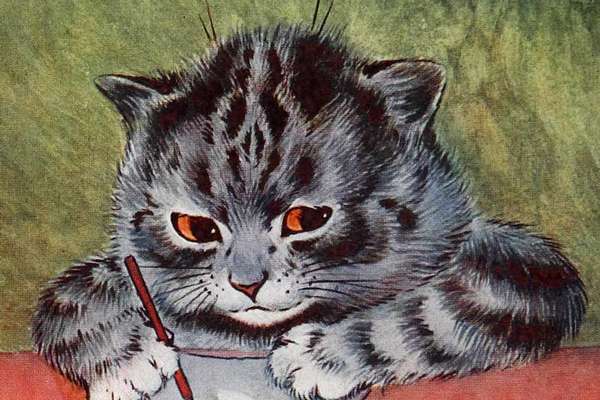
Artist and illustrator Louis Wain (1860–1939) achieved great fame for his whimsical drawings of cats, but his story is also a sad one of personal tragedy.
The next stages of the project
On behalf of The National Archives, I want to thank our brilliant team of volunteers who have worked hard to catalogue this collection.
As well as photographs and artworks, other forms of creative work including books, music and dramatic works were covered by copyright legislation. In the long term we hope that the many thousands of entry forms for these works will also be catalogued, creating a fully accessible collection of copyright records from 1842 and 1912.
In the meantime, our volunteers have started cataloguing entry forms covering paintings and drawings registered for copyright protection between 1900 and 1906. We look forward to sharing this work with you soon.
Explore our research guide
For more information about the history of this collection and guidance on how to use it, please see our research guide.
-
- From our collection
- [unknown]
- Title
- 'Drawing of label "Cornflower Brand" showing cornflowers and lettering beneath enclosed in oval band bearing wording "Guinness's best brew" etc'.
- Date
- 18 January 1900
-
- From our collection
- [unknown]
- Title
- Drawing. Stairs with four children climbing up. Lady assisting one child, orange tree in tub, floral decorations.
- Date
- 7 November 1899
-
- From our collection
- [unknown]
- Title
- 'Drawing of spider "Linyphia triangularis"
- Date
- 19 December 1896
-
- From our collection
- [unknown]
- Title
- Drawing "A (n)ice bath". A group of cats skating. Two of them fallen through broken ice'
- Date
- 25 January 1900
