Important information
This article discusses the segregation, exile, violence and murder of Jewish people that took place in Nazi-occupied territories.
A new collaboration between the European Holocaust Research Infrastructure and The National Archives aims to look into unexplored sources of Holocaust history in archives across the UK. As a researcher of Jewish refugees within the British empire, I began my contribution to this search by assessing our records from the Colonial Office.
An urgent request
Benjamin, Rebeka, Simon, Margot, Josef, Max, Bella, Herman, Ruth, Solomon, Ernst, Henny: pages upon pages of names arrived at the Colonial Office in 1943 and 1944. These were the details of prominent rabbis and their families trapped in Nazi-occupied Europe. They were sent by Britain’s Chief Rabbi, Joseph Hertz, to the British government with a plea: could any visas, to any British territory, be provided?
On 17 December 1942, Foreign Secretary Anthony Eden delivered an official United Nations Declaration to the House of Commons which described the destruction of ghettos (an enclosed and under-resourced district, where Jewish people were forced to live in segregation from the non-Jewish population in Nazi-occupied territories) in Poland and the death of their Jewish inmates through forced labour, exposure, starvation and mass executions. To Rabbi Hertz’s contacts in the Colonial Office, it was clear that visas could offer a lifesaving escape from these terrors.
However, Britain’s overseas territories were already struggling to accommodate displaced groups. From Burma to Barbados, hundreds of thousands of evacuated civilians, political refugees, resistance organisations and prisoners of war strained food, shelter and medical aid resources. As Colonial Office official Walker noted, ‘we really are at our wits end to find accommodation…’
An unlikely result
Despite these concerns, a letter from Chief Rabbi Hertz in June 1943 thanked Oliver Stanley, Secretary of State for the Colonies, for his:
‘decision to grant asylum in Mauritius for the prominent Rabbis now in Nazi occupied territories. Words fail me to express my profound gratitude for the sympathetic and effective manner in which you have dealt with this life-saving scheme’. Catalogue reference: FO 371/36735
Due to these efforts, 100 rabbis were granted visas for the Crown colony of Mauritius.
Organisational hurdles
This was just the beginning of a complex and flawed process. Firstly, all names submitted to the Mauritius scheme had to be checked for the possibility of enemy agent infiltration. Additionally, while various governments working in exile from London could support security checks for refugees, applications from Axis or neutral countries such as Germany took much longer to process.
Once applications were approved and papers issued, communication became a problem: how could visa holders be informed of their status? In most cases, the current location of applicants was uncertain, making direct communication impossible. Recent records were held by the occupying administration, and the risks involved in alerting German authorities to the presence of rabbis in occupied territories was a concern. The British government had to consider if the Nazi government would use the visa lists as a blueprint for arrests.

W /667/48.
[CYPHER] DEPARTMENTAL NO.1.
FROM FOREIGN OFFICE TO ANGORA
No. 106 D.9.35 p.m. 20th January, 1944.
20th January, 1944.
T T T T T
IMMEDIATE.
My telegram No.. 1523 [of the 4th November: removal of Jews from Slovakia to Mauritius].
Chief Rabbi here has received information that 30 Rabbis in Slovakia, all of whom he declares are on life to be granted visas for Mauritius on arrival in Turkey, will shortly be deported to Poland. He suggests that only way to save them is for Turkish Authorities to authorise Turkish Consul at Budapest to give them visas to enter Turkey. If this is done Chief Rabbi issatisfied that Slovakian exit permits will be granted, and departure of Rabbis in question from Turkey for Mauritius could be quickly arranged.
2 Please ask Turkish Authorities to assist.
You will have furnished them with the names. It would be useful to get in touch with Chief Rabbi’s representative in Istanbul (Constantinople), Schleuderer, Post Box 2324, who may have alternative method to suggest.
O.T.P.
Letter to Ministry of Foreign Affairs, Ankara, 26 January 1944. Catalogue reference: FO 371/42777
Additionally, how could Jewish families – impoverished and travel-restricted by 1943 – reach the appropriate embassies, even if they knew papers waited for them? To support these families, the Chief Rabbi’s Religious Emergency Council provided emergency funds. However, sending money into enemy territory was a criminal offence under the 1939 Trading with the Enemy Act which slowed this support. As time ticked on, problems continued to pile up.
International collaboration
The range of records we hold is testament to the number of actors involved in the Mauritius scheme. For months, letters went back and forth between the Colonial Office, the War Office, the Governor’s Office in Mauritius, the Refugee Department of the Foreign Office, and various Passport Control Departments.
Due to these efforts, by autumn 1944, the Colonial Office had authorised a further 1,000 visas and relaxed the requirement to collect papers in person in the hope that ’people in Hungary may actually be able to avail themselves of these emigration facilities.’
But for many, this came too late. The spring and summer of 1944 saw the deportation of around 440,000 Jews from Hungary. The majority were sent to Auschwitz-Birkenau and killed on arrival. By autumn 1944, only the Jews of Budapest remained.
Tracing journeys
The Holocaust would continue to take millions of lives, but we can find successful rescues within the Mauritius scheme. In March 1944, Chief Rabbi Hertz wrote to Anthony Eden to praise the efforts of the British Ambassador in Lisbon, who had secured Portuguese entrance visas for those on the lists for Mauritius. Crucially, this allowed them to reach the British embassy in Lisbon and collect their papers. Months later, the Chief Rabbi’s office ‘confirmed that the possession of emigration facilities…has rescued holders from deportation and all that it implies.’

Telephone:
Office of the Chief Rabbi,
Avenue 5377.
4, Creechurch Place, Aldgate,
London, E.C.3
Telegrams:
Chirabinat, Maida, London.
Cabelgrams:
Chirabinat, London.
6th March 1944
The Right Hon.
Anthony Eden, Esq., M.P.,
Secretary of State for Foreign Affairs,
The Foreign Office,
S.W.1.
Dear Mr Eden,
I am writing to express my thanks for the excellent manner in which H.M. Ambassador in Lisbon has dealt with the cases of refugee Rabbis and religious officials in Nazi occupied territories for whom H.M. Government have granted Mauritius visas on our application.
Mr. Isaac Weissman, the representative in Lisbon for the World Jewish Congress, has reported to us concerning the efforts made by H.M. Ambassador to procure Portuguese entrance visas for all these refugees; and, as you know, he has been successful. In order to obtain this exceptional treatment from the Portuguese authorities, the Ambassador and his staff have gone out of their way to approach the Portuguese authorities.
In view of the disappointing situation of the refugee problem on the whole, we think that this outstanding success is worthy of special note.
I should, therefore, be deeply grateful if you could kindly convey this expression of thanks to H.M. Ambassador in Lisbon.
I should like to mention, especially, the trouble taken by his Attache, Mr. John Hart, who has taken great trouble over all these arrangements.
Sincerely Yours
J.H. Hertz
CHIEF RABBI
Letter from Chief Rabbi Hertz to Anthony Eden, 6 March 1944. Catalogue reference: FO 371/42777
Tracing individual outcomes is difficult, though. Their paper trail is usually incomplete, inaccurate and can lead researchers to archives around the world.
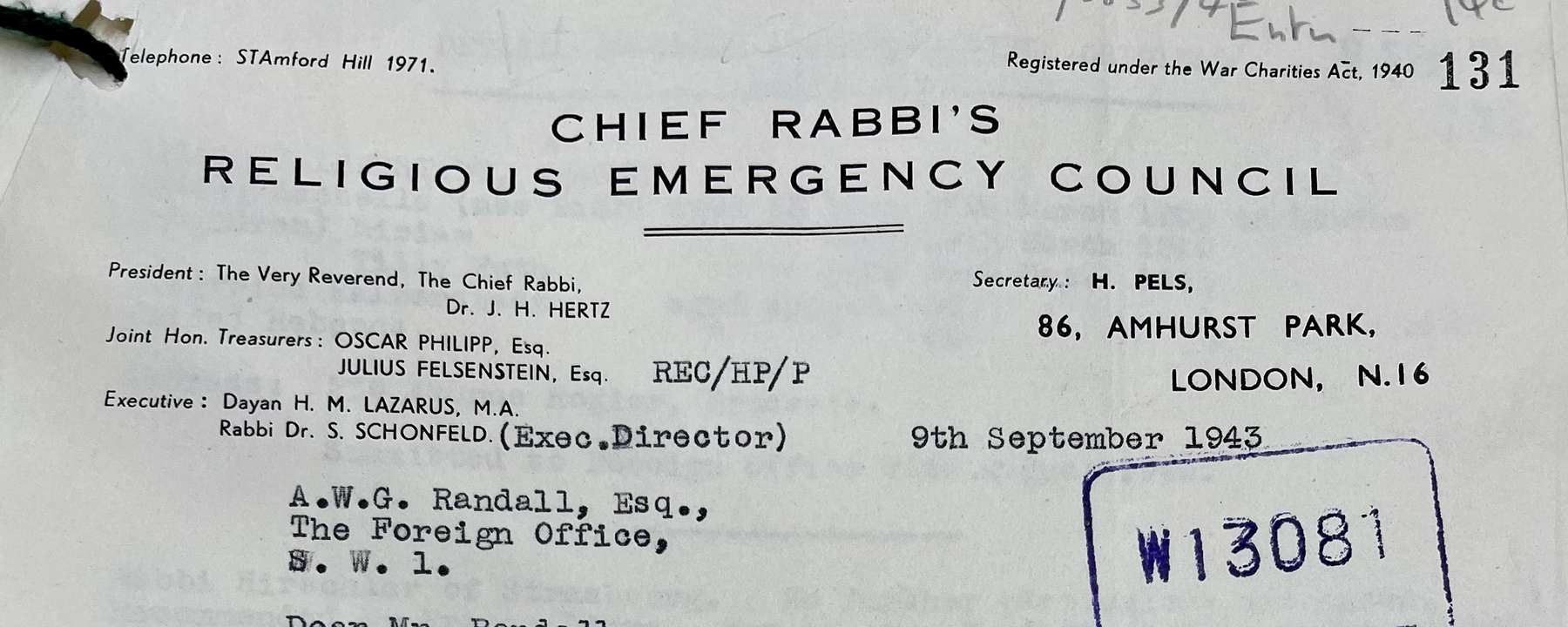
For instance, we hold a visa application for Rabbi Karl Zuntz, ‘the last Rabbi of Frankfurt community’. The application was made on 9 September 1943 yet records in the United States Holocaust Memorial Museum demonstrate that Rabbi Zuntz had been deported from Frankfurt a year earlier to the Theresienstadt ghetto.
Additional deportation lists held at the Arolsen Archives in Germany show that Zuntz’s family were deported alongside him. In 1944, Rabbi Zuntz’s brother, Gustav, died from disease in Theresienstadt and the surviving family members were transported to Auschwitz. Further documents at the Yad Vashem archive in Israel record Rabbi Zuntz’s arrival at Auschwitz on 6 October 1944 and the murder of the entire family there within the year.

Dear Mr. Randall,
The Chief Rabbi has received information from the Colonial Office that, with the consent of the Government of Mauritius, a total of 100 Rabbis and their families, amounting to 340 souls, will be admitted to Mauritius. The list so far submitted amounts to 108 souls, that is 31 families.
We beg to submit herewith the cases of:-
- Rabbi Karl Zuntz, who was the last Rabbi of Frankfurt community and only left that town when the last Jews of Frankfurt were deported to Theresienstadt.
- Dr. Aron Cohen, born 18th October 1905 and his wife Ella nee Pels born 27.11.1892. Last address c/o Mrs. Ella Cohen, c/o Gerson, 4 Leonard Street, Amsterdam.
Both were formerly German nationals and we beg to apply to you kindly to grant these families facilities to proceed to Mauritius. Particulars of the families are on the enclosed list.
I take this opportunity of enquiring whether the additional cases we submitted since the 25th March in the first list have been settled. The names of these are given on the attached list and we should be grateful for a confirmation concerning their Mauritius visas.
With reiterated thanks, I remain,
Yours sincerely,
Solomon Schonfeld
Exec. Director.
Application for Rabbi Karl Zuntz, 9 September 1943. Catalogue reference: FO 371/36735
Uniting collections
None of the records held on the Zuntz family in Germany, USA or Israel note their inclusion in the Mauritius visa scheme. Indeed, it is unlikely that Rabbi Zuntz himself knew that offices across London were working to rescue him as he boarded the train from Theresienstadt to Auschwitz. Our documents on the Mauritius visa scheme show how much we still have to learn about the millions of journeys which ended there. Furthermore, the Zuntz family story underlines how much refugee history relies on bringing collections from many archives together.
The National Archives’ partnership with the European Holocaust Research Infrastructure is an important step towards integrating Holocaust-related collections in the UK. This Holocaust Memorial Day, we can remember the lives lost while continuing to look for the names, stories and fates we can recover to be in the UK’s archives.
Anna Brady's research at The National Archives was supported by the European Holocaust Research Infrastructure.