Record revealed
Love letter from John Laurens to his wife, Martha Manning
This short love letter sent from John Laurens, one of George Washington’s most trusted soldiers, expresses his longing to reunite with his wife during the American Revolutionary War.

Images
Image 1 of 3

This letter is addressed to John Laurens' wife, Martha, at her London address.
Transcript
Mrs M. Laurens, St Mary Axe, London
Image 2 of 3

This love letter was sent by John Laurens to his wife, in 1777, the middle of the American Revolutionary War.
Transcript
Pennsylvania 9th Novem 1777
The time allowed me for writing to several Friends in different parts of the world obliged me to be laconic in each letter – yours claims of night the greatest number of moments- but will necessarily be very short compared with what I wish to send you at this period. If you have received two letters written in the last month and one in this, you will see in all of them a Repetition of what I said to you in England and soon after my return to Carolina upon the subject of your voyage to America. In two late letters to your Father I likewise dwelt upon this cause of our anxiety, perhaps by the time this reaches you some prospect may open which was undiscover’d at the time of our parting. My only hopes then were founded in your having an opportunity of accompanying some respectable Carolina Family to your own Country. I fear by the delay of those whom I had principally in view that some unexpected obstacles to their return have presented themselves. However great our unhappiness be, in consequence of our separation, I can never consent my dearest love that you should expose yourself to all the dangers which now attend a sea voyage in a common vessel and without the guardianship of a particular Friend. Reflect for a moment into how much misery we might both be plunged by your captivity, and say dear Girl whether it will not be better to endure the pain of absence patiently till some eligible opportunity offer. I shall not be able to write to our
Image 3 of 3

John's sign-off to his wife Martha, where he declares that he is 'unalterably yours'.
Transcript
good Friend your Father will be so kind as to make amends for it by expressions of Respect and Friendship from me to him. Assure your dear mother and Sisters of my Love. This will give you satisfaction by informing you that I am as well and as happy as I can be at too great a distance from you Madam and that with ardent wishes for our reunion I am unalterably yours,
JLaurens
Why this record matters
- Date
- 9 November 1777
- Catalogue reference
- HCA 32/392/7
In September 1777, the British army marched into Philadelphia and claimed it as their own. The city was a highly strategic and symbolic place as it was the seat of the Second Continental Congress, which functioned as the American government during the Revolutionary War. George Washington, leader of the Continental Army, knew this and needed to win the city back.
Later in 1777, Washington and his military staff, including John Laurens, were busy planning the critical recapture of Philadelphia. During this important and chaotic time for the revolution, John took a few moments to write a letter to his wife in London, who he hoped to be reunited with soon.
John met Martha while studying law in London. During his stay in the British capital, he frequently visited the house of William Manning, a business partner of John’s father Henry. Both William Manning and Henry Laurens’ wealth came from enslaved people’s labour on plantations in the West Indies and South Carolina.
Manning had five daughters and, in the spring of 1776, John started a secret love affair with the youngest, Martha. She soon became pregnant, and the couple married quickly without parental approval.
John had no intention of settling in London with Martha. Instead, he wanted to go back to America to join the revolution. In December 1776, he left London without Martha, who gave birth to their daughter just a few weeks later.
John was known for his strong sense of patriotism and recklessness in battle. This letter, written almost a year after leaving Martha behind, shows a different side of him, one of care for his wife and of a desire for them to be together. It reveals how he frequently wrote to his wife while at war, and that he attempted several times to find safe passage for her to come to America, but without success. Assuring her of his love, he suggests that it might be best to remain in London for the time being:
‘However great our unhappiness be, in consequence of our separation, I can never consent my dearest love that you should expose yourself to all the dangers which now attend a sea voyage in a common vessel and without the guardianship of a particular Friend.’
John had good reason to be concerned. The crossing of the Atlantic was hazardous at the best of times, but during wartime, it was even more dangerous, as ships risked being captured by enemy forces. The letter testifies to John’s awareness of the dangers at sea, which made him fear for his wife’s safety if she were to travel. He makes it clear that he considers the crossing too risky and that it would be best to ‘endure the pain of absence patiently’ than the misery of her captivity.
Sadly, Martha never received her husband’s affectionate letter, because the ship that carried it, The Lowndes, was captured by HMS Martin on 4 June 1778. It was then brought into Plymouth to be claimed as a prize.
To ensure that a capture was legal, the captors had to bring their prizes in front of a court. In Britain, this was the High Court of Admiralty. The court process involved confiscating all documents found on board to use as evidence. This is how John Laurens’ letter came to The National Archives. It sits within our High Court of Admiralty records and was recently rediscovered as part of the Prize Papers project.
The letter closes with John Laurens’ 'ardent wishes’ for their reunion, which would never happen. Washington’s young lieutenant colonel died on 27 August 1782 at the Battle of Combahee River as one of the last casualties of the American Revolutionary War. He never saw his wife again or had the chance to meet his daughter.
Featured articles
The story of
Ann Nevil: 'The most Notorious Malafactor Imaginable'
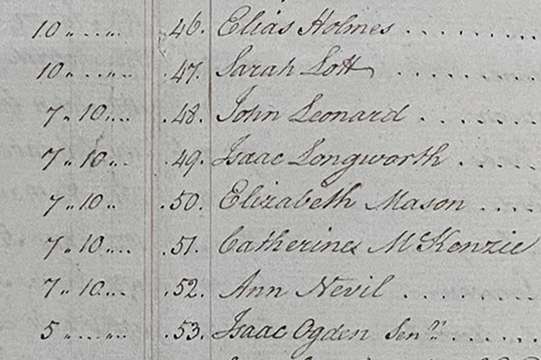
Ann Nevil's story is one of many extraordinary people whose lives were changed forever during the American Revolution.