





oldbaileyonline.org
The Proceedings of the Old Bailey, 1674-1913
A resource you and your students can use to access details of criminal trials.
Teaching resource
Use original sources in this lesson to find about the Victorian attitude to crime and punishment. How were prisoners treated in Victorian prisons?

Inmates pulling carts around the courtyard of Wormwood Scrubs, 1895. Catalogue reference: COPY 1/420
Why were Victorian Prisons so tough?
Coldbath Fields Prison was named after a well nearby. It was an old prison, re-built in 1794, holding men, women and children. In 1850 it was changed to take men only and extended again. It was known as a tough prison, used for local London criminals on short sentences.

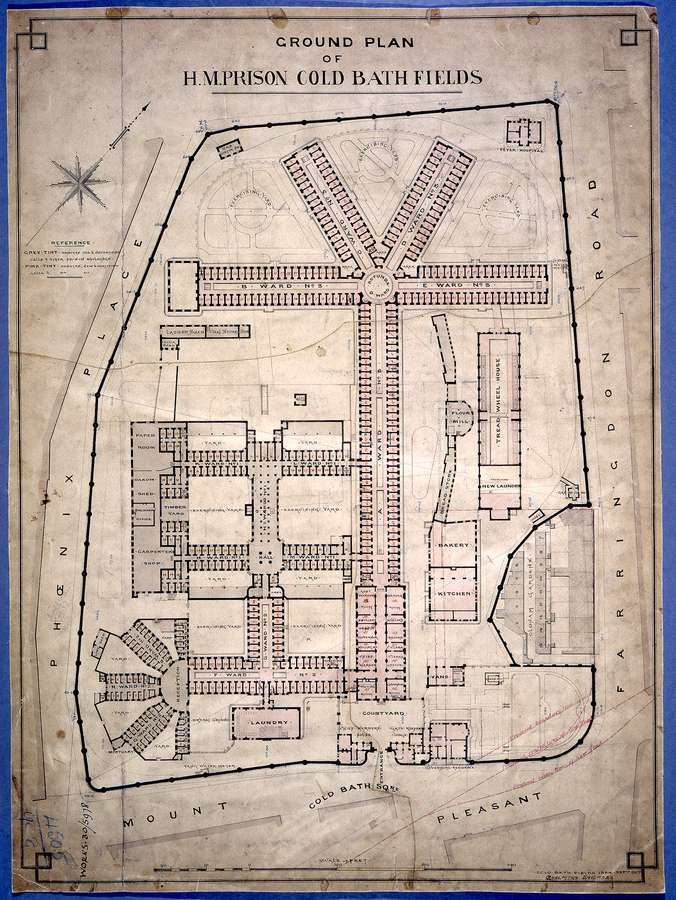
Map description: A plan of a prison titled ‘GROUND PLAN OF H.M. PRISON COLDBATH FIELDS’.
A pink-tinted section of the building stretches in a straight line from the bottom to the top of the plan, labelled ‘A Ward No 1’. It ends in a circle labelled ‘Rotuna D Ward’. Four spokes come off this circle labelled ‘B Ward No. 3’, ‘C Ward No. 3’, and ‘E Ward No. 3’. In between these spokes are exercising yards.
A pink-tinted building comes down off the spoke to the right, labelled E Ward No. 3. This building is labelled ‘Treadwheel House’ and a ‘New Laundry’ is attached to it.
At the bottom of the plan, the main pink-tinted building ends in a courtyard and then an entrance. A pink-tinted section labelled ‘F Ward No. 2’ is attached to it on the left, alongside a ‘Laundry’.
A grey-tinted building is attached above the F Ward, labelled ‘N Ward No. 1’. Four hallways with cells come off this building labelled ‘H Ward No. 1’, ‘K Ward No. 1’, ‘L Ward No. 1’, and ‘M Ward No. 1’. Exercising yards are in between these.
On the left of these wards is a grey-tinted building with several rooms. These are labelled ‘Timber Yard’, ‘Paper Room’, ‘Oakum Shed’, and ‘Carpenter’s Shop’.
A grey-tinted half-moon shaped room comes off the left of the pink-tinted F Ward, labelled ‘Reception’. Five spokes come off this room, labelled ‘P Ward No. 2’, ‘Q Ward No. 2’, ‘R Ward No. 2’, ‘S Ward No. 2’, and ‘T Ward No. 2’. Yards are in between these.
To the right of the A Ward, but not connected to it, are two pink-tinted rooms labelled ‘Bakery’ and ‘Kitchen’. Above these is a long narrow grey-tinted section labelled ‘Bread Store’ and ‘Flour Mill’.
Ground plan of HM Prison Coldbath Fields. Catalogue reference: WORK 30/5978
The work on the treadwheel was to hold on to a bar and walk up the wheel. You did ten minutes on and five off, for eight hours, climbing the equivalent of over 8,000 feet in the process.
The prisoner in source 2b is doing hard labour in his cell. He would have to turn the crank in his cell a set number of times to earn his food. Unlike the treadmill, which was used to power machinery in the prison, the crank simply turned paddles in a box of sand.
You were not allowed to talk during these jobs. This was strictly enforced; the punishment book at Coldbath Fields records 11,624 offences against this rule in one year.

Prisoners on a treadwheel at Pentonville Prison, 1895. Catalogue reference: COPY 1/420

Photograph of prisoner at hard labour in his cell at Wormwood Scrubs Prison, 1895. Catalogue reference: COPY 1/420 f171
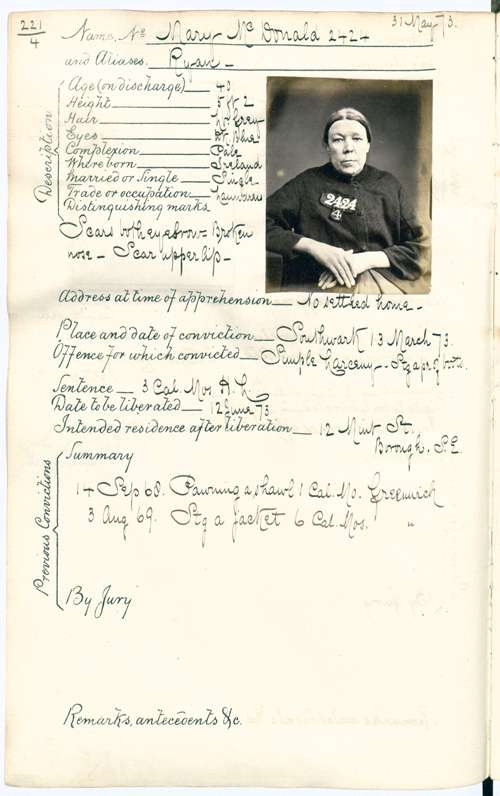
This is the prison record for Mary McDonald, who was convicted of theft in 1873.

Name No – Mary McDonald 2424
and Aliases – Ryan
Description
Age (on discharge) – 40
Height – 5ft 2
Hair – L Grey
Eyes – D Blue
Complexion – Pale
Where born – Ireland
Married or Single – Single
Trade or occupation – Laundress
Distinguishing marks: Scars both eyebrows Broken nose – Scar upper lip
Address at time of apprehension – No settled home
Place and date of conviction – Southwark 13 March 73
Offence for which convicted: Simple Larceny – St[ealin]g a p[ai]r of boots
Sentence – 3 Cal{endar] Mo[nth]s H[ard] L[abour]
Date to be liberated – 12 June 73
Intended residence after liberation – 12 Mint St Borough S.E.
Previous Convictions
Summary
14 Sep 68 Pawning a shawl 1 Cal[endar] Mo[nth] Greenwich
3 Aug 69 St[ealin]g a jacket 6 Cal[endar] Mo[nth]s ” By Jury
Remarks, antecedents &c
Mary McDonald, prisoner number 2424, 1873. Catalogue reference: PCOM 2/291
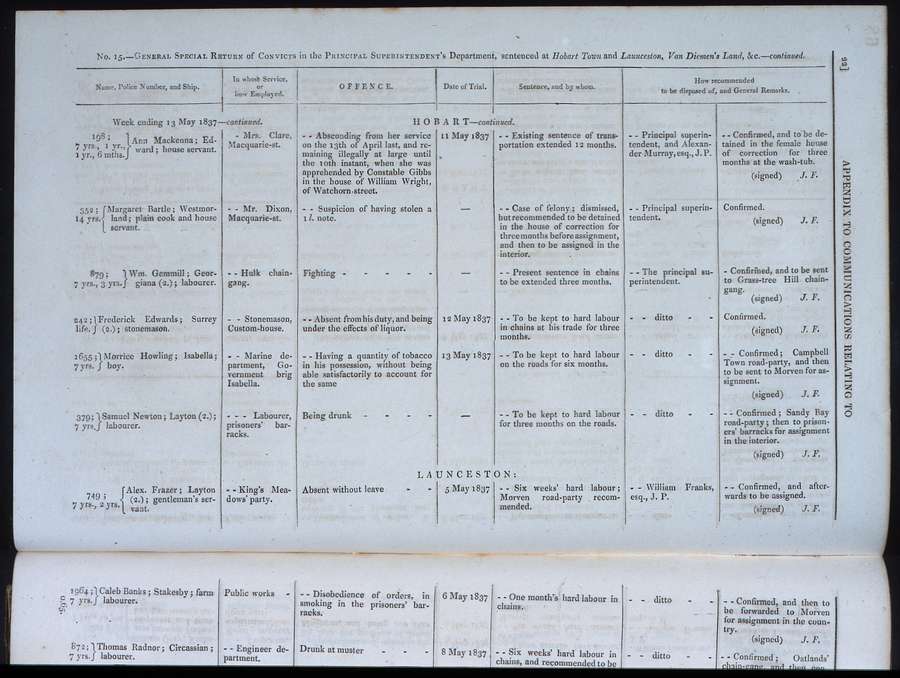
This is an extract from the discipline records for convicts transported to Hobart in Van Diemen's Land (now Tasmania). Transportation meant that convicted criminals were sent away, often to a colony, for a set term. Few returned having served their sentences as they could not afford the cost of a passage home.

Colonial Office: Tasmania Convict Discipline, 1873. Catalogue reference: CO 280/83
The first source used in this lesson is the 1884 ground plan of Coldbath Fields prison. The original prison was built to hold men, women and children although from 1850 it only took men and was extended. Students can use the plan to explore how the prison was organised and the purpose behind it. They go onto examine two photographs which provide insight into the ‘silent system’ of punishment and consider the ideas behind it. The next source is a Prison Commission source providing details of a female convict and her sentence. Students are asked to consider the severity of her punishment, the probable reasons behind her crime and how such cases would be regarded today. The final source provides a window into treatment of those who were transported in the 19th century.
All documents are provided with transcripts. Students can work through the questions individually or in pairs and report back to the class. It is worth considering with students what other sources could help us understand how the criminal justice system worked and the thinking behind the Victorian prison system.
Edexcel GCSE History: Crime and punishment in Britain, c1000 to present
OCR GCSE Schools History Project: Crime and Punishment c1250 to present
Law and order was a major issue in Victorian Britain. Victorians were worried about the new cities that had grown up following the Industrial Revolution – how were the masses to be kept under control? The government worried about the growing crime rate- the number of offences went up from about 5,000 per year in 1800 to about 20,000 per year by 1840. They were firm believers in punishment for criminals but faced a problem: what should the punishment be?
There were prisons, but they were mostly small, old and badly-run. Common punishments included transportation – sending the offender to America, Australia or Van Diemen’s Land (Tasmania) – or execution: hundreds of offences carried the death penalty.
British prisons were often in old buildings and tended to be damp, unhealthy, insanitary and over-crowded. All kinds of prisoners were mixed in together, as at Coldbath Fields: men, women, children; the mentally ill; serious criminals and petty criminals; people awaiting trial; and debtors. Each prison was run by the gaoler in his own way. He made up the rules. If you could pay, you could buy extra privileges, such as private rooms, better food, more visitors, keeping pets, letters going in and out, and books to read. If you could not, the basic fare was grim. You even had to pay the gaoler to be let out when your sentence was finished.
Transportation of convicts to Australia was not the answer and Australia did not want to be a dumping-ground for Britain’s criminals. From the 1830s, the British government began to reconsider how to deal with those who broke the law. The answer was to reform the police and to build more prisons.
Between 1842 and 1877, 90 prisons were built or added to. It was a massive building programme, costing millions of pounds. You can see the big extension to Coldbath Fields prison in Source 1. Many Victorian prisons are still in use today.
The Victorians had clear ideas about what these prisons should be like. They should be unpleasant places, to deter people from committing crimes. Once inside, prisoners had to be made to face up to their own faults, by keeping them in silence and making them do hard, boring work. Walking a treadwheel or picking oakum (separating strands of rope) were the most common forms of hard labour.
Christian prison reformers however, felt that prisoners were God’s creatures and deserved to be treated decently. Rational reformers believed that the purpose of prison was to punish and reform, not to kill prisoners with disease or teach them how to be better criminals.
There was more to Victorian plans than just bigger and better buildings. In the 1840s a system of rules called ‘The Separate System’ was tried. This was based on the belief that convicted criminals had to face up to themselves. Accordingly, they were kept on their own in their cells most of the time. When they were let out, to go to chapel or for exercise, they sat in special seats or wore special masks so that they couldn’t even see, let alone talk to, another prisoner. Not surprisingly, many went mad under this system.
By the 1860s opinion had changed. Many criminals were considered habitual criminals, and that nothing would change them. They just had to be scared enough by prison never to offend again. The purpose of the silent system was to break convicts’ wills by being kept in total silence and by long, pointless hard labour. The Silent System is associated with the Prisons Act 1865 and the Assistant Director of Prisons, Sir Edmund du Cane, who promised the public that prisoners would get ‘Hard Labour, Hard Fare and Hard Board’. You can see hard labour in Sources 2a and 2b of this lesson. Hard fare meant a deliberately monotonous diet, with the same food on the same day each week. Hard board meant wooden board beds instead of the hammocks that prisoners had slept on before. In 1902 the treadwheel was banned.
oldbaileyonline.org
A resource you and your students can use to access details of criminal trials.
digitalpanopticon.org
Find out more about tracing London convicts in Britain and Australia, 1780-1925.