








The story of
The Treason Trial in South Africa, 1956–1961
In June 1955, a multi-racial group came together to write the Freedom Charter, demanding racial equality and democracy in South Africa. They were put on trial.
Teaching resource
Use this lesson to examine original documents and consider some of the main legislative steps taken to create a system of apartheid in South Africa. What were the impacts and consequences of apartheid for Black, White and ‘Coloured’ South Africans?

Photograph titled 'Love Story', of a couple in Johannesburg, South Africa, 1954.
Bob Gosani – Drum Social Histories / BAHA / Africa Media Online / african.pictures
Please note that sources in this resource often contain racist and offensive language. It is presented here to accurately represent our records and to help us understand the past.
How far was a system of apartheid implemented in South Africa in the period 1949–1959?
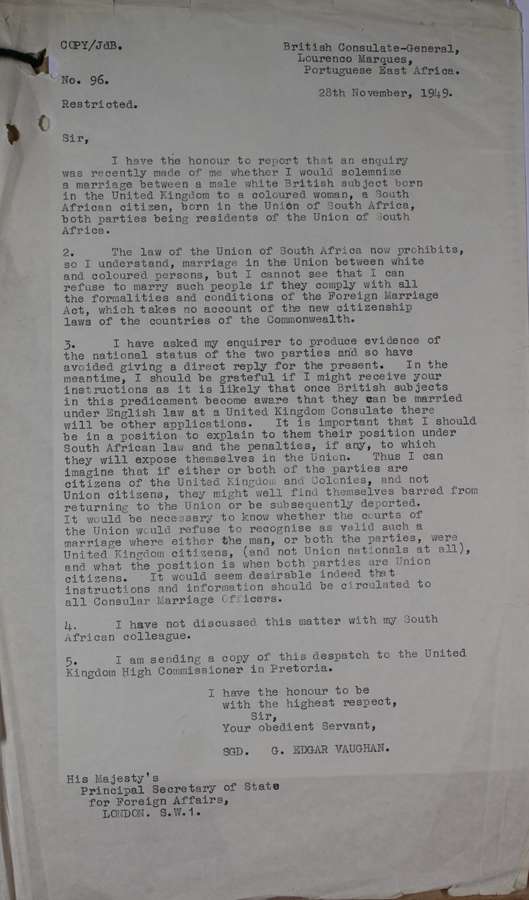
Source 1a relates to the Mixed Marriages Act 1949 that forbade marriages between people of different racial groups. The Foreign Marriages Act 1892 mentioned in this letter allowed British officials abroad to perform marriages.

No. 96.
Restricted
British Consulate-General,
Lourenco Marques,
Portuguese East Africa,
28th November 1949.
Sir,
I have the honour to report that an enquiry was recently made of me whether I would solemnize a marriage between a male white British subject born in the United Kingdom to a coloured woman, a South African citizen, born in the Union of South Africa, both parties being residents of the Union of South Africa.
I have the honour to be with the highest respect,
Sir,
Your obedient Servant,
SGD. G. EDGAR VAUGHAN
His Majesty’s Principal Secretary of State for Foreign Affairs
LONDON SW1
Letter from Lourenco Marques, British Consulate General, Portuguese East Africa (Mozambique) to the Foreign Office, 28 November 1949. Catalogue reference: DO 35/2229

2. The feature of the Nationalist Government’s policy, which has caused the greatest shock in their relations with the rest of the world is their programme of Apartheid- a stiffer form of the traditional South African policy of racial segregation. Their ultimate objective is the establishment in the Union of a Republican, white and predominantly Afrikaner, form of Government which would ensure the domination of the white race and postpone as long as possible, if not forever, the rise to power of the native population. While the Republican aspect of their policy has recently been in abeyance [receded], the Nationalists are pressing on with their racial programme. They have by legislation prohibited marriages between Europeans and non-Europeans, and they have now passed the Group Areas Act, 1950 described by Dr Malan as the ’kernel of apartheid’. Which extends earlier legislation so as to provide for the segregation of different racial groups of the population into defined areas for both residential and commercial purposes. In all this they have gone much further than their predecessors, the precious United Party Government, but much of the strength of the Nationalists is derived from the general support for some form of racial segregation apparent among most sections of all the white population including those of British descent.
Extract from a Cabinet memorandum by Patrick Gordon Walker, Secretary of State for Commonwealth Relations, 25 September 1950. Catalogue reference: CAB 129/42
The Population Registration Act 1950 defined people exclusively in terms of appearance and perception. People had to be identified and registered from birth as belonging to one of three racial groups: white, ‘native’ (Black African), or ‘coloured’ (neither white nor ‘native’). Identity documents were issued to each person and the Identity Number included their assigned race.
Field Marshal Jan Christiaan Smuts successfully led troops against Britain in the South African War. Smuts went on to command the South African Defence Force fighting alongside British soldiers in various First World War campaigns. From 1939 to1948 Smuts was also the leader of the United Party, and Prime Minister in South Africa.

POPULATION REGISTRATION
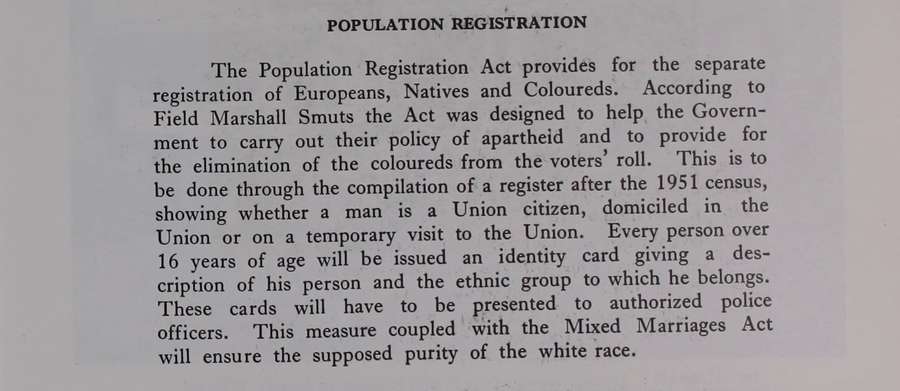
The Population Registration Act provides for the separate registration of Europeans, Natives and Coloureds. According to Field Marshall Smuts the Act was designed to help the Government to carry out their policy of apartheid and to provide for the elimination of the coloured from the voters’ roll. This is to be done through the compilation of a register after the 1951 census, showing whether a man is a Union citizen, domiciled in the Union or on a temporary visit to the Union. Every person over 16 years of age will be issued with an identity card giving a description of his person and the ethnic group to which he belongs. These cards will have to be presented to authorized police officers. This measure coupled with the Mixed Marriage Act will ensure the supposed purity of the white race.
Extract from booklet titled ‘Apartheid: Racial Discrimination’, published on behalf of the Indian Government in around 1951. Catalogue reference: DO 35/3837
Foreign Relations Society of India

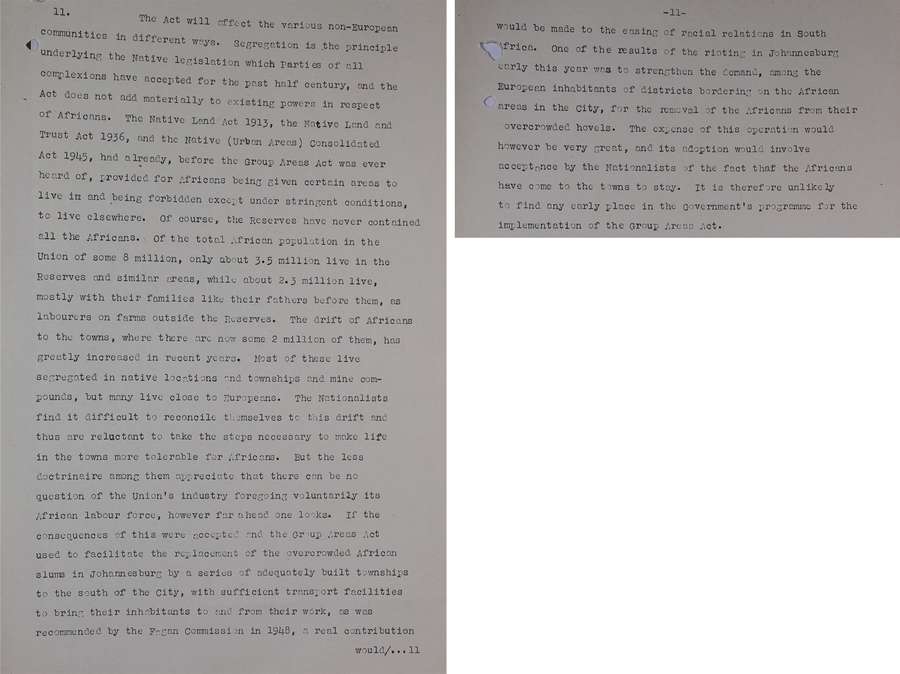
11. The Act will affect the various non-European communities in different ways. Segregation is the principle underlying the Native legalisation which Parties of all complexions have accepted for the past half century, and the Act does not add materially to existing powers in respect of Africans. The Native land Act of 1913, the Native Land and Trust Act 1936, and the Native (Urban Areas) Consolidated Act 1945, had already, before the Group Areas Act was ever heard of, provided for Africans being given certain areas to live in and being forbidden except under stringent conditions, to live elsewhere. Of course, the Reserves never contained all the Africans. Of the total African population in the Union of some 8 million, only about 3.5 million live in the Reserves and similar areas, while about 2.3 million live, mostly with their families like their fathers before them, as labourers on farms outside the Reserves. The drift of Africans to the towns, where there are now some 2 million of them, has greatly increase in recent years. Most of these live segregated in native locations and townships and mine compounds, but many live close to Europeans. The Nationalists find it difficult to reconcile themselves to this drift and thus are reluctant to take the steps necessary to make life in the towns more tolerable for Africans. But the less doctrinaire among them appreciates that there can be no question of the Union’s industry foregoing voluntarily its African labour force, however far ahead one looks. If the consequences of this are accepted and the Group Areas Act used to facilitate the replacement of the overcrowded African slums in Johannesburg by a series of adequately built townships to the south of the City, with sufficient transport facilities to bring their inhabitants to and from their work, as was recommended by the Fagan Commission in 1948, a real contribution
[new page]
would be made to the easing of racial relations in South Africa. One of the results of the rioting in Johannesburg early this year was to strengthen the demand, among the European inhabitants bordering on the African areas in the City, for the removal of the Africans from their overcrowded hovels. The expense of this operation would however be very great, and its adoption would involve acceptance by the Nationalist of the fact that the Africans have come to the towns to stay. It is therefore unlikely to find any early place in the Government’s programme for the implementation of the Group Area Act.
Extract from a report by the High Commissioner to the Commonwealth Relations Office, 13 December 1950. Catalogue reference: DO 35/3260

The Group Areas Act
9. I went through most of the Indian and Native areas in Durban discussed with the Mayor of Durban, the Provincial Secretary and others, the application of the Group Area Act to these areas. Up to date the Act has been brought into force in Durban to the extent of prohibiting except under licence, the transfer of the ownership or occupation of any land or premises to person of a different race from that of the previous owner or occupier. I attach a sketch map indicating the non-European areas.
Extract from the High Commissioner’s report on Durban with map and a caption, June 1951. Catalogue reference: DO 35/3260

…
Native Urban Areas (Opdom 20 of 1951 paragraph 22)
Group Area Act in Durban (1951 Opdom 25 paragraph 8(a))
Extract from an internal memo from the Union to the High Commissioner, 19 May 1952, concerning removing people from Johannesburg and Cape Town. Catalogue reference: DO 35/3260
The Separate Amenities Act 1953 enforced segregation for all public amenities, including buildings and transport. Segregation meant that White people (or Europeans) were given separate facilities from everyone else, described as ‘Coloureds, Indians, and Blacks’. The act stated that facilities provided for different races need not be equal.

ACT
To provide for the reservation of public premises and vehicles or portions thereof for the exclusion of persons of a particular race or class, for the interpretation of laws which provide for such reservation, and for matters incidental thereto.
(English text signed by the Governor-General.)
(Assented by 5th October,1953.)
BE IT ENACTED by the Queen’s Most Excellent Majesty, the Senate and the House of Assembly of the union of South Africa, as follows: –
Definitions
“public premises” includes any land, enclosure, building, structure, hall room, office or convenience to which the public has access, whether on the payment of an admission fee or not but does not include a public road or street;
“public vehicle” includes any train, tram, bus, vessel or aircraft used for the conveyance for reward or otherwise of members of the public.
Extract from the Separate Amenities Act, 5 October 1953. Catalogue reference: DO 35/10560
Parliament of South Africa

RACIAL BEACH ZONING IN DURBAN
6. After months of discussion the Durban City Council has approved the Beach Committee’s recommendations for the racial zoning of the main beach front. The Council has resisted considerable pressure for the reservation of the whole length of the main beach for the exclusive use of Europeans. The Natives get 700 feet, the Coloured 600 feet, and the Indians 2,700 feet. These areas are to the north of the European beach which stretches along the built-up area in which all the hotels are situated.
Extract from High Commissioner’s report concerning racial beach zoning in Durban, South Africa, October 1955. Catalogue reference: DO 35/6716

Non-European & Tradesmen’s entrance
Through Garage
No Hawkers Allowed
This lift is for Europeans only
Service lift is provided for tradesmen, Non-Europeans, Prams & Dogs
No Hawkers Allowed [a hawker is a person who travels about selling goods]
Photographs showing official notices used in entrances for public buildings in South Africa. These were published in a booklet titled ‘Apartheid: Racial Discrimination’, published on behalf of the Indian Government in around 1951. Catalogue reference: DO 35/3837
Foreign Relations Society of India
Source 5a describes the terms of the law and comments on its legality. The government later used the Suppression of Communism Act in December 1956 to arrest 156 individuals and charged them with high treason, beginning a five-year legal struggle.
Source 5b refers to the African National Congress (ANC), a political party in South Africa. At the time of this newspaper the ANC was a liberation movement founded to support rights for Black South Africans before the First World War. By 1948 it worked to oppose apartheid in South Africa through a defiance campaign against unjust laws, and other civil disobedience actions.

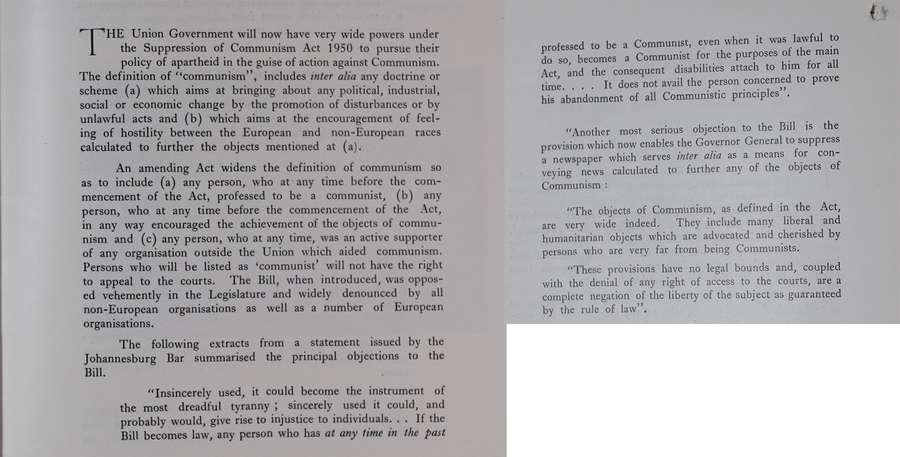
The Union Government will now have very wide powers under the Suppression of Communism Act 1950 to pursue their policy of Apartheid in the guise of action against Communism. The definition of “communism” includes inter alia [among other things] any doctrine or scheme (a) which aims at bringing about any political, industrial, social or economic change by the promotion of disturbances or by unlawful acts and (b) which aims at the encouragement of feeling of hostility between European and non-European races calculated to further the objects mentioned at (a).
An amending Act widens the definition of Communism so as to include (a) any person, who at an time before the commencement of the Act, professed to be a communist, (b) any person, who at any time before the commencement of the Act, in any way encouraged the achievement of the objectives of communism and (c) any, person, who at any time, was an active supporter of any organisation outside the Union which aided communism. Persons who will be listed as “communist” will not have the right to appeal to the courts. The Bill, when introduced, was opposed vehemently [strongly] in the Legislature and widely denounced by all non-European organisations as well as a number of European organisations.
The following extracts from a statement issued by the Johannesburg Bar summarised the principal objections to the Bill.
“Insincerely used, it could become the instrument of the most dreadful tyranny; sincerely used it could, and probably would give rise to injustice to individuals. If the Bill becomes law, any person who has at any time in the past
professed to be a Communist, even when it was lawful to do so, becomes a Communist for the purposes of the main Act, and the consequent disabilities attach to him for all time. It does not avail the person concerned to prove his abandonment of all Communistic principles.”
“Another most serious objection to the Bill is the provision which now enables the Governor General to supress a newspaper which serves inter alia as a means for conveying news calculated to further any of the objects of Communism”.
“The objects of Communism as defined in the Act are very wide indeed. They include many liberal and humanitarian objects which are advocated and cherished by persons who are very far from being Communists.”
“These provisions have no legal bounds and, coupled with the denial of any right of access to the courts, are a complete negation of the liberty of the subject as guaranteed by the rule of law”.
…
Extracts from booklet titled 'Apartheid: Racial Discrimination', published on behalf of the Indian Government in around 1951. Catalogue reference: DO 35/3837
Foreign Relations Society of India

Africans & Indians to Unite
By the FOREIGN EDITOR
Africans have decided to join the Indian community in South Africa in a planned campaign of non-co-operation in 1952.
This decision was taken at the meeting of the African National Congress which had just been held in Bloemfontein. It is historic because it brings Indians and Africans into a united planned campaign of resistance for the first time.
They are resisting the Malan Government’s racial laws against both peoples.
The Congress describes the action, to take place in 1952, as intended “for the redress of the just and legitimate grievances of the majority of the South African people”.
PASS LAWS
The laws against which the two communities will act are:
The Pass Laws, the Group Areas Act, the Separate Representation of Voters Act, the Suppression of Communism Act, the Bantu Authorities Act and certain other regulations.
This legislation is the basis of racial discrimination and persecution in South Africa.
If the Government does not repeal these measures by February 29, 1952, says the Congress, the people will have no alternative to launch the mass campaign.
Article from the Daily Worker titled ‘Africans & Indians to Unite’, 23 December 1951. Catalogue reference: DO 35/3837
People's History Museum
According to apartheid ideology, Black people were only allowed to be in the cities and towns if they carried pass books. This was part of the ‘Grand Apartheid’ scheme of ‘Influx Control’. Black workers were required to always carry their ‘dompas’ and were subject to spot checks.
The Women’s March of 1956 was a protest against the introduction of pass laws by the apartheid government. Around 20 000 women, organised by the Federation of South African Women (FEDSAW), marched to the Union Buildings in Pretoria, Transvaal, South Africa.

Photograph of a South African Police officer checking a man's 'dompas', a pass book used to control the movement of the majority of South Africans within urban areas. Date unknown.
ANC Archives / african.pictures

[...]
159. An example will illustrate the system–
Johannesburg is an urban area “closed” to natives save those who fulfil special requirements. If a native in the Transvaal wishes to go to Johannesburg, he has to produce his tax receipt and identification pass to the
District pass officer and obtain a travelling pass. On arrival in Johannesburg, he has to report within 24 hours for a permit to seek work for six days. This may be renewed. If he finds work his contract of service must be registered monthly at a cost (to the employer) of 2s. If he wishes to travel, he must have his employer’s permission or a travel pass. An exemption certification relieves the holder of all these obligations.
[…]
149. According to those who wish to retain the pass system, their object is three-fold:-
(1) they prevent the collection of vagrant labour in urban areas.
(2) they assist in the “proper” supply of labour to agriculture and mining; and
(3) they protect the standard of living of urban natives from the competition of temporary migrant labour.
The opponents of the system believe that on ethical and moral grounds the movement of the native should not be restricted, he should be able to sell his labour where he wishes. They maintain too that the harassing and constant interference with the freedom of the native is mainly responsible for the growing sense of grievance and injustice felt against the European.
Extract from a memorandum entitled ‘The development of Union Native Policy since 1935’, 1950. Catalogue reference: DO 35/ 4326

Photograph showing the Women’s March of 1956.
Eli Weinberg – ANC Archives / african.pictures

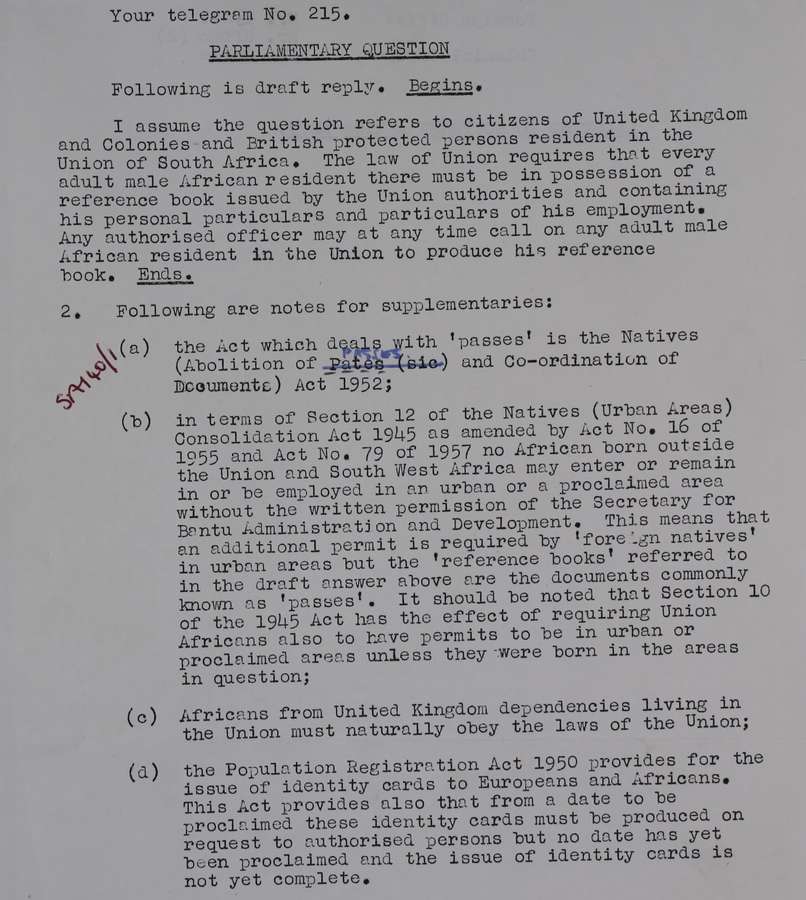
Your telegram No. 215.
PARLIAMENTARY QUESTION
Following is a draft reply. Begins.
I assume the question refers to citizens of United Kingdom and the Colonies and British protected persons resident in the Union of South Africa. The law of Union requires that every adult male African resident there must be in possession of a reference book issued by the Union authorities and containing his personal particulars and particulars of his employment. Any authorised officer may at any time call on any adult male African resident in the Union to produce his reference book. Ends.
(a) The Act which deals with ‘passes’ is the Natives (Abolition of Passes) and the Co-ordination of Documents) Act 1952
(b) In terms of Section 12 of the Natives (Urban Areas) Consolidation Act 1945 as amended by Act No.16 of 1955 and Act No.79 of 1957, no African born outside the Union and South West Africa may enter or remain in or be employed in an urban or a proclaimed area without the written permission of the Secretary for Bantu Administration and Development. This means that an additional permit is required by ‘foreign natives’ in urban areas but the ‘reference books’ referred to in the draft answer above are the documents commonly known as ‘passes’. It should be noted that Section 10 of the 1945 Act has the effect of requiring Union Africans also to have permits to be in the urban or proclaimed areas unless they were born in the areas in question;
(c) Africans from United Kingdom dependencies living in the Union must naturally obey the laws of the Union.
(d) The population Registration Act 1950 provides for the issue of identity cards to Europeans and Africans. This Act provides also that from a date to be proclaimed these identity cards must be produced on request to authorised persons but no date has yet been proclaimed and the issue of identity cards is not yet complete.
[...]
Question asked in the House of Commons about ‘citizens of United Kingdom and Colonies and British protected persons living in the Union of South Africa’, 26 March 1960. It points out that the pass laws apply to adult male African residents, and provides some ‘supplementaries’, or extra notes, on the pass laws. Catalogue reference: DO 35/10578
Using Source 6a, consider:
In 1949 Hendrick Verwoerd, Minister for Native Affairs and the Eiselen Commission, investigated African education. This formed the basis of the later Bantu Education Act that enforced apartheid and created a limited vocational curriculum for African pupils. It meant complete separation of educational facilities for White, Black, ‘Coloured’ (mixed-race), and Indian populations, creating a huge divergence of opportunity. African education was now controlled by the Minister for Native Affairs, not the Ministry of Education. Mission schools were no longer state-funded and large numbers were forced to close.
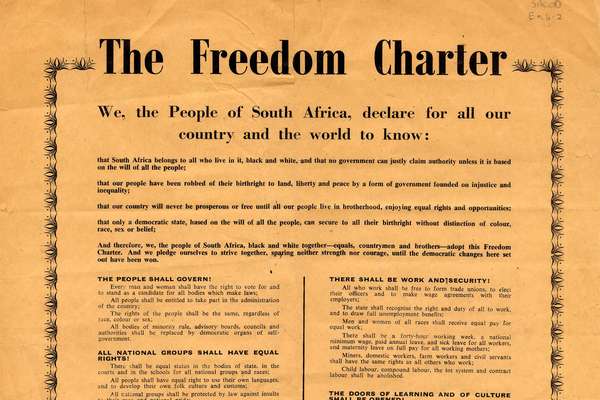
The Freedom Charter of 1955 was a charter of universal rights based on the wishes of the people. It meant a fundamental restructuring of South African society and outlined a list of freedoms and ideals in opposition to the apartheid government. In June 1955 the Freedom Charter was adopted by the Congress Alliance, the ANC, the South African Indian Congress, the South African Coloured People’s Organisation, and the South African Congress of Democrats.

[First extract]
BANTU EDUCATION BILL
5. This Bill, which will remove control of Native education from the Provincial Administration and place it completely in the hands of the Ministry of Native Affairs is being roundly condemned in Natal. It is conceded that there is a lot to be said for the Government’s arguments in favour of creating a unified system of local Bantu Government, charged with the administration of all local services, in place of the present multiplicity of uncoordinated development services. But it is widely felt that it would be a great mistake to strengthen the hands of the central Government still further, at the expense of the already weakened Provincial councils and all the missionary bodies, which have done such excellent pioneering work in the field of Native education. This Bill proposes to give arbitrary powers to the Minister, who will be able to ban any Bantu school other than a government school, and who will have power to “make regulations for religious instruction in Bantu schools”; it is felt that this may pave the way for the eventual introduction of the discredited “Christian National” education in Native schools, which would be most undesirable.
[Second extract]
BANTU EDUCATION ACT
6. The decision of the Bishops of Johannesburg and Pretoria to close all 100 Anglican Mission Schools in the Transvaal because of their reluctance to co-operate with the Government in the administration of the Bantu Education Act, has aroused considerable interest and sympathy in Natal. The excellent training college for African teachers at Adam’s College, Natal, is also to be closed at the end of 1955, because the Minister for Native Affairs has decided to take the training of African teachers out of the hands of the college authorities. The 40 Anglican Mission schools in Natal will however not be closed down although the Episcopal Synod [bishops’ council] has made it very clear that it deplores the Bantu Education Act. The highly respected Roman Catholic Bishop of Durban, Denis Hurley, has also weighed in against the Government over this issue most outspokenly, to the intense annoyance of the Minister of Native Affairs.
Two extracts:
(i) from the High Commissioner’s Report No. 24 on the Bantu Education Bill, 7 August 1953. Catalogue reference: DO 35/6716.
(ii) from the High Commissioner’s Report No. 31 on the Bantu Education Act, November 1954. Catalogue reference: DO 35/6716

MISSION SCHOOL CLOSED
“THREAT TO WHITE DOMINATION”
Christian Action made public in London last night a statement received from the Bishop of Johannesburg. The Bishop said: –
Today, by order of the Minister of Native Affairs in South Africa Dr Verwoerd), the School of Christ the King in Sophiatown, Johannesburg, is to close down. Formerly the School of Christ the King was St Cyprian’s School, which was closed down on 31 March 1955. St Cyprian’s centred upon the Priory of Christ the King, was part of the mission of the Community of Resurrection, under the care of Father Huddleston.
Under the now notorious Bantu Education Act of 1953, mission schools are taken out of the control of the missions. Supposing Dr Verwoerd to be sincere when he said that missions could continue to give African’s education in private schools without any State subsidy, the bishop decided to operate a private primary school as a pilot scheme, to see whether the African parents would be able and willing to pay a school fee. So, St. Cyprian’s became the private school of Christ the King and opened on April 10, 1955.
On February 6, 1956, the mission received a letter from the Secretary for Native Affairs ordering the school to close forthwith. The school was allowed to reopen on February 9, and all the 550 pupils returned. Today sees the school liquidated. The Minister of Native Affairs has refused all requests for reconsideration- he is determined to remove this threat to white domination.
Canon L.J. Collins, the chairman of Christian action said last night-
This vicious and spiteful action of the Minister of Native Affairs speaks clearly of the real intentions behind the Bantu education Act- white domination over black at all costs, and senseless oppression. This closing of the school looks like a vindictive and obstinate attack on Father Huddleston and the Bishop of Johannesburg because of their courageous, Christian stand for justice and freedom for the Africans.
Extract from an article titled ‘Plans for new S. African Black Communities’ from The Times, 28 March 1956. Catalogue reference: DO 35/4382
News Licensing, 28 March 1956

THE DOORS OF LEARNING AND OF CULTURE SHALL BE OPENED!
The government shall discover, develop and encourage national talent for the enhancement of our cultural life;
All the cultural treasures of mankind shall be open to all, by free exchange of books, ideas and contact with other lands;
The aim of education shall be to teach the youth to love their people and their culture, to honour human brotherhood, liberty and peace;
Education shall be free, compulsory, universal and equal for all children;
Higher education and technical training shall be opened to all by means of state allowances and scholarships awarded on the basis of merit;
Adult illiteracy shall be ended by a mass state education plan;
Teachers shall have all the rights of other citizens;
The colour bar in cultural life, in sport and in education shall be abolished.
Extract on the subject of education from The Freedom Charter, South Africa, June 1955.
Historical Papers Research Archive, University of the Witwatersrand Library, South Africa

In Meadowlands there are well built schools, but in Sophiatown, a few miles away, children will make do with education in a cluttered backyard.
Photograph used in a Sunday Times article by Iain Lang titled ‘Tragic South Africa: 2. Beyond the White Barriers’, 12 January 1958. Catalogue reference: DO 35/6715
News Licensing, 12 January 1958
Using Source 7a (i), consider:
Using Source 7a (ii), consider:
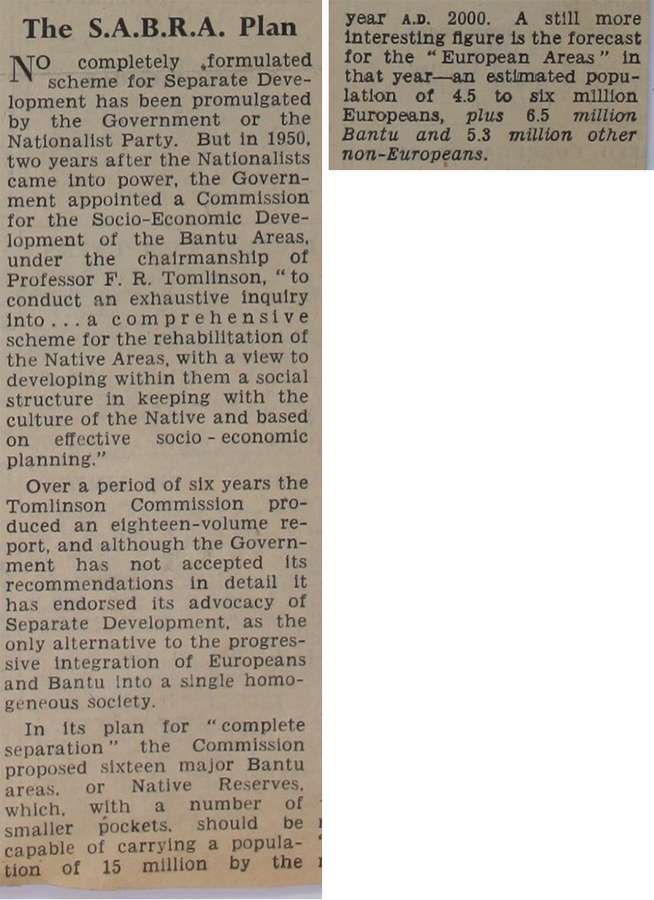
The South African government's Tomlinson Commission investigated the economic development of the native reserves, later formed as Bantustans or homelands. The Tomlinson Report was published in 1954.
The South African Bureau for Racial Affairs (SABRA) was set up in 1948 to provide an alternative to the South African Institute of Race Relations (SAIRR). The organisation provided academic justification for the apartheid policy.

The S.A.B.R.A. Plan
No completely formulated scheme for Separate Development has been promulgated by the Government or the Nationalist Party. But in 1950, two years after the Nationalists came to power, the Government appointed a Commission for the Socio-Economic Development of the Bantu areas under the chairmanship of Professor F. R. Tomlinson, “to conduct an exhaustive inquiry into a comprehensive scheme for the rehabilitation of the Native Areas, with a view to developing with them a social structure in keeping with the culture of the Native and based on effective socio-economic planning”.
Over a period of six years the Tomlinson Commission produced an eighteen-volume report, and although the Government has not accepted its recommendations in detail it has endorsed its advocacy of Separate Development, as the only alternative to the progressive integration of Europeans and Bantu into a single homogenous society.
In its plan for “complete separation” the commission proposed sixteen major Bantu areas, or Native Reserves which, with a number of smaller pockets, should be capable of carrying a population of 15 million by the year A.D. 2000. A still more interesting figure is the forecast for the “European Areas” in that year- an estimated population of 4.5 to six million Europeans, plus 6.5 million Bantu and 5.3 million other non-Europeans.
Extract from a Sunday Times article by Iain Lang entitled ‘Tragic South Africa: 1. Where Apartheid leads’, 5 January 1958. Catalogue reference: DO 35/6715
Iain Lang, News Licensing, 5 January 1958

Native Areas
In any case, it is sheer fantasy to suppose that the Bantu peoples can be persuaded, except by the uncompromising use of force, to accept any plan of Separate Development which would concentrate them in areas, not of their choosing, deliberately designed to emphasis the “ethnic grouping”, the tribal divisions, which virtually every intelligent Bantu considers outworn and inimical [harmful] to African development.
Native Reserves are no new thing. As long ago as 1913 the Bantu were given the sole right of occupation of certain areas which had remained in their possession after the White conquest of Southern Africa, and provision for the additional land for Native occupation was made by the Native Trust and Land Act of 1936 making up the Reserves to a total of about 57,000 square miles, or about 13 per cent. of the area of the Union.
Although much of the Reserves is fair farming land, they are under-developed and eroded, and production remains on a traditional primitive subsistence level. Poverty in the Reserves has benefited mining, manufacturing and large-scale agriculture, for it has driven Africans from their homes to seek work in the cities and on the European farms. Thus, at the last census, out of a total Bantu population of 8.5 million little more than 3.6 million were in the Reserves, as against 2.6 million on European farms and 2.3 million in urban areas.
Extract from a Sunday Times article by Iain Lang entitled ‘Tragic South Africa: 1. Where Apartheid leads’, 5 January 1958. Catalogue reference: DO 35/6715
Iain Lang, News Licensing, 5 January 1958

With No Wings
Less than half the Bantu population lives in the human equivalent of the game sanctuary, the Native Reserves; the working lives of the rest, about five million of them are inextricably interwoven with the lives of the three million Europeans, 1,200,000 “Coloureds” and 400,000 Asiatics, who make up the population of South Africa today.
Perhaps everybody, including the Bantu, would be happier – as the propagandist of “Separate Development” maintain – if the Natives were withdrawn to enclaves of their own, to lead lives as colourful as they chose or could afford. One snag is that, in present conditions, a withdrawal would bring industry and agriculture to an abrupt halt.
Another snag is that relatively few Africans would withdraw to “Bantu Areas” unless they were driven there by force. A significant number have become urbanised – there are 700,000 in the Johannesburg area alone, besides the Native populations of Cape Town, Durban, Port Elizabeth, East London and other cities – and they are determined not to revert to the tribal society and “ethnic grouping” that Separate Development envisages.
“I don’t know who my chief is,” a young African in Johannesburg said to me, “and why should I care? The time for chiefs is past.”
Extract from a Sunday Times article by Iain Lang entitled ‘Tragic South Africa: 2. Beyond the White Barriers’, 12 January 1958. Catalogue reference: DO 35/6715
Iain Lang, News Licensing, 12 January 1958
This lesson containing original documents can be used to support GCE units at A-Level for AQA, Edexcel and OCR, and GCSE Edexcel.
It explores the implementation of apartheid in 1948–1959 in the South African Union. Students will be able find out about the application of grand and petty apartheid through legislation. It is important to note that we have not included every piece of legislation and hope the lesson will form part of their own course of study.
The term apartheid comes from the Afrikaans word meaning ‘separation’. This system implemented political, social, and economic segregation on racial grounds in South Africa. It ensured domination by the White minority population and discrimination against the non-White majority.
D.F. Malan, Prime Minister of the Union of South Africa (1948–1954) for the National Party, introduced apartheid in 1948. It meant that White citizens held the highest status, then ‘Coloureds' (people with a Mixed race background) and ‘Black Africans’. Apartheid was contrary to all notions of equality. It was the intention of the government to separate and divide different tribal groups, confining them to specific areas or Bantustans.
It is important to note that the documents cover sensitive subjects. Some include language and concepts that are entirely unacceptable and inappropriate today. We have included this language as part of the historical record. We suggest that teachers look at the material carefully before introducing it to students.
It is also worth highlighting the issue of perspective during this lesson. Most sources come from a British government perspective from the Dominions Office or Foreign Office. Other sources include photographs from South African photographic archival collections. What other sources of information could be used to explore the establishment of the apartheid state?
Teachers may wish to break the documents into smaller extracts if they appear too long, or to create additional simplified transcripts.
Students should be encouraged to read the Background section to help with the source context.
Suggest that students ‘look behind the source’. Where has the record come from and why has it been created? Does it offer a national or local perspective? What is the difference between a government report or a newspaper? What is the value of oral testimony? What type of sources help with specific investigations?
Finally, encourage students to consider both the witting and unwitting testimony a source may reveal. Part of this evaluation is to consider if there are any gaps in the evidence or issues of accuracy in authorship. Why would we trust or not trust this source? What other sources might be needed to provide additional information or context? Does the document support other knowledge that you already have for a certain line of enquiry? Use the document prompt questions to promote discussion of the content.
South Africa became a Union with independence from the British Empire in 1910. It consisted of two Afrikaner (Dutch dominated) republics the Transvaal and Orange Free State and the British dominated Cape Colony and the Natal Province. The Afrikaners and the English speakers (roughly 60% and 40% respectively) controlled the country. It meant that the aspirations of the vast Black majority together with other races, including an Indian population, were completely ignored in the new Union.
With the Union, the South Africa Act removed Black people’s right to vote in Parliament and the Pass Regulations Act denied them the right to vote. Only the Cape Colony insisted on retaining voting rights for Black people and others on a basis of a property qualifying franchise. The Afrikaner republics granted no political rights for Black people and Natal was scarcely less conservative.
After 1910 what little rights remained for Black South African peoples began to be chipped away. The 1913 Natives Land Act severely restricted Black South Africans from owning or renting land outside of designated 'native reserves', laying the groundwork for racial segregation and apartheid (separateness). The Native (Urban Areas) Act 1923 created an internal passport system restricting movement of Black South Africans.
Successive onslaughts on Black rights increased with the growth of Afrikaner Nationalism under the Nationalist party of J.B.M. Hertzog, who realised that Afrikaners formed 60% of the White community and could exploit White conservatism to control the country. Afrikaner nationalism developed confidence in the interwar period emboldened by their Dutch Reform Church faith and Broederbond (brotherhood), emphasising the alleged racial superiority of Europeans over Black South Africans. Many Afrikaners also opposed South Africa’s entry on the Allied side during the Second World War.
In law, apartheid began long before 1948 and the election of the National Party. Although clauses of the 1910 Constitution regarding voting rights for ‘Coloureds’ (people with a Mixed race background) were not amended until the 1950s, the 1936 Native Trust and Land Act expanded existing restrictions on Black land ownership by establishing the South African Native Trust to manage land for Black people, limiting where they could live and own land. Moreover, the Asiatic Land Tenure Act 1946 sought to confine Asian ownership and occupation of land to certain clearly defined areas of towns.
By the late 1940s such legislation led to the growth of shantytowns on the outskirts of White cities occupied by poor Black people dependent upon jobs in the cities. The National Party campaigned to protect White Afrikaans ‘purity’ and eliminate the already meagre rights of Black South Africans through legislative separation, so what happened automatically before, became law.
To preserve racial 'purity', the apartheid government passed the Prohibition of Mixed Marriages Act 1949 preventing marriage between people of different races. The Population Registration Act (1950) created a national system of racial classification: ‘White’, ‘Native’, ‘Coloured’ and later ‘Indian’ that determined which rights an individual would be able to enjoy. This included where a person could live, if they had to carry a passbook to travel and the education available to them.
The Group Areas Act 1950 was the nationalist government’s first attempt to increase the separation between White and Black urban residential areas. The law was both a continuation of earlier laws of segregation but also a realisation of an apartheid ideal that cultures should be allowed to develop separately.
The new law declared many historically Black urban areas officially White, forcing people to move out of a specific area. The act also controlled the transfer of land and property and only allowed people to buy land from people of the same race. The act also restricted trading licences prohibiting Asians from trading in White areas. Later legislation (the Native Resettlement Act 1954) authorised the government to force out residents and demolish buildings to make room for White-owned residences and businesses. However, White South Africans relied upon cheap Black labour, and the removal of millions of Black workers would be expensive according to the government-sponsored Tomlinson Report of 1954.
The Separate Amenities Act 1953 legalised the racial segregation of public premises, vehicles and services. Part of the act stated that facilities for the different races did not need to be equal and that some services could be completely excluded based on their race. Public toilets, buses, railway carriages and Post Office entrances, as well as parks and beaches, were typically segregated.
The passbook system regulating where White South Africans could travel from and to already existed before 1948, and it was now expanded and formalised. An act of 1952 repealed regional passes and instituted one nationwide pass law, making it compulsory for all Black South Africans males over the age of 16 to carry the passbook whilst within White areas. This internal passport (containing a photograph and details of employment) stipulated where, when and for how long a person could remain. The passbook provided the authorities with the excuse to detain Black people at will.
Other pieces of apartheid legislation were enacted to enforce separation of the races, such as the Bantu Authorities Act (1951) and the Bantu Self Government Act (1959). This act created 'homelands' for Black South Africans, known as Bantustans, giving the appearance of self-government but stripping them of their national citizenship.
By 1959 the system of apartheid was consolidated. In response to such oppression the Black South African population of South Africa began to resist. They agreed a Freedom Charter for all South Africans embracing equality, which would lead to a 'Treason Trial' of those opposing apartheid doctrine.
The story of
In June 1955, a multi-racial group came together to write the Freedom Charter, demanding racial equality and democracy in South Africa. They were put on trial.
sahistory.org.za
Comprehensive online resource including documents and timelines.